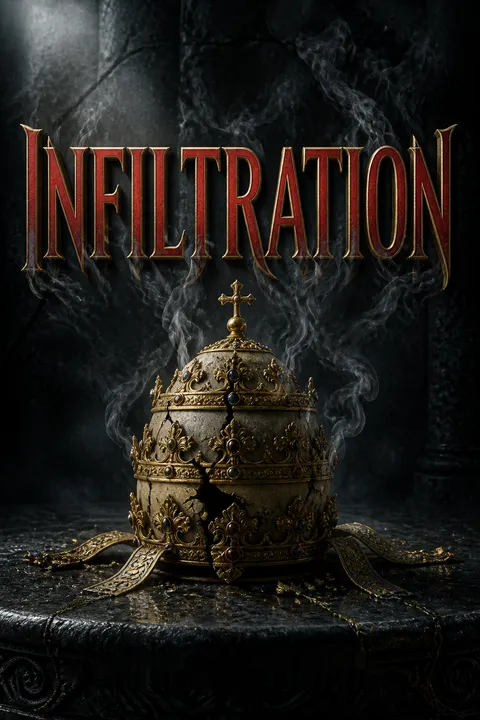

Key Takeaways
1. The Catholic Church is experiencing a profound "smoke of Satan" infiltration.
We would say that, through some mysterious crack — no, it’s not mysterious; through some crack, the smoke of Satan has entered the Church of God.
Demonic intrusion acknowledged. Pope Paul VI's 1972 lament about the "smoke of Satan" entering the Church signifies a spiritual crisis beyond mere secularization. This "smoke" is interpreted as a demonic influence, mirroring the perverted smoke of Satan described in the Book of Revelation, contrasting with the sacred smoke of divine worship.
Supernatural vs. Naturalism. The core conflict is between supernaturalism (reliance on God's grace) and naturalism (reliance on created nature alone), which the author equates with Satanism. This naturalistic worldview seeks to replace the divine with the human, echoing Lucifer's prideful rebellion and Adam and Eve's original sin.
A new strategy of attack. Historically, external attacks on the Church only created martyrs and strengthened her. However, a new, more insidious strategy emerged: infiltration from within. This plot aimed to place "one of their own in the papal shoes," a slow, patient plan to establish a "Satanic revolution with the pope as puppet."
2. Freemasonry orchestrated a century-long plot to subvert the papacy from within.
The Pope, whoever he may be, will never come to the secret societies. It is for the secret societies to come first to the Church, with the aim of winning them both.
Long-term infiltration strategy. The secret document "The Permanent Instruction of the Alta Vendita," acquired by the Catholic Church before 1859, detailed a Freemasonic plot to infiltrate the Church. This plan aimed not to convert popes to Freemasonry, but to cultivate a generation of clergy imbued with "Italian and humanitarian principles" that would eventually elect a pope aligned with their naturalistic goals.
Freemasonry's core tenets. Originating from Rosicrucian mysticism, Freemasonry sought a "new world order" based on "liberté, égalité, fraternité," rejecting Catholicism's supernatural claims. Its "Great Architect of the Universe" is seen as a pantheistic deity, equating God with nature, and denying the unique Incarnation of Christ, sin, and the need for salvation through grace.
Targeting youth and clergy. The Alta Vendita explicitly stated the need to target youth, seminaries, and convents to instill their naturalistic ideas. This gradual corruption would ensure that future clergy, and eventually cardinals and popes, would unknowingly advance Freemasonic ideals, leading to a "revolution in tiara and cope."
3. Marian apparitions at La Salette and Fatima warned of widespread apostasy and Church crisis.
Rome will lose faith and become the seat of the Antichrist.
La Salette's dire prophecy. In 1846, Our Lady of La Salette appeared to two children, warning of a Freemasonic plot to overturn the Church and condemning wicked priests. Mélanie Calvat's 1879 published secret, though controversial, explicitly stated that "Rome will lose faith and become the seat of the Antichrist," and that Lucifer would be unloosed in 1864 to erode faith.
Fatima's three-part secret. The 1917 Fatima apparitions, occurring during World War I, included a three-part secret. The first two parts revealed a vision of hell and the need for Russia's consecration to Mary's Immaculate Heart to prevent a "worse war" and the spread of Russia's errors. The third part, to be revealed in 1960, was so shocking that Pope John XXIII chose to suppress it.
Warnings of internal apostasy. Both apparitions emphasized internal Church corruption and a coming apostasy. The Third Secret, as interpreted by those who claimed to have read it, spoke of a "great apostasy in the Church" that would "begin at the top," and "dangers threatening the faith and the life of the Christian."
4. Modernism, disguised as "new theology," systematically eroded Catholic doctrine and tradition.
Modernism, however, came into existence after the rejection of the Catholic intellectual tradition.
"Synthesis of all heresies." Pope Pius X identified Modernism as the "synthesis of all heresies," a movement seeking to reinterpret Catholicism through a post-Christian, rationalist, and naturalistic lens. It rejected Scholasticism and the supernatural, advocating for an "evolution of dogma" to conform faith to modern science and philosophy.
Three key features. Modernism manifested in three ways:
- Demythologizing Scripture: Treating biblical accounts, miracles, and even Christ's Resurrection as symbolic rather than historical or supernatural.
- Secularism and universal fraternity: Reducing salvation to secular or political goals, making the Church irrelevant in the public sphere, and promoting a universal brotherhood where all religions are equally valid.
- Rejection of traditional truth, goodness, and beauty: Abandoning clear moral distinctions, prioritizing "pastoral" approaches over objective truth, and replacing traditional Catholic art and music with the pedestrian.
The "nouvelle théologie." After Pius X's death, a "new theology" emerged, dissimulating Modernist ideas under the guise of "ressourcement" (a return to the Church Fathers). Theologians like Rahner, de Lubac, and Congar, initially suspected of heresy, became influential at Vatican II, promoting a naturalistic view where human nature is inherently divine, blurring the lines between grace and nature.
5. Communist agents successfully infiltrated Catholic seminaries and the priesthood.
In the 1930s we put eleven hundred men into the priesthood in order to destroy the Church from within, and that right now they are in the highest places in the Church.
Kremlin's infiltration strategy. Former Communist agents Bella Dodd and Manning Johnson testified before the U.S. House Committee on Un-American Activities in 1953 about a deliberate Kremlin directive. This strategy involved planting Communist Party members in Catholic seminaries during the 1920s and 1930s to subvert the Church from within.
"Successful beyond expectations." The infiltration was reportedly "successful beyond even Communist expectations," with Dodd claiming that four of these infiltrated priests had reached the rank of cardinal by the 1960s. This echoes the Alta Vendita's long-term plan to cultivate a generation of clergy aligned with their agenda.
Archbishop Bugnini's case. Further evidence of infiltration emerged with Archbishop Annibale Bugnini, the chief architect of the Novus Ordo Mass. Documents found in his briefcase in 1975, addressed "to Brother Bugnini" from secret societies, and his name appearing on a Masonic register in 1976, confirmed his Freemasonic ties and subsequent exile by Pope Paul VI.
6. Liturgical reforms after Vatican II were driven by a Modernist agenda, altering the Mass.
The rite of the Mass is to be revised in such a way that the intrinsic nature and purpose of its several parts, as also the connection between them, may be more clearly manifested, and that devout and active participation by the faithful may be more easily achieved.
"Active participation" redefined. While Pope Pius X encouraged "participation in the divine mysteries," Vatican II's "Sacrosanctum concilium" redefined "active participation" to necessitate simplifying rites, introducing vernacular language, and removing elements deemed "duplicated" or "suffered injury through accidents of history." This approach, spearheaded by Annibale Bugnini, aimed to make the Mass more accessible but fundamentally altered its ancient form.
Bugnini's radical changes. Bugnini's influence began with the 1951 Holy Saturday reform, which became a template for broader liturgical changes. His "restorations" suppressed traditional elements, encouraged freestanding altars, allowed concelebration, and introduced Communion in the hand. These changes were seen by critics as a "Protestantization" of the Catholic liturgy, undermining belief in transubstantiation and increasing sacrilege.
The Ottaviani Intervention. In 1969, Cardinals Ottaviani and Bacci, along with Archbishop Lefebvre, presented a "Short Critical Study of the Novus Ordo Missae" to Pope Paul VI. This "Ottaviani Intervention" argued that Bugnini's new Mass departed from the sacrificial and sacerdotal theology of the Council of Trent, leaning towards Protestantism. Despite this, Paul VI dismissed the critique and promulgated the Novus Ordo Missale in 1970.
7. Vatican financial scandals under Paul VI exposed deep corruption and illicit dealings.
Financial historians unanimously agree that Sindona was mixing Vatican funds with heroin profits from Mafia families.
Vatican Bank's illicit use. The Vatican Bank (IOR), founded by Pius XII, was intended for charitable works but became embroiled in scandal under Pope Paul VI. In the 1960s and 1970s, it was allegedly used for money laundering by organized crime, leading to significant financial losses for the Vatican.
Michele "the Shark" Sindona. Pope Paul VI hired Michele Sindona, a notorious Freemason and alleged Mafia member, as a financial adviser in 1968. Sindona, who had laundered heroin profits for the Gambino family, used the Vatican Bank to move money internationally and speculate against currencies. His banking empire collapsed in 1974, causing the Vatican to lose millions.
Mysterious deaths and cover-ups. The fallout from Sindona's collapse led to a series of suspicious deaths, including Sindona himself (poisoned in prison) and Roberto Calvi ("God's Banker," found hanged). These events, along with the alleged involvement of high-ranking Vatican officials like Archbishop Paul Marcinkus and Cardinal Jean-Marie Villot, pointed to a deep web of Freemasonic and Mafia infiltration within the Vatican's financial structures.
8. The mysterious 1958 papal conclave and the suppressed Third Secret of Fatima signaled deeper issues.
The white smoke and bells testify that a pope was elected and that some mistake or misunderstanding occurred.
White smoke, no pope. The 1958 papal conclave, following the death of Pius XII, saw white smoke billow from the Sistine Chapel on October 26, signaling a pope's election, and bells rang. However, no pope appeared for half an hour, and Vatican Radio announced a mistake. This event fueled speculation that Cardinal Giuseppe Siri, a conservative, was elected but pressured to decline.
The unrevealed Third Secret. Pope John XXIII opened the Third Secret of Fatima in 1959, a year earlier than instructed by Sister Lúcia. Despite its apocalyptic warnings about apostasy and the Church, he declared it "does not concern my pontificate" and refused to publish it in 1960, dismissing the "prophets of doom."
Controversy over its content. The Third Secret, as released by the Vatican in 2000, describes a vision of a "bishop dressed in White" (the Pope) being killed along with other clergy. However, many believe a second, explanatory part of the secret, beginning with "In Portugal, the dogma of the Faith will always be preserved," remains unreleased. This missing text is believed to detail the "great apostasy in the Church" starting "at the top."
9. The "Sankt Gallen Mafia" actively campaigned to elect a progressive pope.
The election of Bergoglio corresponded with the aims of St. Gallen, on that there is no doubt.
A secret society of cardinals. Beginning in 1995, a group of prominent liberal cardinals, led by Carlo Maria Martini, regularly met in Sankt Gallen, Switzerland. This "Sankt Gallen Mafia" aimed to "modernize" the Church, opposing John Paul II and Cardinal Ratzinger, and advocating for issues like women deacons, Communion for the divorced, and relaxed sexual morality.
Campaigning for Bergoglio. Recognizing their leader Martini was too old, the group identified Jorge Cardinal Bergoglio as their preferred candidate for pope. Their goal was to cultivate a successor who would advance their progressive agenda, ensuring the "spirit of Vatican II" would continue.
Sankt Gallen's dark connections. The town of Sankt Gallen has historical ties to Communism, with Fritz Platten, a Freemason and Communist, having smuggled Vladimir Lenin out of Switzerland. It also has occult connections, with Aleister Crowley's Gnostic Catholic Church (a phallic cult) having its headquarters nearby. The author notes that Theodore McCarrick, a notorious pedophile, spent a formative year in Sankt Gallen in 1949, financially sponsored by a wealthy patron.
10. Pope Benedict XVI's resignation was preceded by financial and moral scandals, leading to a controversial election.
I prayed to God ‘Please don’t do this to me.’ Evidently, this time He didn’t listen to me.
Ratzinger's election and resistance. Joseph Cardinal Ratzinger, a conservative, was elected Pope Benedict XVI in 2005, despite the Sankt Gallen Mafia's efforts to elect Bergoglio. Benedict's pontificate saw a return to traditional papal attire and the issuance of "Summorum pontificum," which affirmed the traditional Latin Mass was never abrogated, much to the dismay of liberals.
Vatileaks and financial pressure. A plot against Benedict XVI culminated in the 2012 "Vatileaks" scandal, where his butler leaked confidential documents exposing financial corruption, blackmail, and homosexual predators within the Vatican. Archbishop Carlo Maria Viganò's efforts to centralize Vatican accounting uncovered millions in hidden funds, leading to his demotion.
The "red binder" and resignation. On December 17, 2012, a commission of cardinals presented Benedict XVI with a 300-page dossier detailing Vatican corruption and sexual misconduct. This, coupled with the freezing of Vatican Bank funds by Deutsche Bank in January 2013, led Benedict to announce his resignation on February 11, 2013. The author suggests this resignation, the first in nearly 600 years, may have been under duress or due to "substantial error" regarding the nature of the papacy.
11. Pope Francis's pontificate reflects the culmination of long-term infiltration and Modernist ideals.
Mission accomplished for the Sankt Gallen Mafia: at last they delivered to the world a “Revolution in Tiara and Cope” as had been prophesied by the Freemasonic document Alta Vendita more than 150 years before.
Bergoglio's election. In the 2013 conclave, Jorge Bergoglio was elected Pope Francis, fulfilling the Sankt Gallen Mafia's long-term goal. His election was reportedly influenced by members of this group, who saw him as the ideal candidate to "change things" and implement their progressive agenda.
Problematic teachings and policies. Pope Francis's pontificate has been marked by a strong shift towards ecumenism, globalism, immigration, and socialism. His encyclicals and teachings, such as "Amoris laetitia," have sparked criticism for ambiguity on moral issues, suggesting that hell is not eternal and allowing divorced and remarried Catholics to receive Communion.
Contradictions with tradition. Francis has taught that God "divinely and wisely wills the diversity and plurality of religions" and endorsed the UN's 2030 Plan, aligning with Freemasonic naturalism. His actions, like kissing the Koran and hosting the Assisi World Day of Prayer for Peace (where a Buddha idol was placed on a tabernacle), are seen as direct contradictions to previous papal condemnations of religious indifferentism and idolatry.
12. Catholics are called to "recognize and resist" doctrinal errors while engaging in spiritual warfare.
The Catholic Church has been infiltrated all the way to the top. We have a valid pope and valid cardinals, but we have received the mantle of Saint Athanasius and Saint Catherine of Siena to call, respectfully and reverently, certain spiritual fathers back to Christ and the unadulterated Apostolic Faith.
Rejecting alternative solutions. The author dismisses several common responses to the crisis:
- Modernist Catholicism: Intellectually dishonest, as Catholicism cannot contradict itself.
- Atheism: Rejects personal encounters with Christ and the existence of God.
- Protestantism: Ignores Scripture's testimony for sacraments and apostolic succession.
- Eastern Orthodoxy: Fails to account for Rome's universal jurisdiction prophesied in Daniel.
- Sedevacantism: Lacks a consistent narrative for the crisis's origin and a means to restore the papacy.
- Resignationism: Lacks proof of duress or substantial error in Benedict's resignation and creates insoluble ecclesial problems.
The "recognize and resist" position. The author advocates for "recognize and resist," a position rooted in Saint Paul's resistance to Saint Peter. This acknowledges the validity of the pope and cardinals but permits resistance to their errors, especially since Vatican II documents were declared non-infallible. This approach allows Catholics to remain faithful to tradition while navigating contemporary challenges.
Spiritual weapons for battle. The crisis is fundamentally spiritual, requiring spiritual warfare. Catholics must abandon cowardice and embrace humble weapons: the Rosary, Scapular, prayer, fasting, and rigorous study of Catholic Faith. The author calls for a return to the "trumpet call" of the sanctus bell, rallying to Christ in the Eucharist, and defending the Church against its demonic enemies.
Review Summary
Reviews of Infiltration are deeply divided. Enthusiastic readers praise its thorough historical research, readable style, and courageous examination of Church corruption, finding it essential reading for Catholics seeking to understand recent crises. Critics, however, raise serious concerns about poor sourcing, factual errors, reliance on unverified conspiracy theories, excessive dependence on private revelation, and a tendency toward calumny against popes and Church figures. Several reviewers note the book oversimplifies complex events and fosters an unhealthy conspiratorial mindset, though even critics acknowledge some sections are well-argued and valuable.
People Also Read
Download PDF
Download EPUB
.epub digital book format is ideal for reading ebooks on phones, tablets, and e-readers.








































