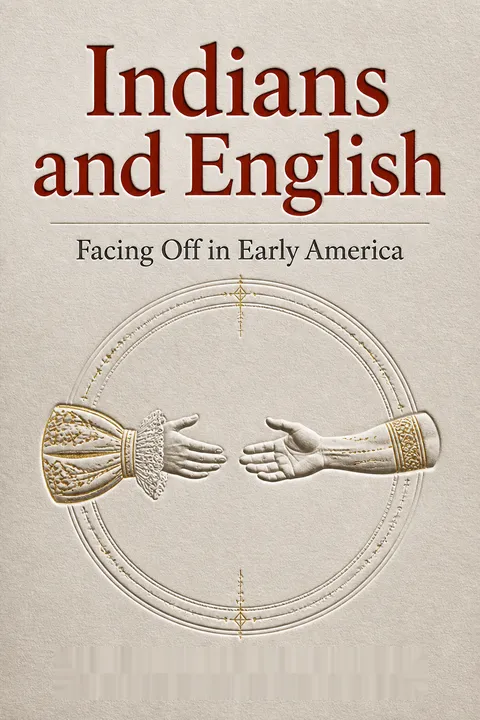

Key Takeaways
1. Mutual Curiosity Shaped Early Encounters
The first response on all sides was curiosity; the Americans and the English were drawn to early meetings because they wanted to understand something about the different people they met.
Initial Fascination. Early interactions between English colonists and Native Americans were driven by a profound mutual curiosity. Both groups, encountering previously unknown transatlantic "others," sought to integrate these new people into their existing frameworks of understanding human society and nature. This initial curiosity was a complex mix of genuine interest and a desire to place the unfamiliar within familiar schemes.
Evolving Definitions. This period was characterized by both English and Native Americans evolving their self-definitions as groups. The process of defining "self" and "other" was mutually reinforcing, with each encounter prompting a re-evaluation of their own identities. For instance, Narragansett friends told Roger Williams that before Europeans, they had no word to differentiate themselves from strangers, but now adopted "Indians" in opposition to "English."
Complex Reactions. Early encounters provoked a varied series of reactions, meticulously recorded in English sources. These records, often collaborations with native hosts, reveal a spectrum of responses from curiosity and admiration to hostility and fear. The English, for their part, were looking at a world God had kept hidden for millennia, eager to understand everything from family arrangements and laws to religious beliefs and self-presentation.
2. English Ambivalence Reflected Internal Changes
Ambivalence—the mixture of fear and anticipation that characterized English culture as Elizabeth's long reign drew to a close and James I and his son Charles I began the new dynasty—shaped the context in which ideas of the American Indians were formed, and conceptions of the Indians reflected that mental dividedness.
Societal Upheaval. Early modern England was undergoing massive transformations, including population growth, inflation, and religious ferment, leading to widespread fears of social disorder and moral decay. Commentators worried about the "wandering poor" and the blurring of traditional social and gender distinctions, seeing these as signs of national degeneration. This internal anxiety profoundly influenced how the English perceived the "new world" and its inhabitants.
Mirror to Self. English writers often used Native Americans as a mirror to reflect on their own society's virtues and vices. They sometimes celebrated the Indians' vigor, simplicity, and primary virtue, contrasting it with England's perceived luxurious degeneracy. Conversely, they might castigate Native Americans as primitive savages, reinforcing their own sense of civility and superiority. This "double vision" was particularly evident in accounts from those who had direct experience in America.
Tacitean Parallels. Many English intellectuals, steeped in classical education, drew parallels between Native Americans and the ancient Germans or Britons described by Tacitus. These ancestors were depicted as simple, barbaric, yet strong and liberty-loving peoples, providing a framework for understanding the "civil savages" of America. This comparison allowed the English to measure their own gains in civility against a perceived decline in primitive virtue, while also justifying their imperial ambitions as a civilizing mission.
3. Native Americans Actively Shaped Interactions
The Americans' own knowledge is embedded in the early English texts, especially those written by English observers who formed close relationships with their neighbors, and over the intervening centuries many Indian people have recorded their oral traditions about the early period.
Controlling the Narrative. Native Americans were not passive recipients of European intrusion; they actively shaped the narratives and actions described in early English texts. They dictated the terms of encounters, set meeting times and places, and often provided the bulk of the information about their history, religious beliefs, and cultural practices to inquiring travelers. This agency ensured that indigenous knowledge was embedded within the colonial record.
Strategic Communication. Recognizing the English desire for understanding, Native Americans often employed strategic communication. They taught colonists pidgins—simplified forms of their complex languages—to facilitate trade while protecting the intricacies of their true tongues. This allowed them to communicate with each other without being fully understood by the newcomers, maintaining a degree of cultural privacy and control.
Adapting to Change. Native societies were already undergoing dramatic changes before sustained European colonization, influenced by factors like climate shifts and pre-existing trade networks. The arrival of Europeans, with their diseases and goods, accelerated these internal dynamics. Native leaders strategically incorporated European elements, such as metal tools and alliances, to consolidate power and adapt to new circumstances, demonstrating remarkable resilience and adaptability.
4. Appearance as a Social Language
The engravings gave an accurate portrayal of those aspects of appearance that are manipulable, that is, in a person's control.
Visible Markers of Identity. Both English and Native American cultures placed immense importance on physical appearance as a means of communicating social status, gender, and identity. English observers, accustomed to sumptuary laws and elaborate courtly displays, meticulously documented Native American clothing, jewelry, body paint, and hairstyles, interpreting them as deliberate acts of self-presentation. This focus on "manipulable" aspects of appearance reflected their own cultural priorities.
Universal Praise for Physique. English accounts universally praised the physical attributes of Native Americans, describing them as strong, agile, and well-proportioned, often "as straite as arrowes." This admiration for their "perfect constitution" was often linked to the perceived healthiness of the American environment. However, the English were puzzled by the "tawny" skin color, which they correctly deduced was a cultural artifact, not an inherent racial trait, achieved through dyes and oils.
Complexities of "Nakedness." The term "naked" in English accounts was complex, rarely meaning complete nudity. It often implied simpler clothing than European layered fashions, or a lack of elaborate social distinctions in dress. Some writers linked it to prelapsarian innocence, while others used it to suggest vulnerability or a lack of "civility." Yet, many observers also praised the modesty of Native Americans, often contrasting it favorably with European immodesty.
5. Language was Key to Understanding and Control
The Life of all Language is in the Pronuntiation.
Fundamental to Society. Language was considered absolutely fundamental to civil society by the English, who, following Cicero, believed it separated humans from animals and made social cooperation possible. This conviction fueled intense interest in Native American languages, both for practical reasons like trade and for deeper intellectual inquiries into the origins of language and the nature of human culture.
Pidgins and Protection. While colonists sought to learn native tongues, Native Americans often deliberately taught them pidgins—simplified forms of their languages. This strategic choice allowed for necessary communication and trade while safeguarding the complexities and nuances of their authentic languages from foreign understanding. Some English observers, like Jonas Michaëlius, recognized this, noting that "they rather design to conceal their language from us than to properly communicate it."
Beyond Spoken Words. Communication extended beyond spoken language. Both English and Native Americans relied on a "natural language of gestures" to bridge linguistic gaps, especially in initial encounters. The English were also fascinated by Native American methods of recording information, such as wampum belts and tally sticks, which served as forms of memory and historical record, analogous to European written documents.
6. Indian Polities Were Complex and Ordered
Although the countrie people be very barbarous, yet have they amongst them such governement, as that their Magistrats for good commanding, and their people for du subjection, and obeying, excell many places that would be counted very civill.
Structured Governance. English observers, despite initial assumptions of "lawless" savages, consistently reported finding highly organized and well-governed Native American societies. They described complex monarchical structures, with paramount chiefs (like Powhatan, called "Emperor") ruling over many sub-chiefs or "kings." This hierarchical organization, often based on hereditary lineages, impressed the English, who valued stable, ordered governance.
Tacitean Ideals. Native American governance often resonated with English ideals of ancient Germanic polities, as described by Tacitus, where leaders governed through persuasion rather than absolute command. Observers noted that Indian chiefs, though powerful, relied on councils of respected elders and the consent of their people for major decisions like war or law. This reliance on eloquence and consensus was seen as a mark of wisdom and effective leadership.
Orderly Justice. Contrary to the "lawless" stereotype, Native American societies had established systems of justice, often based on customary law. Crimes like murder and theft were punished, sometimes with death, and restitution was a common means of resolving conflicts between individuals or groups. English writers, lamenting the litigiousness of their own society, sometimes praised the Indians' ability to maintain social harmony and justice without extensive written laws or lawyers.
7. Religious Beliefs Were Central to Both Cultures
There is yet in Virginia no place discovered to bee so Savage in which the Savages have not a religion, Deare, and Bow, and Arrowes.
Universal Sense of Deity. Religion was paramount for both English and Native Americans, making it a central point of mutual curiosity and contention. English observers, following theologians like John Calvin, believed that a "sense of a deity" was fundamental to human consciousness. They were relieved to find that Native Americans acknowledged a higher power, even if they considered their specific practices "Paganisme and Idolatrie," seeing it as a foundation upon which Christianity could be built.
Dual Deities and Spiritual Power. Native American belief systems, particularly among Algonquian peoples, often centered on a pantheon of supernatural forces (Manitou/Montóac), including two preeminent gods: a benevolent, remote creator (Tanto, Kiehtan, Ahone) and a powerful, often feared, trickster-like deity intimately involved in daily life (Okeus, Hobbomock, Squanto). This dualistic understanding of divine power, with its capacity for both good and harm, was a key aspect of indigenous cosmology.
Shamans and Spiritual Authority. Native religious practitioners, known as powwows or pniese, held immense power and respect within their communities. They were believed to have direct access to the spirit world, capable of healing, foretelling the future, and even summoning deities. English observers, while often dismissing these figures as "jugglers" or "witches" in league with the devil, acknowledged their genuine influence and the "effects of wonderment" they produced, recognizing them as formidable cultural guardians.
8. Village Life Showcased Native Ingenuity
The manner of makinge their boates in Virginia is verye wonderfull.
Settled Agriculturalists. Contrary to stereotypes of nomadic "wild men," English accounts overwhelmingly depicted Native Americans as settled agriculturalists living in well-organized villages. John White's paintings and Thomas Harriot's notes, for instance, showed villages with cornfields in various stages of growth, demonstrating sophisticated farming techniques and a commitment to providing for the future. These communities were the heart of Native American social and economic life.
Innovative Technology. Native Americans displayed remarkable ingenuity in adapting to their environment. Their houses, built from saplings and covered with bark or woven mats, were praised for their warmth and ventilation, sometimes even preferred over English dwellings. Canoes, crafted from dugouts or birchbark, were universally admired for their lightness, speed, and maneuverability, far surpassing English boats in navigating American waterways.
Resourceful Subsistence. Agriculture, primarily maize and beans, formed the backbone of the Native American diet, supplemented by extensive hunting and fishing. English observers were astonished by the high yields of maize and the efficient methods of food preservation, such as storing dried corn in bark-lined pits. While some English criticized perceived "laziness" or "wastefulness," they also relied heavily on Native American knowledge and food supplies for their own survival.
9. Incorporation Was a Primary Native Strategy
Captaine Newport it is not agreeable to my greatnesse, in this pedling manner to trade for trifles; and I esteeme you also a great Werowance.
Clients, Not Conquerors. Native leaders initially viewed the English settlers as potential clients or allies, seeking to incorporate them into their existing ceremonial and political arrangements. They saw the struggling English outposts, dependent on native aid for food and training, as useful sources of trade goods and military support. This strategy was a mirror image of the English desire to "civilize" and convert the Indians.
Strategic Diplomacy. Leaders like Powhatan engaged in sophisticated diplomacy, using elaborate ceremonies and carefully chosen language to assert their authority and define the terms of interaction. Powhatan's attempt to adopt John Smith as a sub-werowance, or his insistence on a ceremonial exchange of goods with Captain Newport rather than "pedling" trade, demonstrated his efforts to integrate the English into his paramount chiefdom.
Spiritual Integration. European trade goods were not merely commodities; they were often incorporated into Native American spiritual cosmologies. Blue beads, for instance, were highly valued by Powhatan not just for their material worth but for their symbolic connection to the sky and spiritual power. Native Americans also sought to understand the English within their own spiritual frameworks, sometimes perceiving them as "risen dead" or attributing their invulnerability to disease to supernatural origins.
10. Escalating Conflict Revealed Divergent Worldviews
What will it availe you to take that by force you may quickly have by love, or to destroy them that provide you food.
Clash of Expectations. Despite initial attempts at incorporation and alliance, fundamental differences in worldview and escalating English demands led to inevitable conflict. Native leaders like Powhatan warned the English that taking food by force would lead to starvation, as Indians could simply hide provisions and retreat. This demonstrated a clear understanding of English dependence and the limits of their power.
English Vulnerability and Brutality. The English, often fearful and paranoid due to their precarious position and internal disunity, frequently reacted to perceived challenges with extreme brutality. Acts like burning Native American towns, desecrating graves, and executing non-combatants were justified as necessary "vengeance" or "examples" to instill fear. This behavior, often driven by weakness and a belief that any show of mercy invited further attack, horrified Native allies and fueled cycles of retaliation.
Divergent Rules of War. English and Native American approaches to warfare differed significantly. While English forces aimed for total victory and the extermination of enemies (as seen in the Pequot War), Native warfare often focused on limited objectives like taking captives, punishing clients, or seeking revenge, with less emphasis on mass slaughter. Native allies were appalled by the English "furious" and indiscriminate killing of women and children, highlighting a profound cultural gap in acceptable conduct during conflict.
11. Cross-Cultural Intermediaries Faced Stretched Identities
Sir, let this barbarian be proud and angry and covetous and filthy, hating and hateful, (as we ourselves have been till kindness from heaven pitied us, etc.) yet let me humbly beg belief, that for myself, I am not yet turned Indian, to believe all barbarians tell me...
Liminal Existence. Individuals who lived between English and Native American cultures—interpreters, captives, or converts—occupied a liminal space, often experiencing profound identity crises. Figures like Henry Spelman and Thomas Savage, English boys adopted by Native leaders, developed deep affectionate ties but also faced suspicion and taunts from both sides, struggling with divided loyalties.
Spiritual Crossroads. Native intermediaries often adopted names with spiritual significance (like Squanto or Hobbomock, names of deities) to signify their role as boundary-crossers. This choice indicated their project of mediating between worlds, but also the spiritual dangers involved. For Pocahontas, her baptism as Rebecca and subsequent marriage to John Rolfe, intended to make her an English agent, presented an unbearable conflict between her traditional identity and the mission to convert her own people.
Mistrust and Scorn. Despite their invaluable roles, these cross-cultural figures were frequently regarded with mistrust by both English and Native communities. English colonists, fearing "contamination" or "degeneracy," often viewed those who "turned Indian" with suspicion, accusing them of treachery or moral corruption. Similarly, Native compatriots often taunted those who embraced English ways, highlighting the immense personal cost of navigating these deeply divided worlds.
Review Summary
Reviews of Indians and English are largely positive, averaging 3.85 out of 5. Readers praise Kupperman's thorough research, extensive use of primary sources, and her challenge to long-held perceptions of inevitable conflict between Native Americans and English colonists. The book is commended for its nuanced portrayal of both cultures and its postcolonial approach. Some criticisms include repetitiveness, insufficient depth from the Indian perspective, and a lack of clear signposting. Overall, it is considered essential reading for those interested in early colonial history.
People Also Read
Download PDF
Download EPUB
.epub digital book format is ideal for reading ebooks on phones, tablets, and e-readers.








































