
Key Takeaways
1. Islam's Origins: A Chasm of Silence and Speculation
Far from Islam having been born in the full light of history, its birth was shrouded in what has appeared, to an increasing number of scholars, an almost impenetrable darkness.
Problematic sources. The traditional narrative of Islam's origins, including biographies of the Prophet and collections of his sayings (hadiths), largely dates from two centuries after Muhammad's death. These later accounts often served specific political or religious agendas, making their historical reliability highly questionable. Scholars like Joseph Schacht have argued that "we must abandon the gratuitous assumptions that there existed originally an authentic core of information going back to the time of the Prophet."
The "yawning chasm." This lack of contemporary evidence creates a significant gap in our understanding of early Islam. Unlike other major religions, which have more immediate historical records, the foundational period of Islam is remarkably opaque. This has led to radical reinterpretations, with some scholars questioning:
- The precise dating and compilation of the Qur'an.
- The historical context of Muhammad's life.
- The very existence of certain traditional events.
Qur'an's enigmatic nature. Even the Qur'an itself, when stripped of later commentaries, offers few concrete historical details. It rarely names specific places or contemporary figures, focusing instead on divine pronouncements. This internal ambiguity, combined with the external silence of early records, makes reconstructing Islam's genesis a treacherous, speculative endeavor, forcing historians to look beyond traditional narratives.
2. Late Antiquity: A World Ripe for Monotheistic Transformation
The impact of the revolution that it witnessed still reverberates today.
A transitional era. The sixth century AD, often termed "late antiquity," was a period of profound change, standing between the classical world and the Middle Ages. It was characterized by:
- The decline of classical civilizations.
- The rise of new political orders.
- A pervasive sense of lengthening shadows and impending change.
Monotheism's ascendancy. This era saw the unprecedented establishment of various forms of monotheism as state religions. Judaism and Christianity, in particular, solidified their doctrines and institutions, profoundly shaping human thought and behavior. This development was globally influential, laying the groundwork for future religious movements.
Cosmic geopolitics. The belief in a single, universal God permeated the Near East, influencing almost every aspect of geopolitics. Conflicts, like the one between the Jewish king Yusuf and Christian Ethiopians, were seen not just as struggles between warlords but as celestial dramas, reflecting the clash of heavenly and hellish forces. This spiritual dimension was central to understanding the age.
3. Persia's Imperial Resilience and Religious Ferment
A monarchy that is proud and exceedingly powerful: so one foreign commentator described the dynasty in a tone of rueful awe.
Sasanian might. The Persian Empire (Iranshahr), ruled by the Sasanian dynasty, was a formidable power stretching from India to Central Asia. Its kings, the Shahanshahs, possessed a supernatural mystique (farr) and were seen as divine protectors of order and justice. Their heavy cavalry was renowned as the deadliest strike-force in the world.
Internal struggles. Despite its outward strength, Iranshahr faced severe internal challenges:
- Hephthalite invasions: Devastating defeats, like that of Peroz in 484, weakened the empire.
- Parthian dynasts: Powerful aristocratic families, like the Karin and Mihran, often challenged royal authority.
- Mazdakite revolt: A communist-like movement advocating social equality, which briefly gained royal patronage under Kavad, threatened the traditional social order.
Zoroastrianism's evolution. The Zoroastrian priesthood, initially subservient to the monarchy, seized opportunities during periods of imperial weakness to consolidate its power. They codified their ancient scriptures, established a hierarchical "Church," and actively persecuted rival faiths. This process of defining and asserting orthodoxy mirrored developments in the Christian world.
4. Rome's Enduring Power and Christian Orthodoxy
We stand powerful as much by our piety as by our force of arms.
Millennial empire. The Roman Empire, celebrating its millennium in 248 AD, believed its global dominion was divinely ordained. Despite the collapse of its western half, the eastern empire, ruled from Constantinople, remained a formidable power, seeing itself as the "New Rome" and the "Queen of Cities."
Justinian's ambition. Emperor Justinian (527-565 AD) epitomized this imperial confidence. He aimed to "remake" the Roman world through:
- Legal reforms: Codifying centuries of Roman law into a comprehensive system, asserting imperial authority as the "living law."
- Military reconquests: Recovering lost territories in North Africa and Italy, driven by a vision of restoring Rome's universal dominion.
- Architectural grandeur: Commissioning monumental projects like the Hagia Sophia, symbolizing God's wisdom on Earth.
Christian unity and persecution. Justinian also sought to enforce Christian orthodoxy, viewing religious unity as crucial for state security. He suppressed paganism, closed philosophical schools, and persecuted heresies like Monophysitism. The Council of Nicaea (325 AD) had already established a "catholic" creed, but theological disputes continued to fragment the Church, particularly in the East.
5. The Holy Land: A Crucible of Competing Monotheisms
The land promised to God’s people was theirs, triumphantly theirs: a Holy Land.
Sacred geography. The Holy Land, particularly Jerusalem, was revered by Jews and Christians as the center of the world, imbued with divine presence. For Christians, sites like Golgotha and the Church of the Resurrection were paramount, while Jews cherished the Temple Mount as the "foundation-stone of the whole of the universe."
Jewish resilience and rabbinical authority. Despite centuries of Roman rule and the destruction of their Temple, Jews in Palestine maintained their identity, increasingly guided by rabbis. These scholars, like their Mesopotamian counterparts, compiled their Talmud, asserting their authority over Jewish law and tradition, often in defiance of Christian attempts to define "Judaism."
Samaritan defiance. The Samaritans, a distinct monotheistic group, fiercely rejected both Jewish and Christian claims, asserting Mount Gerizim as the true holy site. Their repeated revolts against Roman rule, brutally suppressed by Justinian, highlight the intense religious conflicts and the Roman state's determination to enforce its Christian order.
6. Apocalyptic Anxieties and the Plague's Devastating Impact
Calamities are approaching, such as the current generation cannot imagine.
The Justinianic Plague. Beginning in 541 AD, a devastating bubonic plague swept across the Near East and the Roman Empire, causing widespread death and societal collapse. This pandemic, the first of its kind, led to:
- Massive depopulation: Estimates suggest a third of the population perished.
- Economic disruption: Labor shortages, inflation, and agricultural decline.
- Imperial weakening: Severely hampered Justinian's ambitions and left the empire vulnerable.
Harbingers of the End Days. The plague, combined with earthquakes, barbarian invasions (Slavs, Avars, Lombards), and political instability, fueled widespread apocalyptic fears across all faiths. Christians saw these events as signs of Christ's imminent return, while Jews anticipated the coming of the Messiah.
Gog and Magog. The ancient prophecy of Gog and Magog, savage hordes imprisoned by Alexander the Great, gained renewed currency. The belief that these monstrous figures would be unleashed at the end of time intensified anxieties, suggesting that the world was on the brink of a final, cataclysmic struggle.
7. The Arab Conquests: A Divine Mandate for a New Order
We went to meet them with small abilities and weak forces, and God made us triumph, and gave us possession of their territories.
Astonishing speed. In the decades following Muhammad's death (traditionally 632 AD), Arab armies, previously dismissed as mere barbarians, launched an unprecedented wave of conquests. They swiftly dismembered the Persian Empire and seized vast territories from the Roman Empire, including Syria, Palestine, and Egypt.
Explaining the inexplicable. The sheer scale and speed of these victories astonished contemporaries, leading both conquerors and conquered to attribute them to divine intervention. For the Arabs, it was undeniable proof of God's favor, a mandate to establish a new, divinely sanctioned order.
Weakened empires. The conquests occurred against a backdrop of severely weakened Roman and Persian empires. Decades of plague, war, and internal strife had left both superpowers exhausted, depopulated, and financially depleted. Their reliance on Arab foederati (mercenaries) ultimately backfired, as these alliances provided the Arabs with military experience and knowledge of imperial vulnerabilities.
8. Muhammad's Revelations: A Synthesis of Ancient Traditions
It is indeed a revelation from the Lord of the Worlds, brought down by the Trustworthy Spirit, upon your heart, so that you may be a warner, in manifest Arabic speech—but it is also in the Books of the ancients.
Qur'an's historical context. The Qur'an, while presented as a timeless divine revelation, contains numerous allusions that firmly place it within the historical and intellectual currents of late antiquity. It reflects:
- Apocalyptic anxieties: Warnings of the End Days, famines, and pestilences.
- Roman-Persian conflict: Prophecies of Roman victory and references to Alexander the Great (Dhu'l Qarnayn).
- Biblical figures: Extensive mentions of Abraham, Moses, Jesus, and other prophets.
Dialogue with existing monotheisms. Muhammad's revelations engaged directly with Jewish and Christian traditions, often affirming shared beliefs while vehemently refuting others. He condemned the "Mushrikun" (those guilty of shirk) for associating angels with God, a practice also criticized by early Christians. The Qur'an's references to "Nasara" (Nazoreans) and echoes of Gnostic gospels suggest a familiarity with diverse, sometimes obscure, Christian sects.
A new "straight path." The Qur'an presented itself not as a novel faith, but as the ultimate, purified restoration of primordial monotheism. It called for "submission" (Islam) to the one God, demanding a radical break from tribal loyalties and a commitment to a new community of believers (Umma). This message, combined with the promise of plunder, proved powerfully appealing to Arab tribes.
9. The Umayyad Caliphate: Forging an Islamic Identity
Justice flourished in his time, and there was great peace in the regions under his control. He allowed everyone to live as they wanted.
From conquest to empire. Following the initial conquests, the nascent Arab state faced internal strife (fitna) and the challenge of governing a vast, diverse empire. Mu'awiya, the first Umayyad Caliph, emerged as a shrewd and pragmatic ruler, establishing Damascus as his capital and consolidating power.
Syncretic rule. Mu'awiya's reign (661-680 AD) was characterized by a pragmatic approach to religious diversity. He:
- Prayed at Golgotha and restored Christian churches.
- Maintained a vague monotheism, respecting Jesus and Jewish prophets.
- Allowed subjects to practice their faiths, focusing on stability and taxation.
This approach, however, meant a relative de-emphasis on Muhammad's specific teachings.
Abd al-Malik's transformative vision. Mu'awiya's successor, Abd al-Malik (685-705 AD), undertook a more radical project of state-building and religious definition. He:
- Centralized authority: Crushed rivals like Ibn al-Zubayr, ending the fitna.
- Monumental architecture: Built the Dome of the Rock in Jerusalem, asserting Islamic supremacy and defining a new sacred geography.
- Arabicization: Made Arabic the official language of administration and minted coins with Arabic inscriptions, replacing Roman and Persian imagery.
- Qur'an's codification: Initiated a state-sponsored effort to collect and standardize Muhammad's revelations, solidifying the Qur'an as the definitive holy text.
10. The Ulama's Rise: Shaping Islam's Eternal Law
The pen, it seems, is indeed mightier than the sword.
Challenge to Caliphal authority. The Umayyads' imperial ambitions and perceived worldliness created a vacuum for religious authority. A new class of scholars, the ulama, many of whom were converts or descendants of conquered peoples, began to assert their right to define true Islam.
Forging the Sunna. Drawing inspiration from Jewish rabbinical traditions, the ulama embarked on the monumental task of compiling the Sunna – a body of sacred law based on the sayings and actions (hadiths) of the Prophet Muhammad. This project aimed to:
- Provide a comprehensive guide: Regulating every aspect of Muslim life.
- Ground authority in the Prophet: Presenting Muhammad as the ultimate exemplar, thereby challenging the Caliph's claim as "Deputy of God."
- Incorporate diverse influences: Blending elements from Jewish law, Zoroastrian ritual, and Persian customs into an ostensibly purely Islamic framework.
A new paradigm of governance. By the time the Abbasids overthrew the Umayyads in 750 AD and established Baghdad as their capital, the ulama's influence was ascendant. Their work ensured that Islam would be defined not by imperial decree, but by a meticulously constructed body of sacred law. This intellectual revolution ultimately rendered the Caliphate's political power largely ceremonial, demonstrating the enduring power of religious scholarship over temporal rule.
Review Summary
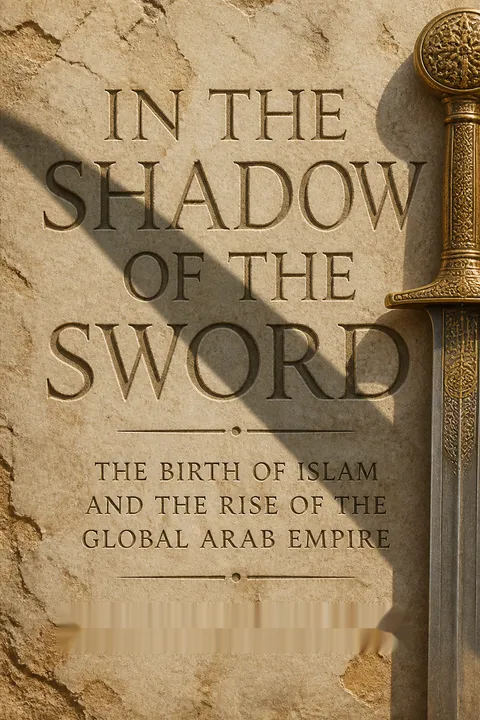
In the Shadow of the Sword explores the rise of Islam and the Arab Empire, challenging traditional narratives. Readers appreciate Holland's narrative style and historical context but find the book's structure and focus sometimes lacking. Some praise its controversial insights, while others criticize its speculative nature. The book covers late antiquity, focusing on Roman and Persian empires before delving into early Islam. Readers note it's more about setting the stage for Islam's emergence than a comprehensive history of the religion itself. Overall, it's seen as thought-provoking but not definitive.
People Also Read


About the Author



Download PDF
Download EPUB
.epub digital book format is ideal for reading ebooks on phones, tablets, and e-readers.








































