
Key Takeaways
1. Neoliberalism is a Moral-Political Project, Not Just Economic Policy
Rather, the argument is that nothing is untouched by a neoliberal mode of reason and valuation and that neoliberalism’s attack on democracy has everywhere inflected law, political culture, and political subjectivity.
Beyond economics. Neoliberalism is often understood primarily as an economic agenda focused on privatization, deregulation, and reducing the social state. However, this view is incomplete. Wendy Brown argues that neoliberalism is a profound "reprogramming of liberalism" that extends far beyond economic policy, shaping law, political culture, and even individual subjectivity. It's a comprehensive rationality that reorients values and reality principles across all spheres of existence.
Foundational shift. The core of this reprogramming lies in applying market principles as ubiquitous governing principles, transforming individuals into "human capital" and states into entities primarily serving market needs. This shift isn't merely about rebooting capitalism; it's about fundamentally altering the coordinates of liberal orders. The original neoliberal thinkers, like Friedrich Hayek, envisioned a moral-political project where markets and traditional morality would govern and discipline individuals, maximizing freedom by demonizing the social state and democratic political life.
Shaping the present. Understanding the current surge of antidemocratic forces in the West requires appreciating this broader neoliberal political culture and subject production. It's not just about economic conditions or enduring racisms, but how neoliberalism's assault on democracy, equality, and society has contoured these phenomena. The rise of white nationalist authoritarianism, for instance, is animated by economic abandonment and racial resentment, but its form is shaped by decades of neoliberal rationality.
2. Neoliberalism Systematically Dismantles "Society" and "Social Justice"
Tellingly, the existence of society and the idea of the social—its intelligibility, its harboring of stratifying powers, and above all, its appropriateness as a site of justice and the commonweal—is precisely what neoliberalism set out to destroy conceptually, normatively, and practically.
Society as a target. For neoliberalism, the concept of "society" is not just irrelevant but dangerous. Hayek, a key neoliberal intellectual, systematically criticized "society" as a "semantic fraud," a "makeshift phrase" that falsely suggests common purposes and deliberate human creation. This conceptual dismantling is crucial because "society" is where political equality is forged, where diverse citizens experience a linked fate, and where historical inequalities are identified and redressed through social justice.
Hayek's critique. Hayek's animus against society and social justice stems from several beliefs:
- False conflation: "Society" wrongly conflates intimate associations with impersonal, mass cooperation.
- False personification: It mistakenly treats a collection of individuals as a unified entity, leading to the conceit that things can be "of value to society."
- Totalitarian trajectory: Belief in "social justice" inevitably leads to unlimited state intervention in markets and moral codes, progressively approaching a totalitarian system.
- Justice as rules, not outcomes: True justice is about universally applied rules of conduct, not about rewarding effort or achieving specific outcomes, which are often determined by skill and luck.
Consequences of dismantling. This neoliberal assault on the social manifests in various ways:
- Epistemological: Denying society's existence, dismissing inequality concerns as "politics of envy."
- Political: Dismantling or privatizing the social state (welfare, education, healthcare).
- Legal: Using liberty claims to challenge equality and secularism.
- Ethical: Challenging social justice with the "natural authority" of traditional values.
- Cultural: "Demassification" and "entrepreneurialization" of subjects, shifting social responsibilities to individuals and families.
3. Neoliberalism Actively "Dethrones" Democratic Politics and Popular Sovereignty
Throttling democracy was fundamental, not incidental, to the broader neoliberal program.
Wariness of the political. Neoliberal thinkers viewed "the political" – the theater of deliberations, powers, and values where common existence is shaped – with deep suspicion. They aimed to limit and contain it, detaching it from sovereignty and eliminating its democratic form. This was driven by the belief that democratic energies inherently "engorge the political," threatening individual freedom, spontaneous order, and leading to state despotism or totalitarianism.
Friedman's critique of democracy. Milton Friedman argued that "competitive capitalism" requires limited government and a sharp separation of economic from political power. For him, any exercise of political power, including by popular majorities, threatens freedom due to its inherent concentration and reliance on coercion. He opposed most democratically enacted legislation, seeing it as imposing the will of the majority on minorities, whereas markets allow individual preferences to prevail.
Hayek's rejection of popular sovereignty. Friedrich Hayek considered popular sovereignty a "dangerous nonsense notion." He argued that it:
- Threatens individual freedom and licenses unbounded government.
- Confers supremacy on the political domain, which needs to be leashed.
- Permits legislative power to run amok, expanding the administrative state and leading to corruption.
- Mistakenly believes that "the people are acting together," when true order comes from spontaneously evolved rules of conduct.
Hayek distinguished liberalism (concerned with limiting coercive government power) from democracy (a method of majority rule), arguing that authoritarianism is compatible with a liberal society, while totalitarianism can be administered by democratic majorities.
Ordoliberal technocracy. The Ordoliberals, while not rejecting state sovereignty, sought to insulate the state from democratic demands. They aimed for a strong, technocratic state, guided by expert knowledge and bound by an "economic constitution" that secures economic liberalism. They believed democracy inflicted damage on both states and markets, leading to weak states susceptible to powerful interest groups and economic vicissitudes. This vision replaced democratic deliberation with management, law, and technocracy.
4. Traditional Morality and Markets are the Twin Pillars of Neoliberal Order
Rather, markets and morals, equally important to a thriving civilization, are rooted in a common ontology of spontaneously evolved orders borne by tradition.
Beyond economic logic. While neoliberalism is known for its market fundamentalism, it also deeply integrates traditional morality. For Hayek, markets and morals are not merely complementary but share a common ontological basis: they are both spontaneously evolved orders borne by tradition. This means they generate discipline and freedom, inheritance and innovation, evolution and stability, authority and independence, all without relying on comprehensive knowledge, rational design, or state coercion.
Tradition as freedom's anchor. Hayek argued that freedom is not emancipation from accepted social norms but the uncoerced capacity for endeavor within codes of conduct generated by tradition. He believed that:
- Tradition produces order: It yields social harmony and integration through habitual conduct, not conscious adherence to known rules.
- Tradition is dynamic: Its voluntary nature allows for gradual, experimental change and adaptation.
- Tradition is anti-rationalist: It embodies more experience than any single person possesses, making attempts to replace it with rational designs "enemies of freedom."
- Religion's role: Religious mystifications often codify and transmit traditions, promoting survival and flourishing by providing "symbolic truths" that are beyond scientific statements.
The Hayekian dilemma. Hayek faced a challenge: how to restore traditional moral principles, which he believed were damaged by capitalism and the social state, without resorting to state-legislated morality, which he saw as totalitarian. His solution involved a three-pronged approach:
- Limit legislative power: Confine it to universal rules, excluding policy-making in the "public interest."
- Discredit social justice: Frame it as "nonsense" and "totalitarian."
- Expand the "personal protected sphere": This would extend the purview of traditional morality beyond church and family, allowing it to legitimately reclaim civic and social life from democratic norms.
5. The "Personal Protected Sphere" Expands Traditional Morality into Public Life
Enlarging the domain in which personal freedom is rightly unrestricted allows traditional beliefs and mores, or what Hayek calls “conventions and customs of human intercourse,” to legitimately reclaim and indeed recolonize, the civic and social where democracy once ruled.
Shielding from the state. Hayek's concept of the "personal protected sphere" is crucial for understanding how traditional morality is re-embedded in neoliberalism. This sphere designates activities and domains that the state is prohibited from touching, effectively blocking coercive state power. While a familiar liberal idea, Hayek aimed to significantly enlarge its contents and domain, designating ever more activity within it as private and thus appropriately shielded from state impingement and democratic norms.
Beyond material property. The "personal protected sphere" extends beyond mere material property to encompass "conventions and customs of human intercourse." This includes:
- Heteropatriarchal norms and family forms.
- Racial norms and enclaves.
- Property ownership and wealth accumulation, retention, and transmission.
In essence, it protects all that reproduces and legitimates historical powers and ordinances of class, kinship, race, and gender from democratic challenges.
Familialization and Christianization. In practice, this expansion of the personal protected sphere leads to a "privatization by familialization and Christianization." This process challenges principles of equality, secularism, pluralism, and inclusion, along with democratic determination of a common good. Examples include:
- School vouchers and charter schools: Allowing parents to choose "value-aligned" schools, indemnifying family "choice" against a secular, pluralistic public, and undermining equal opportunity in public education.
- Religious Freedom Restoration Acts (RFRAs): Enabling religious claims to displace democratically enacted principles of equality, inclusion, and nondiscrimination, such as reproductive autonomy or LGBTQ+ rights.
- Repealing the Johnson Amendment: Amplifying the political power of wealthy churches by allowing direct participation in political campaigns.
6. Neoliberal Jurisprudence Weaponizes the First Amendment for Capital and Christian Values
As it upholds a stream of First Amendment challenges to laws of equality, regulated markets, and secularism, the Supreme Court is helping to enact a twisted version of the Hayekian dream—replacing democratically governed society with one organized by markets and traditional morality, under the sign of freedom.
From shield to sword. Historically, the First Amendment protected vulnerable minorities and political dissenters. However, in recent decades, neoliberal jurisprudence has transformed it into a weapon for broad deregulation, particularly for corporate and religious interests. This new interpretation enhances the economic, social, and political powers of capital, ownership, Christianity, and traditional morality, pushing back against equality and antidiscrimination laws.
Key jurisprudential techniques: The Supreme Court employs specific designations to achieve this:
- "Speech" expansion: Everything from money, cakes, and advertising to legal notices is designated as "speech."
- "Speaker" expansion: Corporations, small businesses, and nonprofits are designated as entities that "speak."
- "Controversy" designation: Specific acts, practices, and laws are labeled "controversial" among those with "deeply held beliefs," allowing exemptions from laws.
Case Study: Masterpiece Cakeshop v. Colorado Civil Rights Commission (2018). A baker refused to make a wedding cake for a same-sex couple, citing religious liberty and free speech. The Court's narrow ruling focused on the Colorado Commission's religious bias, but the underlying arguments revealed the strategy:
- Artistry as speech: The baker's artistic work was framed as "expressive conduct," making the cake itself a form of "speech."
- Religious belief permeating business: The baker's devout Christianity was presented as saturating his business, linking religious liberty to commercial ownership.
- Free speech extending free exercise: This conjoining allowed actions based on religious beliefs to circumvent public accommodations law, effectively permitting discrimination under the guise of protecting speech.
Case Study: NIFLA v. Becerra (2018). California required crisis pregnancy centers (CPCs) to disclose their unlicensed status and the availability of state-provided reproductive healthcare (including abortion). The Court ruled this compelled speech, violating "deeply held beliefs."
- Abortion as "controversial": The Court designated abortion as a "controversy," converting factual health information into a "viewpoint" that the state could not compel CPCs to "advertise."
- Professional speech deregulation: The Court rejected the idea of special restrictions on "professional speech," allowing religiously animated antiabortion advocates to operate as unregulated purveyors of professional services, even engaging in deception.
- State as authoritarian: The Court analogized the FACT Act to authoritarian regimes, framing public interest regulation as "state speech" suppressing "unpopular ideas."
7. Neoliberalism's Unintended Consequence: A Frankensteinian Monster of Antidemocratic Forces
In short, while the book will argue that the constellation of principles, policies, practices, and forms of governing reason that may be gathered under the sign of neoliberalism has importantly constituted the catastrophic present, this was not neoliberalism’s intended spawn, but its Frankensteinian creation.
Dreams gone awry. The original neoliberal vision was a global order of free-flowing capital, nations organized by traditional morality and markets, and states focused on this project. Democracy was to be demoted to a mere method for peaceful power transfer, and citizenship limited to voting. The state would be lean, non-sovereign, and insulated from vested interests and mass demands, leading to a politically pacified citizenry. However, this utopian dream produced a "Frankensteinian creation" – a monstrous political reality its founders would abhor.
Three reasons for deformation:
- Return of the repressed: Neoliberalism's dedemocratizing project inadvertently unleashed the very social and political forces it sought to vanquish. The throttling of democracy led to an "enraged" form of majority rule, lacking common civil norms.
- Unleashed financialization: The accidental unleashing of the financial sector profoundly undermined neoliberal dreams of a competitive global order and states autonomous of economic interests. States became instrumentalized by big capital, with major industries influencing legislative wheels.
- Twisted markets and morals: Markets and morals, when submitted to each other's grammars, became politicized fighting creeds, losing their "organic, spontaneous" character. Traditional values became battle cries, often emptied of substance and used as political cudgels.
The "political deficit." Neoliberalism's profound aversion to and inadequate theorization of "the political" created a "deficit" in its theory and practice. This made the project intrinsically vulnerable to continued domination by large capital interests and unable to anticipate its transmogrification by rogue political powers and antidemocratic rebellions. The result is a profoundly antidemocratic political culture, where political power is increasingly deprived of informed deliberation, compromise, accountability, and legitimation by the will of the people.
8. Nihilism and Desublimation Fuel a Politics of Indifference and Aggression
As the nihilistic devaluation of values lightens the force of conscience, it frees us from the restraint, self-blame, and self-abuse that conscience imposes.
The death of values. Nietzsche argued that nihilism begins when reason and science challenge God, revealing all meaning as constructed and values as unmoored from their foundations. This leads not to an absence of values, but to their "devaluation" – they become fungible, trivial, and easily instrumentalized. Neoliberalism intensifies this by economizing and financializing every aspect of existence, making "selling one's soul" quotidian and reducing virtue to branding.
Desublimation of the will to power. This nihilistic devaluation of values has a cascading effect:
- Weakened conscience: It lessens the force of conscience, freeing subjects from self-restraint and self-blame.
- Outward will to power: The will to power, previously sublimated and turned inward (as conscience), is desublimated and sent outward, unbridled by humility or ethics. Religion itself can become a cynical instrument for unrestrained power.
- Repressive desublimation (Marcuse): In advanced capitalism, instinctual energies are released (e.g., reduced sexual strictures) but in a non-liberatory way. This leads to "happy consciousness," where conscience relaxes not just for personal conduct but also for social wrongs, fostering indifference to injustice and suffering.
Aggression and indifference. This toxic mix explains several features of the contemporary right:
- Broken social compact: A profound indifference to the suffering of others, ecological devastation, or social obligations.
- Unprecedented aggression: The viciousness in right-wing media, blogs, and online trolling, often expressed as "wreaking the will" to feel power when world-building is unavailable.
- Survival of moral scandals: The ability of right-wing leaders to survive moral transgressions (e.g., Trump's conduct) because nihilism depresses the significance of conduct and consistency. Values become instrumentalized, revealing the raw privilege and entitlement they encode.
9. Ressentiment of the "Dethroned" White Male Drives Contemporary Right-Wing Populism
Rather, this politics of ressentiment emerges from the historically dominant as they feel that dominance ebbing—as whiteness, especially, but also masculinity provides limited protection against the displacements and losses that forty years of neoliberalism have yielded for the working and middle classes.
Beyond Nietzsche's "weakness." Nietzsche theorized ressentiment as the revenge of the weak, who invent new moral systems to condemn the strong. However, contemporary right-wing populism is driven by a different kind of ressentiment: that of the dethroned. This anger stems from the lost entitlement of historically dominant groups, particularly white men, who feel their power and privilege ebbing amidst the displacements and losses wrought by neoliberalism.
Neoliberalism's role in exacerbating ressentiment:
- Economic displacement: Neoliberal globalization led to deindustrialization, loss of union jobs, and declining living standards for working and middle classes in the Global North.
- Cultural demotion: The rise of multiculturalism, identity politics, and cosmopolitan elites is perceived as disdaining and unseating traditional white male dominance.
- Inequality of access: The relentless neoliberal stratification of everyday life by wealth (tiered services, "premier lounges") intensifies the anger of those who feel left behind and disrespected, even if they are not the poorest.
Unsublimated rage and revenge. Unlike Nietzsche's "slave morality" which sublimated ressentiment into creative moral systems, the ressentiment of the dethroned often remains raw rancor and rage. It is:
- Unsublimated: It doesn't transform into refined moral values but fuels a permanent politics of revenge against those blamed for their dethronement (feminists, multiculturalists, globalists).
- Nihilistic: Combined with nihilism, it mocks all values, leading to high levels of affect rather than developed moral systems.
- Expressed as destruction: Leaders like Trump embody this, with revenge as a core philosophy, aiming to destroy opponents and overturn policies, often with gleeful, vengeful rallying cries from their base.
10. The Privatization of the Nation-State Fuels Illiberal Nationalism
When the nation is privatized and familialized in this way, it becomes legitimately illiberal toward aversive insiders and invading outsiders; thus does neoliberalism plant seeds of a nationalism that it formally abjures.
Nation as private property. Neoliberalism's twin processes of marketization and familialization extend to the very concept of the nation-state. The nation is refigured not as a public, democratic entity, but as a private firm or an endangered family home. This re-imagining is evident in political rhetoric:
- Nation as business: Leaders like Trump depict the nation as a business needing "better deals" in international relations.
- Nation as home: The nation is portrayed as an "inadequately secured home," besieged by "ill-willed or nonbelonging outsiders," justifying border walls and expelling immigrants. Marine Le Pen's "France for the French" campaign similarly uses familial language ("our house," "refrigerator of France is empty").
Illiberal consequences. This privatization and familialization of the nation-state has profound illiberal and antidemocratic consequences:
- Rejection of democratic principles: It rejects a public, pluralistic, secular democratic order in favor of a private, homogenous, familial one, where principles of democratic justice and human rights are deemed irrelevant to "outsiders."
- Legitimation of exclusion: It legitimizes illiberal attitudes towards "aversive insiders" and "invading outsiders," fostering xenophobia and nativism.
- Growth of the securitarian state: Walling and securitization of every kind are authorized and required by this privatization. The state's protective function expands, leading to increased border patrols, police, and military presence, legitimized by the need to protect the "private" nation.
Twist from Hayek's vision. While Hayek formally abjured nationalism and dreaded state expansion, neoliberalism inadvertently plants the seeds for it. The politicization of tradition, combined with the instrumentalization of values, leads to a nationalism that is aggressive and supremacist, rather than organically integrating social life. This "freedom" becomes unbridled and uncultured, a "stick in the eye of accepted norms," ultimately leading to a nihilistic destruction of social bonds.
11. The Erosion of the Social and Political Imaginary Leads to a Bleak Future
Still broken, and absent from these important discourses of rebellion against neoliberalism’s aim to vanquish society and the social, is the relation of the social to democratic rule.
Lost horizons. Neoliberalism, beyond its economic and political effects, has caused tectonic shifts in the organization and consciousness of space, profoundly impacting our collective imaginary of the future.
- Lost horizon of the nation-state: Globalization, with its capital and immigrant flows, digital networks, and supply chains, has weakened national borders and sovereignty, leading to rancor and a divide between those accommodating and those rebelling against this shift.
- Destruction of the social sphere: Neoliberalism dissolves the social into market and familial orders, eliminating the space for civic equality and concern for the common good. The rise of digital sociality, while novel, is deterritorialized and dedemocratized, lacking protocols for power sharing or pluralism.
- Despatialization of power: The vaporous powers of finance capital, which rule everything but live nowhere, transform spatial consciousness, making power seem uncontrollable and intangible, akin to a Copernican revolution for subjectivity.
"Somewheres" vs. "Nowheres." This leads to a geopolitical divide between "somewheres" (rooted, less educated, conservative, clinging to place) and "nowheres" (rootless, urban, educated, progressive, embracing globalization). The "somewheres" experience profound threats to their demographic rootedness, leading to a politically reactionary formation.
Nihilism and apocalypse. This toxic mix of nihilism, fatalism, and ressentiment, combined with neoliberal assaults on the social and political, creates a population that rages against secular cosmopolitans and embraces racial indeterminacy, gender fluidity, godlessness, open borders, and rootlessness. When nation, family, property, and traditional privileges are mortally wounded, they are reduced to affective remains. This leads to a profound sense of futurity being in doubt, where:
- Weariness of man: Humanity is seen as having brought itself and the planet to the brink of destruction, leading to a weariness of man and a sense of being diminished by humanly created, uncontrollable powers.
- Apocalyptic turn: If white men cannot own democracy or rule the planet, there will be no democracy or planet. This is a turn towards apocalypse, where supremacy is clung to as civilization itself appears finished.
Review Summary
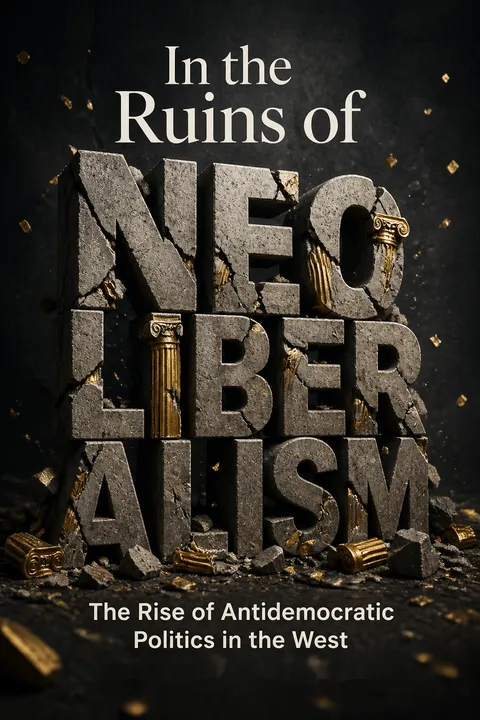
In the Ruins of Neoliberalism by Wendy Brown examines how neoliberalism's attack on democracy laid foundations for right-wing authoritarianism. Reviewers praise Brown's analysis showing neoliberalism always promoted traditional morality alongside markets, creating an alliance with conservative forces. The book explores how decades of neoliberal rationality produced antidemocratic culture, nihilism, and figures like Trump. While most found it brilliant and timely for understanding contemporary politics, some criticized its dense theoretical language and lack of prescriptive solutions. Brown's examination of Supreme Court cases and her revision of classical neoliberal thinkers particularly resonated with readers.
People Also Read






Download PDF
Download EPUB
.epub digital book format is ideal for reading ebooks on phones, tablets, and e-readers.








































