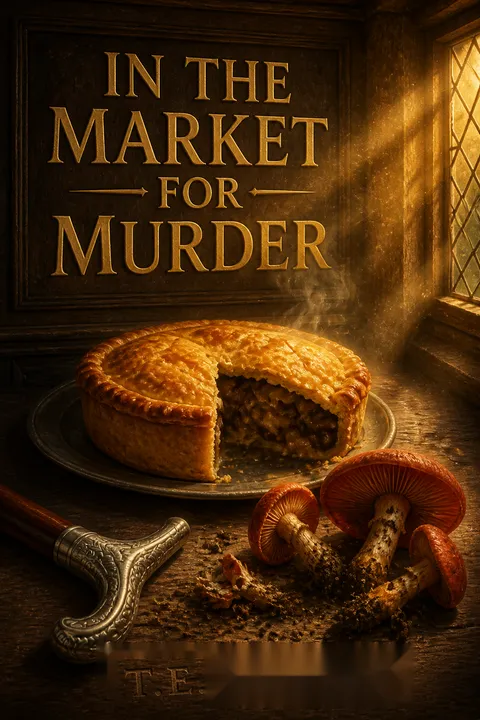

Plot Summary
Spring's Return, Shadows Linger
After a long, difficult winter, Lady Hardcastle finally emerges from her convalescence, accompanied by her loyal maid, Florence Armstrong. The Gloucestershire countryside is waking up, and so are the pair's appetites for adventure. Their walks through the village reveal a community that has come to accept them, and a sense of normalcy returns. Yet, beneath the surface, the scars of past violence and intrigue linger. Lady Hardcastle's stick is both a symbol of her recovery and a subtle badge of vulnerability, a reminder to herself and others of the dangers that have passed—and those that may yet come. The promise of spring is tinged with the knowledge that peace in Littleton Cotterell is always fragile, and that the quiet country life may not remain so for long.
Market Day Intrigues
Invited by Lady Farley-Stroud, Lady Hardcastle and Flo join the local gentry for a day at the bustling Chipping Bevington cattle market. The event is a swirl of muddy boots, sharp-tongued farmers, and the earthy commerce of rural England. Amid the auction's arcane rituals, rivalries between farmers surface, particularly between Caradine and Ackley, whose competitive bidding drives up prices and tempers. The day is not just about livestock; it's a window into the social fabric of the countryside, where alliances and grudges are forged over pints and pies. The market's energy is infectious, but beneath the laughter and cider, old resentments simmer, hinting at the tensions that will soon erupt into something far darker.
Death in the Hayrick
The village's routine is shattered when Spencer Caradine, a notoriously disagreeable farmer, collapses and dies face-first in his pie at The Hayrick pub. Lady Farley-Stroud, present at the scene, is deeply shaken and brings the news to Lady Hardcastle and Flo. The local doctor suspects poison, and the community is thrown into turmoil. Inspector Sunderland, already stretched thin by other cases, enlists Lady Hardcastle and Flo to investigate. The death is more than a tragedy; it's a catalyst that exposes the undercurrents of animosity and suspicion among the farmers. The pub, once a place of camaraderie, becomes the epicenter of a murder mystery, and the villagers' secrets begin to unravel.
The Poisoned Pie
Lady Hardcastle and Flo embark on their inquiry, interviewing Caradine's widow, neighbors, and rivals. Each encounter reveals layers of resentment: Caradine was universally disliked, a bully whose death is mourned by few. The investigation is complicated by the lack of clear evidence and the abundance of motive. The local farmers—Ackley, Lock, Tribley—each have their own grievances, and even Caradine's family is not above suspicion. The possibility of poison in the pub's food or drink is explored, but the means and opportunity remain elusive. The case is a puzzle of personalities and grudges, with every answer leading to more questions.
Suspects and Secrets
As Lady Hardcastle and Flo dig deeper, the web of suspicion widens. Audrey Caradine, the widow, is relieved rather than bereaved; her son Morris is eager to escape the farm; Noah Lock, the neighbor, is in love with Audrey; and Dick Ackley, the rival, nursed a bitter feud with the victim. Lancelot Tribley, another neighbor, is a chef trapped in a farmer's life, desperate to sell his land. Each has motive, but none seem capable of murder. The investigation is further muddied by the insular nature of rural life, where everyone knows everyone's business, but no one is willing to speak ill of the dead—at least, not openly.
The Haunted Pub
While the murder investigation stalls, the village is gripped by another mystery: the Dog and Duck pub is reportedly haunted. Séances are held, and Madame Eugénie, a medium, arrives to commune with the spirits. During a dramatic séance, a ghostly apparition accuses newcomer Mr. Snelson of murder, sending the village into a frenzy of gossip and suspicion. The line between the supernatural and the criminal blurs, as Lady Hardcastle and Flo suspect trickery behind the haunting. The pub becomes a stage for both genuine grief and calculated deception, and the villagers' appetite for drama is whetted by the promise of otherworldly revelations.
Ghosts and Grudges
The séance's accusation against Snelson leads to renewed scrutiny of his past. Rumors swirl about a suspicious fire at his former timber business, and the ghost's messages become increasingly insistent, implicating him in the death of his partner, Emmanuel Bean. Lady Hardcastle and Flo, skeptical of the supernatural, investigate the possibility of a hoax. Their inquiries reveal that the haunting is a carefully orchestrated scheme, designed to manipulate both the villagers and the authorities. The intersection of old grudges and new trickery complicates the search for truth, as the boundaries between victim and villain blur.
The Rugby Club Riddle
The village's rugby club is burgled, and prized trophies vanish. Oily footprints implicate Lofty Trevellian, a gentle giant with a checkered past, but Lady Hardcastle and Flo suspect a frame-up. Their investigation uncovers a hidden mechanism in the trophy cabinet, a legacy of a prankster club chairman, and a plot to discredit Lofty for personal gain. The theft is not just about silverware; it's a microcosm of the village's rivalries and ambitions. The case tests Flo's skills of observation and deduction, and the solution is as much about understanding human nature as it is about following clues.
False Trails and Footprints
As the investigations into murder, haunting, and theft converge, Lady Hardcastle and Flo find themselves navigating a labyrinth of false leads. The evidence against Lofty is revealed to be planted, and the ghostly accusations against Snelson are exposed as the work of a vengeful daughter and a fraudulent medium. The real motives—greed, jealousy, and desperation—come into focus. The village's penchant for gossip and spectacle has allowed the true culprits to hide in plain sight, but Lady Hardcastle's persistence and Flo's practical wisdom begin to unravel the tangled threads.
Séance and Scandal
A second séance is staged, and Flo, drawing on her circus background, exposes Madame Eugénie's sleight of hand and her assistant's role as the "ghost." The haunting is revealed as a scam to frame Snelson and claim an inheritance. The villagers are both relieved and embarrassed to have been so thoroughly duped. The exposure of the hoax brings a measure of closure, but also a sense of vulnerability—if the supernatural can be faked so convincingly, what other truths might be illusions? The episode is a lesson in skepticism and the dangers of credulity.
The Witchcraft Hoax
With the medium and her accomplice arrested under the Witchcraft Act, and Snelson cleared of murder, the village breathes a sigh of relief. Yet, the real murderer of Caradine remains at large, and the rugby club's missing trophies are still unaccounted for. The resolution of the haunting is bittersweet: justice is served, but the wounds of suspicion and betrayal linger. Lady Hardcastle and Flo reflect on the power of stories—ghostly or otherwise—to shape a community's fears and hopes, and the importance of seeking truth beneath the surface.
The Deadly Webcap
A chance encounter in the woods with Jed Halfpenny, a local poacher, provides the breakthrough: deadly webcap mushrooms, nearly identical to edible chanterelles, are discovered growing nearby. Lady Hardcastle realizes that Caradine's death matches the symptoms of webcap poisoning—slow, insidious, and easily mistaken for illness. The focus shifts from quick-acting poisons to a more subtle method, and the circle of suspects narrows to those with knowledge of both mushrooms and the pub's kitchen. The case pivots from the supernatural to the scientific, and the final pieces begin to fall into place.
Revelations in the Woods
Lady Hardcastle and Flo revisit the timeline, realizing that the murder was committed a week before Caradine's death, when the pies at The Hayrick contained mushrooms. The only person with the expertise and opportunity to substitute deadly webcaps for chanterelles is Lancelot Tribley, the frustrated chef. His motive is clear: trapped in a life he despises, desperate to sell his farm, and blocked by Caradine's refusal to sell his own land. The murder is both a crime of opportunity and a calculated act of self-liberation. The woods, once a place of innocent foraging, become the scene of premeditated murder.
The Chef's Motive
Tribley's plot is revealed in full: by killing Caradine, he hopes to free himself to sell his farm and pursue happiness with Winnie Marsh. His attempt to frame Lofty for the rugby club theft is part of a broader scheme to remove rivals and obstacles. The interconnectedness of the village's dramas—murder, theft, haunting—becomes clear. Each crime is rooted in the same soil of ambition, resentment, and longing for escape. Lady Hardcastle's empathy for the human condition is matched by her resolve to see justice done, even when the motives are all too understandable.
Truth at Market Noon
At the next market day, Lady Hardcastle orchestrates a dramatic confrontation at The Hayrick. With Inspector Sunderland and his men in place, she exposes Tribley's guilt and prevents another poisoning. The villagers, stunned by the revelations, must come to terms with the fact that the murderer was one of their own, hiding behind the mask of respectability. The case is closed, but not without cost: trust has been shaken, and the boundaries between friend and foe have shifted. Lady Hardcastle and Flo, once again, have restored order, but the village will never be quite the same.
Justice and New Beginnings
With the mysteries resolved, the village begins to heal. Lofty is exonerated, Snelson's name is cleared, and the rugby club's trophies are recovered. Lady Hardcastle and Flo reflect on the nature of justice, the dangers of unchecked ambition, and the resilience of community. New adventures beckon—a motorcar, a racing invitation, and the promise of more mysteries to come. The story ends with a sense of renewal: spring has truly arrived, and with it, the hope that even in the darkest corners of the countryside, truth and friendship can prevail.
Analysis
"In the Market for Murder" is a masterful blend of cozy mystery, social satire, and psychological insight. At its heart, the novel is a meditation on the masks we wear—whether to protect ourselves, to deceive others, or to survive in a world that is often indifferent or hostile. Through the intertwined mysteries of murder, haunting, and theft, T.E. Kinsey explores the ways in which communities construct and police their own narratives, often at the expense of truth and justice. The story's resolution is both satisfying and sobering: justice is served, but not without collateral damage, and the boundaries between good and evil remain porous. Lady Hardcastle and Flo, with their unique blend of empathy, skepticism, and courage, embody the virtues of curiosity and compassion, reminding us that the search for truth is as much about understanding ourselves and our neighbors as it is about solving crimes. The novel's enduring lesson is that beneath the surface of even the most idyllic village lies a complex web of longing, fear, and hope—and that it is only by facing these shadows that we can truly begin anew.
Characters
Lady Emily Hardcastle
Lady Hardcastle is a woman of contradictions: an upper-class widow with a history of espionage, she combines genteel manners with a taste for adventure and a formidable intellect. Her relationship with Flo is both employer-employee and deep friendship, marked by banter, mutual respect, and shared trauma. Psychologically, Lady Hardcastle is driven by a need for purpose and justice, her convalescence a reminder of mortality and vulnerability. Her curiosity is insatiable, her empathy genuine, but she is not above theatricality or manipulation to achieve her ends. Over the course of the story, she moves from recovery to renewed vigor, her confidence restored by the challenge of unraveling the village's mysteries.
Florence "Flo" Armstrong
Flo is more than a servant; she is Lady Hardcastle's confidante, bodyguard, and intellectual equal. Her background in the circus and espionage has given her a unique skill set—physical prowess, keen observation, and a healthy skepticism. Flo's psychological resilience is matched by her wit and warmth; she grounds Lady Hardcastle's flights of fancy and provides the practical perspective needed to solve complex puzzles. Her development is subtle: from caretaker to co-investigator, she finds her own voice and agency, often taking the lead in moments of crisis. The dynamic between Flo and Lady Hardcastle is the emotional heart of the story, blending affection, exasperation, and deep trust.
Lady Gertrude Farley-Stroud
Lady Farley-Stroud is the embodiment of rural aristocracy—formidable, dotty, and deeply kind. Her outward bluster hides a sensitive soul, easily shaken by tragedy but quick to recover her humor. She serves as both catalyst and confidante, drawing Lady Hardcastle and Flo into village life and providing crucial insights into the community's dynamics. Psychologically, she is driven by a need for connection and relevance, her invitations and schemes a way to stave off loneliness. Her devotion to her husband and friends is genuine, and her moments of vulnerability reveal the costs of maintaining a public façade.
Inspector Oliver Sunderland
Inspector Sunderland is a rare breed: a policeman who respects amateur detectives and values their insights. His straightforward manner and dry humor mask a deep sense of responsibility and a willingness to bend the rules for the greater good. He is psychologically grounded, unflappable in the face of chaos, and capable of both empathy and firmness. His relationship with Lady Hardcastle and Flo is collaborative, marked by mutual admiration and occasional exasperation. Sunderland's presence ensures that justice is not just a matter of law, but of fairness and compassion.
Spencer Caradine
Caradine is the story's absent center—a man whose death reveals more about the living than about himself. Universally disliked, he is a figure of resentment and fear, his bullying shaping the lives of his family and neighbors. Psychologically, Caradine is a study in isolation and bitterness, his inability to connect with others making him both a target and a symbol of the village's darker impulses. His murder is less a personal tragedy than a release for those around him, and his legacy is one of division and suspicion.
Audrey Caradine
Audrey is a woman trapped by circumstance and duty, her marriage to Caradine a source of pain and endurance. Her faith and sense of propriety prevent her from seeking happiness with Noah Lock until freed by widowhood. Psychologically, she is resilient but guarded, her relief at Caradine's death tempered by guilt and uncertainty. Her relationship with her son Morris is strained by the family's dysfunction, but her capacity for love and hope emerges as the story unfolds.
Morris Caradine
Morris is the archetypal "wet lettuce"—timid, stammering, and desperate to leave the farm. His psychological scars are the result of years of paternal abuse, and his dreams of art school represent both a literal and metaphorical escape. Morris's journey is one of self-assertion, as he navigates grief, opportunity, and the possibility of a new life. His innocence and vulnerability make him both a suspect and a figure of sympathy.
Lancelot Tribley
Tribley is a man out of place—an artist trapped in a farmer's body, his ambitions thwarted by circumstance. His psychological profile is marked by resentment, envy, and a desperate longing for freedom. The murder of Caradine is both a crime of passion and a calculated act, rooted in the belief that happiness is always just out of reach. Tribley's attempts to frame others and manipulate events reveal a mind both clever and self-destructive, his downfall a cautionary tale about the dangers of unchecked ambition.
Dick Ackley
Ackley is Caradine's chief antagonist, their feud a fixture of village life. Outwardly gruff and combative, Ackley is psychologically driven by pride and a sense of injustice. His bluster masks insecurity, and his role as a suspect is as much about perception as reality. Ackley's interactions with Lady Hardcastle and Flo reveal a man capable of both aggression and vulnerability, his ultimate innocence a reminder that not all enemies are villains.
Noah Lock
Lock is the story's quiet hero—a former soldier turned farmer, in love with Audrey Caradine but constrained by honor and circumstance. His psychological strength lies in his patience and integrity, his willingness to wait for happiness rather than seize it at any cost. Lock's presence is a stabilizing force, his actions guided by empathy and a sense of duty. His relationship with Audrey is a testament to the power of love to endure hardship and loss.
Plot Devices
Dual Mysteries Intertwined
The novel employs a dual-mystery structure: the murder of Caradine and the haunting of the pub. These threads run in parallel, each complicating the other and providing red herrings and false leads. The structure allows for a rich exploration of character and setting, as the investigations intersect and diverge. The use of parallel mysteries also serves to highlight the theme of appearance versus reality, as supernatural explanations give way to human motives.
Red Herrings and False Accusations
The narrative is rife with red herrings: the séance, the rugby club theft, the planted evidence against Lofty, and the ghostly accusations against Snelson. These devices keep both characters and readers guessing, sustaining suspense and deepening the sense of uncertainty. The false accusations serve as commentary on the dangers of gossip and the ease with which communities can turn on outsiders or the vulnerable.
Character-Driven Investigation
Lady Hardcastle and Flo's approach to investigation is rooted in empathy, observation, and psychological insight. Their interviews are as much about reading people as about gathering facts, and their understanding of human nature is as important as their deductive skills. This device allows the narrative to explore themes of trauma, resilience, and the complexity of motive, elevating the story beyond a simple whodunit.
Foreshadowing and Symbolism
The novel uses foreshadowing—Lady Hardcastle's stick, the recurring motif of mushrooms, the symbolism of spring's return—to hint at deeper meanings and future revelations. The stick is both a weapon and a crutch; the mushrooms are both food and poison; spring is both renewal and the return of old shadows. These devices enrich the narrative, inviting readers to look beyond the surface.
Theatrical Revelations
Key moments—such as the market day denouement and the exposure of the séance hoax—are staged as public performances, with Lady Hardcastle orchestrating events for maximum impact. This device underscores the performative nature of village life, where reputation and spectacle are as important as truth. The theatricality also serves to reinforce the story's themes of illusion, deception, and the search for authenticity.
Lady Hardcastle Mysteries Series
Download PDF
Download EPUB
.epub digital book format is ideal for reading ebooks on phones, tablets, and e-readers.








































