

Key Takeaways
Manipulators are fighters who never look like they're fighting
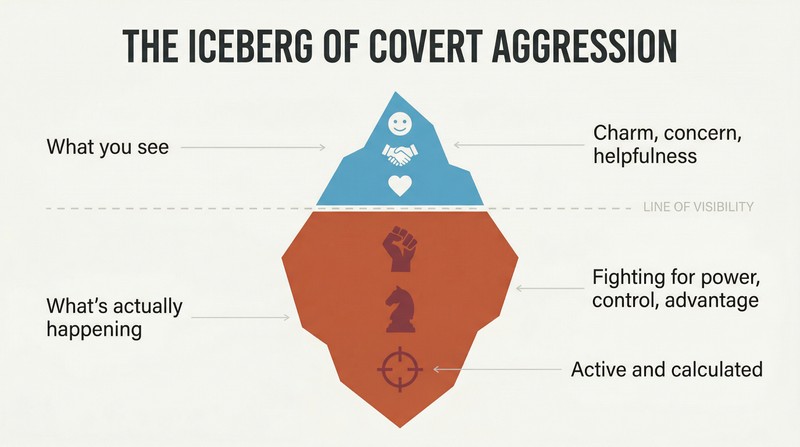
Covert aggression is the engine of manipulation. Simon defines it as actively fighting to win — pursuing power, advantage, or control — while concealing aggressive intent behind charm, concern, or helpfulness. A covert-aggressive personality is someone whose habitual style revolves around this hidden fighting. Unlike passive aggression (resisting through inaction, like the silent treatment), covert aggression is very active and calculated. The manipulator knows exactly what they're doing.
The book illustrates this through vivid cases. A father claims concern for his daughter's education while ruthlessly demanding straight A's to feed his ego. A minister appears devoted to God's work while climbing the power ladder. A boss compliments employees warmly while secretly recruiting their replacements. In each case, the victim senses the aggression but can't prove it — and ends up feeling crazy.
Stop assuming manipulators are insecure — most have too little conscience
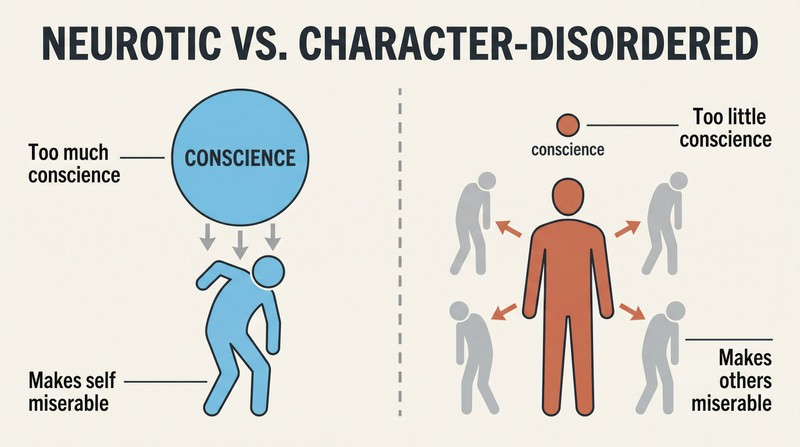
Simon challenges the Freudian assumption that troubled behavior always stems from fear or unconscious conflict. He draws a sharp line between neurotic personalities — who have too much conscience, excessive guilt, and anxiety — and character-disordered individuals, who have too little. Neurotics inhibit themselves to a fault. Character-disordered individuals refuse to inhibit themselves at all. Their behavior is ego-syntonic: they're comfortable with who they are, even if everyone around them isn't.
The practical differences are radical. Character-disordered individuals don't need insight into why they behave badly — they already know. Their thinking patterns are self-centered, entitled, and shameless. What they need is confrontation, limits, and correction. Treating them with empathy-first therapy only gives them better tools to manipulate the therapist.
Your gut senses covert aggression before your brain can prove it
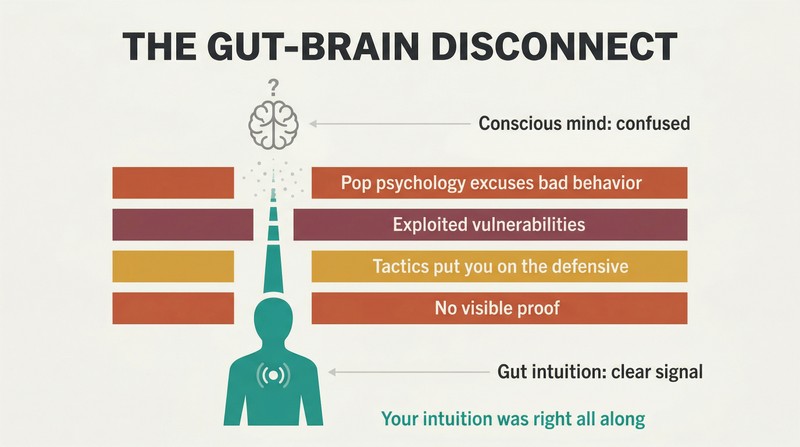
Victims aren't gullible — they're systematically hoodwinked. Simon identifies four reasons victims can't trust their own perception:
1. The aggression isn't obvious, so there's no proof to match the gut feeling
2. Tactics simultaneously disguise the attack and put you on the defensive
3. Manipulators exploit specific vulnerabilities you may not even know you have
4. Pop psychology teaches that bad behavior always masks hidden pain
The signature experience is feeling crazy. You sense something is wrong but can't name it. You confront the manipulator and somehow end up apologizing. You leave every interaction confused, guilty, or drained. Simon's message: your gut was right all along. The problem isn't your perception — it's a psychological framework that tells you to doubt it.
Manipulators aren't reacting defensively — they're calmly hunting
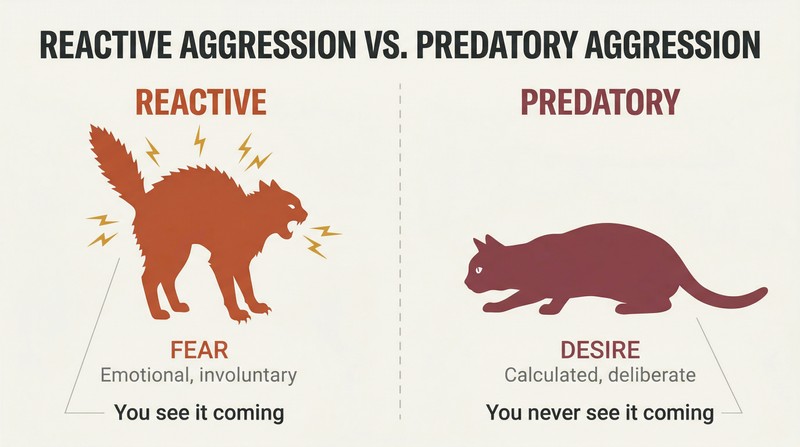
Simon uses a vivid cat analogy. A threatened cat arches its back, hisses, shows claws — emotions visibly on the surface. That's reactive aggression: fear-driven and involuntary. A hunting cat is the opposite — low to the ground, fur smooth, eerily calm. The prey never sees the strike coming. That's predatory aggression: planned, deliberate, and fueled by desire rather than fear.
This reframe changes everything about diagnosis. Sending a predatory aggressor to anger management or fear-of-intimacy therapy completely misses the point. In the book, Betty — a long-tenured office worker — methodically destroyed a new executive's career through calculated praise, whisper campaigns, and strategic confidences with the boss. She was never threatened. She was hunting for continued dominance.
Label the tactic in real time to break the manipulator's spell
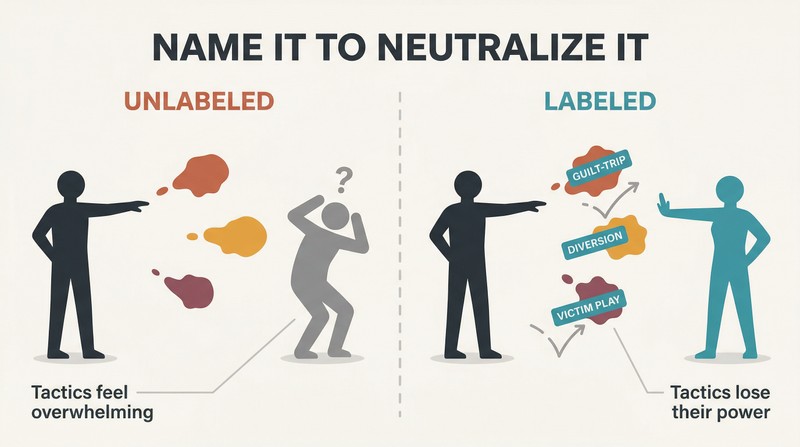
Simon catalogs the manipulator's full arsenal. Key weapons include:
1. Guilt-tripping and shaming — weaponizing your conscience against you
2. Rationalization — excuses that make just enough sense to disarm criticism
3. Diversion and evasion — dodging direct questions, changing subjects mid-confrontation
4. Playing the victim — portraying themselves as the injured party
5. Minimization and denial — dismissing or flatly refusing to acknowledge harmful behavior
The critical insight: these aren't defense mechanisms. Classical psychology frames them as unconscious protections for a fragile ego. Simon reframes them as responsibility-avoidance behaviors — offensive weapons deployed consciously and habitually. The moment you label a tactic in real time ("that's a guilt-trip"), you reclaim clarity and stop questioning yourself.
Map your own guilt buttons before a manipulator pushes them
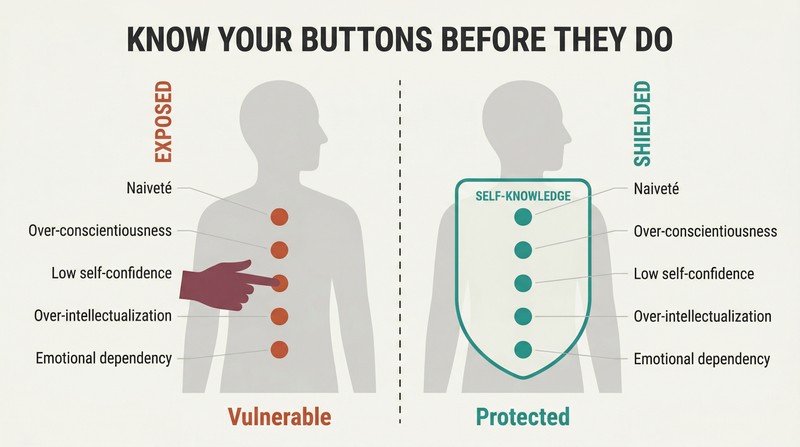
Simon identifies five traits that make you easy prey:
1. Naiveté — refusing to believe anyone could be that calculating
2. Over-conscientiousness — being harder on yourself than anyone else is
3. Low self-confidence — doubting your right to assert your needs
4. Over-intellectualization — analyzing the "why" instead of protecting yourself
5. Emotional dependency — needing approval so badly you tolerate abuse
Janice's story shows this clearly. Married to manipulative Bill, she endured rages, infidelity, and substance abuse because his intermittent approval was her only source of self-worth. Bill played that need masterfully — appearing to value her just enough to keep her invested, then guilt-tripping her whenever she considered leaving. Self-knowledge is your strongest shield.
Abusive relationships trap victims like slot machines
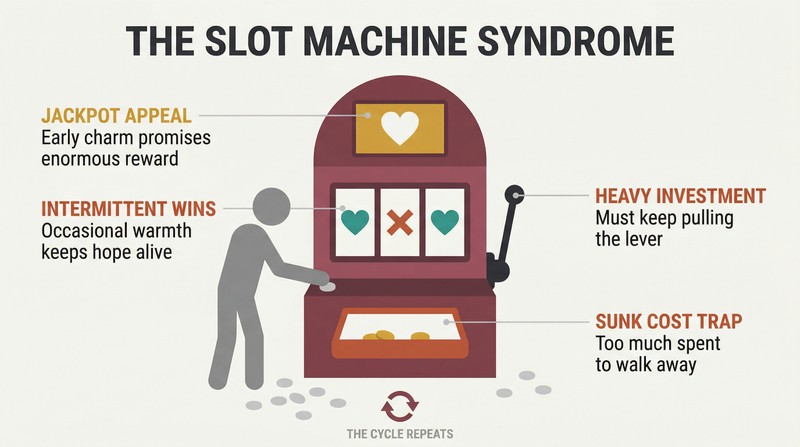
Four dynamics keep victims pulling the lever. Simon's Slot Machine Syndrome explains why people stay in manipulative relationships:
1. The "jackpot" appeal — early charm promises enormous emotional rewards
2. Effort-based payoff — you must invest heavily just for a chance at return
3. Intermittent small wins — occasional warmth keeps hope alive
4. Sunk cost trap — leaving means abandoning years of emotional investment
The aggressor fights to keep the position, not the person. When Janice grew strong enough to consider leaving, Bill staged a medication overdose that wasn't medically serious but was emotionally devastating. He wasn't expressing despair. He was deploying his most powerful guilt weapon to preserve dominance. Losing means relinquishing control — and aggressive personalities never accept that.
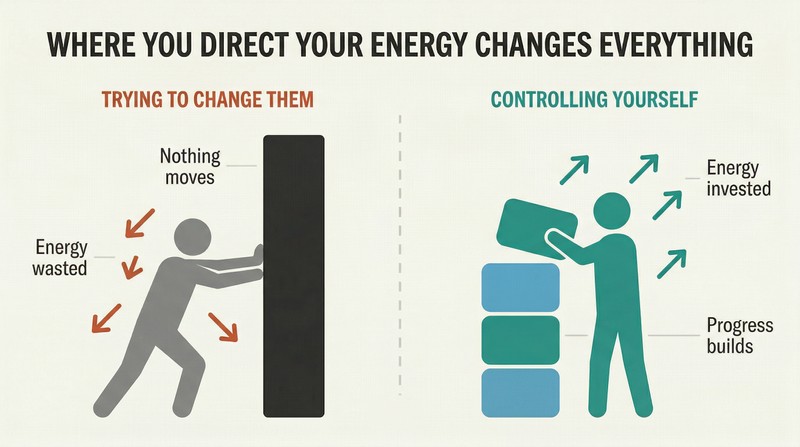
Pour your energy into your own behavior, not changing the manipulator
The biggest mistake victims make is investing energy in changing the manipulator. They analyze, plead, threaten, accommodate — endlessly searching for the magic formula that will make the manipulator finally "get it." But you have zero power over someone else's behavior. Persisting at this unwinnable fight is what Simon identifies as the primary driver of victims' depression.
The cure is ruthlessly redirecting your energy. Invest exclusively where you hold absolute power — your own conduct. When Helen separated from her manipulative husband Matt, she stopped trying to fix him. She set clear conditions, proposed a path forward, and made the next move entirely his choice. "I know I have power over my own behavior," she declared — and the transformation began the moment she stopped controlling him and started controlling herself.
Judge the behavior pattern — never the excuse, never the intention
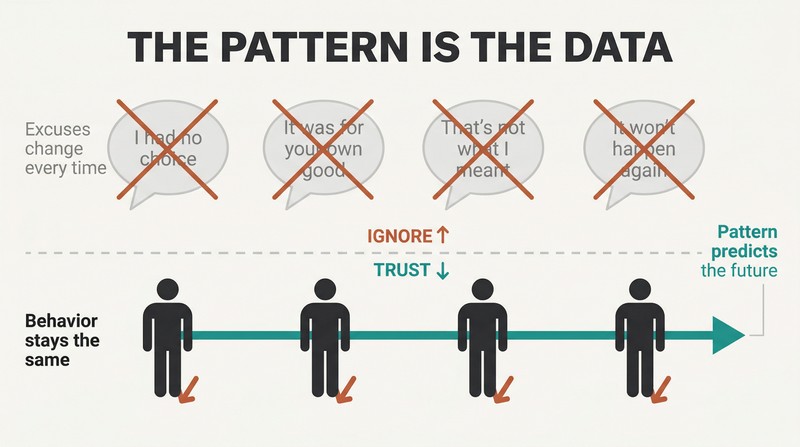
Excuses are tactical weapons, not explanations. Simon's most practical rule: never accept rationalizations for harmful behavior. The moment someone starts "explaining" why they acted hurtfully, they are actively resisting submission to the principle they violated — and you can be certain they'll offend again. Equally important: never try to mind-read intentions. Covert-aggressives are masters of impression management whose apparent motives always seem benign.
Only behavior patterns tell the truth. The father demanding A's always had a compelling rationale. The minister always invoked God's will. The charming boss always cited company interests. Only their repeated, observable actions revealed who they truly were. If someone consistently harms you while offering polished explanations, the pattern is the data and the "why" is irrelevant.
Propose win-win scenarios — aggressors tolerate sharing victory
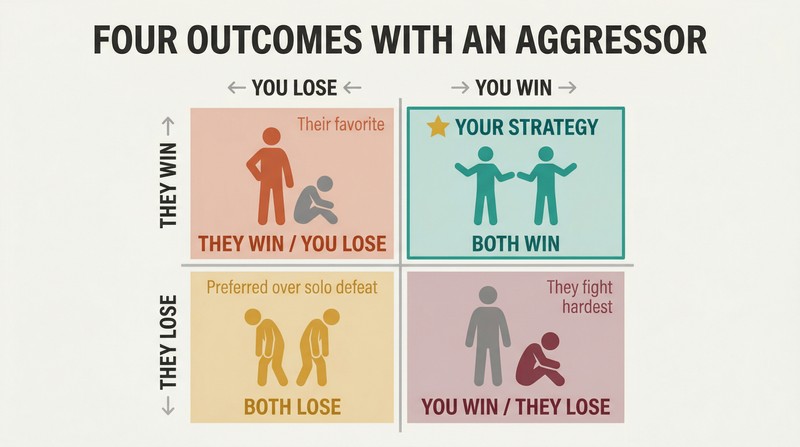
Four outcomes exist in any confrontation with an aggressive personality: they win and you lose (their favorite), you win and they lose (they'll fight to the death against this), both lose (they'll choose mutual destruction over solo defeat), or both win (a tolerable second-best). Smart engagement means crafting scenarios where the aggressor gets something they want while you protect what matters most.
Jean and the power-hungry minister illustrate this. Instead of demanding James abandon his career ambitions entirely — which would guarantee war — she told him she'd support his advancement if he spent weekends with the family and two evenings a week at home. She harnessed his aggressive drive rather than trying to extinguish it, offering a path to win without crushing her needs.
Analysis
Simon's In Sheep's Clothing occupies a distinctive position in popular psychology: published in 1996, it was one of the first widely accessible books to argue that the Freudian neurosis framework — still dominant in clinical training and cultural consciousness — systematically blinds us to character-disordered individuals. It anticipated the cognitive-behavioral revolution's challenge to psychodynamic assumptions by insisting that some people's problems stem not from unconscious conflict but from distorted thinking patterns and insufficient moral development.
The book's most radical contribution is reframing defense mechanisms as offensive tactics when deployed by character-disordered individuals. This single conceptual move — from defense to offense — transforms how victims interpret their experience and validates the disorienting confusion so many describe in manipulative relationships.
However, the framework has real limitations. The neurotic-versus-character-disordered dichotomy, while clinically illuminating, risks becoming a binary sorting mechanism that oversimplifies human complexity. Simon acknowledges this as a continuum but often writes in categorical terms. More critically, the book provides no systematic method for distinguishing genuine covert aggression from the hypervigilance of someone with complex PTSD — a traumatized reader might pathologize ordinary interpersonal friction.
The Slot Machine Syndrome predates and elegantly captures what trauma researchers now call intermittent reinforcement and trauma bonding, concepts later popularized by Patrick Carnes and Judith Herman. Simon's four-factor model maps almost perfectly onto modern behavioral addiction research, suggesting his clinical observations were ahead of the formal science.
Perhaps the book's most uncomfortable implication is that decent, conscientious people are more vulnerable to manipulation precisely because of their decency. This is not victim-blaming — it is a structural insight about how the traits society most values (empathy, benefit-of-the-doubt, self-reflection) become attack surfaces when encountered by someone who entirely lacks those same traits. The asymmetry is the trap, and recognizing it is the escape.
Review Summary
In Sheep's Clothing receives mostly positive reviews for its insights into manipulative behavior. Readers appreciate the book's clear explanations of covert aggression tactics and practical advice for dealing with manipulators. Many find it eye-opening and wish they had read it earlier in life. Some criticize the limited solutions offered and occasional editing errors. The book is praised for its accessible language and real-life examples. Overall, readers consider it a valuable resource for understanding and countering manipulative personalities in various settings.
People Also Read









Glossary
Covert-aggressive personality
hidden fighters seeking dominanceA personality type identified by Simon characterized by habitually pursuing power, control, and personal advantage through subtle, underhanded means while concealing aggressive intent behind charm, concern, or service. Distinguished from passive-aggressive personalities (who aggress through passivity) by their active, calculated nature. They are primarily character-disordered rather than neurotic.
Character-disordered
insufficient conscience and self-restraintSimon's category for individuals who lack adequate self-restraint over their basic instincts. They have underdeveloped consciences, diminished capacity for genuine guilt or shame, and their problematic behavior is ego-syntonic—they are comfortable with how they act even if others suffer. On virtually every clinical dimension they differ from neurotic individuals, requiring confrontation and behavioral correction rather than insight-oriented therapy.
Slot Machine Syndrome
why victims stay in abuseSimon's framework explaining why victims remain in manipulative relationships, modeled on gambling psychology. Four dynamics sustain the trap: the appeal of the initial 'jackpot' (early charm), effort-based reinforcement ratios requiring heavy investment, intermittent small 'wins' that sustain hope of a larger payoff, and the sunk-cost dilemma of walking away from a massive emotional investment with nothing to show for it.
Predatory aggression
planned aggression driven by desireA type of aggression that is planned, deliberate, and motivated by desire rather than fear or anger. Simon contrasts it with reactive aggression (a fear-driven, involuntary response to threat) using the analogy of a cat calmly stalking prey versus a cat arching its back at a dog. Recognizing this distinction is critical because treating predatory aggressors with anger management or trauma therapy fundamentally misdiagnoses the problem.
Responsibility-avoidance behaviors
offensive tactics disguised as defensesSimon's reframing of behaviors traditionally labeled 'defense mechanisms' (denial, rationalization, minimization, projection) when used by character-disordered individuals. Unlike genuine ego defenses, which are unconscious shields against emotional pain, these are conscious, habitual tactics used to resist social norms, manipulate others, and avoid accepting responsibility for harmful conduct. Recognizing them as offensive rather than defensive is key to avoiding victimization.
Selective speaking
speaking only when they listenA therapeutic technique Simon developed for engaging manipulative individuals, especially children. The therapist stops talking whenever the other person looks away or shows inattention, and resumes only when the person makes direct eye contact and appears genuinely receptive. It counters the manipulation tactic of selective inattention and reinforces the effort of genuine listening as worthy of respect.
Ego-syntonic
comfortable with own behavior patternsA clinical term Simon uses extensively to describe how character-disordered individuals experience their problematic personality traits as natural, acceptable, and consistent with their self-image. Unlike neurotic individuals whose symptoms are ego-dystonic (unwanted and distressing), character-disordered individuals like who they are and see no reason to change—which is why they rarely seek therapy voluntarily.
FAQ
What's "In Sheep's Clothing" about?
- Understanding Manipulation: "In Sheep's Clothing" by George K. Simon Jr. focuses on understanding and dealing with manipulative people, particularly those who use covert aggression.
- Covert-Aggression: The book explains how manipulative individuals use subtle, underhanded tactics to control and dominate others without appearing overtly aggressive.
- Practical Guidance: It provides practical advice on recognizing these tactics and effectively dealing with manipulative personalities in various relationships, including personal and professional settings.
Why should I read "In Sheep's Clothing"?
- Awareness of Manipulation: The book helps readers become more aware of manipulative behaviors and tactics, which are often difficult to identify.
- Empowerment: It empowers readers by providing strategies to protect themselves from being victimized by manipulative individuals.
- Improved Relationships: By understanding and addressing manipulation, readers can improve their relationships and interactions with others.
What are the key takeaways of "In Sheep's Clothing"?
- Recognize Tactics: Learn to identify common manipulative tactics such as guilt-tripping, shaming, and playing the victim role.
- Assertive Responses: Develop assertive responses to manipulative behaviors to maintain control and protect personal boundaries.
- Self-Awareness: Increase self-awareness to understand personal vulnerabilities that manipulators might exploit.
What are the best quotes from "In Sheep's Clothing" and what do they mean?
- "Covert-aggression is at the heart of most manipulation." This quote highlights the subtle nature of manipulative tactics that often go unnoticed.
- "Manipulators know us better than we know ourselves." It emphasizes the manipulator's skill in exploiting personal weaknesses.
- "The ends never justify the means." This underscores the importance of not accepting rationalizations for harmful behavior.
How does George K. Simon Jr. define covert-aggression in "In Sheep's Clothing"?
- Subtle Manipulation: Covert-aggression is defined as a subtle, underhanded way of fighting to gain control or advantage over others.
- Concealed Intentions: It involves concealing aggressive intentions while simultaneously intimidating others into submission.
- Manipulative Tactics: Covert-aggressive individuals use tactics like lying, denial, and rationalization to manipulate and control their victims.
What are some common tactics used by manipulative people according to "In Sheep's Clothing"?
- Guilt-Tripping: Manipulators use guilt to make others feel responsible for their actions, leading them to back down.
- Shaming: Subtle sarcasm and put-downs are used to make victims feel inadequate and defer to the manipulator.
- Playing the Victim: Manipulators portray themselves as victims to gain sympathy and manipulate others into compliance.
How can I recognize a manipulative person as described in "In Sheep's Clothing"?
- Behavior Patterns: Look for consistent patterns of behavior where the person always seeks to win or dominate.
- Tactic Usage: Be aware of frequent use of manipulative tactics like diversion, evasion, and rationalization.
- Lack of Directness: Manipulative individuals rarely give straight answers and often avoid direct confrontation.
What strategies does "In Sheep's Clothing" suggest for dealing with manipulative people?
- Set Limits: Clearly define what behaviors you will tolerate and what actions you will take if boundaries are crossed.
- Direct Communication: Use clear, direct requests and insist on direct responses to avoid manipulation.
- Focus on Behavior: Judge actions rather than intentions and keep the focus on the manipulator's behavior.
How does "In Sheep's Clothing" suggest improving self-awareness to avoid manipulation?
- Identify Vulnerabilities: Recognize personal traits like over-conscientiousness or low self-confidence that manipulators might exploit.
- Understand Emotional Dependency: Be aware of any emotional dependencies that could make you susceptible to manipulation.
- Reflect on Reactions: Analyze your reactions to manipulative tactics to better understand and control them.
What role does self-esteem play in manipulation according to "In Sheep's Clothing"?
- Over-Estimation: Manipulators often have inflated self-esteem, which leads them to disregard others' needs.
- Self-Respect vs. Self-Esteem: The book distinguishes between self-esteem (what you think of yourself) and self-respect (what you've done with your abilities).
- Building Self-Respect: Encourages focusing on personal achievements and efforts to build genuine self-respect.
How does "In Sheep's Clothing" address the issue of character disturbance?
- Character vs. Neurosis: The book differentiates between character-disturbed individuals and neurotics, emphasizing the lack of conscience in the former.
- Cognitive-Behavioral Approach: Suggests cognitive-behavioral therapy as effective for addressing distorted thinking patterns in character-disturbed individuals.
- Responsibility and Correction: Emphasizes the need for correction and responsibility rather than insight for character-disturbed individuals.
What is the "Slot Machine Syndrome" as described in "In Sheep's Clothing"?
- Investment Trap: Victims of manipulation often stay in abusive relationships due to the investment they've made, hoping for a "jackpot" of approval or change.
- Intermittent Rewards: Manipulators provide occasional rewards, reinforcing the victim's hope and keeping them engaged.
- Breaking the Cycle: Recognizing this pattern is crucial for breaking free from manipulative relationships and regaining control.
Download PDF
Download EPUB
.epub digital book format is ideal for reading ebooks on phones, tablets, and e-readers.








































