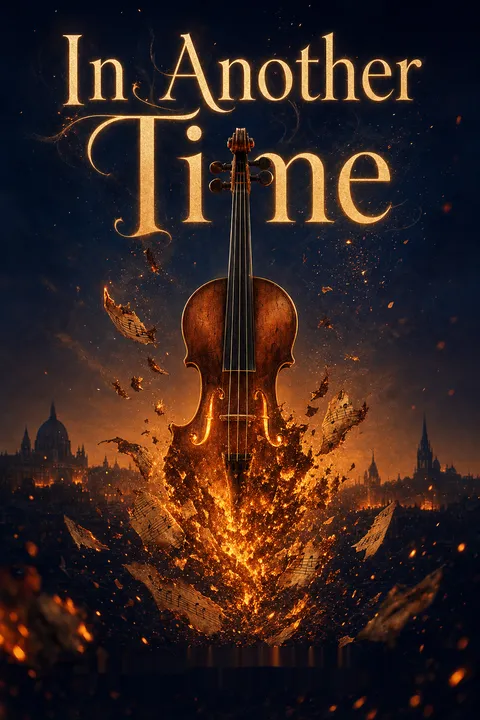

Plot Summary
Awakening After the War
After blacking out, Hanna finds herself in a strange field near Berlin in 1946, absent a decade of her life. Her only connection is her beloved violin, her memories obscured by trauma. Taken in by a kindly nun, Sister Louisa, she learns the harrowing events of WWII have come and passed. Her bookshop, her town, and countless loved ones are gone—lost to the violence and flames of the Nazi era. Suffering from dissociative amnesia, she struggles to comprehend the enormity of her lost years: Hitler's reign, the fate of Jews, and the disappearance of Max, the man she loved. Her violin, still intact, connects her to a before she feels both real and imagined.
A Bookshop Encounter
In 1931, Max, an earnest bookshop owner in small-town Germany, discovers Hanna through the sound of her violin. Their awkward encounter at her rehearsal draws them together, despite their differences—he the solitary bookseller, she the ambitious Jewish violinist. Mutual admiration grows through returned books and chance encounters. Their budding affection is set not only to the melody of music but the undertones of rising tension in Germany. This meeting becomes the axis around which their intertwined fates will spiral, as both seek meaning and warmth amid encroaching social and political coldness.
Falling for the Fire
As their connection deepens, Max and Hanna fill lonely spaces in each other's lives. Max becomes enchanted by Hanna's fiery playing, telling her she plays "like fire." They share nervous recitals, bookshop conversations, and hesitant trust. Political tides shift, worries about Jewish identity and nationalist fervor threaten to intrude, but for a moment, music and companionship provide shelter. Hanna's music, Max's gentle admiration, and their tentative love kindles hope in a darkening landscape. Yet both know their romance can't stay insulated from the fever creeping through Germany.
Love Amid Shadows
Max and Hanna's relationship solidifies through stolen nights in Max's apartment, secret dinners, and vulnerable moments sharing art and grief. Hanna tends to her ailing mother, while Max mourns both his parents. Familial pressures are strong—Hanna's are wary, Max's ghosts ever-present. Old wounds and insecurities rise but are soothed through intimacy and friendship with Johann and Elsa, their closest friends. Still, societal cracks widen: book burnings, anti-Jewish decrees, Nazi flags—a world that deems their love illicit. Max sees danger where others hope for normalcy. But when Hanna's passion wavers after an audition failure, Max is her comfort, promising more concerts, more fire—if only they can withstand the coming storm.
The Memory Blanket
Years later, traumatized by events she cannot recall, Hanna clings to music and routine in Allied-occupied Berlin and then in postwar London with her sister Julia. Doctors diagnose her with amnesia due to psychological shock: she is missing a decade, unable to reconcile the past or the fate of loved ones. Only through violin does she feel whole, her identity narrowed to the act of playing. Attempts to reclaim memory—through therapy, conversation, and telegrams—reveal fragments of nightmarish absence, but little clarity. Her survivor's guilt and displacement become a silent thread, stitched into time's lost blanket.
Tuning for Survival
Seeking meaning and belonging, Hanna turns music from a vocation into a lifeline. In London, she faces skepticism and gender bias but fights for a place in the orchestra. New mentors like Stuart help reconnect her to passion, though the fire is slow to rekindle. Her relationships are tenuous—sisterly friction with Julia, chilly adjustment to exile, and ill-defined affections for Stuart. Through tentative lessons and eventually public performances, music remains not just memory but survival. Hanna rediscovers technique and passion, holding together a self shattered by unnamed horror.
Time's Dangerous Closet
Max, desperate to save those he loves, uncovers his father's mysterious journal and the secret of a wormhole-closet in the shop, a bridge through time. Family tragedies and his own grief drive him to test the closet, each traversal exacting an increasing cost—memory gaps, physical toll, days or years skipped. Max's efforts to help Jewish neighbors escape, and his plans to save Hanna, are both heroic and heartbreaking. His time travels echo the trauma of rupture and the cost of trying to rewrite fate. Max, struggling between hope and futility, risks everything against the unstoppable tide of history.
Separated by History
Hanna and Max's worlds are finally torn apart. As Germany descends into totalitarianism, anti-Jewish laws and violence close around them. Hanna loses her orchestra, then is arrested for "race defilement" alongside Max. Her final rescue—via music that gains her relative safety as a camp violinist—separates her from Max entirely. For Max, cycles of time travel and his own repeated losses bring ever greater despair. For Hanna, survival costs memory and leaves her adrift. The two become exiles not only from each other but from their own histories, waiting for impossible reunions across years and continents.
Burned Bridges and Letters
Kristallnacht and the bookshop's destruction herald the nightmarish epitaph of Max's world. He saves others through the closet, but each sacrifice leaves him further from Hanna and from home. Hanna, meanwhile, shuffles through bombed-out cities and lonely guest rooms, unable to anchor her identity or trust in belonging. Unsent letters, lost addresses, and disappointed hopes fill their postwar years—fragmentary but tied together by fragile friendship, the occasional letter from Elsa, or a brush with familiar music. Hanna's violin is the only tangible thread tying her to the self she can't fully recall.
Music Under Occupation
Buried memories resurface as Hanna learns she was part of a concentration camp orchestra—her music both shield and shackle. Compelled to play for the Nazis, Hanna survives, but her art is forever haunted by guilt and horror. Liberated at war's end, she suppresses the most traumatic memories, her amnesia in part an unconscious survival strategy. Only much later, through conversations with other survivors and therapy in London and Vienna, does she grasp the full cost of living by her instrument: what was once her greatest love became, temporarily, a painful instrument of survival.
Night of Arrest
In Nazi Germany, the consequences catch up: Max and Hanna are discovered together and arrested, their love now officially criminal. Hanna manages to keep her violin but is cast into the machinery of the camps. Max is imprisoned, then eventually released, but his attempts to find or help Hanna are futile, compounding his guilt. Through alternating perspectives, their separation becomes absolute—a void filled only by music and memory, fractured by trauma and time.
Lost Years, Evaded Truths
Hanna rebuilds her life in Europe: first as a guest in her sister's fractured home, then as a performer in Paris and Vienna, always traveling, always an outsider. Others—like Stuart and Henry—offer new prospects for love and partnership, but she remains haunted by what she cannot recall, her sense of self fragmented. Max travels blindly, through time and loneliness, always seeking Hanna, forever uncertain if rescue, reunion, or even memory is possible. Both must learn to exist amid absences, uncertain of what, or whom, they have survived for.
Survivors and Survivorship
At Julia's wedding years later, Hanna's repressed memories return in a torrent. She remembers the full truth: how music—her greatest gift—became a double-edged blade, condemning her to survivor's guilt but also to life. Conversations with fellow survivors and Henry help her reframe her story, moving from self-condemnation to hard-won understanding: she—like so many—did what was necessary to survive. Liberation, for her, means learning to live with her story, to again play with honest fire, and to grant herself the elusive grace of forgiveness.
Reunion in Paris Gardens
Years after the war, Hanna is a star violinist in Paris. During a concert, Max appears in the audience—unaged, unchanged by years, but running out of borrowed time. Their reunion is passionate and tender but painfully brief: Max, weakened by years of time travel, can only stay one night. They share memories, regrets, and love, but dawn brings another separation. Both recognize that forgiveness, not rescue, is the final act of love. Their connection remains, now, more in memory than in hope for future togetherness.
Second Chances in Exile
Life moves forward. Hanna acknowledges her violin as her true, enduring love. She drifts through cities, through orchestras, and through shifting relationships, finally arriving at peace with what the past has taken and what the future refuses to promise. Julia, too, remarries and finds new happiness, and Elsa becomes Hanna's link to old friends and times. Stuart, ever a friend and sometimes more, offers acceptance rather than demand.
Last Concert in Berlin
Decades after her story began, Hanna returns to Berlin, performing in the rebuilt concert hall with her orchestra. The city—rebuilt, unrecognizable yet imbued with restless ghosts—becomes her final stage. Old wounds surface, but through music, she honors what was lost and what, miraculously, survived. In Bartók's complex rhythms, in the presence of Elsa and Grace, in reconciliation with Stuart, Hanna finds bittersweet closure. Time has not been healed nor conquered, but endured—transformed not by heroic rescue but by the stubborn constancy of creation, memory, and survival.
Analysis
A modern meditation on trauma, time, and the endurance of art and love
In Another Time transforms historical fiction into a deeply psychological exploration of survival, guilt, and the search for meaning after unspeakable loss. Instead of casting Hanna and Max as mere victims or triumphal survivors, the novel immerses the reader in the cyclic, nonlinear recovery from trauma—mirrored structurally by its leapfrogging timelines and the fantastical yet exhausting hope of time travel. Hanna's musicality and Max's bibliophilia are not only talents, but life-rafts: art is what both insulates and exposes them, what makes survival possible and guilt inescapable. Love here is not salvation in a simplistic sense, but a series of choices, forfeitures, and returns; Max cannot truly rescue Hanna from the machinery of history, and Hanna ultimately must rescue herself—by reclaiming and accepting her whole story. The novel refuses easy closure. Its ultimate message is nuanced: survival is messy, memory is unreliable, and healing comes through both accepting ambiguity and finding new ways to create. The gift of music, of fire, endures even as empires, families, and bodies fall apart. In our era of displacement, crisis, and the deteriorating weight of history, Cantor's work suggests that to live "in another time" is both curse and calling—the world remakes us, and we, in turn, must find new songs to play.
Review Summary
Characters
Hanna Ginsberg
Hanna is the passionate heart of the novel, a Jewish violinist whose prodigious talent is both her salvation and her curse. Throughout shifting geographies and eras, she contends with loss—of love, family, country, and memory itself. Hanna's trauma-induced amnesia shields her from the horrors she survived in a Nazi camp orchestra. Psychoanalytically, she is shaped by guilt, resilience, and an unrelenting desire for agency; her violin is a physical extension of her need for order and purpose. Her relationships—to Max, to her family, to mentors like Stuart—are filtered through the tumult of self-recovery, love, guilt, and forgiveness.
Max Beissinger
Max is a German bookseller and secret time traveler, defined by loyalty, melancholy, and a desperate determination to save Hanna from history's encroaching darkness. His bookstore is an island of gentleness in a hardening world. The discovery of a time-travel wormhole becomes both a literal and metaphorical means to fight fate, but also isolates him further, eroding his sense of agency as guilt and longing mount. Psychoanalytically, Max embodies both hope and impotence—the would-be rescuer who must confront the limits of love and the impossibility of erasing trauma.
Stuart Beckham
Stuart is a compassionate, slightly world-weary British violinist/conductor. He mentors Hanna in her recovery, deepens her artistry, and offers her a quieter, more stable love after the war. Unlike Max's consuming passion, Stuart's affection is supportive and steady; he stands as an emblem of postwar possibility, connection, and professional solidarity. Eventually crippled by injury, his relationship with Hanna highlights the difference between healing and forgetting, acceptance and longing.
Julia Weiner
Hanna's older sister is a baseline for normalcy and postwar domesticity: she flees Germany with foresight and becomes Hanna's London anchor. Julia is pragmatic, sometimes overbearing, but her strengths (family, routine, adaptation) offer Hanna needed stability. Psychoanalytically, she embodies the superego: structure, safety, yet limited understanding of Hanna's trauma or soul-deep passion.
Elsa Wilhelm
Elsa, wife to Johann, is a maternal, nurturing presence who bridges the world before and after the Holocaust. Her friendship with Hanna survives exile and loss; her own family's tragedies echo wider historical ruptures. Elsa becomes a living memory-keeper, helping connect Hanna to her earliest loves and the possibility of renewal.
Johann Wilhelm
Max's lifelong friend and Elsa's husband, Johann is loyal, stable, but increasingly ill at ease as Germany unravels. His practical advice and kindness contrast with Max's restless idealism; his quiet fate—tragically accidental death—highlights the randomness and cruelty of history.
Henry Childs
Henry, a British doctor and psychoanalyst, shepherds Hanna through the psychological labyrinth of trauma and amnesia. His kindness and curiosity nudge Hanna toward recollection, eventually facilitating her acceptance and reconnection with her repressed self and with Julia.
Sister Louisa
The nun who cares for Hanna after her postwar awakening, Sister Louisa represents faith, gentleness, and practical care. She helps Hanna begin coping with her losses, suggesting that music might be both a path to healing and a bridge to memory.
Adelle
Adelle, a camp survivor and part of Henry's group therapy, holds a piece of Hanna's lost past. Their encounter in London acts as a catalyst for Hanna's painful recovery of her memories, particularly regarding the moral ambiguities and costs of musical survival in the camps.
Moritz and Lev (and the next generation)
Julia's sons, initially distant and then increasingly loving, are reminders of postwar life's renewal and the complex burdens inherited from family trauma. Their growth and affection help anchor Hanna's shifting identity and purpose.
Plot Devices
Nonlinear, Dual Timeline Structure
The narrative switches between prewar Germany (1931–1936, Max and Hanna's love story amid rising Nazi power) and postwar Europe/London/New York/Paris (1946–1958, Hanna's exile, amnesia, and piecemeal recovery). This structure allows readers to experience suspense, the weight of memory, and the profound rupture caused by war—mirroring both Hanna's confusion and the collective psychic fragmentation of Holocaust survivors.
Time Travel as Metaphor and Mechanism
The time closet in Max's bookshop, inherited from his father, literalizes the urge to rewrite or escape history. Time travel functions both as a magical-realist plot engine (allowing rescue, reunion, and tragic forfeiture) and a metaphor for survivor's dissociation, the futility of erasing trauma, and the perennial hope of return.
Amnesia and the Blank Decade
Hanna's dissociative memory loss is both a result of, and refuge from, her traumatic ordeal as a camp orchestra survivor. This device creates both mystery (what happened? Is Max alive?) and emotional verisimilitude, reflecting the well-documented psychological aftereffects of extreme trauma.
Intertextuality: Music, Books, Letters
Throughout the narrative, music is both an existential necessity and a literal means of survival. Books, too, are symbol and solace: Max's shop is a last bastion of civilization; letters and dedications are the fragile tendrils holding people together. Connections via art enable reunion, healing, and the bittersweet acceptance of loss.
Symbolic Motifs: The Violin, The Ring, Fire
Hanna's Stradivarius violin embodies passion, memory, and resilience. The engagement ring and gifts from Max symbolize the interrupted, enduring power of first love. Fire, from burning books and homes to ignited passions and trauma, signals both creative and destructive power—paralleling Hanna's "violin like fire."
Download PDF
Download EPUB
.epub digital book format is ideal for reading ebooks on phones, tablets, and e-readers.








































