
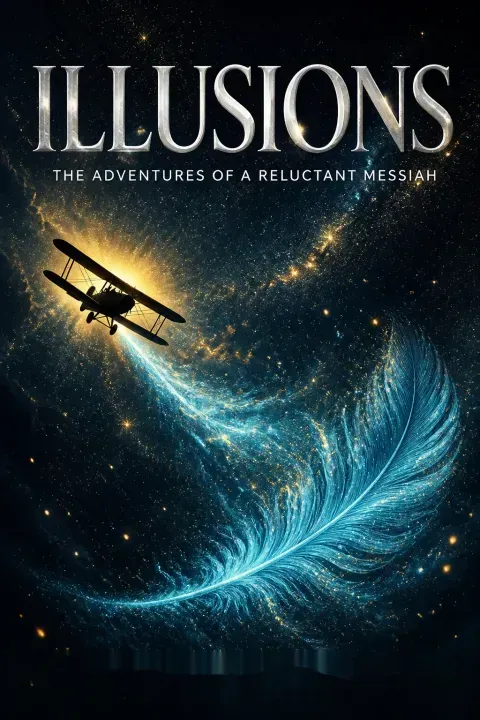


Plot Summary
Prologue
A master2 was born in Indiana, raised in public schools, and worked as an auto mechanic.2 He remembered past lives and became wise and strong. Crowds gathered in the garages where he worked, seeking healing and wisdom, until the shop foremen bid him leave: there was no room to work.
He went to the countryside, where people called him Messiah.2 He stilled storms and spoke in parables, including one about river creatures who clung to rocks and called a drifter2 “savior” when he simply let go.
When the throngs pressed him without rest to heal them and live their lives, he climbed a hilltop and prayed to be released. A voice told him to go his way as other men. He came down humming, told the multitude “I quit,” and returned to the world of engines and tools.
The parable subverts messianic expectation at every turn. The master is born not in ancient Palestine but in Indiana; his trade is not carpentry but auto mechanics. His miracles are real, yet his response to fame is not sacrifice but resignation: he quits. The river parable encapsulates the book’s thesis: liberation is not conferred by messiahs but chosen by individuals who dare to let go. God’s command to “be happy” is treated as an impossible demand, revealing how deeply suffering has been confused with virtue. The master’s return to ordinary life sanctifies the mundane, setting the stage for a story in which enlightenment wears blue jeans and flies a biplane.
No Bugs on the Propeller
Mid-summer, flying his Fleet biplane over Illinois, Richard1 spots a gold-and-white Travel Air 4000 in a hayfield near Ferris. He lands, and the pilot, Donald Shimoda,2 sits calmly against his wheel, offers a sandwich, and says he has been waiting.
Richard1 circles the plane: twenty coats of mirror paint, original 1928 instruments with a spark advance, not a scratch or oil streak anywhere. After supposedly five weeks of barnstorming, there is no straw on the cockpit floor, no bugs on the propeller. A grandfather and his granddaughter Sarah3 arrive.
Sarah3 is petrified of heights, unable to climb ladders or loft stairs. Don2 speaks to her quietly, takes her flying. She lands transformed: her terror gone, she declares she will become a pilot. Don2 told her she once died from a fall and need not fear anymore. Richard1 is hooked and unnerved.
The pristine airplane is the first crack in Richard’s materialist worldview. Machines leave traces—oil, scratches, crushed bugs—and their absence signals that Don operates outside cause and effect. Sarah’s instant healing introduces the reincarnation framework: present fears are past-life residue, releasable through awareness. Don’s casual revelation that he has been “waiting” reframes the chance meeting as destiny. Richard’s dual response—he likes Don instantly but senses something wrong—establishes the tension that will drive the entire apprenticeship: attraction and fear in equal measure.
The Mechanic Messiah Revealed
Richard1 dreams of a man engulfed by crowds, walking over an ocean that turns to grass where a Travel Air lands. He wakes at 3 a.m. to find Don2 awake, who confirms the dream’s truth: he is Donald Shimoda, the Mechanic Messiah, the American Avatar2 who disappeared in front of 25,000 eyewitnesses.
Richard1 recalls reading about it on an Ohio newspaper’s front page. Don2 explains he quit because the crowds were a kind of drowning: they pressed him to heal without rest, to learn for them, to live their lives. Miracles bored him when nobody wanted the understanding behind them.
He floats a wrench to Richard1’s hand — the tool drifts weightless through the air, stopping mid-flight, then grows heavy only when touched. Don2 says he can teach someone else to be the Messiah. Richard,1 tightening cylinder nuts on his own engine, scoffs but does not leave.
The dream sequence blurs the boundary between Richard’s subconscious and Don’s telepathic communication. Don’s complaint about messiah-hood is psychological, not theological: dependency is exhausting, not flattering. The floating wrench introduces praxis—miracles are learnable skills, not divine gifts. Don’s offer to “teach someone else” hints that Richard is being recruited, whether he knows it or not. Richard’s decision to stay despite his fear marks the point of no return. The scene desacralizes the messianic, portraying quitting as a legitimate career change rather than failure.
The Messiah’s Handbook
Richard1 asks where Don2 learned it all. Don2 pulls a small suede-bound volume from his plane: “Messiah’s Handbook: Reminders for the Advanced Soul.” Richard1 reads that you teach best what you most need to learn, that you should never be ashamed of anything published about you even if false, that you can change your past as easily as your future.
The pages seem to offer exactly the wisdom each moment requires. Don2 claims that with a little theory and lots of practice, Richard1 can learn everything in about a week and a half.
Just believe you are a master and you are. Richard1 protests he never asked for mastery. Don2 does not argue. The handbook stays in Richard1’s pocket from that moment, and he reads it obsessively, finding new aphorisms each time. Don2 never asks for it back.
The Handbook functions as a personalized oracle, its meaning shifting with the reader’s need. The claim that past and future are equally changeable challenges linear causality at its root. Don’s “week and a half” timeline for enlightenment mocks spiritual striving: mastery is not earned but recognized. Richard’s protest echoes every reluctant hero narrative, while the handbook’s quiet insertion into his life suggests that seeking and finding are the same motion. Its aphorisms are structured as poems, each line break a pause for assimilation, mirroring Don’s method: truth delivered at the speed of understanding.
The Crippled Man Runs
They land in a Troy, Ohio cow pasture. Don2’s Travel Air touches down at 30 miles per hour, half the speed that should keep it airborne. Richard1 is frightened by this open defiance of aerodynamics. A man in a battered wheelchair4 arrives, body twisted by eleven years of paralysis since a truck accident.
Don2 commands him to get up and fly. The man4 launches from the chair at a half-run, marveling at his own legs, and scrambles into the cockpit. Don2 takes him up while forty or fifty watchers turn into a tight, murmuring knot.
When they land, more wheelchairs appear, pushed by desperate people. Richard,1 feeling a violence about to detonate, starts his Fleet, takes off, and abandons Don2 to the mob. He flies east and lands in a remote meadow, telling himself he was wise to escape.
The crippled man’s healing is the book’s most unambiguous miracle, yet its consequence is menace. The crowd’s transformation from curious to desperate reveals the dark side of public magic: people want the healer, not the healing principle. Richard’s flight is self-aware cowardice, but his survival instinct overrides loyalty. The scene establishes a pattern: wherever Don performs publicly, a mob crystallizes. The man’s healing is described as an actor finishing a role, suggesting illness is a performance one can step out of. Don treats the miracle as ordinary commerce, refusing to dramatize what he considers natural.
The Wrench Floats Alone
Alone in a vast meadow, Richard1 cooks, sings to his plane, and tries to forget. At sunrise, the nine-sixteenths wrench floats to his forehead and taps him awake. He swats it, hurts his hand, watches it hover and then sink. Minutes later, Don2’s Travel Air appears.
Don2 tracked him by the cosmic law that like attracts like: miracle-workers draw each other. Richard1 is doing miracles in his sleep, his waking mind still refusing to accept them.
They talk through the morning, and Richard1 delivers the insight that cuts Don2 silent: Don2’s hidden suffering is that his happiness depends on people caring what he says. If no one listens, all his power means nothing. Don2 stares, then says Richard1 is right, and falls asleep. The messiah2 has been healed by the student.1
Richard’s unconscious wrench-floating proves that mastery is innate, not acquired. It emerges when the skeptical mind sleeps. Don’s tracking by “like attracts like” introduces the book’s central physics of consciousness: vibration draws vibration. But the scene’s real climax is psychological. Richard diagnoses Don’s wound: the need to be heard. Even a messiah can be enslaved by the desire for an audience. Don’s sleep after the insight suggests a lifelong tension releasing. This role reversal is the heart of the book’s pedagogy: Don chose Richard not to create a disciple but to find an equal who could reflect his own blind spot.
A Movie Called Life
In Hammond, Wisconsin, Richard1 asks why we exist. Don2 takes him to see “Butch Cassidy and the Sundance Kid.” During the film, he whispers: why are you here? For fun, for learning, for escape. Afterward, Don2 unfolds the metaphor: lifetimes are movies we write, direct, and star in.
We buy tickets by agreeing to believe in space and time. The film already exists whole — beginning, middle, and end simultaneous — but we run it through imagination’s projector minute by minute to experience it.
Nobody is forced to watch horror films; people choose them for reasons that make sense to them. Reality is divinely indifferent, like a mother unconcerned which role her child plays. Perfection and constant change are not opposites: the sky is always a perfect sky, even as clouds move.
The movie metaphor makes abstract cosmology accessible: existence as entertainment freely chosen. The claim that the film “already exists complete” offers a deterministic counterpoint to the book’s emphasis on choice, as if free will and predestination are both true depending on where you stand in the theater. The mother’s indifference to her child’s game reframes cosmic justice: the divine does not track our plotlines because they are not ultimately real. This is the book’s theodicy: suffering is self-selected role-play, not punishment. The metaphor also accounts for artistic taste—some souls prefer tragedy, others comedy, and no genre is morally superior.
Walking on the Horse Pond
At a three-acre horse pond, Don2 walks onto the surface as if on pavement. Richard,1 seeing it done, follows. The water feels like blue linoleum. Don2 stamps and the pond splashes liquid. He tells Richard1 to breathe it. Richard1 puts his face under and inhales warm liquid oxygen without choking.
Then Don2 walks ashore and sinks into the ground, swimming through grass and loam like a sea. Richard1 tries to wade into “liquid earth” and instantly plunges over his head into black underground.
He panics, then remembers to see it solid, and climbs out caked in dirt. Don,2 spotlessly clean, laughs. Richard1 washes in normal water. Don2 tells him the beauty is real even if the image is a dream. The world is an exercise book, not reality, but you can express reality there if you wish.
These demonstrations prove that physical laws are agreements, not absolutes. Water can be floor, air, or drink, determined solely by the consciousness interacting with it. Richard’s panic underground reveals the depth of his conditioning: he can accept miraculous water-walking but not the reversal of a more familiar element. Don’s spotlessness suggests perfect non-attachment: the illusion’s residue cannot stick to one who knows its nature. The progression from observer to participant is crucial. Richard no longer merely watches Don’s miracles; he performs them himself, however clumsily. His failure with the earth teaches more than success with water ever could.
The Vampire’s Consent
Richard1 challenges Don2’s claim that everyone is free to do whatever they want, adding the familiar caveat: as long as we do not hurt someone else. That night, a figure emerges from the dark: a Transylvanian vampire5 in evening clothes and red-lined cape, begging to drink Richard1’s blood.
He explains he will writhe in pain and die without it. Richard1 threatens violence. The vampire5 instantly drops his accent and terror, speaks perfect English, smiles, and fades away. Don2 explains: the vampire5 chose to be hurt if refused; Richard1 chose to refuse.
Both made free choices. The common rule that freedom ends where harm begins is impossible, because harm always requires the victim’s consent to be experienced as harm. Richard1 is horrified and liberated by the implications.
The vampire scene dramatizes the book’s most ethically challenging claim: no one can be a victim without consent. This is not victim-blaming but a metaphysical assertion that consciousness precedes experience. The thought-form’s theatricality—cape, accent, fangs—mocks Richard’s belief in external evil. All monsters are self-created; all harm is self-permitted. This reframes morality from rules about not-hurting to radical self-responsibility for one’s own experience. The vampire’s quick exit, smiling and American, reveals the illusion’s seams, teaching Richard to see through future fear-appearances.
Radio Threats at Midnight
On the Jeff Sykes6 radio show, Don2 abandons tact. He tells a caller that people who work for a living are doing exactly what they most want to do. A woman recites scripture about earning bread by sweat; Don2 says we are free to choose that path too.
He tells her it does not matter if the world is destroyed because infinite other planets await. A man calls him the antichrist for preaching selfishness. Another caller says he is free to come shoot Don2 in the head. Don2 agrees. The line clicks dead.
Every button on the phone lights up with fury. Richard1 feels the same doom that preceded the Troy mob, now amplified. After the broadcast, Don2 says quietly that he has learned what he came for: it does not matter whether anyone understands. His happiness is finally his own.
Don’s radio performance is either suicidal honesty or transcendent indifference, perhaps both. He refuses the pastoral tact that might make his message palatable. His claim that destruction does not matter because “other worlds await” sounds monstrous to a caller worried about actual rivers and oceans, yet it is consistent with the movie metaphor: no film is final. The death threat, and Don’s acceptance of it, foreshadows the next day’s shooting and reframes it as consensual. The show marks Don’s completion. Richard diagnosed his need to be heard; now Don demonstrates he is cured by refusing to persuade.
The Shotgun’s Lesson
The next noon, before the passenger crowd arrives, a shotgun blast tears through the Travel Air’s fuselage. Don2 slumps against his cockpit, his left side a gory mass. Richard1 runs to him, finds him breathing, and jokes that he should heal himself.
Don2 says he likes the drama and identifies the fleeing shooter as a friend: better a friend than a hater carrying murder-guilt. Then his head drops to the primer knob. He dies. Richard1 slides to the blood-wet grass.
The Messiah’s Handbook falls from his pocket, wind ruffling pages, stopping at words Richard1 reads three times before they register: “Everything in this book may be wrong.” The paradox shatters his grief into wonder. He cannot understand why a master2 would choose to die. The question will take months to answer.
Don’s death is the book’s most destabilizing teaching. The Handbook’s self-negation prevents any fixed belief system from crystallizing: even its own wisdom is provisional. Don calls his killer “friend,” reframing murder as a consensual service that protects a stranger from karmic weight. His death is consistent with everything he taught: the body is illusion, dying is like diving into a cold lake, shocking then liberating. But Richard’s grief is real—enlightenment does not bypass the human heart. The scene’s physicality grounds the metaphysical in viscera, and Richard’s inability to reconcile Don’s choice is the final lesson he must learn alone.
Epilogue
By autumn, Richard1 flies south. Crowds grow larger at his landings; some people say they feel better after talking with him. The Fleet stops throwing oil, stops killing bugs on its windshield, uses less gas. But Don2’s death replays endlessly in his mind.
One October night he dreams of Don2 in a meadow, patching the bullet hole with fabric and dope. Richard1 waves a hand and the hole vanishes. Don2 grins. They share pan-bread: Don2’s is made of plaster, intentionally terrible, to teach Richard1 never to teach with pan-bread.
Don2 says dying is like diving into a cold lake, the shock fading into a swim in reality. He suggests Richard1 write a book instead of facing crowds. Richard1 refuses. Don2 flies away. Richard1 wakes, reaches for his journal, and begins: “There was a master2 come unto the earth, born in the holy land of Indiana…”
The epilogue closes the circle: Richard becomes the messiah he resisted, but his miracles are subtle—a cleaner windshield, better fuel efficiency, not public healings. The dream reunion confirms that death is illusion and transfers authority to Richard, who heals the Travel Air’s wound with a gesture. Don’s plaster pan-bread delivers a final playful lesson: teach with your knowing, not your cooking. When Don suggests writing instead of preaching, he resolves Richard’s crowd-phobia. Richard’s first written line mirrors the book’s own opening, making the entire novel a Möbius strip: the story we just read is the act of its own creation, and the student has become the voice that told the story all along.
Analysis
Illusions is a spiritual pedagogy disguised as a buddy comedy. Its genre innovation is the desacralized messiah: Donald Shimoda2 wears blue jeans, flies a biplane, and quits his divine assignment citing boredom. This reframes enlightenment as accessible and ordinary rather than remote and solemn. The book’s central philosophical claim — that reality is a consensual illusion we can manipulate through understanding — arrives not as doctrine but as accumulated demonstration: floating wrenches, disappearing clouds, water that bears weight.
The master-student relationship drives the narrative, but it reverses midstream. Richard1’s most important act is not learning to walk on water but diagnosing Don2’s hidden suffering: the need to be heard. This psychological insight heals the healer and establishes the book’s deepest theme: even awakened beings carry wounds, and those wounds are the last chain to break.
The Messiah’s Handbook functions as a silent third character, a trickster text whose final message prevents the book from hardening into scripture. This self-subverting move is the epistemological climax: truth is always provisional, always contextual, always one step ahead of its formulation. You can hold the words but not the meaning.
Structurally, the book is a Möbius strip. The epilogue reveals that the entire narrative is the book Richard1 begins writing, which means the story we just read is the act of its own creation. This closes the loop between teacher and student, experience and expression, life and art. Don2’s death, which seemed senseless, becomes the necessary catalyst: grief forces Richard1 to find his own voice, which turns out to be the voice that told the story all along.
The book’s enduring appeal lies in its emotional honesty beneath the metaphysical play. Richard1’s loneliness, Don2’s isolation, the fear of crowds, the terror of loss: these are not transcended but integrated. The final teaching is not that illusions do not matter but that love, friendship, and the impulse to share what you have learned are real, even if the forms they take are dreams.
Review Summary
Illusions receives mostly positive reviews, with many readers finding it life-changing and profound. Fans praise its spiritual messages, wisdom, and thought-provoking nature. Critics argue it's trite and lacks substance. The book explores themes of reality, perception, and personal growth through a story of two pilots, one a reluctant messiah. Many readers appreciate its quotable passages and find it inspirational, while others dismiss it as new-age fluff. Overall, it's a polarizing work that resonates deeply with some and falls flat for others.
People Also Read



Characters
Richard
Barnstormer turned reluctant messiahA barnstorming pilot who flies a Fleet biplane across the Midwest, selling three-dollar rides from hayfields. He chose the wandering life to escape routine, authority, and gravity itself, suspecting there is a way to fly without machines. Practical and self-deprecating, he masks fierce intelligence beneath a casual drifter’s exterior. He is independent to the point of isolation, lonely in ways he rarely admits. His encounter with Don2 awakens a latent mastery he did not know he possessed: he begins performing miracles in his sleep before accepting them awake. His deepest conflict is between freedom and connection, fearing that attachment means entrapment. He devours the Messiah’s Handbook and asks the questions that drive the book’s philosophy, his humor a defense against the terrifying implications of what he is learning.
Donald Shimoda
The Mechanic Messiah who quitA fully realized spiritual master who worked as an auto mechanic in Indiana, remembered past lives, and attracted followers who called him the Mechanic Messiah. He performed public miracles until the crowds’ desperate dependency drove him to quit before 25,000 witnesses. Now he flies a pristine Travel Air biplane, keeping ahead of recognition. Playful, blunt, and deeply lonely, he needs someone who genuinely wants to learn what he knows rather than just receive healings. His teaching is experiential: he creates situations that force discovery rather than delivering answers. His hidden wound, which Richard1 diagnoses, is the master’s paradox: knowing everything loses meaning without anyone to share it with. He chose this lifetime specifically to communicate the nature of reality.
Sarah
Girl healed of lifelong fearA solemn, mechanically gifted ten-year-old whose pathological fear of heights—she cannot climb trees, ladders, or loft stairs—evaporates after one flight with Don2. He tells her the fear stems from a past-life death by falling, and the recognition releases her. She lands declaring she will become a pilot. Her instant transformation is the first miracle Richard1 witnesses and his first clue that Don2 is more than an ordinary barnstormer.
The crippled man
Paralyzed stranger publicly healedA man wheelchair-bound for eleven years after a truck accident. Don2 commands him to stand, and he runs to the airplane like an actor finishing a role. His dramatic public healing triggers the mob in Troy.
The vampire
Thought-form teaching deviceA thought-form Don2 materializes to teach Richard1 about free will. Dressed in evening clothes with a red-lined cape, speaking with a thick Transylvanian accent, he begs for blood, then drops the act, smiles, and vanishes. Embodies the lesson that no one can be hurt without consent.
Jeff Sykes
Radio host and foilThe local radio talk show host who interviews Don2. His call-in program becomes the platform where Don2 speaks his most provocative truths, triggering outrage and a death threat. A foil for conventional morality and religious orthodoxy.
Plot Devices
Messiah’s Handbook
Portable oracle for the soulA small volume bound in suede that Don2 gives Richard1 early in their relationship. Its pages do not seem fixed; each time Richard1 opens it, he finds an aphorism precisely suited to his current question or crisis. The entries range from practical reminders to metaphysical provocations about changing the past or arguing for limitations. Don2 calls it the Savior’s Manual, the bible for masters. Richard1 carries it constantly, consulting it in moments of confusion or fear, and it functions as a silent third voice in the narrative, offering counterpoint and confirmation at every turn.
The Travel Air 4000
Visible proof of miraclesDon2’s gold-and-white 1928 biplane, kept in showroom condition despite daily barnstorming. It never accumulates oil streaks, bugs on the propeller, or straw on the cockpit floor. It flies for eight hours of takeoffs and landings without refueling. It lands at 30 miles per hour in an aircraft that should stall at 50. For Richard1, a trained pilot who knows what machines do in the real world, the Travel Air is the first and most persistent miracle. Every flight challenges his understanding of physics. The plane becomes a metaphor for Don2 himself: ordinary in appearance, impossible in operation, constantly threatening to reveal its true nature to the wrong observer.
The floating wrench
First miracle objectA nine-sixteenths Snap-On end-wrench from Richard1’s toolbag. Don2 first floats it weightlessly through the air to Richard1’s hand, where it regains normal heaviness only when touched. Later, while Richard1 sleeps alone in a remote meadow, the same wrench floats to his forehead and taps him awake: his first unconscious miracle. The wrench represents the mind’s innate power over matter, an object both utterly ordinary and, in Don2’s presence and eventually Richard1’s, utterly disobedient to gravity. Its journey from Don2’s hand to Richard1’s sleeping mind traces the transfer of mastery, grounding the book’s metaphysics in grease-stained physical reality.
Thought-forms
Experiential teaching toolsDon2’s ability to materialize convincing illusions drawn from his imagination. The most dramatic example is the Transylvanian vampire5 he conjures to teach Richard1 about free will: a figure in evening clothes who begs for blood, then drops the act and vanishes. These thought-forms function as three-dimensional parables, bypassing intellectual resistance by making abstract principles viscerally real. Richard1’s fear of the vampire5, and his subsequent understanding that the entire experience was a construct, teaches him more about the nature of reality than any lecture could. They demonstrate that if Don2 can create such convincing temporary illusions, the solid world might be a similar construct on a larger scale.
The movie theater metaphor
Cosmological frameworkDon2’s central explanatory model for reality, introduced after he takes Richard1 to see “Butch Cassidy and the Sundance Kid.” Lifetimes are films we write, direct, act in, and watch. The projector is imagination; the screen is space-time. The film already exists complete, but must be run through the projector moment by moment to be experienced. We buy tickets by agreeing to believe in the solidity of matter and the sequence of time. Genres vary by soul-preference: some choose horror, others comedy, and no genre is morally superior. The metaphor accounts for both free will and determinism simultaneously, resolving the paradox through perspective.
FAQ
Synopsis & Basic Details
What is Illusions: The Adventures of a Reluctant Messiah about?
- Barnstormer meets Messiah: Richard, a pilot giving rides in his biplane, encounters Donald Shimoda, a former messiah who teaches him about the illusory nature of reality.
- Lessons in mastering reality: Shimoda guides Richard through experiences that challenge his perceptions and reveal the power of belief and imagination in shaping the world.
- Tragedy and transformation: The story culminates in Shimoda's death, prompting Richard to internalize the lessons he's learned and continue his journey of self-discovery.
Why should I read Illusions: The Adventures of a Reluctant Messiah?
- Philosophical exploration: The book delves into profound questions about reality, perception, and the power of the human mind, offering a unique perspective on these concepts.
- Inspirational journey: Richard's transformation from a skeptical pilot to a believer in the power of illusions is an inspiring tale of self-discovery and personal growth.
- Engaging narrative: The story combines philosophical ideas with an adventurous plot, making it both thought-provoking and entertaining.
What is the background of Illusions: The Adventures of a Reluctant Messiah?
- Midwest America setting: The story is set in the green meadow seas of midwest America, where Richard Bach flew passengers for three-dollar rides.
- Barnstorming culture: The backdrop of barnstorming, with its itinerant pilots and small-town airfields, provides a unique and nostalgic setting for the philosophical exploration.
- Post-Jonathan Seagull inspiration: The book was written after the success of Jonathan Livingston Seagull, addressing the author's desire to explore further spiritual themes.
What are the most memorable quotes in Illusions: The Adventures of a Reluctant Messiah?
- "The world is your exercise-book": This quote encapsulates the idea that life is a learning experience, and we are free to create our own reality within it. "The world is your exercise-book, the pages on which you do your sums. It is not reality, although you can express reality there if you wish."
- "Argue for your limitations, and sure enough, they're yours": This quote highlights the power of belief in shaping our capabilities and the importance of challenging self-imposed restrictions. "Argue for your limitations, and sure enough, they're yours."
- "There is no such thing as a problem without a gift for you in its hands": This quote emphasizes the potential for growth and learning in every challenge, encouraging a positive perspective on difficulties. "There is no such thing as a problem without a gift for you in its hands."
What writing style, narrative choices, and literary techniques does Richard Bach use?
- Parable-like storytelling: Bach employs simple, direct language and parable-like narratives to convey complex philosophical ideas, making them accessible to a wide audience.
- First-person perspective: The story is told from Richard's point of view, creating a personal and intimate connection with the reader as he grapples with Shimoda's teachings.
- Blending reality and fantasy: Bach blurs the lines between reality and fantasy, using elements of magical realism to illustrate the illusory nature of the world and the power of belief.
Hidden Details & Subtle Connections
What are some minor details that add significant meaning?
- The immaculate Travel Air: Shimoda's pristine airplane, untouched by dirt or wear, symbolizes his mastery over the physical world and his detachment from its limitations. "It was a 1928 or 1929 machine, and it was completely unscratched...No scratch anywhere, not a patch on the fabric, not a single streak of engine oil from the cowling."
- The nine-sixteenths wrench: The recurring appearance of the nine-sixteenths wrench, which Richard attempts to levitate, represents his struggle to grasp Shimoda's teachings and his gradual awakening to his own potential. "Ever since a cheap seven-eighths broke in my hand. I've bought the best tools a man can have . . . this one happened to be a Snap-On"
- Pan-bread as a metaphor: Richard's terrible pan-bread symbolizes his flawed understanding and the need to move beyond his limited perceptions. "this is really terrible stuff...I'd say that you believe that it's good and that therefore it does taste good to you."
What are some subtle foreshadowing and callbacks?
- The Mechanic Messiah: The opening chapter, presenting a messiah figure who quits, foreshadows Shimoda's own story and sets the stage for the exploration of the messianic role.
- Sarah's fear of heights: Sarah's initial fear of heights and subsequent transformation during her flight with Shimoda foreshadows Richard's own journey of overcoming limitations. "Grampa, I'm not afraid! I wasn't scared, honest! The house looked like a little toy and Mom waved at me and Don said I was scared just because I fell and died once and I don't have to be afraid anymore!"
- The "Savior's Manual": The Messiah's Handbook is first called the "Savior's Manual," which is a subtle foreshadowing of the book's true purpose: to remind advanced souls of their potential.
What are some unexpected character connections?
- Richard and Shimoda's past: The suggestion that Richard and Shimoda have met in past lives adds a layer of depth to their relationship, implying a shared history and purpose. "I'm going to say that we met three or four thousand years ago, give or take a day. We like the same kind of adventures, we probably hate the same sort of destroyers, learn with about as much fun, about as fast as each other."
- The vampire as a thought-form: The appearance of the vampire, created by Shimoda, reveals the power of thought and the illusory nature of reality, blurring the lines between the physical and mental realms. "Dot was a wompire from Tronsylwania...Or to be more precise, dot was a thought-form of a wompire from Tronsylwania."
- The crowd's anger: The anger of the crowd after Shimoda's radio show foreshadows the violence that ultimately leads to his death, highlighting the resistance to his unconventional ideas.
Who are the most significant supporting characters?
- Jeff Sykes: The radio show host, Jeff Sykes, acts as a catalyst for the events leading to Shimoda's death, highlighting the conflict between Shimoda's teachings and societal norms.
- The angry callers: The callers on Jeff Sykes' radio show represent the fear and resistance that Shimoda's message provokes, illustrating the challenges of sharing unconventional ideas.
- The hardware store owner: The hardware store owner, playing "Green Sleeves" on a cheap guitar, provides a moment of beauty and connection, reminding Richard of the simple joys in life.
Psychological, Emotional, & Relational Analysis
What are some unspoken motivations of the characters?
- Richard's need for connection: Richard's initial motivation for seeking out Shimoda stems from his loneliness as a barnstorming pilot, highlighting his desire for companionship and shared understanding. "Mine's a free life, but it does get lonely, sometimes. I saw the biplane there, thought about it for a few seconds, and decided it would be no harm to drop in."
- Shimoda's desire to be understood: Despite his claims of detachment, Shimoda's actions suggest a deep-seated desire to share his knowledge and be understood, even if he ultimately accepts that it may not be possible. "I wanted to say, for the love of God, if you want freedom and joy so much, can't you see it's not anywhere outside of you?"
- The crowd's search for meaning: The crowds that gather around Shimoda are driven by a desire for meaning and purpose in their lives, seeking miracles and guidance to fill a void.
What psychological complexities do the characters exhibit?
- Richard's skepticism vs. openness: Richard struggles between his rational skepticism and his growing openness to Shimoda's teachings, reflecting the internal conflict between logic and intuition.
- Shimoda's detachment vs. engagement: Shimoda presents a detached and indifferent facade, but his actions reveal a deep engagement with the world and a desire to help others, creating a complex and contradictory character.
- The crowd's hope vs. fear: The crowd's reaction to Shimoda is driven by both hope for a better world and fear of the unknown, highlighting the psychological tension between embracing change and clinging to the familiar.
What are the major emotional turning points?
- Richard's realization of Shimoda's death: The moment Richard realizes that Shimoda is truly dead is a major emotional turning point, forcing him to confront the impermanence of life and the limitations of even the most enlightened beings.
- Richard's dream of Shimoda: Richard's dream of Shimoda patching the airplane provides closure and reaffirms the lessons he has learned, offering a sense of hope and renewed purpose.
- Richard's decision to write: Richard's final decision to write about his experiences marks a turning point in his journey, signifying his commitment to sharing his knowledge and inspiring others.
How do relationship dynamics evolve?
- Skepticism to mentorship: Richard and Shimoda's relationship evolves from initial skepticism to a deep mentorship, with Richard gradually accepting Shimoda's teachings and embracing his own potential.
- Teacher to friend: The relationship between Richard and Shimoda transcends the teacher-student dynamic, evolving into a genuine friendship based on shared experiences and mutual respect.
- Crowd to individual: Shimoda's relationship with the crowds transforms from one of messianic expectation to one of individual connection, as he realizes the importance of reaching people on a personal level.
Interpretation & Debate
Which parts of the story remain ambiguous or open-ended?
- The nature of Shimoda's powers: The extent and source of Shimoda's powers remain ambiguous, leaving the reader to question whether they are divine gifts, mental projections, or simply illusions.
- The meaning of Shimoda's death: The reason for Shimoda's death is open to interpretation, with possibilities ranging from a necessary sacrifice to a random act of violence, prompting reflection on the nature of fate and free will.
- Richard's future: Richard's future as a potential messiah figure is left open-ended, suggesting that the journey of self-discovery is ongoing and that the potential for enlightenment exists within everyone.
What are some debatable, controversial scenes or moments in Illusions: The Adventures of a Reluctant Messiah?
- Shimoda's radio show appearance: Shimoda's controversial statements on the radio, particularly his dismissal of good and evil, are likely to spark debate about the nature of morality and personal responsibility.
- The vampire encounter: The scene with the vampire, a thought-form created by Shimoda, raises questions about the ethics of manipulating reality and the potential for harm in such actions.
- Shimoda's acceptance of his death: Shimoda's seemingly passive acceptance of his death may be seen as controversial, prompting debate about the role of free will and the meaning of sacrifice.
Illusions: The Adventures of a Reluctant Messiah Ending Explained: How It Ends & What It Means
- Shimoda's death as a catalyst: Shimoda's death serves as a catalyst for Richard's deeper understanding of the illusory nature of reality and the importance of letting go of attachments.
- The dream as affirmation: The dream encounter with Shimoda reaffirms the lessons Richard has learned and provides closure, suggesting that their connection transcends physical existence.
- Richard's writing as legacy: Richard's decision to write about his experiences signifies his commitment to sharing his knowledge and inspiring others, ensuring that Shimoda's teachings continue to resonate.

Download PDF
Download EPUB
.epub digital book format is ideal for reading ebooks on phones, tablets, and e-readers.








































