

Key Takeaways
After a breakup, vanish completely: silence hands the power back to you
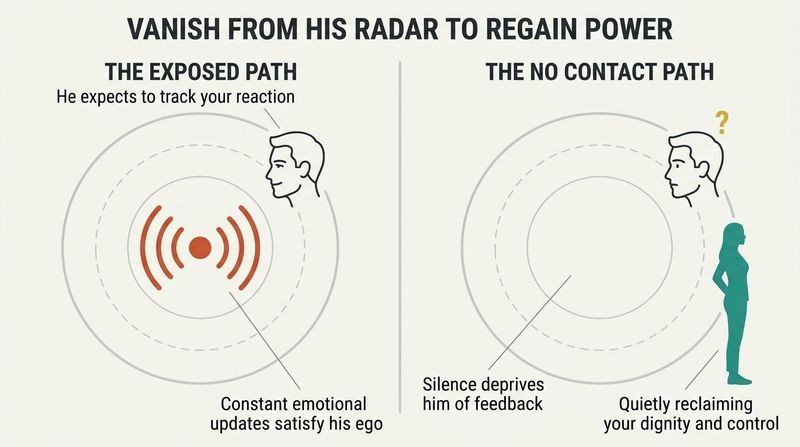
No Contact is the entire strategy. Braswell's core prescription is radical silence after a breakup: no calls, no texts, no accidental run-ins, no ex-sex, no social media peeking. You quietly disappear from his radar without announcing your intentions. The logic is dual purpose. First, silence hides that you may be falling apart, protecting your dignity. Second, it deprives him of the reaction he expects and forces him to wonder what you are thinking.
Silence camouflages emotion. The author frames talking, explaining, and seeking closure as the fastest way to lose. There is nothing you can say in the raw aftermath that changes his mind, so saying nothing becomes the strongest move. You accept the breakup, closure or not, and go quiet. If you have already begged or pleaded, you stop immediately before more damage is done.
The advice echoes a real psychological principle: intermittent and absent reinforcement can intensify pursuit, and removing yourself creates space that constant contact forecloses. Attachment research supports that reducing exposure to an ex genuinely speeds emotional recovery, so the self-healing half of the claim is well grounded. The manipulation half is shakier. Framing silence primarily as a tactic to win him back can keep a woman emotionally tethered to the very person she claims to be releasing. The healthiest reading treats No Contact as a recovery tool first and any reconciliation as a byproduct, not the goal.
Never show him you are shattered; men weaponize a woman's emotions
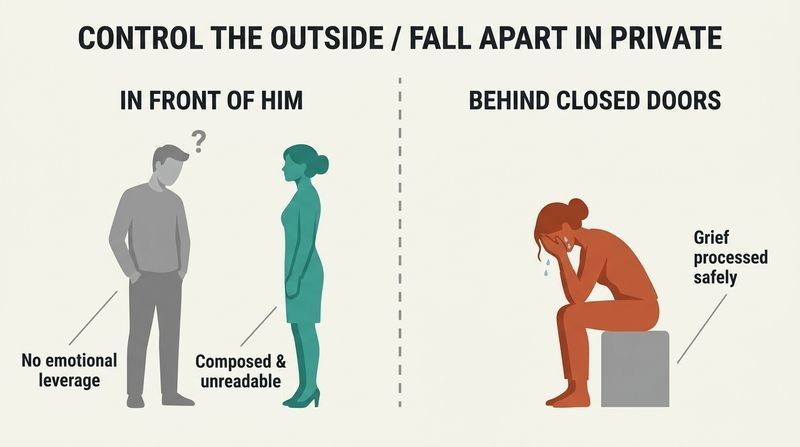
Control the outside, fall apart in private. Braswell insists it is fine to sob into a pillow, just never in front of your ex. Her view is blunt: men hide feelings daily and are expert at reading and exploiting a woman's, which makes an emotional woman an easy target. Display every feeling and you show all your cards before the game begins.
Logic over heart during emotional times. She invokes the cliche that after a breakup a woman thinks with her heart, not her brain, and urges the opposite: use logic to outsmart the situation. By refusing to let him see your devastation, you transfer the insecurity and rejection he made you feel back onto him. She calls emotional restraint a learnable skill requiring discipline and willpower, not a personality trait you either have or lack.
There is wisdom in not making irreversible decisions while flooded with cortisol and grief. Behavioral economists call this the hot-cold empathy gap: in a hot emotional state we make choices our cold, rational self regrets. Delaying communication is sound. Yet the gendered framing, that men coldly weaponize female emotion, is a sweeping generalization that risks teaching women to suppress rather than process feelings. A more durable frame is emotional regulation, not emotional concealment. The goal is not performing invulnerability for an audience of one but genuinely steadying yourself so choices come from clarity rather than panic.
A breakup is grief; ride the same stages you would mourning a death
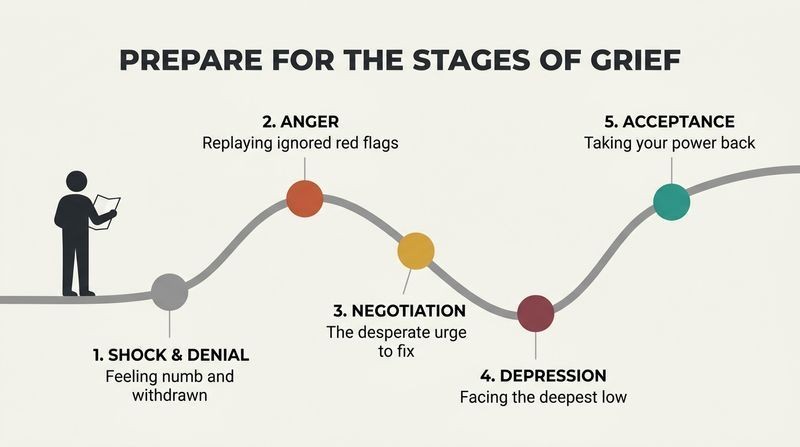
Name the emotional roller coaster. Braswell repeatedly compares a breakup to the death of a loved one, quoting Dennis Quaid that your whole identity shatters. She maps predictable stages so you are not blindsided by them:
1. Shock, where speaking and eating feel impossible
2. Denial, the urge to withdraw and pretend it did not happen
3. Anger, replaying the red flags you ignored
4. Negotiation, the itch to fix and compromise
5. Depression, then finally acceptance
Preparation defuses the pain. Her argument is that we handle unexpected feelings badly precisely because they are unexpected. Knowing the highs, lows, and twists in advance lets you meet them logically. She recommends mourning hard the first week, marking seven-day No Contact milestones on a calendar, and rewarding yourself at each one.
Borrowing the Kubler-Ross stages, originally about terminal illness, is a useful metaphor even if the science treats grief as messier and less linear than a five-step ladder. Modern bereavement research favors an oscillation model, where people swing between confronting loss and getting on with life, which fits Braswell's advice to both mourn and stay busy. Naming emotions has measurable value too: affect labeling reduces amygdala activation, meaning simply calling the feeling shock or anger literally lowers its intensity. The calendar milestone trick is quietly clever, converting a passive waiting game into a series of small, trackable wins.
Men chase what retreats; the moment you pursue, respect evaporates
The conquest is the point. Braswell's model of male psychology centers on the thrill of the chase. Men, she argues, fear losing the adrenaline of pursuit far more than they fear commitment. Once a woman is caught, especially one who becomes too available and too nice, the excitement drains and he drifts toward the next challenge.
Stay interesting to yourself. Her antidote is to never lose interest in your own life. Keep goals, hobbies, friends, and standards so high he must keep working to meet them. She frames a man as the topping on an already great dessert, never the dessert itself. When you spring into fix-it mode after a breakup, you become, in her words, the star of a drama show he watches for free, and every needy text lowers his respect.
This leans on evolutionary-psychology tropes that are real but overstated. Preference for novelty exists, yet decades of relationship science from researchers like John Gottman show lasting attraction is built on responsiveness, friendship, and trust, not perpetual scarcity games. The genuinely useful kernel here is self-concept clarity: people who maintain a rich independent identity report higher relationship satisfaction and recover faster from breakups. The weakness is treating all men as interchangeable chase-driven creatures, which can trap a woman in permanent strategic performance. The stronger takeaway is not play hard to get but actually have a life so full that games become unnecessary.
How he ended it exposes his character better than anything he said
The method is the message. Braswell reads breakup style as a character test. A face-to-face breakup, rare today, signals a man of courage who respected you enough to give real closure. A phone call is acceptable only long distance. A text or email breakup marks a coward who cannot handle a hard conversation. The man who simply vanishes, the Houdini, takes the path of least resistance and likely kept you as one option among several.
Closure is already given. Her sharpest point: a man who disappears without a word has told you everything about his character, so stop hunting for a verbal explanation. On cheating, she distinguishes a one-time guilt-ridden slip, which some women forgive, from a sustained double life, which she calls the ultimate betrayal and a reason to run.
The framing that behavior under low accountability reveals true character aligns with a robust finding in psychology: how people treat those who cannot benefit them, or act when unobserved, predicts integrity better than stated values. Ghosting, in particular, has drawn research attention as a uniquely modern harm, correlating with avoidant attachment and lower empathy in the ghoster. Where the book overreaches is moral certainty. A text breakup from a three-week fling is not cowardice, and life circumstances complicate the tidy hierarchy. Still, using someone's exit behavior as data rather than a mystery to solve is genuinely liberating advice.
Refuse the friendship offer and cut off ex-sex until he earns you
"Let's be friends" is an ego balm. Braswell decodes the friendship offer as serving him, not you. It lets him feel less like a jerk while keeping you as backup insurance in case his other options fail. Her scripted response is to smile, say sure, then never actually engage, ignoring the calls and declining the dinners.
Sex bonds you chemically. She explains post-breakup attachment through oxytocin, the hormone released during intimacy that floods your system and creates an addiction-like bond to that specific man. This, she argues, is why women convince themselves an ex is irreplaceable when biology is doing the talking. Her rule: no ex-sex until his actions prove love, because being easily seduced after a breakup gets you filed as a plaything, never a woman he adores enough to commit to.
The oxytocin claim is directionally accurate but oversimplified. Oxytocin does facilitate pair-bonding and is released during intimacy, though it is not a simple love drug and affects men too, complicating the gendered framing. The deeper insight stands: physical intimacy manufactures felt closeness that can override judgment, so abstaining during the fog protects decision-making. On staying friends, research on post-breakup friendships finds they often prolong distress and are most common when one party harbors reconciliation hopes, exactly Braswell's concern. The book's transactional language, making him earn you, is off-putting to some, but the underlying boundary, do not offer intimacy to someone who offers only ambiguity, is sound.
Hide your crazy: every desperate text massages his ego and buries you
Neediness reads as instability. Braswell opens this idea with astronaut Lisa Nowak, who drove hundreds of miles in a diaper to confront a rival, as the cautionary extreme of a woman undone by heartbreak. Short of that, she catalogs the everyday behaviors that quietly signal desperation and delight his ego:
1. Text bombing and the fake accidental text
2. Repeated calling or call-and-hang-up
3. Driving past his house or haunting his hangouts
4. Begging, cursing, or threatening he will never find better
5. Cyber-stalking his new followers and friends
One unanswered text means stop. Her firm rule: send one message, get no reply, never send a second. Real conflict is resolved face to face, not through a keyboard, and every unanswered attempt confirms to him that you are falling apart and doing all the work he should be doing.
The unflattering label crazy aside, the mechanism is real. Anxious protest behavior, the flurry of calls and texts after rejection, is a documented attachment response, not a character flaw, but it reliably pushes an avoidant partner further away. The book's value is behavioral guardrails during a low-impulse-control window, similar to why financial advisors say never trade stocks in a panic. Where it stumbles is compassion: shaming the impulse as crazy can deepen the very anxiety driving it. A kinder framing, urge surfing or waiting out the wave, achieves the same restraint without the self-judgment that often triggers relapse into contact.
Delete him online and phase him out without a public announcement
Erase the highlight reel. Braswell treats social media as the modern enemy of mystery and healing. Her instruction is to delete or unfriend him, because he cannot possibly miss you if your face appears in his feed daily, and he has no incentive to call when a login tells him everything. Take down couple photos or move them to private, and wait three days before quietly switching your relationship status, with settings preset to private so nothing broadcasts.
Do not perform your recovery. She warns against two opposite traps: flooding your feed with staged happiness or posting sad, veiled jabs at him. Both draw attention and read as a charade. Keep posting exactly as you did before. Deleting your accounts entirely, she argues, signals you are hiding and cannot cope. When people ask, a simple line like things just did not work out ends it with class.
This is one of the book's most durable sections precisely because it targets an environmental cue rather than willpower. Research on breakup recovery confirms that continued exposure to an ex's online presence, called Facebook surveillance in one widely cited study, predicts greater distress, negative feelings, and slower personal growth. Removing the stimulus is more effective than resisting it, echoing habit science: change the environment, not just the intention. The performative-happiness warning is astute too, anticipating what psychologists call impression management, where curated displays of thriving usually signal the opposite. The advice to keep posting as normal is subtle: authenticity, not spectacle, is the credible signal.
Give it four to eight weeks; if he wanted you, he would call
Let him be the pursuer. Braswell's timeline is specific. It takes roughly four to eight weeks for a man to genuinely feel your absence and register that he may lose you for good. If a real connection existed, he typically makes contact within thirty days. Sixty days of silence means it is safely over, and by then, if you have rebuilt your life, you may not even notice.
Do not initiate, do not over-respond. Her rule against women calling men frames any outreach as pursuit, and men run from what chases them. When he does reach out, reply to only one of every three or four attempts, keep calls under five minutes, stay light, and end first. She cites the blunt line from another dating book that busy is just a euphemism, and that you deserve an actual phone call rather than crumbs of ambiguous attention.
The precise four-to-eight-week window should be read as a rule of thumb, not data; human timelines vary enormously and the number lends false scientific weight. That said, the underlying principle, imposing a waiting period so decisions are made from strength rather than panic, has real merit. The reply-to-one-of-four ratio resembles intermittent reinforcement, the most addictive reward schedule, which is precisely why it can hook someone but also why it feels manipulative. The most honest version of this advice drops the ratio math and keeps the boundary: someone genuinely interested pursues clearly and consistently, and inconsistent contact is itself the answer you were seeking.
Rebuild yourself so thoroughly that his return becomes irrelevant
Get your house in order. The endgame is not winning him back but becoming a woman for whom the outcome no longer decides her happiness. Braswell prescribes concrete self-restoration: a subtle makeover, a wardrobe upgrade, the gym, reconnecting with neglected friends, and literally cleaning your home. She invokes the law of attraction, likes attract likes, arguing you cannot draw a man who loves you until you like yourself.
Date widely, love yourself first. She urges keeping three or four men in rotation, not out of cruelty but to shift you from chaser to selector and refill an empty calendar. Confidence, she insists, is trained, not inherited, built through daily affirmations and defining your own standards. The closing note lands on First Corinthians and self-love: being alone is not the same as being lonely, and no man should be the source of a happiness you have not first built yourself.
This is where the book transcends its tactical packaging. The pivot from get him back to become whole is supported by research on post-traumatic growth, the finding that many people emerge from breakups with greater self-clarity and stronger identity than before. Self-concept reconstruction is one of the most reliable predictors of recovery. The law of attraction framing is pop-psychology shorthand, but the practical version holds: people with secure self-worth choose better partners and tolerate less. The dating-rotation advice is more debatable, useful for rebuilding agency but potentially a distraction from genuine healing. The strongest thread is the last one: self-sufficiency as the true breakup cure.
Analysis
This is a compact, prescriptive self-help book aimed at heartbroken women, built around a single tactic, No Contact, extended across breakup grief, dating psychology, social media, and self-rebuilding. Its structure is advice-dense and repetitive, circling the same core injunction, go silent, from a dozen angles, which makes it easy to absorb but analytically thin. Braswell writes as a confident friend rather than a researcher, leaning on celebrity quotes, other dating books (The Rules, He's Just Not That Into You, Act Like a Lady Think Like a Man), and folk psychology rather than studies. The book's genuine strength is behavioral: it identifies the low-impulse-control window after rejection and installs guardrails, no texting, no stalking, no ex-sex, that protect people from decisions their calmer selves would regret. This aligns with real science on the hot-cold empathy gap, affect labeling, and the documented harm of monitoring an ex online. Its central tension is philosophical incoherence. The book oscillates between two incompatible goals: heal and move on, versus manipulate him into returning. Every chapter promising self-love is undercut by tactics, the reply-to-one-of-four ratio, the strategic silence, the staged mystery, engineered to reoccupy his mind. This is intermittent reinforcement dressed as empowerment, and it can keep a reader psychologically leashed to the very person she claims to release. The gender essentialism is also dated: all men are cast as chase-driven, ego-fragile, and interchangeable (any man with a pulse can supply the oxytocin), which flattens real relational variety and may teach performance over authenticity. Read charitably, the book is most valuable when its manipulation frame is discarded and its recovery frame kept. Strip away the win-him-back scaffolding and what remains is durable: stop pursuing, protect your dignity, remove painful stimuli, wait out the emotional storm, rebuild an independent identity, and let a partner's consistency, not your effort, tell you what you need to know.
Review Summary
Download PDF
Download EPUB
.epub digital book format is ideal for reading ebooks on phones, tablets, and e-readers.








































