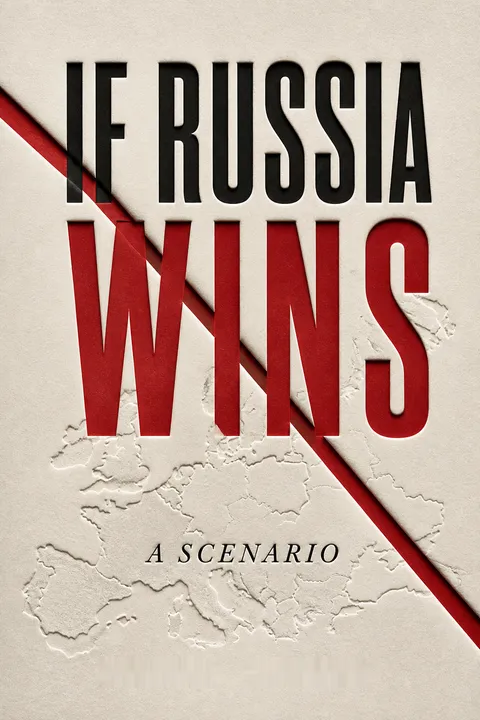

Key Takeaways
1. Ukraine's Capitulation: A Precursor to Broader Instability
The EU has not managed to ramp up the production of the military equipment necessary for Ukraine’s defence to a level where a constant supply can be guaranteed.
Dwindling Western support. The scenario begins with Ukraine's forced capitulation in Geneva, surrendering over 20% of its territory and agreeing to permanent neutrality. This defeat is directly attributed to the West's inability to sustain military aid, with the US president prioritizing domestic concerns and European nations failing to compensate for the shortfall due to economic woes and political shifts. The lack of consistent and sufficient support left Ukraine with no viable option but to negotiate a peace treaty on Russia's terms.
Political opportunism. The "Geneva Capitulation," as it's internally known, is publicly framed as the "Geneva Peace," but Russian media celebrates it as a clear victory, signaling further ambitions for the "Russian World" project. This outcome fuels populist parties in Europe and the US, who criticize past support for Ukraine and advocate for normalized relations with Russia, further weakening the collective Western stance. The narrative of "ending the war" overshadows the long-term security implications.
Internal Ukrainian chaos. Post-capitulation, Ukraine descends into chaos, marked by massive refugee movements, ongoing Russification in occupied territories, and persistent skirmishes. The devastated economy, degraded infrastructure, and resurgence of internal conflicts among oligarchs and political factions create fertile ground for Russian intelligence to recruit informants and for pro-Russian political forces to gain power, ultimately leading to President Zelensky's electoral defeat and a pro-Moscow government.
2. Western Complacency and Strategic Drift Post-Ukraine
Now that Russia’s war against Ukraine is over, at least in its high-intensity phase, there are growing calls among Republicans and Democrats alike to leave the European post-war order up to the Europeans and to focus US efforts on the Indo-Pacific region instead.
Shifting priorities. Following Ukraine's defeat, a pervasive sense of relief washes over the West, leading to a significant decline in the perceived need for robust defense spending. The United States, eager to pivot its strategic focus, begins reducing its troop presence in Europe to concentrate on the Indo-Pacific region, leaving European security largely to the Europeans. This reorientation is driven by a cross-party consensus that Europe should bear the primary responsibility for its own defense.
European apathy. Despite US urging, many European capitals resist substantial increases in defense budgets, prioritizing social stability and public services over military preparedness. Arguments emerge that Russia's army, having suffered losses in Ukraine, is sufficiently deterred, and that a "new" moderate Russian president, Obmanshchikov, should be given a chance. This leads to a continued neglect of critical capability gaps within NATO, such as:
- Inadequate air defenses
- Weaknesses in conventional cruise missiles
- Insufficient ammunition procurement
- Logistical and digital communication deficiencies
- Lack of capacity to quickly mobilize additional soldiers
Unheeded warnings. Central and Eastern European countries, along with the Baltic states, express grave concerns about this growing apathy, warning against repeating past mistakes and highlighting Russia's ongoing Russification policies in annexed Ukrainian territories. However, their warnings are largely dismissed by Western European governments, who remain convinced that Russia poses no immediate large-scale threat and that a "thaw" in relations is possible.
3. Russia's Deceptive Strategy: Limited Aggression and Psychological Warfare
Why don’t we take the remilitarization of the Rhineland as a blueprint?
A new face, old ambitions. Following Putin's surprise resignation, a seemingly young, charismatic economist, Oleg Obmanshchikov, takes power, projecting an image of reform and a desire for normalized relations. This "thaw" in Moscow is eagerly embraced by many in the West, who hope for a new Gorbachev. However, behind the scenes, Obmanshchikov and his inner circle are meticulously planning to continue Putin's political course, aiming to expand Russia's influence without direct, large-scale confrontation with NATO.
Rhineland blueprint. The core of Russia's strategy is inspired by the 1936 remilitarization of the Rhineland: a limited, surprising military advance accompanied by peaceful rhetoric, designed to test NATO's resolve. The plan hinges on the assumption that NATO would be unwilling to risk a major conflict over a small territorial gain, allowing Russia to withdraw if met with strong resistance, or to consolidate its gains if not. Key elements of this strategy include:
- Element of surprise to prevent NATO mobilization
- Limited objectives to avoid full-scale war
- Rhetoric of self-defense and non-aggression
- Exploiting perceived Western weaknesses and divisions
Exploiting Western perceptions. Russian strategists deliberately cultivate an image of "schizophrenia" – appearing both aggressive and peace-seeking – believing the West will interpret this through its own biases, seeing Russia as irrational but ultimately not seeking a world war. This psychological manipulation, combined with covert communication channels, aims to give Western leaders a "route out of retaliation without losing face," while simultaneously demonstrating Russia's resolve and willingness to escalate if challenged.
4. Global Diversions: Tying Up Western Resources
China is currently distracting the US in Asia, and our guys in Africa have managed to keep the European naval forces busy in the Mediterranean.
Engineered refugee crisis. Russia orchestrates a new refugee crisis from Mali, using its mercenaries to round up civilians and force them onto boats bound for Europe. This influx of migrants, coupled with renewed visa issuance by Russian and Belarusian embassies to Middle Eastern and African nationals, triggers alarm in the EU. Europe responds by deploying rapid response forces and naval assets to the Mediterranean, diverting critical military capabilities from NATO's eastern flank.
South China Sea escalation. Simultaneously, China escalates tensions with the Philippines over Second Thomas Shoal in the South China Sea, seizing the reef and establishing a maritime exclusion zone. This move, backed by an aggressive social media campaign, forces the US to deploy carrier strike groups to the region, further diverting American military attention and resources away from Europe. China's deployment of nuclear submarines to the Taiwan Strait amplifies the distraction, exceeding Russia's initial expectations.
Strategic coordination. These seemingly disparate global events are, in fact, coordinated diversionary tactics by Russia and its allies. The goal is to stretch Western military resources thin, distract key decision-makers, and create a multi-front crisis that prevents a unified and decisive NATO response to Russia's primary objective in Europe. This strategy leverages the interconnectedness of global security challenges to Russia's advantage, demonstrating a sophisticated understanding of Western vulnerabilities.
5. NATO's Critical Capability Gaps and Internal Divisions
Reports from the NATO military and strategic headquarters in Brussels that the alliance lacks the decisive capabilities in many areas to quickly and decisively repel a potential Russian attack on NATO territory are dismissed by most Western European governments as exaggerated.
Unaddressed deficiencies. Despite warnings from military planners, NATO's European members fail to close critical capability gaps identified during and after the Ukraine war. These include:
- Air defense: Insufficient systems to protect against ballistic missile attacks.
- Deep strike capabilities: Lack of conventional cruise missiles with sufficient range.
- Logistics and communication: Persistent weaknesses in supporting large-scale operations.
- Expansion capacity: Inability to quickly mobilize and deploy additional soldiers.
The deployment of US Dark Eagle hypersonic missiles in Wiesbaden is seen by some as sufficient deterrence, but overall European rearmament efforts stagnate.
Political apathy and denial. Most Western European governments dismiss military concerns as exaggerated, prioritizing domestic social stability over expensive defense preparations. They cling to the hope that Russia's new president is a moderate, and that increased Western armament would only bolster conservative forces in Russia. This attitude leads to a noticeable failure to designate specific units for NATO's defense plans, with some countries even using their participation in the UN monitoring mission in Ukraine as an excuse to avoid further commitments to the eastern flank.
Erosion of collective defense. This widespread apathy and denial among key NATO members, particularly Germany, France, and Italy, undermines the credibility of Article 5. Central and Eastern European states, who maintain a high threat perception, warn against repeating past mistakes, but their Cassandra-like prophecies go unheeded. The visible weaknesses of NATO, coupled with the reluctance to commit to substantial defense spending, are perceived by Russia as an invitation for a limited military operation against a NATO member state.
6. Hybrid Warfare and Sabotage: The New Battlefield
We are dealing with a hybrid war. It has been waged against our countries and societies for some time but is now becoming increasingly intense.
Covert attacks. As Russia launches its conventional invasion of Estonia, it simultaneously employs hybrid warfare tactics against key NATO members. These covert operations are designed to sow confusion, disrupt critical infrastructure, and demonstrate Russia's reach without direct military confrontation. The attacks include:
- Sabotage of military infrastructure: Explosions at the UK's Faslane naval base, home to nuclear submarines, severely damage infrastructure.
- Targeted assassinations: A leading German arms industry CEO is killed in a plane crash, widely suspected to be a Kremlin-orchestrated attack.
These incidents occur concurrently with the Estonian invasion, highlighting a multi-faceted assault on Western security.
Psychological impact. The hybrid attacks, while not directly involving NATO forces, serve to heighten the sense of vulnerability and fear within the alliance. They underscore the chancellor's observation that a hybrid war has been waged for some time, now escalating in intensity. The lack of immediate, clear attribution for these attacks further complicates NATO's response, as it struggles to differentiate between conventional aggression and covert destabilization efforts.
Undermining resolve. These acts of sabotage contribute to the overall atmosphere of uncertainty and fear, reinforcing the narrative that a direct military response to Russia's actions could lead to unpredictable and devastating consequences. By demonstrating its capacity to strike at the heart of NATO's military and industrial capabilities, Russia aims to further deter a unified and robust Article 5 invocation, making Western leaders hesitant to escalate.
7. The Nuclear Threat: Russia's Ultimate Coercion Tool
Furthermore, I wonder – and I hope you will allow me to be so candid – whether the Americans would be prepared to accept unfathomable damage on their own territory for the liberation of what is, from an American perspective, a small town in Eastern Europe?
Explicit and implicit threats. Russia consistently leverages the threat of nuclear weapons to deter a decisive Western response. During the Ukraine war, mere hints of nuclear use effectively constrained military aid and imposed restrictions on weapon deployment. In the scenario, this tactic is explicitly employed by a Russian diplomat in a meeting with the US National Security Advisor, questioning America's willingness to risk "unfathomable damage" for a "small town in Eastern Europe."
Psychological impact. The nuclear threat creates a powerful psychological barrier for Western leaders, particularly in "Old Europe" and the US. The fear of World War III and global catastrophe outweighs the imperative to defend NATO territory. This fear is amplified by "fear merchants" in media and politics who advocate for caution and de-escalation on Russian terms, influencing public opinion and delaying robust military responses.
Strategic advantage. Russia's deployment of a nuclear submarine near Hans Island, a barren rock between Canada and Greenland, serves as a dramatic demonstration of its nuclear capabilities and willingness to escalate. This unexpected move, coupled with the explicit diplomatic threat, reinforces the perception that Russia is prepared to "risk everything" to achieve its goals. NATO military commanders acknowledge the risk of ballistic missile attacks on European territory, with the uncertainty of conventional versus nuclear warheads, further paralyzing decision-making.
8. US Reluctance: Prioritizing Avoidance of World War III
But let me be clear: I’m not going to risk World War III over some small town in Estonia. Unless we have concrete evidence that Obmanshchikov wants to seize more territory, I will not, and the United States will not, agree to invoke Article 5.
Presidential directive. The US President, facing Russia's aggression against Estonia, explicitly states his unwillingness to risk World War III over Narva. Despite acknowledging the violation of NATO territory, his primary concern is avoiding a direct military confrontation with a nuclear-armed Russia. This stance is communicated directly to allied leaders, setting a clear boundary for the American response.
Conditional engagement. The US President's position is that while he is prepared to exert military pressure to encourage Russian withdrawal, he will not agree to invoke Article 5 unless there is concrete evidence of broader Russian territorial ambitions. He views the Narva incident as a limited action, potentially resolvable through negotiation, and even suggests that Estonia's past treatment of its Russian minority provides a "background" to the aggression, albeit not an excuse.
Shifting burden. The US President expresses frustration with Europe's continued reliance on American military strength and its failure to increase defense spending. He challenges European nations to take responsibility for their own security, stating that if they wish to pursue military action, it must be "your business," without US consent or support. This effectively signals a withdrawal of the US security guarantee for a direct military response to a limited Article 5 violation.
9. NATO's Credibility Crisis: Failure to Invoke Article 5
Today was a dark day for the alliance.
Deep divisions. The emergency NATO summit reveals profound divisions among member states regarding a response to Russia's aggression against Estonia. While Eastern European countries, the UK, and the Baltic states advocate for a decisive Article 5 invocation, Southern European nations, Hungary, and France (under its far-right government) urge caution and restraint. The Italian ambassador even questions Estonia's past treatment of its Russian minority, further fracturing unity.
US veto and European paralysis. The US President's unequivocal refusal to invoke Article 5, coupled with his insistence that any European military action would not receive US support, effectively paralyzes the alliance. Without the overwhelming military capabilities, intelligence, and transport assets of the United States, a purely European-led counter-measure under Article 5 is deemed unfeasible. This highlights Europe's continued dependence on the US for collective defense.
Alliance undermined. The NATO Secretary General, unable to achieve unanimity, is forced to ask Estonia to withdraw its request for Article 5. This public failure to act decisively in response to a clear violation of allied territory shatters NATO's credibility and its core function of collective defense. The Secretary General's somber declaration, "Today was a dark day for the alliance," underscores the profound damage inflicted on the transatlantic security architecture.
10. Russia's Strategic Victory: Reshaping the European Order
Today is the day when the greatness of our country will be restored. Our country and our Russian civilization. For today, I can declare that Narva has returned to the bosom of our great nation.
Consolidated gains. President Obmanshchikov, in a televised address from the Kremlin, declares Russia's victory, announcing that Narva has "returned to the bosom of our great nation." This act, coupled with the successful occupation of Hiiumaa, demonstrates Russia's ability to seize NATO territory without facing a unified military response, effectively redrawing the European security map. The West's failure to act decisively validates Russia's strategy of limited aggression.
Union with Belarus. A significant outcome of Russia's strategic success is the formal agreement to merge Russia and Belarus into a single union by June 1, 2030, with one parliament, one army, and one president. This move dramatically expands Russia's territorial and military reach, further consolidating its power in Eastern Europe and fulfilling long-held neo-imperial ambitions. It represents a direct challenge to the existing European order.
New multi-polar world. Obmanshchikov celebrates the defeat of the "aggressive anti-Russian policy" of the West and announces upcoming talks with the American president on reorganizing the European security architecture and global issues. He credits allies like China and India for their support, envisioning a new multi-polar world order where power is distributed, and no single power dictates to others. This outcome signifies a fundamental shift in global power dynamics, with Russia, China, and India forming a new center of influence.
11. The Author's Urgent Warning: Preventing a Foreseeable Future
We develop scenarios in this way precisely so that we can prepare for them and stop them from happening.
Scenario as a warning. The author explicitly states that the scenario is not a prophecy but a tool to encourage reflection and discussion, aiming to prevent such an outcome from becoming reality. It highlights that the described events are based on observable trends and developments, making them plausible if current trajectories continue. The core message is that Russia will remain a central security threat, regardless of the Ukraine conflict's resolution.
Key contributing factors. The author identifies three critical factors that would lead to Russia's victory in this scenario:
- Nuclear coercion: Russia's effective use of nuclear threats to deter Western action.
- Lack of strategy: The West's failure to define clear goals in supporting Ukraine and to recognize the broader conflict over the world order.
- Fatigue: Societal and political weariness in democratic societies, exploited by Russia through disinformation and the economic burden of prolonged conflict.
These factors, if unaddressed, create vulnerabilities that Russia is poised to exploit.
Call to action. To prevent this future, the author urges conscious political leadership, not merely reactive policy driven by public opinion or upcoming elections. Europe must become independent of Washington's decisions regarding its own security, and the West must overcome its misperception of Russian intentions, recognizing Putin as a dictator willing to use force. Addressing capability gaps, countering disinformation, and fostering a broad social consensus for robust defense are crucial steps to avoid sleepwalking into a catastrophic future.
Review Summary
If Russia Wins receives generally positive reviews, averaging 3.95/5. Readers praise Masala's plausible, sobering scenario of Russian aggression against NATO following a Ukrainian defeat, particularly appreciating its thriller-like accessibility. Many find it a vital wake-up call for European defense complacency. Critics note the writing style can feel amateurish or overly dramatized, and some question the scenario's realism. Ukrainian and Eastern European reviewers find it especially resonant, while several readers highlight its urgency given current geopolitical developments.
People Also Read

Download PDF
Download EPUB
.epub digital book format is ideal for reading ebooks on phones, tablets, and e-readers.








































