
Key Takeaways
1. The Federalist Society: A New Model of Legal Influence
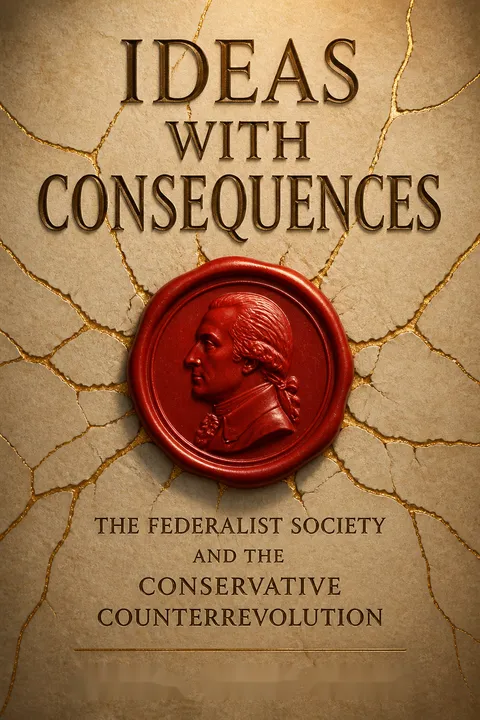
The Federalist Society for Law and Public Policy Studies does not fit comfortably into any of the social science boxes that students of American politics traditionally use to study the impact of civic groups on law and politics.
A unique entity. The Federalist Society (FS) defies easy categorization, operating neither as a traditional public interest law firm, an interest group, nor a conventional think tank. Instead, it functions as a "Political Epistemic Network" (PEN), a fluid, interconnected web of legal professionals united by shared beliefs and a common policy agenda. Its influence is primarily indirect, focusing on intellectual engagement, networking, and training its members to become "citizen-lawyers" who can then apply conservative and libertarian principles in their professional roles.
Core principles. The FS is founded on three powerful principles that guide its members' actions and interpretations. These include the belief that the state exists to preserve freedom, that the separation of governmental powers is central to the Constitution, and that the judiciary's role is to interpret the law, not legislate from the bench. These tenets provide a coherent ideological framework for its diverse membership.
Strategic impact. By fostering a community of like-minded legal elites, the FS aims to reshape America's legal institutions to reflect conservative and libertarian values. Its success lies in its ability to cultivate and deploy intellectual capital, ensuring that its members are well-positioned to influence legal discourse and judicial decisions across all levels of government and the legal profession.
2. Originalism: The Guiding Star of Conservative Legal Thought
I think if you were looking for an honest statement of originalist jurisprudence, Thomas comes closest to the pure Federalist Society model.
Defining Originalism. For Federalist Society members, Originalism is the authoritative method of constitutional interpretation, ensuring fidelity to the text and the framers' intent. This approach holds that the Constitution's meaning should be derived from its text, structure, and the public debates surrounding its ratification, rather than evolving societal norms or judicial preferences. It serves as the shared "notion of validity" within the FS network.
Combating judicial activism. Originalism is seen as a bulwark against "judicial activism," which FS members define as judges imposing their own policy preferences rather than adhering to the law's original meaning. By championing Originalism, the FS seeks to restore what it perceives as the proper, restrained role of the judiciary, ensuring that unelected judges do not usurp the lawmaking functions of elected legislators.
Intellectual development. The FS has actively nurtured and developed Originalist theory over decades, transforming it from a fringe idea into a mainstream legal discourse. Through conferences, publications, and debates, it has provided a platform for scholars like Robert Bork, Antonin Scalia, and Randy Barnett to refine and disseminate Originalist arguments, making them intellectually respectable and influential within the legal community.
3. Reclaiming the Second Amendment: From Collective to Individual Right
The rights of the individual citizen would be little different today if the Second Amendment did not exist.
A "lost" amendment. For decades, the Second Amendment was largely interpreted as protecting a collective right related to militia service, not an individual right to bear arms. This "lost" status, as one scholar lamented, meant that individual citizens' rights were barely impacted by its existence, a situation the Federalist Society network sought to fundamentally reverse.
Decades of advocacy. Beginning in the early 1990s, the FS network aggressively challenged this consensus, advocating for an individual rights view. Key figures like Randy Barnett, Eugene Volokh, and Nelson Lund provided the intellectual scaffolding, arguing that an Originalist reading of the Second Amendment's "operative clause" ("the right of the people to keep and bear Arms") supported a personal right, independent of militia service. They drew heavily on historical sources like Blackstone's Commentaries and The Federalist Papers.
Revolutionary decisions. This sustained effort culminated in landmark Supreme Court decisions:
- District of Columbia v. Heller (2008): Justice Scalia's majority opinion, heavily citing FS-affiliated scholarship, declared the Second Amendment protects an individual right.
- McDonald v. City of Chicago (2010): Justice Alito's majority opinion incorporated this right against the states via the Fourteenth Amendment's Due Process Clause. Justice Thomas's concurrence, drawing on FS scholarship, also pushed for incorporating it through the Privileges or Immunities Clause, signaling a future path for constitutional change.
4. Unleashing Corporate Speech: Reshaping Campaign Finance
The inherent worth of speech in terms of its capacity for informing the public does not depend upon the identity of its source, whether corporation, association, union, or individual.
Challenging speech restrictions. The FS network spearheaded a campaign to dismantle campaign finance regulations, arguing they unconstitutionally abridged free speech, particularly for corporations and unions. This effort gained momentum after the Supreme Court's Austin v. Michigan Chamber of Commerce (1990) decision, which expanded the definition of corruption to justify limiting corporate political spending.
Key arguments: FS members advanced several core arguments:
- The First Amendment prohibits government attempts to equalize speech resources, viewing such efforts as an unconstitutional redistribution of political power.
- There is no meaningful First Amendment distinction between individual and corporate speech, a position bolstered by the First National Bank of Boston v. Bellotti (1978) precedent.
- Judicial restraint should not prevent the Court from correcting past constitutional errors, particularly in campaign finance jurisprudence.
The Citizens United revolution. This sustained intellectual and litigation effort culminated in Citizens United v. FEC (2010). Justice Kennedy's majority opinion, heavily influenced by FS network scholarship and arguments, affirmed that corporations possess robust First Amendment speech rights, effectively overturning Austin and parts of McConnell v. FEC (2003). This decision, though controversial, represented a significant victory for the FS network's vision of expansive free speech.
5. Reining in Federal Power: The Commerce Clause Revolution
The powers delegated by the proposed Constitution to the federal government are few and defined.
Challenging expansive federal reach. For half a century, the Supreme Court's broad interpretation of the Commerce Clause allowed Congress to regulate nearly any activity with even a slight connection to interstate commerce. The Federalist Society network, driven by its commitment to limited government and individual liberty, sought to reverse this trend and restore meaningful judicial limits on federal power.
Multi-pronged critique. FS members deployed several arguments to narrow the Commerce Clause:
- Textualist-Originalist: Advocating a narrow, 18th-century understanding of "commerce" as limited to "trade" or "exchange," excluding manufacturing and agriculture.
- Structural: Emphasizing James Madison's Federalist 45, which asserted that federal powers are "few and defined," with states retaining broad authority.
- Functionalist: Drawing on public choice theory, arguing that unchecked federal power leads to inefficient "rent-seeking" by special interests.
Landmark decisions. This intellectual groundwork paved the way for a series of pivotal Supreme Court rulings:
- New York v. United States (1992): Signaled a return to "formalistic" federalism, limiting federal coercion of states.
- United States v. Lopez (1995): Struck down the Gun-Free School Zones Act, marking the first time in decades the Court limited Congress's Commerce Clause power. Justice Thomas's concurrence explicitly adopted FS-member Richard Epstein's narrow reading of "commerce."
- United States v. Morrison (2000): Further reinforced these limits by striking down parts of the Violence Against Women Act.
6. Reviving State Sovereignty: The Anti-Commandeering Doctrine
State governments are neither regional offices nor administrative agencies of the federal Government.
Tenth Amendment's resurgence. For decades, the Tenth Amendment was dismissed as a "truism," offering little substantive protection against federal encroachment. The Federalist Society network vehemently rejected this view, arguing that the Tenth Amendment and the principle of state sovereignty were fundamental to the Constitution's original design and crucial for preserving individual liberty.
Combating coercive federalism. FS members criticized "cooperative federalism" for devolving into "coercive federalism," where the federal government imposed burdensome conditions on states, effectively reducing them to administrative units. They argued that states, as sovereign entities, could not be compelled to implement federal programs against their will.
The Anti-Commandeering Doctrine. This advocacy culminated in the Supreme Court's development of the Anti-Commandeering Doctrine:
- New York v. United States (1992): While primarily a Commerce Clause case, it laid the groundwork by emphasizing the Tenth Amendment's implicit prohibitions on federal coercion.
- Printz v. United States (1997): Justice Scalia's majority opinion, heavily citing FS scholarship, established that Congress cannot compel state law enforcement officers to administer federal laws, striking down parts of the Brady Act.
- NFIB v. Sebelius (2012): The Court, in a fractured opinion, used the Anti-Commandeering Doctrine to strike down the Affordable Care Act's Medicaid expansion as unconstitutionally "coercive," marking a significant victory for state sovereignty.
7. Shaping Judicial Outcomes: Ideas as Constitutional Scaffolding
The further the Supreme Court decides to move away from its established constitutional frame in a given case, the less it will be able to rely on past lines of reasoning and precedent to legitimate its ruling, and the more it will have to fish around for alternative authorities and constitutional frames to justify a decision.
Filling the intellectual void. When the Supreme Court seeks to significantly alter or reconstruct established constitutional frameworks, it faces a "giving reasons requirement" – the need to justify its decisions with authoritative legal reasoning. This creates a critical juncture where the Court cannot simply rely on existing precedent and must "fish around" for alternative intellectual capital. The Federalist Society network excels at providing this scaffolding.
Active conduits of ideas. FS members, acting as "cognitive baggage handlers," actively transmit their shared beliefs and authoritative sources to decision-makers. This occurs through:
- Scholarship: Academics develop and publish legal theories and historical analyses.
- Litigation: FS-affiliated lawyers and amici curiae incorporate these ideas into briefs, directly influencing judicial arguments.
- Clerkships: Clerks, often with FS ties, bring these ideas into the chambers of Justices.
Entrenching new frames. Once these ideas are adopted and incorporated into Supreme Court doctrine, they gain the force of precedent. Subsequent decisions, like Morrison after Lopez, can then simply cite the newly established framework, further entrenching the FS network's influence. This process demonstrates how FS shapes the content, character, and direction of constitutional revolutions.
8. Cultivating Conservative Judges: The "Farm Team" Strategy
The Federalist Society has a de facto monopoly on the credentialing of rising stars. . . on the left there are a million ways of getting credentialed; on the political right, there’s only one way in these legal circles.
"Policy is people." The Federalist Society understands that to change constitutional law, it must first change the people who interpret and enforce it. This involves a deliberate, long-term strategy of identifying, recruiting, training, and credentialing young conservatives and libertarians for influential positions within the legal system.
A powerful pipeline. The FS has become an indispensable "farm team" for Republican administrations seeking judicial nominees. Its network serves as an informal gatekeeper, vetting candidates for federal judgeships and Supreme Court appointments. The "Federalist Society credential" has become a significant asset, signaling ideological alignment and intellectual rigor.
Strategic placement. This strategy has yielded substantial results, with numerous FS members appointed to federal courts, including the Supreme Court (e.g., Justices Scalia, Thomas, Roberts, Alito). These appointments ensure that judges who share the network's core principles are in positions to shape constitutional jurisprudence, fulfilling the goal of pushing public policy in a libertarian-conservative direction.
9. The Federalist Society as a Vigilant Judicial Audience
I’ve said to him face to face that he got it wrong and he’ll tell me why I got it wrong. . . [s]o that’s pretty direct feedback.
Mitigating "judicial drift." Beyond appointing like-minded judges, the Federalist Society acts as a "vigilant and vocal judicial audience" to prevent "judicial drift"—the tendency for some conservative appointees to moderate their views over time. This informal accountability mechanism ensures judges remain faithful to the conservative and libertarian principles they espoused during their nomination.
Feedback loops. FS members, often having personal relationships with judges and Justices, provide direct feedback on their decisions. As exemplified by Douglas Kmiec's direct challenge to Justice Scalia over his Gonzales v. Raich opinion, this "feedback loop" reinforces ideological expectations and signals disapproval when a Justice deviates from the network's shared understanding.
Responding to judicial signals. The FS network also actively interprets "signals" from the Supreme Court, discerning which constitutional questions and arguments Justices are interested in hearing. This enables legal entrepreneurs within the network to strategically find, finance, and litigate cases that align with judicial preferences, effectively shaping the Court's agenda and accelerating constitutional change.
10. Normalizing Radical Ideas: Shifting the Legal and Public Debate
I think certainly in my professional lifetime the debate, the dialogue, about constitutional law has shifted much more towards Originalism. . . even liberals on the Supreme Court take it seriously.
Producing cultural capital. The Federalist Society has successfully transformed once-stigmatized conservative and libertarian legal ideas into legitimate, mainstream discourse. By providing a platform for debate and intellectual development, it has reduced the "stigma associated with those ideas in institutions that produce and transmit professional distinction," particularly within law schools and the legal profession.
Changing the dialogue. The FS has fundamentally shifted the constitutional debate, making Originalism a serious interpretive method that even its liberal opponents must engage with. This intellectual legitimization is crucial because, for the Supreme Court's decisions to be accepted as authoritative, the underlying legal theories must be perceived as reasonable and well-founded by the broader legal community.
Broader public outreach. Beyond the legal academy, the FS has increasingly engaged in public outreach, leveraging media appearances and connecting with movements like the Tea Party. This effort aims to influence the broader political and public debate about the Constitution and the role of government, further normalizing conservative legal positions and fostering a climate conducive to constitutional change.
11. The Federalist Society Model: A Blueprint for Constitutional Change
The Federalist Society model, though inspired by the “Liberal Legal Network,” is viewed now by many within the legal community as strategically superior to its prototype.
A new paradigm. The Federalist Society's formalized and institutionalized approach to building a legal counter-elite represents a significant innovation in how constitutional change is pursued. Unlike the more informal networks of the past, the FS provides a structured, sustained mechanism for identifying, training, promoting, and ideologically disciplining legal professionals from their law school days through their careers.
The ACS as a mirror. The founding of the American Constitution Society (ACS) as a progressive counterpart to the FS is a testament to the perceived strategic superiority of the Federalist Society model. The ACS explicitly seeks to emulate the FS's success in building a community of legal elites, networking them, and supporting their professional development to advance a progressive legal vision.
Challenges for the future. While the FS model has proven highly effective, it raises important normative questions about the politicization of law and the crucial divide between law and politics. For organizations like the ACS, the challenge lies in replicating the FS's ideological coherence, its "farm team" success in judicial appointments, and its ability to effectively shift the public debate, all while navigating the inherent complexities of a diverse progressive movement.
People Also Read









Download PDF
Download EPUB
.epub digital book format is ideal for reading ebooks on phones, tablets, and e-readers.








































