
Plot Summary
The Last Man Standing
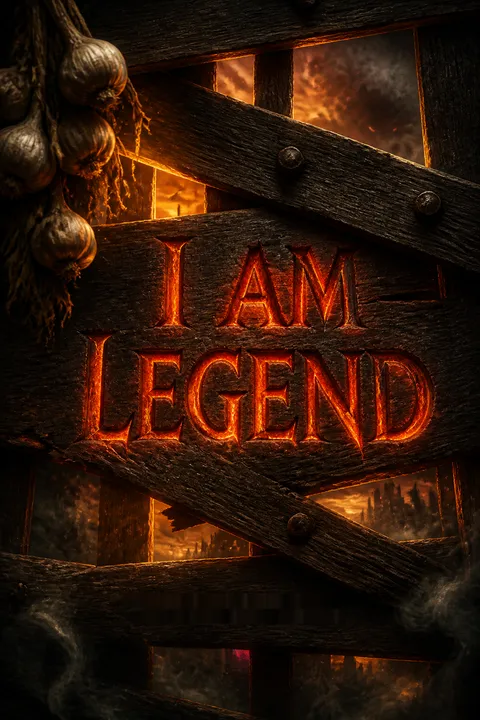
Robert Neville is the last known human in a world overrun by vampires. Each day, he fortifies his home with garlic, mirrors, and wooden planks, and by night, he endures the relentless siege of the undead. The city is silent by day, but at night, the vampires gather, calling his name, taunting him, and trying to lure him outside. Neville's life is a cycle of survival: repairing his barricades, scavenging for supplies, and disposing of the bodies that accumulate around his home. The loneliness is crushing, and the monotony of his existence is broken only by the constant threat of death. Neville's only solace comes from music, alcohol, and the faint hope that he is not truly alone in the world.
Nightly Terrors and Defenses
As darkness falls, Neville's home becomes a fortress under siege. The vampires, led by his former friend Ben Cortman, surround his house, hurling rocks and insults, and trying to break in. Neville drowns out their cries with loud music and alcohol, but the psychological toll is immense. He is haunted by memories of his wife and daughter, both lost to the plague, and by the seductive, taunting figures of the female vampires outside. Each night is a test of endurance, and each morning brings the grim task of cleaning up the aftermath. Neville's routines—making stakes, hanging garlic, and soundproofing his home—are all that stand between him and madness.
The Science of Survival
Driven by desperation and curiosity, Neville begins to investigate the nature of the vampire plague. He questions the old superstitions—garlic, crosses, mirrors—and seeks scientific answers. He collects books, studies blood, and experiments with different methods of killing the vampires. Through trial and error, he discovers that sunlight and oxygen are fatal to the infected, and that the disease is caused by a bacillus, not by supernatural forces. Neville's scientific approach gives him a sense of purpose, but it also isolates him further, as he realizes that the world he once knew is gone, replaced by a new, terrifying reality.
Haunted by the Past
Neville is tormented by memories of his wife Virginia and daughter Kathy. He recalls the early days of the plague, the fear and confusion, and the desperate measures taken to contain the disease. He remembers the pain of losing his family—Kathy to the plague, Virginia to the infection that turned her into a vampire. Neville's grief is compounded by guilt, as he is forced to destroy his wife's reanimated corpse. These memories fuel his determination to survive, but they also threaten to overwhelm him, driving him to the brink of despair.
The Plague Unleashed
The vampire plague began as a mysterious illness, spreading rapidly through dust storms, insects, and human contact. Society collapsed as the infected turned into bloodthirsty creatures, and the government's attempts to contain the outbreak failed. Neville reflects on the scientific and psychological aspects of the disease, recognizing that fear and superstition played as much a role in the devastation as the bacillus itself. The world is now divided between the living dead, the infected living, and Neville—the last uninfected man.
Losses and Burials
Neville's life is marked by loss. He is forced to burn the bodies of the infected, including friends and neighbors, to prevent the spread of the disease. When Virginia dies, he cannot bring himself to cremate her, instead burying her in secret. But even this act of love is futile, as she returns to him as a vampire, forcing him to destroy her again. These experiences harden Neville, but they also deepen his sense of isolation and futility. He is haunted by the knowledge that he is both a survivor and a destroyer.
Searching for Answers
Neville's relentless experimentation leads to breakthroughs: he identifies the vampire germ, understands its life cycle, and learns why certain superstitions have a basis in biology or psychology. He discovers that the germ can mutate, and that some infected individuals can adapt to sunlight and other former weaknesses. Yet, for every answer, new questions arise. Neville grapples with the morality of his actions, the nature of the vampires, and the possibility that he is now the monster in a world that has moved on without him.
The Dog and Hope
Neville's loneliness is briefly alleviated when he encounters a stray dog, the only other living creature he has seen in years. He painstakingly gains the dog's trust, offering food and companionship. The dog becomes a symbol of hope and normalcy, but it is already infected. Despite Neville's efforts to save it, the dog dies, leaving him more desolate than before. The loss teaches Neville the dangers of hope in a world ruled by death and reinforces his resignation to solitude.
Monotony and Resignation
After the dog's death, Neville sinks into a period of resignation. He accepts the monotony of his existence and the futility of his dreams for rescue or companionship. He finds a grim peace in routine and in the pursuit of knowledge, but he is aware that he is merely marking time. The world outside has changed irrevocably, and Neville is a relic of a lost age. He becomes more philosophical, questioning the nature of normalcy, morality, and survival.
Ruth in the Sunlight
Neville's world is upended when he sees a woman, Ruth, walking in the sunlight. At first, he believes she is a hallucination, but she is real. Their encounter is fraught with fear and mistrust—Neville is desperate for companionship but suspicious of her motives and health. Ruth is terrified of Neville, who represents both hope and danger. Their uneasy alliance is a fragile bridge between the old world and the new, and Neville is forced to confront his own humanity and capacity for trust.
Trust and Betrayal
Neville and Ruth's relationship deepens, but is shadowed by suspicion. Neville tests Ruth for infection, and she reacts violently to garlic, confirming his fears. Yet, he is drawn to her, and they share moments of vulnerability and intimacy. Ruth ultimately reveals that she is part of a new society of infected survivors who have learned to coexist with the disease. She was sent to spy on Neville, but has developed genuine feelings for him. Ruth's betrayal is tempered by her warning: Neville must flee, as the new society plans to destroy him.
The New Society Emerges
The infected survivors, led by Ruth's people, have formed a new society. They hunt and kill the remaining vampires—both the mindless dead and those like Neville, who represent a threat to their existence. Neville witnesses the brutal efficiency of their methods and realizes that he is now the outsider, the monster in their eyes. The world has changed, and Neville's kind is extinct. He is captured, wounded, and imprisoned, awaiting execution by the new order.
Legend and Legacy
As Neville faces death, he reflects on his life and the transformation of the world. He understands that he has become a legend—a figure of fear and myth to the new society, just as the vampires once were to humanity. Normalcy is defined by the majority, and Neville is now the aberration. In his final moments, he accepts his fate, recognizing that the world has moved on and that he is the last of his kind. His death marks the end of an era and the birth of a new legend.
Analysis
Richard Matheson's I Am Legend is a profound meditation on isolation, adaptation, and the fluid nature of normalcy. Through Neville's journey, the novel interrogates the boundaries between human and monster, science and superstition, and individual and society. The story's emotional arc—from despair and hope to resignation and acceptance—mirrors the transformation of the world itself. Matheson's use of scientific rationality to demystify the vampire myth serves as both a critique of fear-driven superstition and a commentary on the limits of reason in the face of existential change. The emergence of a new society of infected survivors forces a reevaluation of morality, justice, and identity, culminating in Neville's realization that he is now the legend—the outsider to be feared and destroyed. The novel's enduring relevance lies in its exploration of what it means to be human in a world that no longer recognizes you, and its warning that normalcy is always defined by the majority, not by truth or virtue. I Am Legend is both a chilling horror story and a poignant reflection on the costs of survival and the inevitability of change.
Review Summary
I Am Legend receives a 4.05 rating from 151,973 reviews. Readers praise Matheson's innovative vampire pandemic story about Robert Neville, seemingly Earth's last human. The novel explores isolation, loneliness, and depression through Neville's daily survival routine: staking vampires, researching cures, and battling alcoholism. Reviewers highlight the shocking ending that redefines heroism and monstrosity, revealing Neville as the true legend—a monster to the new vampire society. Most agree the book vastly surpasses film adaptations, particularly the Will Smith version, which missed the story's profound message about normalcy, evolution, and perspective.
People Also Read


Characters
Robert Neville
Robert Neville is the protagonist and sole uninfected human in a world overrun by vampires. Once an ordinary man, he is transformed by loss, isolation, and the daily struggle for survival. Neville is resourceful, methodical, and driven by a need to understand the plague that destroyed humanity. His scientific curiosity is both a coping mechanism and a means of imposing order on chaos. Psychologically, Neville is tormented by grief, guilt, and loneliness, oscillating between hope and despair. His relationships—with his lost family, the dog, and Ruth—reveal his deep need for connection, even as he becomes increasingly alienated from the world around him. Neville's journey is one of adaptation, resignation, and ultimately, acceptance of his role as a legend in a new world.
Ruth
Ruth is a mysterious woman who appears in Neville's life, shattering his isolation. She is initially fearful and evasive, but gradually reveals herself to be part of a new society of infected survivors. Ruth is intelligent, compassionate, and conflicted—torn between her duty to her people and her growing feelings for Neville. Her relationship with Neville is complex, marked by suspicion, attraction, and betrayal. Psychologically, Ruth embodies the transition between the old and new orders, representing both hope for reconciliation and the inevitability of change. Her actions force Neville to confront his own humanity and the shifting definitions of normalcy and monstrosity.
Ben Cortman
Ben Cortman is Neville's former friend and now a vampire leader who torments him nightly. Cortman is persistent, cunning, and seems to relish the cat-and-mouse game with Neville. He represents the personal cost of the plague, as well as the enduring threat of the undead. Psychologically, Cortman is both a reminder of Neville's lost humanity and a symbol of the world that has been irrevocably altered. His eventual death at the hands of the new society marks the end of an era and the final severing of Neville's ties to the past.
Virginia Neville
Virginia is Neville's wife, lost to the plague and later transformed into a vampire. Her death and reanimation are central traumas in Neville's life, fueling his grief, guilt, and determination to survive. Virginia's memory haunts Neville, shaping his actions and his understanding of loss. Psychologically, she represents the personal and emotional devastation wrought by the plague, as well as the impossibility of returning to the past.
Kathy Neville
Kathy is Neville's young daughter, one of the early victims of the plague. Her death is a profound loss for Neville, embodying the destruction of innocence and the collapse of the future. Kathy's memory is a source of both pain and motivation for Neville, driving his quest for understanding and his struggle to find meaning in a world without hope.
The Dog
The stray dog that Neville befriends is a rare symbol of life and hope in a desolate world. Neville's efforts to gain the dog's trust reflect his deep need for connection and his capacity for care. The dog's eventual death is a devastating blow, reinforcing Neville's isolation and the dangers of hope. Psychologically, the dog represents the possibility of redemption and the inevitability of loss.
The Vampires
The vampires are the infected remnants of humanity, divided between the mindless dead and the living infected who form the new society. They are both antagonists and victims, driven by the disease and by the need to survive. Psychologically, they embody the shifting boundaries between normalcy and monstrosity, challenging Neville's assumptions and forcing him to reconsider his place in the world.
The New Society
The new society is composed of living infected who have adapted to the disease and established a new order. They are organized, pragmatic, and determined to eradicate both the mindless vampires and the last uninfected humans. Psychologically, they represent the evolution of humanity and the redefinition of normalcy. Their actions force Neville to confront the reality that he is now the outsider, the legend to be feared and destroyed.
Ruth's Husband
Ruth's husband is mentioned as a casualty of Neville's crusade against the vampires. His death is a source of pain and motivation for Ruth, complicating her relationship with Neville. Psychologically, he represents the collateral damage of survival and the blurred lines between heroism and monstrosity.
The Council of the New Society
The council is the governing body of the new society, responsible for organizing the eradication of the old vampires and the execution of Neville. They are pragmatic, ruthless, and committed to the survival of their people. Psychologically, they embody the harsh realities of rebuilding civilization and the moral ambiguities of justice in a changed world.
Plot Devices
Isolation and Monstrosity
The narrative structure centers on Neville's extreme isolation, using his perspective to explore the shifting boundaries between human and monster. The story employs foreshadowing through Neville's scientific investigations and his encounters with the dog and Ruth, hinting at the emergence of a new society. The use of flashbacks reveals the origins of the plague and the personal losses that shape Neville's character. The gradual revelation that Neville is now the legend—the monster to the new majority—subverts traditional horror tropes and challenges the reader's assumptions about heroism and villainy. The interplay between science and superstition, as well as the psychological effects of trauma and loneliness, are key devices that drive the narrative and its emotional impact.
Download PDF
Download EPUB
.epub digital book format is ideal for reading ebooks on phones, tablets, and e-readers.








































