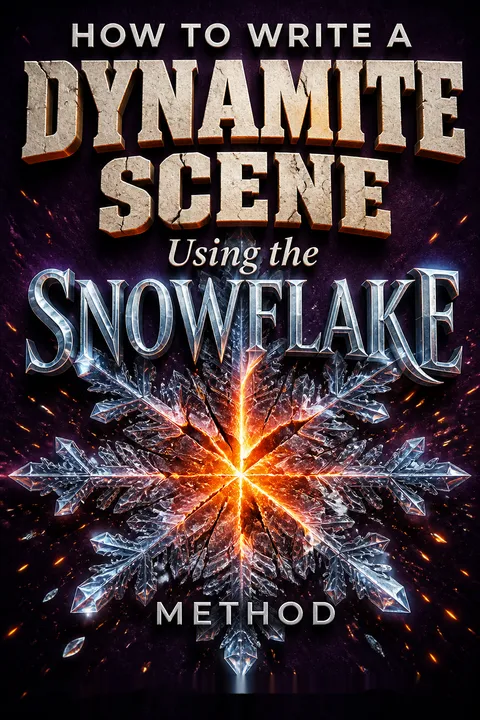

Key Takeaways
1. Story's Core: A Character in a Crucible
Story is what happens when you walk through great danger in somebody else’s skin.
Reader's primal need. Your reader desperately craves Story, not as a luxury, but as a fundamental human necessity. Story provides a safe, vicarious experience of facing danger, building emotional muscle memory that helps individuals and communities survive and thrive in real life. By immersing themselves in a character's journey, readers gain resilience and understanding without personal risk.
Two essential components. Every compelling story, whether a novel or a single scene, boils down to two core elements: a Character and a Crucible. The Character is someone the reader can deeply relate to, who desperately desires to have, be, or do something. The Crucible is the formidable force—be it the world, other characters, or internal flaws—that relentlessly prevents the Character from achieving that desire, creating intense misery and compelling narrative tension.
Relatability through struggle. Readers connect with characters because they, too, face their own crucibles and unfulfilled desires. Witnessing a character's struggle to break free from their crucible makes the reader's own life more bearable and provides a powerful emotional experience. This dynamic ensures that the story is never boring, as it focuses solely on the character's journey through terrifying and transformative challenges.
2. Every Scene is a Miniature Story
If a scene isn’t a story, all on its own, then it’s a bad scene.
Scene as a microcosm. Just as a novel is a grand story, every individual scene within it must function as a complete, self-contained miniature story. This means each scene needs its own distinct beginning, middle, and end, designed to deliver a powerful emotional experience to the reader. This principle is crucial for maintaining reader engagement and ensuring that no part of your narrative feels superfluous or dull.
Miniature Character and Crucible. For a scene to be a miniature story, it must feature a Point-of-View (POV) Character navigating a miniature Scene Crucible. While the overarching Story Crucible spans the entire novel, the Scene Crucible is a specific, immediate challenge that the POV Character faces within that particular scene. This smaller crucible is introduced, confronted, and ultimately broken by the scene's end, paving the way for a new challenge in the subsequent scene.
Focused narrative impact. Resist the urge to use scenes merely for exposition, backstory, or character development in isolation. While these elements can be woven into a scene, their primary purpose must be to advance the miniature story. By ensuring each scene has its own character in a crucible, you guarantee that every moment contributes to the reader's emotional journey, providing information just when it's needed and keeping the narrative momentum strong.
3. Master Your Point-of-View Character
The person with the most to lose in a scene will probably have the most powerful emotional experience.
Reader's emotional anchor. In every scene, your reader needs to step inside the skin of one specific character to fully experience the emotional stakes. This character, the Point-of-View (POV) Character, serves as the reader's emotional yardstick, dictating whose fears, hopes, and struggles they will intimately share. Choosing the right POV Character is paramount for maximizing the scene's emotional impact.
Selecting the POV. When deciding on your POV Character for a scene, ask yourself: "Who has the most to lose?" This character will naturally have the most powerful emotional experience, making them an ideal candidate to immerse the reader. While some stories maintain a single POV, many utilize multiple, requiring a deliberate choice for each scene to ensure the highest emotional resonance.
Viewpoint and Tense choices. Beyond selecting the POV Character, you must also choose the narrative viewpoint and tense.
- Viewpoints:
- First-Person: "I," "me" – reader is inside the character's head.
- Second-Person: "You" – reader is the character (rare).
- Third-Person: "He," "she," "Yung" – reader is inside the character's head, but from an external perspective.
- Third-Person Objective: Camera-like, external view, no internal thoughts.
- Head-Hopping: Switches POV within a scene (controversial).
- Omniscient: God's-eye view, knows all thoughts/feelings (rare today).
- Tense: Past (most common), Present (increasingly popular), Future (rare). These choices dictate how vividly you create the "movie" in your reader's mind, conveying not just actions but also internal states.
4. Proactive Scenes: Goal, Conflict, Setback
Establish the POV Character’s Goal as quickly as possible, preferably in the first sentence of the scene.
The proactive sequence. A Proactive Scene is one of two fundamental scene structures, characterized by a clear sequence: Goal, Conflict, and typically a Setback (though occasionally a Victory). This structure taps into the reader's admiration for characters who bravely confront danger, fostering identification and a strong desire to see them succeed. It's about the character actively pursuing something.
Crafting a dynamite Goal. The scene's Goal must be:
- Time-bound: Achievable within the scene's duration (minutes to hours).
- Possible yet difficult: Challenging but not ridiculously so, pushing the character to their limits.
- Character-aligned: Consistent with the POV Character's core Values, Ambition, and overarching Story Goal.
- Concrete and objective: Something tangible that the reader can clearly root for, with a measurable outcome.
Establishing this Goal early, ideally in the first sentence, immediately transforms the scene into a miniature story.
Engaging the Conflict. The Conflict forms the bulk of a Proactive Scene, arising directly from the Scene Crucible. It's a relentless cycle where the POV Character attempts to achieve their Goal, only to be met with resistance from the environment, other characters, or internal struggles. This back-and-forth struggle builds emotional muscle in the reader, creating tension and keeping them invested. The intensity of the conflict should align with your genre and target audience's expectations.
5. Reactive Scenes: Reaction, Dilemma, Decision
Your reader is just hoping your Character will make the best Decision possible, given the options.
The reactive sequence. Following a Proactive Scene's Setback, a Reactive Scene provides a crucial period for the POV Character to process, strategize, and commit to a new course of action. Its structure is: Reaction, Dilemma, and Decision. These scenes allow for emotional processing and rational planning, preventing the character from appearing inhumanly resilient or impulsively reckless.
Authentic emotional Reaction. The scene begins with the POV Character's emotional Reaction to the previous Setback. This isn't just stating an emotion; it's showing it through physical manifestations and internal monologue, allowing the reader to empathize with the character's pain, fear, or frustration. The Reaction must be:
- Shown, not told: Use "Interior Emotion" techniques.
- Personality-driven: Consistent with the character's temperament.
- Proportional: Reflecting the severity of the Setback.
- Purposeful: Leading naturally into the next stage without excessive wallowing.
Navigating the Dilemma. After the initial emotional storm, the character faces a Dilemma—a situation with no truly good options, only varying degrees of bad ones. This is where the character, or a helpful sidekick, rationally (or seemingly rationally) weighs the pros and cons of potential actions. The Dilemma highlights the character's reasoning, values, and internal contradictions, forcing them to prioritize what truly matters. This phase can be complex, revealing the character's depth as they prune down options to the "least bad" choice.
Committing to a Decision. The Reactive Scene culminates in a clear, committed Decision. This isn't mere contemplation; it's the character fully embracing a chosen path, even if it's risky. A strong Decision:
- Is a forcing move: Reduces options for other characters.
- Forms a strong Goal: For the subsequent Proactive Scene.
- Acknowledges risk: The character understands and accepts the dangers.
- Demonstrates full commitment: The character is "all in."
This decisive moment creates a new open loop for the reader, compelling them to turn the page to see the consequences of this commitment.
6. Leverage Setbacks to Propel Your Narrative
When you end a scene with a Setback, you’re exploiting the so-called “Zeigarnik effect”—the heightened focus that all humans have when they face an open loop.
The power of dissatisfaction. While a Victory might feel good in the moment, it often allows the reader to relax and potentially put the book down. Setbacks, however, are the engine of continuous engagement. By ending most Proactive Scenes with a Setback—a loss for the protagonist or a win for the antagonist—you create an "open loop" in the reader's mind. This psychological phenomenon, the Zeigarnik effect, compels them to seek closure, forcing them to turn the page and continue reading.
Setbacks drive forward momentum. A Setback is not merely a failed attempt; it's a significant blow that leaves the POV Character worse off than at the scene's beginning. This dramatic shift in fortune creates urgency and raises the stakes for the overall story. It forces the character to re-evaluate, react, and make new decisions, directly fueling the narrative progression.
Bittersweet victories. While pure Victories should be rare, a "bittersweet" ending—a Victory marred by a significant Setback—can be just as effective as a pure Setback in maintaining reader engagement. For example, a character might achieve their immediate goal but suffer a profound personal cost or create a new, more dangerous enemy. This mixed outcome provides a momentary sense of achievement while simultaneously creating new, compelling open loops that demand resolution.
7. Triage Your Scenes: Fix, Keep, or Kill
If your scene is not pulling its weight and can’t ever pull its weight, then slit its throat, because it’s sucking the life out of your story.
Editing as battlefield triage. After the first draft, every scene requires critical evaluation, much like a medic triaging patients. You have three options for each scene:
- Yes: The scene is strong, well-designed, and executed, requiring only minor tweaks.
- No: The scene is fundamentally broken, cannot be salvaged, and must be cut.
- Maybe: The scene has potential but needs significant redesign and rewriting.
Criteria for a "Yes" or "No." To earn a "Yes," a scene must:
- Function as a powerful miniature story.
- Deliver a powerful emotional experience.
- Have a clearly identifiable Scene Crucible.
Scenes that fail these tests and offer no compelling reason for their existence, or no clear path to improvement, should be ruthlessly cut. Avoid scenes that merely "set the stage" or "fill in backstory" without also telling a story.
The "Maybe" scene process. Most scenes will fall into the "Maybe" category, requiring dedicated effort to transform them.
- Identify scene type: Determine if it should be Proactive (Goal, Conflict, Setback) or Reactive (Reaction, Dilemma, Decision).
- Define core elements: Clearly articulate the Goal/Reaction, Conflict/Dilemma, and Setback/Decision, along with the Scene Crucible.
- Assess emotional impact: Pinpoint the powerful emotional experience you intend for the reader.
- Rewrite: Execute the scene based on the refined design.
- Re-triage: After rewriting, re-evaluate the scene to ensure it now meets the "Yes" criteria. This iterative process is essential for crafting dynamite scenes that consistently engage your reader.
Review Summary
How to Write a Dynamite Scene Using the Snowflake Method receives an overall 4.32/5 rating. Readers praise Ingermanson's clear breakdown of proactive and reactive scene structure, noting the book's accessibility and practical examples from well-known novels like The Hunger Games, Outlander, and The Godfather. However, several reviewers find the title misleading, as the book doesn't extensively apply the Snowflake Method to scenes but rather teaches standard scene-writing techniques. Some felt it offered little new information beyond what's available in other writing books or online resources, while beginners found it invaluable for understanding scene fundamentals and emotional impact.
People Also Read

About the Author
Other books by Randy Ingermanson
Download PDF
Download EPUB
.epub digital book format is ideal for reading ebooks on phones, tablets, and e-readers.








































