
Key Takeaways
1. Embrace Simplicity and Clarity in All Communication
To use a big word or a foreign word when a small one and a familiar one will answer the same purpose, is a sign of ignorance.
Clarity is paramount. Effective communication hinges on expressing thoughts in a clear, unambiguous manner that anyone can understand. Avoid pompous or pedantic language, as it often obscures meaning rather than enhancing it. The goal is to convey your message directly and efficiently, ensuring no misunderstanding.
Simplicity's power. Great scholars and polite speakers consistently opt for simple, familiar words. For ordinary conversation and writing, a vocabulary of about 2,000 words is sufficient. Using overly complex or foreign terms when simpler alternatives exist often signals a lack of genuine understanding or an attempt to impress rather than communicate.
Three essentials. The English language demands Purity, Perspicuity, and Precision.
- Purity: Use good English, free from slang, vulgarisms, obsolete terms, or ungrammatical constructions.
- Perspicuity: Express thoughts clearly and unequivocally, avoiding double meanings or ambiguous words.
- Precision: Be concise and exact, eliminating redundancy and tautology, striking a balance between overly long and too abrupt sentences.
2. Master the Foundational Principles of English Grammar
In order to speak and write the English language correctly, it is imperative that the fundamental principles of the Grammar be mastered.
Grammar's necessity. A solid grasp of grammar is indispensable for correct speech and writing. Without understanding the underlying principles of sentence formation and word relationships, one risks making egregious blunders, much like a parrot repeating phrases without comprehension. Grammar provides the framework for coherent expression.
Divisions of grammar. English grammar is traditionally divided into four main areas, each addressing a different aspect of language structure:
- Orthography: Deals with letters and their combination into words.
- Etymology: Focuses on word classes (parts of speech) and their changes.
- Syntax: Governs the connection and arrangement of words in sentences.
- Prosody: Concerns the manner of speaking, reading, and verse.
Parts of speech. All English words fall into nine categories: Article, Noun, Adjective, Pronoun, Verb, Adverb, Preposition, Conjunction, and Interjection. The Noun is central, with others often dependent on it. Understanding the function and inflection of each part—such as a Noun's person, number, gender, and case, or a Verb's tense and mood—is crucial for constructing grammatically sound sentences.
3. Construct Sentences and Paragraphs with Purpose and Precision
The proper placing of words depends upon perspicuity and precision.
Sentence structure. Every sentence must convey a complete thought, containing at least one finite verb and a subject. Sentences can be simple (single thought), compound (two or more equal simple sentences), or complex (one sentence dependent on another). Clarity in construction ensures the intended meaning is conveyed without confusion.
Word arrangement. The beginning and end of a sentence are the most impactful positions, drawing the reader's attention and carrying greater emphasis. Therefore, avoid starting sentences with weak words like "And" or "But," and never end them with prepositions or insignificant adverbs/pronouns. Proper word placement is vital for perspicuity, precision, and overall style.
Paragraph unity. A paragraph is a cohesive group of sentences serving a common purpose, closely related in thought. It should elaborate on a principal sentence, with each item illustrating, confirming, or enforcing the main idea. The first and last sentences of a paragraph are crucial for compelling attention, with the first stating a point clearly and the last enforcing it.
4. Utilize Figurative Language Judiciously for Impact
Figures make speech more effective, they beautify and emphasize it and give to it a relish and piquancy as salt does to food.
Enhancing expression. Figurative language employs words beyond their literal meaning to create more vivid, impressive, and energetic communication. Figures of Rhetoric, such as Simile, Metaphor, and Personification, are particularly important for giving language form, color, and life, making abstract ideas tangible and compelling attention.
Common figures and their use:
- Simile: Likens one thing to another using "like" or "as" (e.g., "memory is like wax"). Objects compared must be of different classes.
- Metaphor: Directly substitutes one object's action for another, implying resemblance without explicit comparison (e.g., "He is a pillar upholding the church"). Avoid mixed metaphors.
- Personification: Treats inanimate objects as if they were animate (e.g., "mountains sing").
- Allegory: A continued metaphor where words symbolize something else (e.g., Bunyan's "Pilgrim's Progress").
- Hyperbole: Exaggerated statement for effect (e.g., "head touched the clouds"). Use sparingly and within reason.
Avoid misuse. While figures add piquancy, they must harmonize with the character and purpose of the communication. Shun trite or far-fetched similes, mixed metaphors, and excessive hyperbole. The goal is to clarify and emphasize, not to obscure or sound ridiculous.
5. Punctuate for Clarity, Connection, and Rhetorical Force
The chief end of punctuation is to mark the grammatical connection and the dependence of the parts of a composition.
Purpose of punctuation. Punctuation primarily serves to clarify grammatical connections and dependencies within a text, ensuring the reader understands the intended structure and meaning. While it can also enhance rhetorical force, its main role is structural, guiding the reader through the flow of ideas.
Key punctuation marks:
- Comma [,]: Marks the slightest separation, used in series, before short quotations, after long subjects, for parenthetical expressions, and with non-restrictive clauses.
- Semicolon [;]: Indicates a slighter connection than a comma, often separating parts of compound sentences or contrasting ideas.
- Period [.]: Marks the end of a complete, non-interrogative, non-exclamatory sentence and is used in abbreviations.
- Interrogation [?]: Denotes a question.
- Exclamation [!]: Expresses strong emotion or surprise, to be used sparingly in prose.
- Dash [—]: Signifies a sudden break, repetition for effect, or an unexpressed conclusion.
- Parenthesis [()]: Encloses illustrative but non-essential expressions.
- Quotation [" "]: Indicates borrowed words or titles.
Capitalization rules. Capital letters are used for emphasis and distinction. They begin every sentence, direct quotation, line of poetry, and numbered clause. Proper names, titles, derived words, and names of the Supreme Being also require capitalization. Consistency in these rules ensures readability and proper emphasis.
6. Actively Avoid Common Grammatical Errors and Pitfalls
Even the best speakers and writers are sometimes caught napping.
Vigilance against errors. Even esteemed authors occasionally make grammatical slips, highlighting the need for constant vigilance. Common errors include incorrect article usage, pronoun-antecedent disagreement, and misapplication of adjective degrees. A keen awareness of these pitfalls is essential for maintaining correctness.
Frequent stumbling blocks:
- Redundancy/Tautology: Using unnecessary words or phrases that repeat meaning (e.g., "return back," "sum and substance").
- Pronoun Case: Confusing nominative and objective cases, especially after verbs or prepositions (e.g., "between you and I" should be "between you and me").
- Verb Agreement: Ensuring the verb matches its subject in person and number, particularly with collective nouns or separated subjects.
- Tense and Participle Confusion: Incorrectly using past participles for past tenses (e.g., "I seen" for "I saw") or vice versa.
- Shall/Will: Misusing these auxiliaries, which convey simple future action or determination depending on the person.
Subtle distinctions. Pay close attention to words like "only" and "alone," whose placement can drastically alter sentence meaning. Distinguish between "between" (two objects) and "among" (more than two), "less" (quantity) and "fewer" (number), and "rise" (intransitive) and "raise" (transitive). Avoid double negatives, split infinitives, and loose participles to ensure clarity and precision.
7. Cultivate a Natural, Reputable, and Unaffected Style
In letter writing the first and most important requisites are to be natural and simple; there should be no straining after effect, but simply a spontaneous out-pouring of thoughts and ideas as they naturally occur to the writer.
Authenticity in expression. A pleasing style is natural and simple, reflecting the writer's genuine thoughts without affectation or bombast. Straining for effect or adopting an overly ornate style repels readers, whereas a conversational and spontaneous tone engages them. Your style should be an honest reflection of who you are.
Diction and purity. The foundation of good style is diction—the careful choice of words. Use reputable, national, and current words, avoiding obsolete terms, provincialisms, and newly coined words until they gain acceptance. Good taste dictates that words are adapted to your purpose, while good use confirms their correctness.
Avoid stylistic pitfalls:
- Foreign words: Unless absolutely necessary and understood.
- Long words: When short ones suffice (e.g., "fire" over "conflagration").
- Technical jargon: Unless writing for specialists.
- Slang: Especially vulgar or unestablished forms.
- Poetical/antiquated words: In prose (e.g., "e'er," "verily").
- Trite expressions: Overused phrases like "sweet sixteen" or "busy as a bee."
8. Prioritize Short, Strong Anglo-Saxon Words
Most of the small words, the simple words, the beautiful words which express so much within small bounds belong to the pure Anglo-Saxon element of our language.
Power of brevity. Always prefer short words over long ones when they convey the same meaning. Long, learned words, often derived from other languages, can obscure thought and confuse the average reader. Simple words ensure that your message is accessible to the widest possible audience, from the "man in the street" to the scholar.
Anglo-Saxon heritage. The Anglo-Saxon element of English provides the core vocabulary for everyday life, expressing fundamental concepts and emotions with strength and terseness. These words are the language of the home, street, and farm, deeply ingrained from childhood. Examples include:
- Natural phenomena: Sun, moon, stars, earth, fire, water, day, night, rain, snow.
- Family relations: Father, mother, husband, wife, brother, sister, home.
- Core emotions: Love, hope, fear, sorrow, shame, tear, smile, laugh.
Universal understanding. Using Anglo-Saxon words ensures universal comprehension, as they are understood by both the learned and the unlearned. Great orators like Daniel Webster and Abraham Lincoln mastered this principle, using simple, clear, and strong terms to stir the souls of men and create enduring literary classics.
9. Write and Speak from Genuine Knowledge and Experience
Know what you write about, write about what you know; this is a golden rule to which you must adhere.
Authenticity is key. Effective writing and speaking stem from genuine knowledge and experience. Don't attempt to describe subjects you know nothing about; instead, draw from familiar themes and personal observations. This ensures originality and authenticity, making your communication more compelling and believable.
Learn from life. While book learning is valuable, practical experience and observation are equally, if not more, important. Many literary masters, like Shakespeare and Bunyan, excelled not primarily through formal education but by keenly observing human nature and interpreting the "book of nature" through their own genius. Poverty, for many, has been a spur to action and a source of profound insight.
Continuous observation. Keep your eyes open to the world around you. Every moment offers something of interest that can be transformed into a compelling narrative or insight. Whether describing a local event, interviewing a notable person, or reflecting on current affairs, ground your writing in tangible reality.
10. Persevere Relentlessly in Your Communication Journey
Perseverance counts more in the newspaper field than anywhere else, and only perseverance wins in the long run.
The path to mastery. Becoming a proficient writer or speaker is a journey that demands patience, labor, and unwavering perseverance. Natural talent is a gift, but consistent effort and practice are what refine and strengthen one's abilities. The best way to learn to write is simply to write, and to learn to speak is to speak.
Embrace feedback and setbacks. Be open to criticism and view those who point out your defects as friends. Rejection is an inevitable part of the process, especially in fields like newspaper writing. Instead of discouragement, let rebuffs act as stimulants for further effort. Many successful writers faced numerous rejections before finding their audience.
Continuous improvement. Constantly review and refine your work. Cut superfluous words, eliminate ambiguous expressions, and prune until your writing is as perfect as possible. Study the masters of language, not to copy them literally, but to understand their techniques and develop your own unique voice.
11. Understand and Navigate Slang with Discretion
We should avoid the use of slang as much as possible, even when it serves to convey our ideas in a forceful manner.
Slang's pervasive nature. Slang, consisting of unrefined but current words and phrases, has permeated nearly all ranks of society. While often effective in conveying ideas vigorously, it lacks the elegance and formality for polite speech or literature. Many use slang unconsciously, integrating it into their everyday vocabulary.
Distinction from cant. Slang differs from "cant," which is the esoteric language of a specific class, craft, or profession, intelligible only to the initiated (e.g., thieves' jargon). Slang, conversely, is widely understood across various social strata, though its specific forms may vary by locality.
Cautious usage. While some authors (like Dickens) might use slang for emphasis or humor in familiar writing, beginners should avoid it. Most slang originates from vulgar sources and carries a "bend sinister of vulgarity." Even "refined" slang, if of good birth but worn out, should be passed by.
Avoid low and coarse slang:
- "He hopped the twig" or "kicked the bucket" for "died."
- "Talking through his hat" for speaking ignorantly.
- "Tipped me his flipper" for shaking hands.
- "Plenty of spondulix" or "long green" for money.
Such expressions are coarse and should be frowned upon. If slang must be used, choose the refined kind and employ it like a gentleman, ensuring it causes no offense.
Review Summary
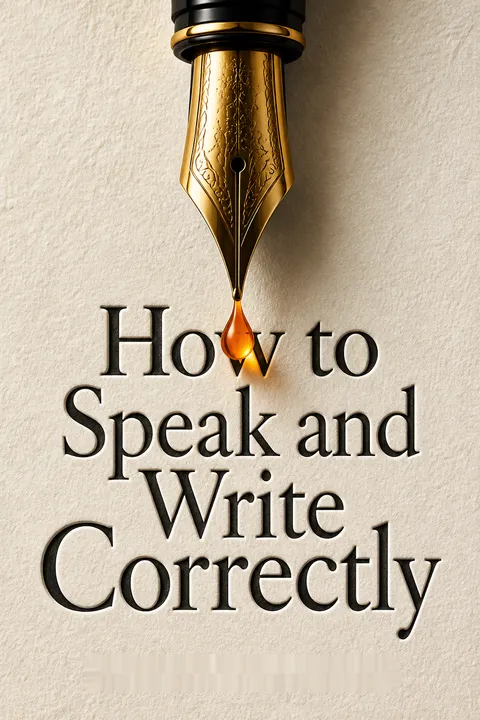
How to Speak and Write Correctly receives mixed reviews, with an average rating of 3.62/5. Readers appreciate its practical advice on grammar and writing, particularly the sections on language history and literary masterpieces. However, many find parts of the book outdated and tedious, especially the grammar explanations and letter-writing sections. Some praise its timeless wisdom on clear communication, while others argue it's no longer relevant for modern readers. The book's list of great authors and works is popular, though some wish for more explanation behind the selections.
People Also Read








Download PDF
Download EPUB
.epub digital book format is ideal for reading ebooks on phones, tablets, and e-readers.








































