

Key Takeaways
Day trading pays like surgery because it's as hard as surgery
The get-rich-quick fantasy kills accounts. Court records released in Massachusetts revealed that after six months of trading, only 16% of day traders actually made money. The other 84% bled cash. Aziz insists day trading is a profession comparable to medicine, law, or engineering, not gambling or a lottery ticket.
The payoff is real but earned. A skilled trader might net $500 to $1,000 daily, roughly $120,000 to $240,000 a year. Aziz's own start was seductive and dangerous: as a beginner he turned a lucky bet on a pharma stock (AQXP) into $6,000 in minutes, then lost it all within weeks. That early jackpot taught him the market's cruelest lesson: beginner's luck breeds the delusion that easy money is repeatable.
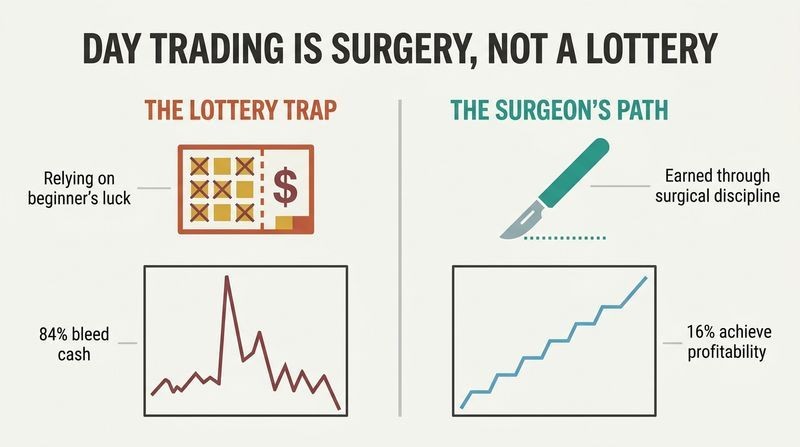
The 84% failure figure echoes findings from Brazilian and Taiwanese academic studies, where researchers found fewer than 1% of day traders reliably beat market returns after fees. What Aziz reframes usefully is the comparison to startups, where roughly 90% fail within a few years. Failure is the baseline in any high-variance venture. The nuance worth adding: survivorship bias saturates trading education. The visible winners write books and run chatrooms; the silent majority quietly close accounts. Readers should weigh whether they possess the temperament, capital, and time before treating this as a career path rather than an expensive hobby.
Your only real job is managing risk, not picking stocks
Your broker buys and sells; you manage exposure. Aziz's core reframe is that a day trader is a risk manager, not a stock picker. Every strategy rests on a three-legged stool: proven strategies, disciplined risk management, and controlled psychology. Remove one leg and it collapses.
The 2% rule and 2:1 minimum. Never risk more than 2% of your account on a single trade (think of milk, 2%). His three-step sizing: decide max dollar risk, calculate risk per share (the distance to your stop loss), then divide the first by the second to get your maximum share size. He only takes trades where potential reward is at least twice potential loss. With a 2:1 ratio, a trader can be wrong 40% of the time and still profit. About 30% of his own trades lose.
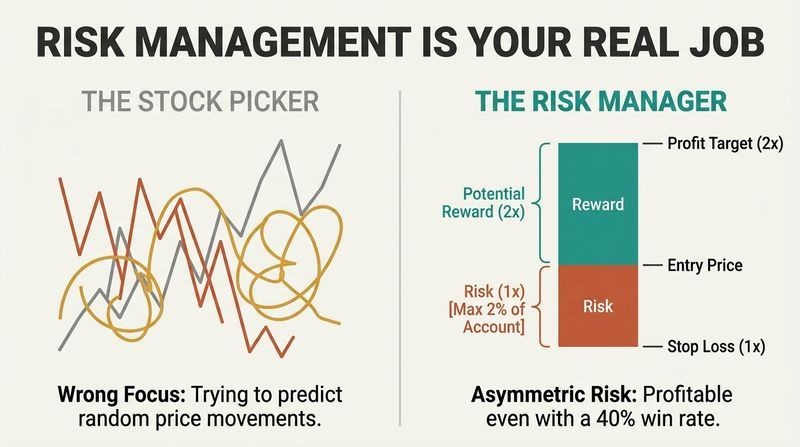
This is the most transferable idea in the book, and it maps directly onto expected-value thinking used in poker and insurance. The insight that you can be wrong 40% of the time and still win reframes success away from accuracy toward asymmetry, a principle Nassim Taleb calls convexity. The behavioral obstacle is loss aversion: Kahneman and Tversky showed losses feel roughly twice as painful as equivalent gains, which is precisely why traders hold losers and cut winners. Aziz's fixed-percentage rule externalizes discipline, removing in-the-moment emotional negotiation. The weakness: position sizing math under time pressure is genuinely hard, which is why he prescribes months of simulator drilling.
Trade only the two or three stocks everyone else is watching
Stocks in Play are your hunting ground. Aziz coins Stocks in Play as high-relative-volume stocks moving on a fresh fundamental catalyst (earnings, FDA rulings, mergers, layoffs) independent of the overall market. He nicknames them Alpha stocks: predators atop the food chain that neither the market nor algorithms can fully control.
Retail traders win by crowding together. His pre-market scanner flags stocks that gapped at least 2%, trade over 500,000 shares daily, and have an Average True Range above 50 cents. From thousands of stocks he narrows to seventeen candidates, then to just two or three. He deliberately avoids mega-caps like Apple unless they show unusual volume, because those are dominated by institutional algorithms. The strength of retail strategies is that other retail traders use them too, making support and resistance levels self-fulfilling.
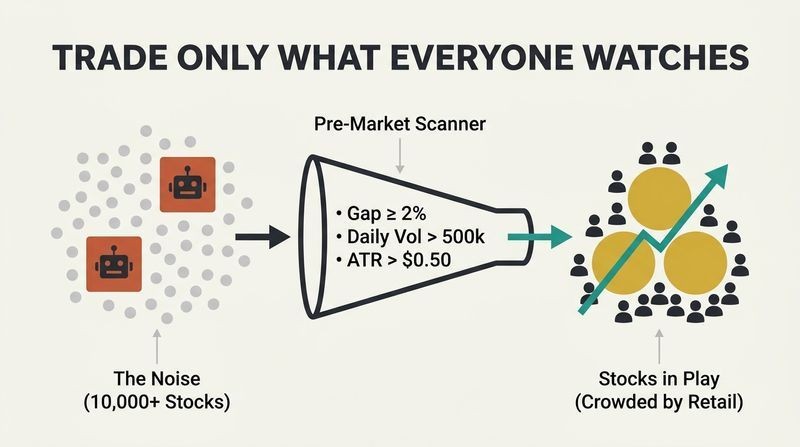
The self-fulfilling-prophecy logic is the book's sharpest strategic insight and connects to game theory's concept of Schelling points, focal solutions people converge on without communication. When thousands of retail traders draw the same support line, buying there becomes rational because everyone else buys there. This is also its fragility: when the crowd's shared belief breaks, the exit stampede is violent. Aziz's guerrilla-warfare metaphor (small, mobile, hit-and-run against a larger force) is apt, but it underplays that institutions increasingly deploy algorithms trained to detect and exploit exactly these retail crowding patterns. The edge is real but perishable, requiring constant adaptation as he himself acknowledges through the veteran trader Kem's story.
Read candlesticks as a live map of crowd psychology
Every candle is a battle between buyers and sellers. Aziz treats the day trader as a social psychologist with charting software. A candlestick shows the open, high, low, and close for a time period. Hollow (or white) candles, where price closed higher than it opened, signal buying pressure. Filled (red) candles, where it closed lower, signal selling pressure.
Indecision candles warn of reversals. Spinning tops and Dojis (candles with tiny bodies and long wicks) reveal a standoff where neither side wins. A long upper wick (shooting star) means buyers pushed up and failed. A long lower wick (hammer) means sellers pushed down and failed. These hint that a trend may flip, but Aziz cautions they only indicate indecision, not certainty. He dismisses fancy named patterns like Three Black Crows as wishful thinking that traders see based on their mood.
The framing of markets as mass psychology has deep lineage, from Charles Mackay's 1841 study of crowd manias to behavioral finance. Candlesticks originated with 18th-century Japanese rice trader Homma, and their endurance suggests they encode something real about herd behavior. Aziz's skepticism toward elaborate patterns is intellectually honest and aligns with critiques that technical analysis often functions like a Rorschach test, confirming preexisting bias. The steelman: even if candlesticks have no predictive power in isolation, if enough traders act on them they generate real, tradeable momentum. That reflexivity, which George Soros elevated to theory, may matter more than whether the patterns are objectively meaningful.
Master one simple strategy before touching a second
Nine strategies, but master one first. Aziz teaches setups like the ABCD Pattern (a stock surges to a high, pulls back to a support Aziz calls point C, then he buys near C targeting a move higher), the Bull Flag (a pole of big candles followed by sideways consolidation before a breakout), Reversals, Moving Average trends, and his favorites: VWAP and Opening Range Breakouts. VWAP (Volume Weighted Average Price) is a moving average weighted by share volume that reveals whether buyers or sellers control price.
Simplicity reduces stress. His philosophy: a minimal method frees mental bandwidth for the psychological battle that separates winners from losers. Success is an evolution, not a revolution. These strategies have worked for over a decade precisely because they are simple, well-known, and widely traded.
The single-strategy discipline mirrors deliberate practice research by Anders Ericsson: expertise comes from narrow, focused repetition with feedback, not scattered dabbling. Trying nine strategies at once guarantees mastering none. There is also a cognitive-load argument here supported by decision science: under time pressure and stress, working memory narrows, so a trader juggling many contradictory indicators makes worse choices than one running a single clean playbook. The tension Aziz navigates is that no single strategy works in all market regimes, so eventually diversification of setups matters. His resolution, sequential mastery (learn one, prove it, add another), is a sound curriculum design borrowed from how skills actually compound.
Averaging down on losers is the account-killer to fear most
Never send good money after bad. Averaging down means buying more of a losing position to lower your average cost, hoping to break even on a bounce. Aziz says it works about 85% of the time, which is exactly the trap: the 15% of times it fails wipe out everything the 85% earned.
Two cautionary tales. Aziz rode a biotech ETF (LABU) down from $120, repeatedly adding shares until a margin call forced liquidation near the bottom, days before it rebounded. Worse, superstar trader Brian Hunter blew up the $9 billion Amaranth hedge fund in 2006 by stubbornly averaging down on natural gas, accepting a $6.6 billion loss. The lesson: even a $10 billion account wasn't big enough. The market can stay irrational longer than you can stay solvent.
The distinction Aziz draws, scaling into winners versus averaging down losers, is subtle and vital. Both look like adding to a position; only one respects the evidence. Averaging down implicitly assumes mean reversion, which holds until it catastrophically doesn't, producing the fat-tailed blowups that define trader ruin. The Amaranth case is a textbook example of what risk theorists call picking up pennies in front of a steamroller. Behaviorally, it stems from the sunk-cost fallacy and the ego's refusal to be wrong. The deeper principle, that your job is not to be right but to make money, is a psychological reframe worth more than any chart pattern.
Never hold a day trade overnight, even at a loss
Close everything before the bell. Aziz's Rule 3 is absolute: day traders flatten all positions before the market closes, selling at a loss if necessary. The temptation to convert a losing day trade into a swing trade, hoping tomorrow rescues you, is a rationalization that often deepens losses, since many volatile stocks lose even more value overnight.
His own $25,000 lesson. In June 2020 Aziz entered American Airlines without a stop loss, ignoring warnings from his own community, betting the government would bail out airlines. He should have accepted a $1,000 loss. Instead he clung to hope and ate a $25,000 loss in front of his peers. Human nature grabs profits fast but waits endlessly for losers to recover. Discipline means overriding that instinct every single time.
This rule enforces a clean separation between two different businesses (intraday speculation versus multi-day positioning) that require different tools, timeframes, and risk models. The overnight-gap risk is genuine: news breaks after hours, and retail traders can't react. What makes the confession valuable is that Aziz, an experienced professional, still fell for hope-based trading, illustrating that discipline is not a trait you acquire and keep but a muscle requiring constant exercise, as he puts it. This resonates with research on ego depletion and decision fatigue: willpower degrades under stress, which is why mechanical rules outperform in-the-moment judgment. The rule substitutes a bright line for fragile self-control.
Treat your body like trading equipment, because it is
Physical state drives decision quality. Aziz borrows Nike's five facets of athletic training and adapts them: technical knowledge, risk management, nutrition, sound psychology, and sleep. Trade sleep-deprived, over-caffeinated, or hungover, and results suffer measurably. He compares day trading to elite athletics: it is judged by daily performance under stress.
A morning routine that primes the brain. Aziz wakes at 4:30 a.m., runs 7 to 10 kilometers, showers, eats oatmeal, and starts building his watchlist at 6 a.m. He cites research that aerobic exercise improves attentional control, working memory, cognitive flexibility, and processing speed. He quit coffee, alcohol, and animal products and says his performance rose. Rolling out of bed in your pajamas fifteen minutes before the open, he warns, is no way to attack the market.
The link between physiology and financial decision-making has hard science behind it. Neuroscientist John Coates, a former Wall Street trader, showed in studies of real traders that cortisol and testosterone levels measurably shift risk appetite, and that stressed, sleep-deprived traders make systematically worse calls. Aziz's routine functions as what psychologists call a keystone habit: exercise cascades into better sleep, mood, and impulse control. The dietary claims are more personal than proven, and readers should treat the veganism and caffeine abstinence as his n-of-1 experiment rather than prescription. The generalizable core, that cognitive performance is a physical output requiring physical inputs, is well-supported and too often ignored by desk-bound professionals.
Trade the plan you wrote before the bell, never improvise
Plan the trade, trade the plan. Aziz's process has six steps: morning routine, build watchlist, organize plan, initiate, execute, then journal and reflect. Before the open he writes if-then scenarios on note cards: if price fails to hold VWAP in the first fifteen minutes, then short toward the previous day's close. Having the plan literally in front of his face eliminates the anxiety he used to feel at the opening bell.
Name every strategy you trade. In his chatroom he announces his setup aloud before entering, for example going long for a one-minute Opening Range Breakout with a stop below VWAP. If you cannot name why you are in a trade and which strategy it belongs to, you should not be in it. Naming prevents strategy-less gambling.
The if-then structure is what psychologist Peter Gollwitzer calls implementation intentions, and decades of research show they dramatically increase follow-through by pre-deciding behavior so the moment of action requires no deliberation. This is arguably the book's most evidence-backed technique, even though Aziz arrives at it through experience rather than citation. Announcing the strategy name aloud adds an accountability and metacognition layer, forcing explicit classification that surfaces bad trades before they happen. The connection to checklists is direct: surgeon Atul Gawande showed that pre-committed protocols reduce errors in high-stakes, time-pressured environments. Markets qualify. The plan converts chaotic real-time judgment into calm execution of prior decisions.
Journal every trade like a surgeon keeps patient records
Records make you a better trader. Aziz asks whether any surgeon memorizes every patient's history without records. None do. He video-records his morning trades and reviews them at midday, noting entries, exits, Level 2 signals, and mistakes. Watching the tape reveals how slow the market actually is once the emotion of live money is stripped away, and it exposes patterns he traded backward.
What to log. His journal captures physical well-being, time of day, intended strategy, how he found the trade, entry quality, position management, and exit execution. Online tools like Tradervue surface hard facts: biggest win, biggest loss, win-to-loss ratio, commissions paid, and best and worst hours. A good trading day, he insists, is a disciplined day that followed sound strategy, not merely a green one. Profit is a by-product of process.
The reframe of a good day as a disciplined day rather than a profitable one is the book's most mature psychological move, decoupling self-evaluation from outcome, which is exactly how poker professionals and elite performers separate decision quality from results (variance means good decisions sometimes lose). Recording and reviewing performance is the feedback half of deliberate practice; without it, repetition just entrenches errors. Aziz's observation that video makes the market look slow points to how arousal distorts time perception under stress, a documented phenomenon. The discipline gap he identifies (everyone can read the book, few will journal daily) is where most of the value quietly lives, and most readers will skip it.
You cannot become a great trader trading alone
Isolation breeds failure. Aziz built Bear Bull Traders on the motto Don't Trade Alone, and the foreword by SMB Capital's Mike Bellafiore drives it home: no one becomes great in a vacuum. New traders absorb mentors' habits like sponges, and seeing experienced traders also take losses normalizes the inevitable. Aziz tried trading in a media blackout bubble; it failed.
Community with independence. The case study of John, a retired Army lieutenant colonel, embodies the balance. John endured a disastrous revenge-trading day (a hulk day) losing $2,600, then turned around by adopting community advice: risk a fixed amount per trade (thinking in R units), risk small until consistent, use hard stops, and master one strategy. Yet Aziz warns against blindly following the herd. Successful traders are independent thinkers who use community for learning, not for someone to mirror or blame.
The tension Aziz holds (belong to a group but think independently) is genuinely hard and echoes findings on collective intelligence: groups improve individual judgment through diverse feedback but degrade it through conformity cascades and groupthink. The prop-firm insight from Bellafiore is telling: traders who leave firms often fail alone because their discipline was external, enforced by managers, never internalized. This maps onto self-determination theory, where sustainable performance requires converting external motivation into autonomous self-regulation. John's story is the book's proof of concept, though as a single hand-picked success it carries obvious survivorship bias. Still, the mechanism (community accelerates the learning curve while the individual must own the edge) is sound and widely observed in skill acquisition.
Analysis
How to Day Trade for a Living is a practitioner's field manual, not a theoretical text. Aziz, a chemical-engineering PhD turned trader, structures it thesis-first (day trading is a serious profession, not a lottery) then layers mechanics: risk management, stock selection, tools, candlesticks, nine strategies, and psychology. Its 2020 pandemic revision responds to the Robinhood-fueled retail surge, addressing new brokers and commission-free apps. The challenge in summarizing it is that much of its bulk is procedural detail (Hotkey scripts, scanner parameters, broker comparisons) that dates quickly, while the durable value concentrates in a handful of psychological and risk principles.
The book's intellectual spine is stronger than typical trading literature because Aziz repeatedly subordinates technique to temperament. His insistence that the trader's job is managing risk rather than predicting prices, that being wrong 40% of the time is compatible with profit, and that a good day is a disciplined day regardless of P&L, reflects genuine understanding of the probabilistic, emotion-laden nature of speculation. These ideas align with behavioral finance (loss aversion, sunk-cost fallacy) and expert-performance research (deliberate practice, implementation intentions) even where Aziz reaches them empirically rather than academically.
The book's blind spot is the one endemic to the genre: it cannot escape its own incentive structure. Aziz runs a paid trading community and a prop firm, and the book funnels readers toward both. The 84% failure statistic is stated honestly, yet the narrative energy pushes toward the 16% who make it, powered by hand-selected success stories. Absent is rigorous engagement with academic evidence that day trading is a near-zero-sum game where retail participants systematically lose to institutions over time. Read critically, it is an excellent operational primer wrapped around sober risk wisdom; read uncritically, it risks recruiting exactly the impulsive gamblers Aziz warns against. The reader's discipline, fittingly, determines its value.
Review Summary
How to Day Trade for a Living by Andrew Aziz receives mostly positive reviews. Readers appreciate its straightforward approach, practical strategies, and emphasis on risk management. Many find it helpful for beginners, offering clear explanations of day trading basics. Some criticize repetitiveness and promotion of the author's website. The book stresses the importance of discipline, practice, and realistic expectations. While some experienced traders find it too basic, most agree it provides a solid foundation for those interested in day trading.
People Also Read

Glossary
Stocks in Play
Catalyst-driven high-volume trading targetsAziz's term for the handful of stocks each day worth trading: those with unusually high relative volume driven by a fresh fundamental catalyst (earnings, FDA news, mergers, layoffs), moving independently of the overall market and their sector. He also calls them Alpha stocks. Retail day traders focus exclusively on these because their price moves are predictable, catchable, and less controlled by institutional algorithms.
VWAP
Volume-weighted average price indicatorVolume Weighted Average Price, a moving average that factors in the number of shares traded at each price, not just price alone. Aziz calls it the single most important day-trading indicator. Trading above VWAP signals buyers control the stock; below it, sellers do. Institutions use it to judge whether large orders were filled at good prices, making it a magnet for price action.
The 2% rule
Maximum risk per tradeAziz's inviolable risk-management rule: never expose more than 2% of your total account to loss on any single trade. He suggests remembering it via 2% milk. Combined with his three-step position-sizing method (max dollar risk divided by risk per share equals share size), it ensures that at least 98% of the account survives any one trade going wrong.
Averaging down
Adding to losing positionsBuying more shares of a losing position to lower your average cost, betting on a rebound to break even or profit. Aziz identifies this as the deadliest beginner mistake. It succeeds roughly 85% of the time, but the 15% of catastrophic failures erase all prior gains and blow up accounts. He distinguishes it sharply from scaling into winning positions, which he endorses.
ABCD Pattern
Surge, pullback, support, breakout setupA basic day-trading pattern: a stock surges from point A to a new high (B), pulls back to a support level (C) that holds above A, then resumes upward (D). Aziz enters near C with a stop just below it, minimizing risk while targeting the move toward D or higher. Its reliability comes partly from how many traders watch for it.
Bull Flag
Momentum consolidation breakout patternA momentum pattern resembling a flag on a pole: several large upward candles (the pole) followed by small sideways candles (the flag) as early buyers take profits during consolidation. Traders enter as price breaks above the consolidation. Aziz favors it for volatile low-float stocks under $10 and treats it as a scalping strategy requiring fast execution.
Opening Range Breakout (ORB)
Trading the post-open range breakA strategy that waits out the violent price action in the first minutes after the 9:30 a.m. open, then trades in the direction price breaks the initial range (up or down). Aziz uses 1-minute or 5-minute ranges, entering long on upward breaks and short on downward ones, with VWAP as his stop reference. It signals entry only; the trader must define exits separately.
Stop loss
Predetermined exit price for lossesThe price level, set before entering a trade, at which you accept the loss and exit. Aziz insists it be placed at a reasonable technical level and honored without alteration mid-trade. If you don't know where your stop belongs, he says, you shouldn't be in the trade. Failing to respect stops is a leading cause of account destruction.
R
Fixed money risked per tradeShorthand, used in trader John Hiltz's case study, for the fixed dollar amount risked on each trade. Losing a trade is a -1R loss; making twice your risk is a 2R gain. Thinking in R units instead of raw dollars builds emotional consistency and patience, letting a trader conceptualize a bad start (say -2R) and the good setup needed to recover.
Pattern Day Trade Rule
$25,000 US minimum equity requirementA US regulation requiring anyone who day trades four or more times in five business days to maintain at least $25,000 in their account. Aziz frames it as protective, shielding undercapitalized amateurs. It does not apply to offshore brokers or most non-US residents, creating a workaround for those with smaller accounts, albeit with higher risk and looser regulation.
FAQ
What's How to Day Trade for a Living about?
- Comprehensive Guide: The book is a detailed guide to day trading, focusing on essential tools, strategies, and psychological aspects necessary for success.
- Beginner-Friendly: It is designed for both novice and intermediate traders, providing clear explanations and practical advice.
- Real-World Examples: Author Andrew Aziz shares personal experiences and case studies to illustrate key points and strategies.
Why should I read How to Day Trade for a Living?
- Proven Strategies: The book outlines effective day trading strategies that have been tested and proven successful by the author and his community.
- Risk Management Focus: It emphasizes the importance of risk management, helping readers protect their capital while trading.
- Community Support: Readers are encouraged to join trading communities for valuable support and insights.
What are the key takeaways of How to Day Trade for a Living?
- Serious Commitment: Day trading is not a get-rich-quick scheme; it requires dedication, discipline, and a solid plan.
- Psychological Importance: Managing emotions and maintaining discipline are crucial for trading success.
- Essential Tools: The book highlights necessary tools like trading platforms and scanners for effective strategy execution.
What are the best quotes from How to Day Trade for a Living and what do they mean?
- "Plan a trade, and trade the plan.": Emphasizes the importance of a structured approach to trading, ensuring decisions are based on analysis.
- "Profitable trading does not involve emotion.": Highlights the need for a disciplined and rational approach to avoid poor decisions.
- "What goes up, must come down.": Reflects the cyclical nature of markets, reminding traders to be cautious of reversals.
What is the ABCD Pattern in day trading according to How to Day Trade for a Living?
- Basic Trading Pattern: The ABCD Pattern is a simple yet effective strategy identifying potential reversal points in stock prices.
- Structure: It consists of four points: A (start), B (peak), C (pullback), and D (next peak).
- Entry and Exit: Traders enter at point C, anticipating a move to point D, with a stop loss set below point C.
How does the Opening Range Breakout (ORB) strategy work in How to Day Trade for a Living?
- Initial Setup: The ORB strategy involves observing price action during the first five to fifteen minutes after market open to establish a range.
- Entry Point: Traders enter when the price breaks above or below this range, indicating a potential trend continuation.
- Risk Management: A stop loss is placed just outside the opening range to protect against false breakouts.
How does risk management play a role in day trading according to How to Day Trade for a Living?
- Protecting Capital: Effective risk management minimizes losses and protects trading capital, essential for long-term success.
- Position Sizing: The book advises not to risk more than 2% of your trading account on any single trade.
- Stop Loss Orders: Implementing stop loss orders helps exit losing trades before they escalate into larger losses.
What are some common mistakes new day traders make as outlined in How to Day Trade for a Living?
- Overtrading: New traders often trade too frequently, leading to high commissions and emotional exhaustion.
- Ignoring Risk Management: Many beginners fail to implement proper risk management strategies, leading to significant losses.
- Averaging Down: Adding to losing positions in hopes of breaking even can lead to devastating losses.
What is the importance of trading psychology in How to Day Trade for a Living?
- Emotional Control: Successful traders manage their emotions and do not let losses affect their decision-making.
- Discipline: Maintaining discipline in following trading plans and strategies is crucial for consistent results.
- Self-Reflection: Traders are encouraged to analyze their performance and emotional state regularly to improve.
What is the significance of VWAP in How to Day Trade for a Living?
- Volume Weighted Average Price: VWAP helps traders understand the average price a stock has traded at throughout the day, weighted by volume.
- Market Control Indicator: Prices above VWAP indicate buyer control, while prices below suggest seller dominance.
- Trading Strategy: Traders use VWAP as a support or resistance level, entering trades when the price respects these levels.
How can I develop my own trading strategy based on How to Day Trade for a Living?
- Start with Basics: Master one or two strategies discussed in the book, such as the ABCD Pattern or VWAP trading.
- Create a Trading Plan: Develop a detailed plan including entry and exit strategies, risk management rules, and specific goals.
- Practice and Reflect: Use a simulator to practice strategies, keeping a journal to reflect and refine your approach.
What is the difference between day trading and swing trading as explained in How to Day Trade for a Living?
- Time Frame: Day trading involves buying and selling stocks within the same day, while swing trading holds positions for days or weeks.
- Trading Strategies: Day traders focus on short-term price movements; swing traders look for longer-term trends.
- Risk Management: Day traders manage overnight risks by closing positions before market close, unlike swing traders.
Download PDF
Download EPUB
.epub digital book format is ideal for reading ebooks on phones, tablets, and e-readers.








































