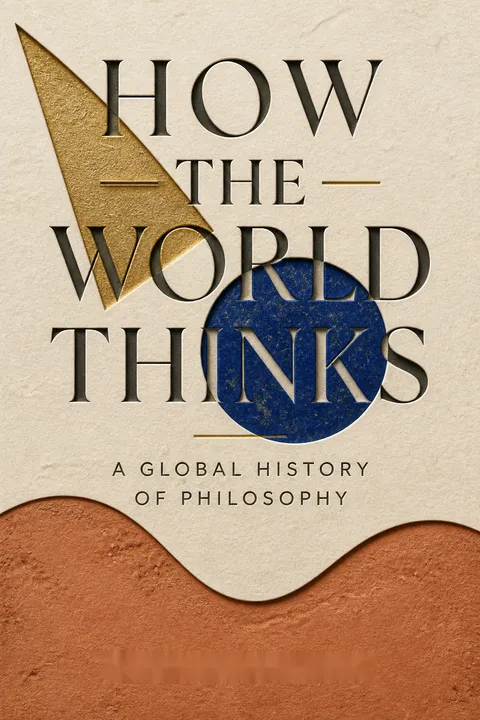

Key Takeaways
1. Global Epistemologies: Beyond Western Secular Reason
To travel around the world’s philosophies is an opportunity to challenge the beliefs and ways of thinking we take for granted.
Diverse sources. How the world knows is not uniform; different cultures prioritize distinct sources of knowledge. While Western philosophy champions secular reason, logic, and empirical evidence, other traditions emphasize insight, tradition, and the ineffable. This diversity reveals that our assumptions about what constitutes "knowledge" are culturally shaped, not universal.
Western emphasis. The West, particularly since the Enlightenment, has foregrounded secular reason, logic, and scientific inquiry. Knowledge is often seen as objectively verifiable, independent of personal experience or divine revelation. This approach has driven scientific and technological progress, but it can also lead to an overconfidence in purely rational or empirical methods, sometimes overlooking other valid forms of understanding.
Eastern perspectives. In contrast, many Eastern traditions, like Indian darśana (seeing) and Japanese kenshō (seeing into nature), value direct, intuitive insight (pratyakṣa) and the testimony of revered seers (śabda). Daoism and Zen Buddhism highlight the limits of language and concepts, suggesting that ultimate truths are ineffable and best grasped through practice and experience rather than abstract reasoning. These approaches challenge the Western notion that all knowledge must be articulable and logically demonstrable.
2. Philosophy's Enduring Dance with Theology
To simply stipulate that faith separates you from philosophy is as deeply unphilosophical as stipulating that a sacred text must have the last word.
Intertwined traditions. In many global philosophies, particularly in the Islamic world and India, the distinction between philosophy and theology is blurred or non-existent. Islamic kalām (theological philosophy) and falsafa (Greek-influenced philosophy) often engaged in a complex interplay, with thinkers like al-Ghazālī and Avicenna using philosophical arguments to interpret or defend religious doctrines. Similarly, Indian philosophy frequently uses reason to justify revealed truths from the Vedas.
Western exception. The modern West's strong secularization of philosophy, where reason is largely independent of religious commitment, is historically an exception rather than the norm. This separation, while fostering scientific autonomy, can lead to a narrow definition of philosophy that excludes rich intellectual traditions deeply rooted in faith. Critics argue that this secular bias is itself a philosophical position requiring justification, not a universal standard.
Challenges and opportunities. Understanding this intertwined relationship is crucial for cross-cultural dialogue. It means acknowledging that philosophical inquiry can be motivated by religious concerns without being "lesser" philosophy. This perspective opens avenues for exploring how faith and reason can complement each other, as seen in Japanese philosophy's lack of sharp separation between religion and philosophy, where both aim at consciousness transformation rather than mere doctrinal belief.
3. Time's Tapestry: Linear, Cyclical, and Place-Bound Realities
The distinction between linear and cyclical time is therefore not always neat.
Linear vs. Cyclical. The Western world predominantly views time as linear, progressing from a beginning to an end, often influenced by Christian eschatology. In contrast, many Eastern traditions, particularly in India and East Asia, perceive time as cyclical, with endless successions of creation, maintenance, and dissolution, as seen in the Indian concept of saṃsāra or Daoist understanding of the seasons. This cyclical view often places a "golden age" in the past, emphasizing tradition over linear progress.
Time and place. Beyond linear or cyclical, some indigenous philosophies, like those of Australian Aboriginal cultures, intimately link time with place, creating a "dreamtime" where past, present, and future coexist in specific locations. This "pattern thinking" emphasizes located events and relationships over abstract temporal or spatial dimensions, challenging Western universalism and its tendency to detach concepts from their specific contexts.
Impact on worldview. These differing conceptions of time profoundly shape how cultures understand history, progress, and personal identity. Linear time fuels a belief in advancement and novelty, while cyclical time fosters reverence for tradition and an acceptance of recurrence. The intimate connection of time and place in oral philosophies highlights how our understanding of existence is deeply rooted in our environment, offering a corrective to abstract, placeless universalism.
4. Emptiness as Dynamic Interconnectedness, Not Absence
Emptiness is here first and foremost an aspect of experience that is only subsequently analysed philosophically.
Beyond non-existence. In many East Asian traditions, particularly Buddhism and Daoism, "emptiness" (śūnyatā in Sanskrit, mu or ku in Japanese) does not signify a void or non-existence. Instead, it denotes the absence of inherent, independent existence. Everything is "empty" of a fixed, unchanging essence because all phenomena are dependently originated, arising in relation to other things. This concept is central to understanding the dynamic, interconnected nature of reality.
Aesthetic and experiential. This understanding of emptiness is often cultivated through aesthetic sensibility and direct experience rather than purely intellectual analysis. Japanese art, like the ensō painting or haiku poetry, emphasizes the "betweenness" (ma)—the space and relationships between elements—as much as the elements themselves. This fosters a sensitivity to impermanence (mono no aware) and the fleeting beauty of existence, challenging the Western focus on enduring "things."
Generative power. Emptiness, in this context, is not inert but a generative power. Because things lack fixed essences, they are open to change and new possibilities. This dynamic view of reality, often linked to qi (life force) in Chinese thought, encourages a fluid, responsive way of engaging with the world, where understanding comes from harmonizing with constant transformation rather than grasping at static definitions.
5. Holism vs. Reductionism: Different Lenses on Reality
Explaining is not the same as explaining away.
Western reductionism. Western thought, particularly modern science, often employs reductionism: understanding phenomena by breaking them down into their smallest constituent parts. This method, championed by figures like Francis Bacon and d'Alembert, seeks to explain complex wholes by analyzing their discrete elements. This approach has been incredibly successful in physical sciences but can lead to an overemphasis on individual components and a neglect of systemic interactions, sometimes mistakenly "explaining away" higher-level phenomena.
Eastern holism. In contrast, many Eastern traditions, like Chinese yinyang and qi cosmology, adopt a more holistic perspective. They emphasize the dynamic interrelations and interdependence of all things, viewing the world as an integrated system where parts are only meaningful in relation to the whole. This approach is less about dissecting reality and more about understanding its flowing, interconnected patterns, as seen in the concept of wu (phenomena as always becoming).
Beyond either/or. While reductionism has its strengths, its uncritical application can be problematic. It can blind us to emergent properties of complex systems (e.g., in biology or psychology) and lead to oversimplified explanations. The distinction between "debunking" and "non-debunking" explanations highlights that understanding underlying mechanisms doesn't necessarily invalidate higher-level descriptions. A balanced approach recognizes the value of both reductionist analysis and holistic synthesis, choosing the appropriate lens for the specific problem at hand.
6. The Self: A Spectrum from Atomistic to Relational to No-Self
I understand myself to be something single and complete.
Atomistic self. The Western philosophical tradition, heavily influenced by Plato and Descartes, often conceives of the self as an atomistic, discrete, and often immortal entity—a "thinking thing" distinct from the body. This view emphasizes individual autonomy, self-authorship, and universal rights, leading to a focus on the individual as the primary unit of moral and social consideration. This can, however, contribute to societal fragmentation and an overestimation of personal control.
Relational self. In many East Asian and traditional societies, the self is understood as fundamentally relational. Identity is defined by one's connections to others, family, community, and even the natural world. Concepts like Japanese ningen (human-space) or African ubuntu ("a person is a person through other people") highlight that individuality is expressed within the group, not in isolation. This fosters pro-social behavior, shared responsibility, and a sense of belonging.
No-self. Buddhism, and to some extent Hume in the West, posits a "no-self" (anattā) doctrine. This view argues that there is no unchanging, inherent essence of self; rather, what we call the self is merely a "bundle" or collection of constantly changing perceptions, sensations, and mental activities (skandhas). This challenges the illusion of a permanent, unified self, aiming for liberation from attachment to a non-existent ego, though it doesn't deny the conventional, functional self.
7. Harmony: The Pursuit of Balanced Diversity
The exemplary person pursues harmony rather than sameness; the small person does the opposite.
Chinese ideal. Harmony (he) is a foundational value in Chinese philosophy, particularly Confucianism, extending from family to state. It is not mere conformity or bland uniformity but a dynamic balance of diverse elements, where creative tension is seen as a driving force. Like a musical composition needing different notes and instruments, true harmony embraces and integrates differences, rather than eradicating them.
Cultivating order. Achieving harmony requires self-cultivation through li (ritual propriety)—appropriate social behaviors that internalize virtuous habits. Society is inherently hierarchical, but these "just hierarchies" are merit-based, dynamic, and empowering, ensuring that individuals fulfill their roles for the benefit of the whole. The ideal ruler, the junzi, leads by moral example, fostering a harmonious society without coercion.
Daoist and global echoes. Daoism also values harmony, emphasizing humanity's accord with nature (yinyang and qi). This involves effortless action (wu-wei) and a sensitivity to the natural flow of things, rather than imposing human order. The concept of harmony resonates across cultures, from African ubuntu to Buddhist ideals of concord, suggesting it is a widely recognized, though diversely interpreted, global political and ethical value.
8. Virtue and Moral Exemplars: Cultivating Character
Character is to be cultivated by his treading in the ways of duty.
Character over rules. Virtue ethics, prominent in classical Greek (Aristotle) and Chinese (Confucius) philosophy, centers on cultivating good character and dispositions (arete or jen) rather than strictly following moral rules. A virtuous person is inclined to act well, leading to human flourishing (eudaimonia). This approach emphasizes practical wisdom and sensitivity to context, recognizing that rigid rules often fail to capture the nuances of moral life.
Self-cultivation. Both traditions stress the importance of self-cultivation. Whether human nature is intrinsically good (Mencius) or requires deliberate effort to overcome inherent badness (Xunzi), virtue is developed through consistent practice and habituation. Li (ritual propriety) in Confucianism, for instance, serves as a "cultural grammar" that trains individuals to interact appropriately and internalize ethical values, making good actions almost automatic.
Moral exemplars. Great individuals, like the Confucian junzi or the Buddha, serve as moral paradigms. Their actions and character provide guidance and inspiration, demonstrating how to live well. This "moral charisma" influences others, fostering ethical behavior through example rather than coercion. While not demanding blind imitation, moral exemplars show that character is paramount, and their human frailties remind us that perfection is not a prerequisite for profound goodness.
9. Liberation from Suffering: Diverse Paths to Mokṣa/Nirvāṇa
It is relatively clear that, over time, classical Indian philosophy comes to acknowledge mokṣa – liberation from the conditions of life in the world – as the supreme good.
Escaping saṃsāra. In Indian philosophy, including Hinduism, Buddhism, and Jainism, mokṣa (liberation) or nirvāṇa (extinction) is the ultimate goal: freedom from saṃsāra, the cycle of birth, death, and rebirth, and its inherent suffering. This pursuit is deeply rooted in the metaphysics of karma, where actions and intentions determine one's future existence. The aim is to transcend the illusory nature of conventional reality and the personal self.
Paths to freedom. Liberation is achieved through various means, often involving a combination of cessation of activity and salvific knowledge. Jainism emphasizes ascetic practices to stop karma accumulation. Vedānta schools focus on realizing the identity between the individual self (ātman) and the universal self (Brahman). Buddhism, through meditation, seeks insight into the impermanence and "no-self" (anattā) nature of existence, leading to the "extinction" of the illusory self.
Detachment and transformation. This soteriological focus fosters an ethics of detachment from worldly concerns, wealth, and fleeting pleasures. While not always advocating extreme asceticism, it encourages a balanced approach where material prosperity is secondary to spiritual development. The ultimate aim is an inner transformation that alters consciousness and the very conditions of existence, leading to a profound peace that transcends the ordinary world.
10. Impartiality vs. Role Ethics: Defining Moral Obligations
everybody to count for one, nobody for more than one.
Western impartiality. Western moral philosophy, particularly utilitarianism and Kantian ethics, emphasizes absolute impartiality. Utilitarianism demands maximizing overall welfare, treating everyone's interests equally, regardless of personal relationship. Kant's categorical imperative requires universalizable maxims, meaning actions must be justifiable for everyone in similar circumstances. This underpins ideals of universal rights and equality, but can be extremely demanding, sometimes clashing with natural human partiality towards family and friends.
Role ethics. In contrast, many non-Western traditions, such as Confucianism and African philosophies (e.g., ubuntu), embrace "role ethics." Moral obligations are not universal but differ based on one's specific social roles (father to son, ruler to ruled, community member to community). This acknowledges the inherent partiality of human relationships, where special duties and affections are due to those with whom one is intimately connected.
Balancing demands. Mozi, an ancient Chinese philosopher, uniquely advocated for impartial benevolence, arguing that extending care to all would ultimately benefit one's own family. However, his ideas did not become dominant, as most Chinese thought maintained that filial piety and other role-based duties were paramount. The tension between absolute impartiality and the recognition of particular ties remains a significant challenge, especially in the West, where civic ideals of equality often conflict with personal loyalties, leading to societal discontent when this balance is not carefully managed.
11. Cross-Cultural Dialogue: A "Mixing Desk" for Flourishing
Concepts can travel, but not intact.
Beyond borders. Comparative philosophy offers a vital opportunity to challenge ingrained assumptions and enrich our understanding of the human condition. While the aspiration for a truly universal philosophy might be hubristic, given that all thought is rooted in specific times and places, we can still achieve a more objective understanding by embracing multiple perspectives. This involves recognizing that concepts, when transplanted, often transform and adapt to new cultural soils.
The "mixing desk" metaphor. Moral and philosophical traditions can be likened to a mixing desk, with various "channels" like impartiality, virtue, harmony, and autonomy. Each culture sets the "volume" of these channels differently, creating unique moral "music." No single mix is universally superior, and moral pluralism acknowledges that multiple combinations of values can lead to human flourishing. This perspective encourages us to listen to and learn from the moral music of others, not to impose our own.
Enriching understanding. Engaging with diverse philosophies provides three key benefits:
- Cubist perspective: Combining different viewpoints to form a more complete, holistic picture of complex truths, like the parable of the blind men and the elephant.
- Disaggregating perspective: Breaking down seemingly simple questions (e.g., "What is the self?") into their multifaceted components, revealing the diverse issues at stake.
- Pluralist perspective: Recognizing that there is more than one legitimate way to understand the world or construct norms, fostering modesty and openness to different visions of the good life.
This approach allows us to reflect on our own cultural "mix," identify its strengths and weaknesses, and consider how adjusting the "volume" of certain values might lead to greater flourishing, without demanding that any tradition abandon its essential character.
Review Summary
How the World Thinks receives mixed reviews (3.68/5). Readers appreciate Baggini's exploration of global philosophies, particularly Asian traditions, and his comparative approach using themes rather than separate treatments. Many found it intellectually stimulating and mind-expanding. However, critics note significant issues: heavy Western and male bias, limited coverage of African and indigenous philosophies, excessive generalizations, poor structure with frequent topic-jumping, and dense academic writing that assumes prior knowledge. Some felt the title oversells its scope. The book works best for readers with philosophical background seeking comparative perspectives, less so for beginners wanting accessible introductions.
People Also Read




About the Author
Other books by Julian Baggini




Download PDF
Download EPUB
.epub digital book format is ideal for reading ebooks on phones, tablets, and e-readers.








































