

Key Takeaways
Never grow a product until 40% of users would mourn its death
Product/market fit comes first. Aladdin Happy, founder of the 26,000-member GrowthHackingIdea community, burned through five failed startups and years of his life because he tried to promote products nobody wanted. His verdict: growth hacking a product without fit is like mining gold on Mars before testing whether there is any gold in the ground.
There is a simple test, invented by Sean Ellis (who coined "growth hacking"): ask current users how they would feel if the product vanished. Offer three answers: very disappointed, somewhat disappointed, not disappointed. If at least 40% say "very disappointed," you have fit. Below that, stop everything and fix the product. One company Ellis worked with sat at 7%, retargeted its most passionate niche users, and crossed 40% within weeks. It is now worth billions.
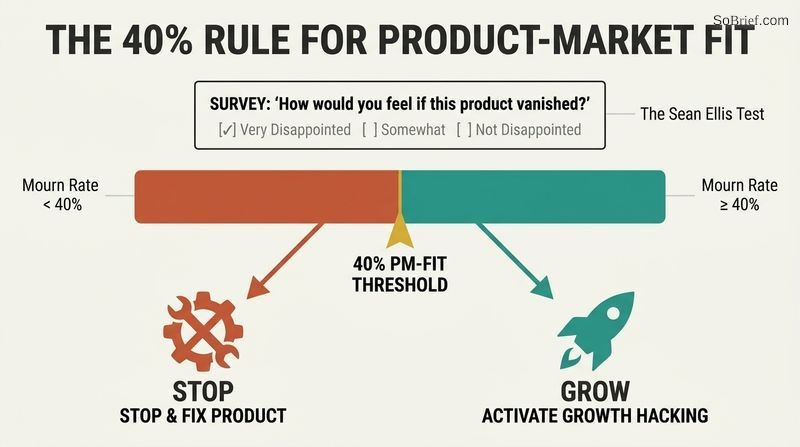
The 40% threshold has become gospel in startup circles, though it deserves scrutiny. It is a directional signal, not a law of physics; the number emerged from Ellis's pattern-matching across surveys, not controlled experiments. What's valuable is the underlying discipline it enforces: founders systematically overestimate demand because of sunk-cost bias and confirmation-seeking. Marc Andreessen's original framing that "the market pulls product out of the startup" complements this well. The danger is treating the survey as a finish line rather than a leading indicator; a product can pass at 40% among early adopters and still crater in the mainstream, a gap Geoffrey Moore called "the chasm."
Collect the money before you write a single line of code
Sell the product that does not exist yet. Happy's fastest, cheapest path to product/market fit is a four-step sequence he calls MPAP: Mailing list, Problem, Agitation, Pre-sale. Build an email list of even 100 target people, then send three emails. First, ask which problem hurts most. Second, describe the common mistakes and manual fixes. Third, offer to build a tool that automates the fix, at half price, but only if enough people pre-pay.
Money is the only honest signal. A verbal "yes, I'd buy that" cost Happy an extra year of his life; only cash in the account proves demand. Brian Harris pre-sold a nonexistent product to 13 of 205 fresh subscribers in 28 hours. Three companies each handed Hayes Drumwright $35,000 based on a concept alone. Bill Gates famously sold software he had not built, then built it.
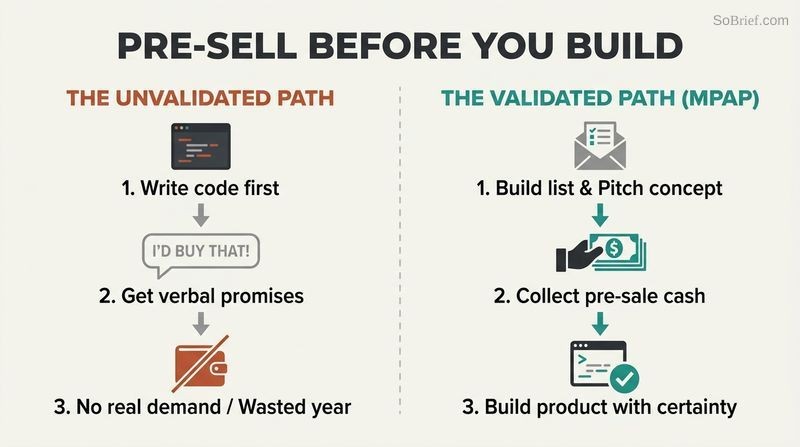
This inverts the intuitive "build it and they will come" instinct, and it aligns tightly with lean startup methodology and Kickstarter-style validation. The psychological insight is sharp: a nonexistent product is infinitely flexible, so the seller can adapt to objections in real time. There is a caveat worth flagging. Pre-selling works cleanly for software and info products where marginal cost is near zero and delivery can be delayed. It gets ethically and logistically thornier for physical goods, regulated services, or anything requiring upfront capital. The technique also assumes an existing audience relationship; cold pre-sales to strangers convert far worse than warm ones.
Fix your leaky bucket before pouring in expensive new users
Retention is King. Happy killed three startups by obsessing over acquisition while ignoring whether users stuck around. His music alarm app had users inviting five friends each and a 4.3 rating, yet today it has roughly ten active users, one of whom is his wife. All those users churned. Pouring acquisition money into a leaky bucket just enriches Facebook and Google.
Aim for flat-plateau retention, where users stay indefinitely rather than dropping off. Once retention flattens, acquisition becomes almost effortless; even a plain share button grows the product. Diagnose churn with "Red Flag" metrics: Groove found users who quit averaged 35-second first sessions versus three minutes for those who stayed, so they emailed help to short-session users and retained 40% of them. Slidebean raised prices fourfold and lifted retention 282%.
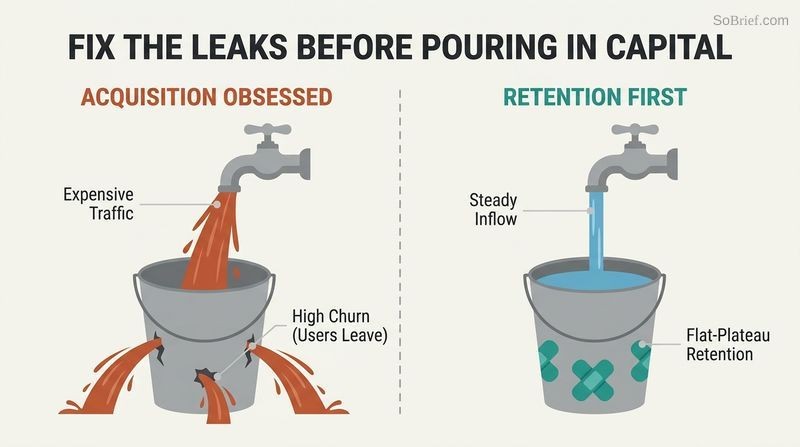
The bucket metaphor captures a truth that unit economics make brutal: if churn exceeds the rate at which lifetime value exceeds acquisition cost, growth accelerates bankruptcy. This echoes David Skok's SaaS work and Reichheld's finding that a 5% retention lift can raise profits 25 to 95%. The Groove example is essentially early behavioral cohort analysis, spotting the "aha" threshold. One nuance the framing understates: retention is partly a product-category ceiling. A tax-filing app cannot achieve daily-use retention no matter how good it is. The smarter move is benchmarking retention against your category's natural frequency, not against an abstract flat line.
Your growth speed equals the number of tests you run each week
High Tempo Testing beats big bets. The giants did not find one magic trick; they ran thousands of experiments, roughly 80% of which failed. Twitter runs over 500 growth tests a year. Each winning test adds a small percentage, and those percentages compound into the hockey-stick curve everyone envies.
Define a minimum weekly test count and hit it no matter what. When Twitter's growth stalled in 2010, they raised their testing tempo and reignited it. When Sean Ellis's GrowthHackers.com plateaued, his tiny team committed to at least three tests per week and doubled growth in three months. Happy's own error: he spent a full year testing just two hypotheses because he tied experiments to a task list instead of a weekly cadence. The engine has four looping parts: analyze KPIs, generate ideas, prioritize ideas, implement them.
This reframes growth as a throughput problem rather than a genius problem, which is empowering and largely correct. It rhymes with Eric Ries's build-measure-learn loop and with Amazon's "we want to be the best place to fail." The subtle risk is optimizing for test volume over test quality. Running fifty trivial button-color tests weekly can crowd out the one structural experiment that actually moves the business. Sample-size and statistical-significance discipline matter enormously; the book itself notes a tool once reported a 23.8% lift between two identical pages. Velocity without rigor manufactures false positives. The best teams pair high tempo with strong hypothesis prioritization.
Burn one channel with a magnifying glass, not sunlight across many
Focus beats breadth. Happy tested comment sites, articles, press, and sharing, each fizzling, before realizing the lesson: success comes not from which channel you pick but from how deeply you exploit one. He grew GrowthHackingIdea to 20,000 subscribers in four months by focusing solely on referral marketing, then made a bestseller by mastering the nuances of Amazon alone.
Focus on what your team does naturally. A magnifying glass held over scattered light lights nothing; concentrated to a point, it burns wood. If nobody on your team writes compulsively and joyfully, do not attempt content marketing. Even billion-dollar companies cannot cover every channel, so a small team's only edge is depth. Happy uses the word "focus" more than 60 times in the book because scattering resources across many channels reliably produces nothing.
This maps onto Peter Thiel's argument that startups should dominate a small market before expanding, and onto the "bullseye framework" from the book Traction, which Happy credits as his gateway drug. The strengths-based staffing point connects to research on strengths psychology: people in roles matched to natural talent show markedly higher engagement and output. The counterpoint is diversification risk. Over-indexing on one channel leaves a company fragile to platform shifts, as anyone who built solely on Facebook organic reach discovered when it collapsed. Focus early to find traction, then deliberately diversify to defend it; single-channel dependence is a strategy with an expiration date.
Acquisition is easy: piggyback on platforms that already hoard your users
Stop inventing audiences; borrow them. Happy insists acquisition is the easiest stage, which is why its framework sits last, after the bucket is sealed. The formula is simple: find a platform already crammed with your audience and hitch a ride. Nearly every noun can be a channel, but the richest are the Alexa top 500 sites.
Concrete tactics abound:
1. SEO: rank for long-tail phrases (four-plus words) and earn backlinks, even a two-minute Wikipedia link.
2. YouTube: the second-largest search engine, far less crowded.
3. Engineering as marketing: embeddable widgets with "Powered by" links, how YouTube and AddThis exploded.
4. Business development: eBay bought bored, captive attention by getting free eBay access onto Delta and Virgin flights.
5. Guest blogging, community marketing (Etsy courting craft-fair feminists), and press via exclusive research.
The piggyback principle is the connective tissue of modern growth, from Airbnb's Craigslist cross-posting to PayPal riding eBay. It reflects a deeper economic truth: attention is the scarcest resource, and it is cheaper to redirect existing attention than to manufacture it. The framing usefully demystifies distribution for founders who assume they need a huge ad budget. The honest limitation is that platforms evolve from open to extractive. The tactics that worked in 2016, aggressive Wikipedia linking, Twitter follow-churn, cheap widget virality, have since been throttled by algorithm changes and spam enforcement. The durable lesson is the meta-strategy of platform arbitrage, not any specific hack, which decays fast.
Every stalled sale hides one of four objections: need, money, hurry, or trust
Diagnose which of four obstacles blocks the sale. For "no need," ask and help rather than push; a "helping tone" email beat a "selling tone" one by 349% in lead inquiries. For "no money," install a reference point: The Economist added a pointless print-only option priced identically to print-plus-web, and print-plus-web sales jumped 262%. For "no hurry," add scarcity or urgency; a countdown timer lifted one product's sales 185%.
For "no trust," attack specific fears. CrazyEgg answered the checkout question "why do you need my credit card for a free trial?" and reframed "$49 per month" as "$0 for 30 days," lifting signups 116%. Trust seals, generous guarantees (one doubled-your-money-back offer raised sales 133%), and removing forced registration (up 45%) all convert hesitation into confidence. Always A/B test; results flip by business.
The four-objection taxonomy is a clean sales-psychology heuristic that overlaps with Cialdini's influence principles, scarcity, social proof, commitment, and with prospect theory's loss aversion, which explains why urgency and guarantees work. The reference-point trick is textbook anchoring from Kahneman and Tversky; the decoy Economist option is a canonical example of the "asymmetric dominance effect" studied by Dan Ariely. The book's repeated insistence on testing everything is its saving grace, because many of these percentage lifts come from single case studies with unknown sample sizes and confounds. Treat each tactic as a hypothesis generator, not a guaranteed outcome; the taxonomy is more durable than the numbers.
Make sharing a gift, not spam, with double-sided incentives
Climb five levels of virality. The holy grail is a viral coefficient of 1 or more, where each user brings at least one new user, growing the product free forever. Happy's ladder:
1. Ask users to share at their peak happiness moment (his app requested ratings only after a user hit "I like it").
2. Give something away in exchange for invites.
3. Reward both sides, as Dropbox and Uber do.
4. Optimize the shared image with a five-word value proposition and social proof.
5. Keep it unstoppable with fresh monthly incentives.
Double-sided incentives hack psychology. When you promote a link that also benefits your friend, you become a giver, not a pusher. Asking members to invite just one friend, rather than many, lifted one company's referrals 250%. Airbnb found altruistic framing ("give your friend $25") beat self-interested framing globally.
The giver-versus-pusher distinction is psychologically astute and underappreciated. It reframes referral as a status-and-reciprocity transaction rather than a bribe, which aligns with Adam Grant's work on how giving builds social capital, and with why the altruistic Airbnb variant won. The "invite one friend" finding reflects the power of reducing friction and cognitive load, echoing BJ Fogg's behavior model where ability trumps motivation. The sober caveat: viral coefficients above 1 are extraordinarily rare and usually short-lived, decaying as networks saturate. Most successful products grow through a blend of moderate virality and paid or content channels. Treating true self-sustaining virality as the default expectation sets founders up for disappointment.
Growth hacking is a whole-company reflex, not one specialist's job
Everyone hunts for growth, or no one does. Happy compares a company with a lone growth hacker to an ant colony where a single ant knows the shortcut while the rest trudge the week-long route. The magic starts only when every member internalizes one question, glued everywhere: what else can I personally do right now to increase revenue?
Nuance lives with the doers. The person writing the copy, the developer touching the API, knows details a CEO never will, and those nuances are the fuel of explosive growth. When Happy finally trained his team and got them on the same page, one developer proposed an idea that achieved in a week what they had planned to reach in ten years. He also warns against outsourcing a startup's core development: it kills speed and the unborn ideas that spark between lines of code.
This democratized view of growth counters the celebrity-growth-hacker myth and aligns with Amazon's insistence that everyone owns the customer, and with Toyota's kaizen philosophy, where frontline workers surface the improvements executives cannot see. The claim that outsourcing kills exponential growth is more debatable. Plenty of successful companies outsource non-core functions effectively; the real variable is whether the outsourced work is close to the product's differentiating value and iteration loop. The stronger, defensible version of the argument is that anything requiring rapid, ideation-heavy iteration should stay in-house, while stable, well-specified tasks can safely leave. The ten-years-to-one-week anecdote is inspiring but almost certainly the exception, not the rule.
Own your email list; you are only renting your social followers
Email is the asset you actually control. Happy's warning is vivid: a million MySpace followers bought in 2008 are worth almost nothing today, and Facebook's organic reach has steadily fallen as its stock price rose, forcing you to pay to reach your "own" audience. Email is different because nobody owns it, it is free to send, and it reaches more people than all social networks combined; roughly 85% of web users use email versus 62% on social.
The proof is in head-to-head tests. Josh Earl sent discount codes to a 4,800-person email list and a 9,300-follower Twitter audience; email generated 1,100% more sales. Email consistently returns more per dollar than search or paid ads. The strategic move is to treat every social profile as a machine for converting followers into email subscribers, then treat that list itself as a startup worth growth-hacking.
The rent-versus-own distinction has aged remarkably well. Platform algorithm changes, deplatforming, and pay-to-reach dynamics have repeatedly punished creators who built solely on rented land, validating the thesis. Email's durability comes from being an open protocol no single company controls, unlike any social feed. That said, the picture has nuances the framing glosses over. Email deliverability is its own arms race, inbox tabs and spam filters have eroded open rates, and younger cohorts lean toward messaging apps and short video. The deeper, transferable principle is owning a direct, unmediated line to your audience, whether that channel is email, SMS, or a downloaded app with push permission.
Analysis
This is a framework-based business playbook wrapped in confessional memoir, unusual for its genre in that the author leads with his failures rather than his wins. Aladdin Happy structures the book as a funnel: a cautionary story, then the AARRR stages (Acquisition, Activation, Retention, Revenue, Referral) borrowed from Dave McClure, then 300 crowdsourced case studies. The difficulty in summarizing it is precisely that back half, an anthology of tactical hacks with wildly varying rigor, many citing single case studies with unknown sample sizes and self-selected sources. The durable value lives in the first third, the mindset and sequencing.
The book's real contribution is ordering. Most growth content dumps tactics; Happy insists on a strict priority: product/market fit, then retention, then activation, then revenue, then referral, and only last, acquisition. This is genuinely contrarian, since acquisition is where anxious founders instinctively spend first and most. His "leaky bucket" logic, that acquisition without retention just subsidizes ad platforms, is the book's most defensible and important argument.
Intellectually, the work synthesizes Sean Ellis (high tempo testing, the 40% fit test), Gabriel Weinberg's Traction, and behavioral economics (anchoring, loss aversion, the decoy effect) without always distinguishing rigorous findings from anecdote. The pre-sell-before-building MPAP framework is its sharpest original packaging of lean validation.
The weaknesses are real. Percentage-lift claims are presented as transferable laws when they are context-bound single results, and the book knows this, repeatedly urging readers to A/B test everything, which partly inoculates it. Its 2016 tactical specifics have decayed as platforms tightened. But the meta-lessons, sequence the funnel correctly, validate with money, test at high tempo, focus ferociously, own your audience, remain a coherent and useful operating philosophy for early-stage founders who read it as a thinking scaffold rather than a recipe.
Glossary
Product/market fit test (40% rule)
Survey proving real demandSean Ellis's method for confirming demand: ask existing users how they would feel if the product disappeared, offering very disappointed, somewhat disappointed, or not disappointed. If at least 40% answer "very disappointed," the product has fit. Below 40%, the book says growth hacking will fail and the founder should focus entirely on reaching fit first.
MPAP
Pre-sell before building sequenceHappy's four-step formula for reaching product/market fit cheaply: Mailing list, Problem, Agitation, Pre-sale. Build a target email list, ask which problem hurts most, describe the mistakes and manual fixes, then offer to build an automating tool at half price contingent on enough pre-payments. Actual pre-sale money, not verbal interest, is the only valid proof of demand.
High Tempo Testing
Growth speed via weekly experimentsA framework from Sean Ellis defining growth speed as the number of tests run per week. It loops through four steps: KPI analysis, generating ideas, prioritizing ideas, and implementing ideas. Since roughly 80% of tests fail, more frequent testing compounds small wins into large growth. Teams set a minimum weekly test count and hit it regardless.
AARRR
Five-stage customer funnel modelDave McClure's "pirate" metrics model with five phases: Acquisition (attracting users), Activation (reaching the aha moment of value), Retention (returning repeatedly), Revenue (converting to paying), and Referral (inviting others). Happy uses it to organize growth ideas and argues teams should optimize these stages roughly in reverse order, sealing retention before scaling acquisition.
Red Flag and Green Flag metrics
Behaviors predicting churn or retentionRed Flag metrics are behaviors common to churned users but rare among retained ones (Groove found quitters averaged 35-second first sessions). Green Flag metrics are the opposite, the key activation behaviors that predict retention, such as Dropbox users backing up one file, Facebook users connecting with seven friends in ten days, or Twitter users following over thirty people.
Content upgrade
Bonus PDF for email opt-inA conversion technique of offering a downloadable version or bonus tied to a specific piece of content in exchange for an email address, such as "download the PDF version of this article." Brian of Backlinko boosted opt-in conversions 785% in one day using it, since the offer matches exactly what the reader is already consuming.
ROCA
Return on customer acquisitionReturn On Customer Acquisition, calculated as lifetime revenue per customer minus cost per acquisition, divided by cost per acquisition. Happy uses it to warn that shallow conversion wins (like visitor-to-signup rate) mean nothing if they lower lifetime value; every channel and hack should be judged against this strategic metric, not against myopic surface conversions.
Download PDF
Download EPUB
.epub digital book format is ideal for reading ebooks on phones, tablets, and e-readers.








































