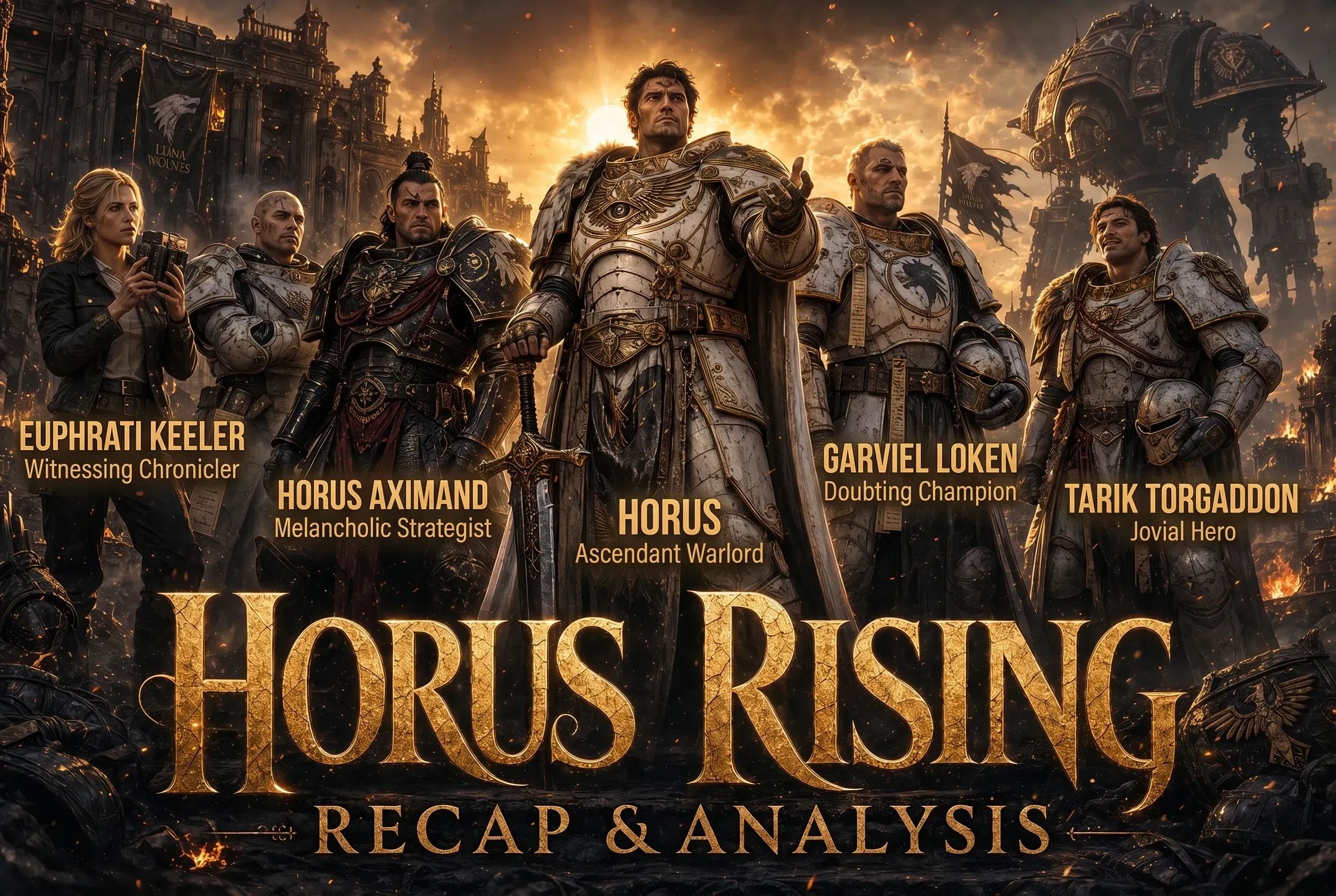


Plot Summary
Prologue
An aging warrior repeats a favorite, treasonous joke to his comrades: he was there, he says, the day Horus2 slew the Emperor. The line earns laughs because of its irony. It refers not to the true Emperor of Mankind but to a delusional pretender on a distant world, and to a tragedy of blood spilled from misunderstanding.
The teller is Garviel Loken,1 captain of the Luna Wolves, in the two hundred and third year of the Great Crusade. Horus2 has just become Warmaster, the Emperor's chosen regent, and the galaxy is being reunited under one rule. The phrase will curdle in time, until afterwards becomes a season without laughter, but for now it is only a soldier's grim jest.
The framing conceit weaponizes dramatic irony against the reader. We are told the punchline before the story, invited to laugh at a joke whose horizon of meaning we cannot yet see. Abnett seeds dread into nostalgia: the narrator's affection for the anecdote is precisely what marks it as doomed. The title 'Emperor' floating in skeptical quotation marks foreshadows a book obsessed with naming, with who deserves a word and who deserves worship. Loken's shame at his complicity, mentioned in passing, establishes conscience as the novel's moral instrument. This is a prologue about memory's fragility, about how the most repeated stories are the first to be poisoned by hindsight.
The False Emperor's Defiance
A warp storm forces the 63rd Expedition into a system of nine worlds, where a ruler styling himself Emperor of Mankind demands the newcomers kneel. Horus,2 freshly titled Warmaster and eager to prove diplomacy over slaughter, sends his beloved captain Hastur Sejanus20 to greet him.
The pretender's invisible elite guard butcher Sejanus20 and his squad on the palace floor for suggesting another Emperor exists. Grief-stricken but patient, Horus2 dispatches a second embassy under his equerry Maloghurst,16 only to watch surface batteries blast it from the sky.
With one hand extended in peace and the other already a fist, the Warmaster orders his speartip to illuminate the imposter and avenge Sejanus,20 launching the Luna Wolves against humans who believe themselves the righteous ones.
The opening collapses the crusade's founding myth into a single brutal misunderstanding. Two cultures speak the same words, Emperor and truth, and value them so differently that language itself becomes a casus belli. Abnett stages the Imperium's central contradiction immediately: a civilization that claims to liberate lost humanity must annihilate the humans who refuse its definitions. Sejanus's death functions as the wound that organizes everything after, the absent ideal against which Loken will be measured. Horus's twin gestures, open palm and clenched fist, encode the tragic doubleness of a peacemaker bred for war, a man whose mercy is always shadowed by overwhelming force already in motion.
Death on the Golden Throne
Loken1 leads the Tenth through the burning High City, racing First Captain Abaddon4 to reach the enemy ruler first. Climbing a kilometer-high spire, he finds an empty golden throne and a frail old man in mauve robes who defies him, then begs that only the supreme commander accept his surrender. Loken1 realizes too late the old man is bait.
The throne itself, occupied by a cloaked invisible figure, erupts with a shockwave that hurls Catulan Reaver Squad out the shattered windows. As Loken1 clings to the ledge, Horus2 teleports in, a golden giant, and ends the hidden tyrant with a single bolt. The Warmaster lifts his captain to safety, declaring this the fate of all deceivers and tyrants.
The set piece literalizes the book's preoccupation with concealment and revelation. The Invisibles, men who vanish by bending light, externalize a deeper invisibility: the unseen forces, soon named warp and Chaos, that the Imperium refuses to perceive. Loken's misreading of the decoy is the first of many failures of sight that structure his arc, a soldier of empirical truth repeatedly blindsided by what truth cannot account for. Horus's entrance, radiant and merciful in the same breath, cements his function as a demigod who seems to make catastrophe redemptive. The throne that kills is a wickedly economical image of power as trap, foreshadowing how seats of authority will betray those who reach for them.
The Remembrancers' Cold Welcome
Months after the conquest, the Emperor's new order of remembrancers reaches the fleet, civilian poets, imagists, and documentarists meant to immortalize the crusade. They find the Astartes contemptuous and access denied.
Documentarist Mersadie Oliton7 finally corners Loken1 to extract his account of the false Emperor's death, only to offend him by speaking Horus's2 name without due reverence. The poet Ignace Karkasy9 drinks and complains, while imagist Euphrati Keeler8 quietly captures striking candid picts that begin to win the order respect.
Beneath the friction lies a deeper unease in the ranks: warriors distrust the Emperor's decision to retire to Terra, to install a Warmaster as proxy, and to let civilian councils and tax collectors govern what their blood had won.
Abnett introduces the novel's chorus of witnesses, the human scale against which superhuman events acquire meaning. The remembrancers embody a thesis the book quietly advances: that a civilization unwitnessed is only half-made, and that documentation is itself a form of moral accountability. Their cold reception dramatizes the militarization of a culture that has forgotten peacetime. Loken's prickliness about Horus's name signals the creeping sacralization of leaders the Imperium officially forbids, a religious instinct returning through the back door. Keeler's lens, soon to record something it should not, is planted here as the device through which forbidden truth will become undeniable image, evidence outliving denial.
Four Captains, One Voice
To fill the vacancy Sejanus20 left, Torgaddon,3 Abaddon,4 and Aximand5 (the strategist nicknamed Little Horus for resembling the Warmaster) invite Loken1 to join the Mournival, an unofficial brotherhood of four captains who counsel and watch over Horus.2 By moonlight in a ruined water garden they brand his helm and swear bonds of brothership.
Loken's1 mentor, the iterator Sindermann,6 and Primarch Rogal Dorn17 both reveal they sponsored him, not for blind obedience but for his doubts. Dorn17 explains the role plainly: a self-confident Warmaster needs an honest dissenting voice, a naysmith, to keep him true to the Emperor's will. Loken1 accepts, understanding that his conscience, not his battle record, is the qualification that matters most.
The induction reframes Loken's worth: his value lies in friction, not conformity. Dorn's concept of the naysmith articulates the book's political anxiety, that absolute trust in a single charismatic figure is dangerous precisely when that figure is beloved and infallible-seeming. The Mournival is a structure of intimacy engineered to humanize a demigod, to give Horus brothers when the Emperor gave him only sonship. Yet the ritual's pseudo-mystical theater unsettles Loken, who clings to secular Imperial Truth. Here Abnett braids the personal and the prophetic: the very mechanism meant to keep Horus honest depends on men loving him too much to ever truly oppose him, a fatal tenderness disguised as counsel.
Karkasy's Drunken Truth
Bored at architect Peeter Egon Momus's tedious presentation of grand reconstruction plans, the poet Karkasy9 slips away into the conquered city. Wandering its scarred streets, drinking local liquor, he copies the defiant graffiti of the defeated and rediscovers his muse among their grief. He stumbles into a temple to the forbidden Lectio Divinitatus, the secret cult that worships the Emperor as a god.
Drunk and unguarded, he tells army troopers in a tavern that nothing mankind builds will last, that the Imperium will crumble as surely as it rose. Enraged, the soldiers beat him almost to death. Loken1 later agrees to sponsor Karkasy9 on probation, on the condition that the poet keep telling the truth, however ugly.
Karkasy is the book's licensed fool, the only character permitted to voice its forbidden thesis: that all empires perish. His beating dramatizes how a triumphalist culture punishes the prophet who names mortality. Abnett threads two heresies through this chapter, the cult that would make the Emperor divine and the despair that would deny the crusade's permanence, both of them suppressed truths that will metastasize. Loken's bargain is quietly profound: he stakes his honor on protecting unwelcome honesty, aligning the warrior's code with the witness's. The drunken poet and the dutiful captain become unlikely allies in a regime increasingly built on flattering silence and managed appearances.
The Whisper Called Samus
Loken1 proposes the Tenth finish a stubborn insurgency in the southern Whisperhead Mountains, a holy, haunted place to the locals. As his stormbirds descend, a strange voice infiltrates the vox: Samus, it says, the only name they will hear, the man beside them, the thing that will gnaw their bones. The Astartes dismiss it as enemy scare tactics.
They storm the icebound fastness in sixty-eight minutes, slaughtering nearly a thousand zealots without a single loss, destroying the meltwater shrines where the defeated had left offerings to their gods. Then Sergeant Jubal,21 passed over for promotion and bitter about it, summons Loken1 to a deep cavern, raving that he can read words in the falling water and that Samus is finally here.
The mountains literalize the permeable membrane between the rational cosmos and what lurks beneath it. Abnett builds dread through the gap between explanation and experience: the Astartes have a confident name for everything, scare tactics, superstition, and that confidence is precisely their vulnerability. Samus, a local devil-myth resurfacing through the vox, embodies the return of the repressed, the spiritual reality a secular empire has outlawed but cannot abolish. Jubal's susceptibility is psychologized as resentment, the small wound of wounded pride opening a door. The chapter weaponizes the Imperium's own ideology against it: men trained to disbelieve in daemons are the least equipped to recognize one wearing a brother's face.
Brother Turns on Brother
In the cavern Jubal21 opens fire on his comrades, gunning down Sergeant Udon and others with impossible strength. Loken,1 unable to fire on his own kind, wrestles him across a chasm-spanning stair and runs him through.
Believing the horror over, Loken1 summons Sindermann,6 who proposes a rational cause: plague, contagion, a deranging fever. Then Jubal's21 corpse rises, swelling into a fanged, gangrenous monstrosity, screaming that Samus is here. It butchers two visiting remembrancers, biting Borodin Flora in half before Loken1 and Nero Vipus10 burn it apart with ninety bolter rounds.
Euphrati Keeler,8 frozen in terror, instinctively photographs the thing. Afterward Abaddon4 orders silence: the official story will be a clean victory, the deaths a landing accident, the truth confined to the inner circle.
The unthinkable, Astartes killing Astartes, arrives here as both literal event and prophetic rehearsal, the heresy in miniature. Abnett stages the collapse of the Imperium's founding assurance: that its enhanced warriors are incorruptible. Sindermann's desperate reach for plague, contagion, anything empirical, is the secular mind defending itself against a reality it has no vocabulary for. The cover-up is the novel's true pivot, the moment institutional self-preservation chooses managed narrative over uncomfortable knowledge. Keeler's reflexive pict-taking makes her the keeper of forbidden evidence, the witness who cannot unsee. Vipus and Loken's reluctance to shoot a brother, even a monstrous one, exposes how the bonds meant to make them strong also make them fatally slow to recognize betrayal.
The Warmaster's Secret Word
Horus2 comes personally to comfort a shaken Loken,1 lifting the shame of an undertaking he insists was no failure. Then he shares a secret known to few: what took Jubal21 was the warp, the same energy that powers their starships, a wild and amoral force that can seep into a vulnerable mind.
The old words, daemon, spirit, possession, are simply convenient labels for extradimensional things, Horus2 argues, with no implication of gods or cosmic evil.
He reveals that the Mistress of Astropaths detected a warp spike when the Tenth landed, that the locals had weaponized their crude knowledge of it. Most strikingly, Horus2 admits the Emperor withdrew to Terra not from weariness but to master the warp's secrets, a calling he kept hidden even from his favored son.
Horus's explanation is the book's great ambiguity, simultaneously reassuring and corrosive. By naming the warp while denying its moral dimension, he performs the exact rationalization that leaves the Imperium defenseless: to admit daemons exist but insist they signify nothing. Abnett locates the heresy's seed not in malice but in epistemic arrogance, the conviction that the universe is too sterile for evil. The revelation that the Emperor hides his deepest work even from Horus plants the wound of paternal abandonment that the novel keeps probing. Loken's comfort is real and the lie is real; the chapter's genius is that both can be true, that a beloved father-figure can console and conceal in a single embrace.
The World Called Murder
Answering distress calls, the fleet diverts to a storm-shrouded world where three companies of Blood Angels have disappeared. The proud Emperor's Children, led by the glory-hungry Lord Commander Eidolon,13 have already dropped in and been scattered.
Captains Saul Tarvitz,11 dutiful and grounded, and Lucius,12 a vain swordsman, fight through forests of giant grass against the megarachnid, hyper-fast metallic insect warriors with living blades for arms. They discover stone thorn-trees where winged predators impale and devour their victims, finding the skewered corpses of the lost Blood Angels.
Tarvitz11 demolishes the trees with explosives. The blast unintentionally signals other survivors and reveals the enemy's eerie efficiency: the megarachnid swarm in to consume the rubble and rebuild the trees before his eyes.
Murder introduces the Emperor's Children as a mirror-Legion obsessed with perfection, their virtue, purity, already souring into superiority. Tarvitz and Lucius form a moral diptych: the file officer content with his station versus the climber who hoards skill like currency, two answers to the question of what excellence is for. The megarachnid, a fusion of biology and weaponry with no separable culture, embody war as pure self-perpetuating process, a horror precisely because they cannot be parlayed with. Abnett uses Eidolon's reckless ambition to critique a hierarchy that confuses pride with honor, setting up the inter-Legion friction that will let the Luna Wolves shine and the Emperor's Children chafe.
A Brotherhood in Shadows
During the long voyage, Loken1 finds a lodge medallion among dead Jubal's21 effects and learns the man belonged to a secret warrior society he has always opposed. Aximand5 invites him to a clandestine meeting in the ship's lonely aft holds. Dreading a daemonic coven, Loken1 instead finds Torgaddon,3 Sedirae, Vipus,10 and dozens of brothers gathered as equals, ranks left at the door.
Lodge master Targost explains the fraternity is ancient, harmless, a place where men of any station can speak freely, and that Horus2 knowingly tolerates it. Even Loken's1 rival Ekaddon earns his respect. Loken1 half-accepts, but voices one nagging fear: an organization this skilled at keeping its own secrets is equally capable of hiding far darker ones.
The lodge chapter is a masterclass in deferred menace. Abnett lets Loken's paranoia be disarmed, the meeting is genuinely fraternal, only to have Loken articulate the precise principle by which such bodies become dangerous: institutionalized secrecy is a muscle that strengthens with use. The scene reveals how the Legion's deepest bonds run perpendicular to its formal chain of command, a hidden architecture of loyalty that could one day redirect the whole. That Horus turns a blind eye, that the Mournival itself descends from the lodge, knits authority and conspiracy into one fabric. Loken's grudging participation marks his integration into the brotherhood he distrusts, deepening the tragedy of a conscience slowly enmeshed.
Torgaddon Drops from the Sky
When a rare break appears in Murder's shield-storms and faint Imperial vox-traffic proves survivors live, Horus2 reluctantly lets Torgaddon3 lead a four-company speartip down. The Luna Wolves crash into the megarachnid swarm just as Tarvitz's11 tiny band is about to be overwhelmed, hauling them from the dirt.
Torgaddon3 then confronts Eidolon13 face to face, refusing to bow, mocking the lord's vanity and the disaster his ambition caused, reminding him that the Warmaster outranks his pride. Learning from the humble Bulle that Tarvitz,11 not Eidolon,13 had destroyed the deadly trees, Torgaddon3 adopts the storm-collapse tactic and forges a genuine brotherhood with Tarvitz,11 easing the rift between the two Legions through shared courage rather than rank.
Torgaddon's irreverence is revealed as moral clarity in motion: the jester is the only one who speaks plainly to power. His refusal to bow to Eidolon enacts the book's argument that true authority is earned through deed and honesty, not inherited posture. The Bulle revelation, a common trooper correcting the record against his own commander, models the witness ethic the remembrancers represent: truth flows upward against hierarchy. Abnett contrasts two visions of Astartes culture, the Wolves' rough fraternity versus the Children's brittle perfectionism, and lets character, not protocol, dissolve the tension. Tarvitz's quiet integrity, content to let Eidolon steal credit, becomes the unsung virtue the narrative rewards with friendship.
Two War Gods United
The winged primarch Sanguinius14 arrives, dearest of Horus's2 brothers, to mourn his lost Blood Angels. Tarvitz11 presents the recovered relics, and the Angel14 weeps real tears rather than ceremonial ones. The two primarchs resolve to murder Murder together, and for six glorious months Astartes, army, and Titans lay waste to the megarachnid in pitched battles.
Fighting at Horus's2 side, Loken1 sees the Warmaster at his most magnificent, leading from the front, unable to bear his beloved brother14 going to war without him. In their tent, Sanguinius14 gently presses Horus2 to consider the Emperor's old suggestion at Ullanor: rename the Sixteenth Legion to reflect his new supremacy. The proposed name, revealed by Abaddon,4 is the Sons of Horus.
Sanguinius functions as Horus's conscience and mirror, the one bond purer than the Mournival's. Their joint campaign is the novel's high golden hour, deliberately luminous so its coming corruption will hurt. Abnett uses the war as a meditation on glory: deeds that should become eternal legend will instead be swallowed by a hateful future, the narrator tells us, draining triumph of permanence even as it unfolds. The proposed renaming, Sons of Horus, is loaded with tragic irony, an honor that subordinates an entire Legion's identity to one man's name. The chapter quietly asks whether a crusade built on a single beloved figure can survive that figure becoming the measure of all things.
Cousins from Lost Terra
As the war ends, three unknown warships arrive, broadcasting music-like signals and a chilling question: did the Imperials not see the warnings, and what have they done here?
They are the interex, a refined human civilization descended from Old Terra, who had exiled the megarachnid to this reservation world rather than exterminate them. Horus,2 determined to make no more mistakes after the bloodshed of his early conquests, chooses dialogue over war.
The Imperials become guests at the city of Xenobia, touring its Hall of Devices, a museum-armory where the interex preserve even alien weapons. There they meet the kinebrach, an ancient alien race the interex defeated yet absorbed as citizens, and learn of the anathames, sentient cursed blades too lethal to release.
The interex are the road not taken, a humanity that chose coexistence over annihilation, exile over genocide, harmony with aliens over xenophobic purity. They force the Imperium to see itself from outside, vast, bellicose, led by a man titled Warmaster, and find it monstrous. Abnett stages a civilizational mirror that indicts the crusade's whole logic: the Imperium annihilates what disagrees; the interex finds humane alternatives. Horus's restraint here represents his finest hour as a thinker, openly questioning whether the Emperor's model is too rigid. The Hall of Devices and the anathame are planted with surgical care, an unfired weapon hanging on the wall, a curse waiting for a hand.
The Name of Chaos
During a guarded night, interex commander Mithras Tull18 speaks frankly with Loken1 before an ancient book warning against sorcery and daemons. He reveals the word the Imperium has never been taught: Chaos, a primal corrupting force in the warp, the true enemy of all humanity, which spreads like disease and turns men into daemons.
Tull18 explains the interex kept the Imperials at arm's length precisely because their warlike bearing resembled Chaos incarnate. Then alarms shatter the moment: the Hall of Devices is burning, its kinebrach curator murdered, and an anathame stolen.
Convinced the Imperials have shown their true face, Tull18 demands Loken1 surrender his weapons, attacks when he refuses, and falls with his sword-arm severed as Loken1 fights free.
This is the keystone the entire saga turns upon: the naming of the unnamed. Tull gives Loken, and the reader, the vocabulary Horus deliberately withheld in the Whisperhead aftermath, recasting Jubal's possession in cosmic terms. The tragedy is exquisite: comprehension and catastrophe arrive in the same instant, just as understanding becomes possible, a frame-up destroys it. Abnett suggests the Imperium's ignorance of Chaos is not innocence but vulnerability, an empire marching blind through a minefield it refuses to admit exists. The stolen anathame, taken by an unseen hand amid the chaos of accusation, is the mechanism by which trust dies, demonstrating how easily perception can be engineered into war.
Fire in Xenobia
As the city erupts, Horus,2 dressed for dinner rather than war, refuses to flee quietly while a terrible mistake destroys everything he built. The interex believe the Imperials robbed and murdered their way into the armory; the Imperials know they did no such thing.
Cornered by sagittar arrows that pierce even Astartes plate, Horus2 takes up a fallen bolter and sword and makes a defiant last stand in a firelit street, Loken1 and Torgaddon3 at his side, screaming his name at the indifferent stars and demanding to know why his father abandoned him to this. Aximand5 and Abaddon4 fight through to extract them, the fleet bombards, and the Imperium withdraws, relations with the interex shattered by a crime it never committed.
The battle inverts every value the Xenobia summit promised, dialogue replaced by slaughter, cousins remade as enemies by manufactured evidence. Horus's anguished cry to his absent father is the emotional core of the entire novel, the beloved son crushed by a responsibility too vast, raging at a withdrawn god. Abnett frames this as Horus's most noble moment, deliberately, so that the reader's memory of his honor will later become unbearable. The injustice is structural: the Imperium's warlike face made the frame believable, meaning the lie succeeds because the truth about them is almost true. Loken witnesses his commander define Imperial courage even as an unseen hand engineers its undoing.
The Sons of Horus
Returning to Imperial space, Horus2 proclaims the decree: henceforth the Luna Wolves are the Sons of Horus. The news is celebrated everywhere, in the archives by Sindermann,6 in the Retreat by Karkasy,9 and at her secret shrine by Keeler,8 who now prays to the Emperor as a god through the forbidden Lectio Divinitatus, thanking him for strong men who protect mankind.
But deep in the ship's rotting bilges, by a single candle, First Chaplain Erebus15 of the Word Bearers studies the stolen anathame, feeling the promise and the curse breathing within it. The fleet's next destination, arranged at Erebus's15 request to settle an old grudge, is a little moon in the Davin system. Loken1 sails toward it, certain he has never trusted Horus2 more.
The epilogue is a masterwork of dramatic irony deferred. Every celebration of the renaming is poisoned by the prologue's warning that this name will become a curse. Keeler's prayer reveals the religion the Emperor forbade flowering in his own fleet, the very apotheosis he denied taking root through trauma and need. Erebus, the patient statesman who shelved his own agenda to win everyone's trust, is unmasked as the architect: he holds the stolen anathame and has steered the fleet to Davin. Abnett ends not with explosion but with a lit fuse, Loken's deepening faith in Horus the cruelest note of all, the seed of heresy sown in the soil of perfect loyalty.
Analysis
Horus Rising is a tragedy told in reverse, its prologue handing us the ending so that everything after reads as the slow ruin of something genuinely good. Abnett's central project is to make the heresy unimaginable before it becomes inevitable, to render Horus2 so noble, so beloved, so worthy, that his fall will register as cosmic loss rather than the rise of a cartoon villain. The novel is structured as a sequence of escalating epistemological failures. Again and again, characters bred to believe in a secular, knowable universe, no gods, no daemons, only light and gravity and human will, collide with phenomena their ideology forbids them to perceive. Jubal's21 possession, the warp, the word Chaos that the interex must teach them: each encounter exposes the Imperium's confidence as its deepest vulnerability. To deny the existence of evil is to be defenseless against it. The book interrogates naming as power. Who deserves the word Emperor, the title Warmaster, the name god? The renaming of the Luna Wolves to Sons of Horus literalizes the danger of subordinating a collective identity to one charismatic man. Meanwhile the forbidden Lectio Divinitatus shows religion returning through trauma and need, the very apotheosis the Emperor denied flowering in his own fleet. Loken1 is the moral instrument throughout, the naysmith whose conscience the institution prizes in theory and crushes in practice, slowly enmeshed in brotherhood, secrecy, and silence until his deepening faith in Horus2 becomes the cruelest irony of all. Abnett's lasting argument concerns the corrosive seductions of loyalty, glory, and managed truth. Empires die, Karkasy9 insists and is beaten for saying. The novel agrees, and locates the rot not in monsters but in good men keeping comfortable secrets, in conviction that admits no doubt, in a father who withdrew and left his sons to interpret his silence.
Review Summary
Horus Rising received mostly positive reviews, praised for its engaging storytelling, complex characters, and vivid battle scenes. Readers appreciated the depth of the Warhammer 40K universe and Dan Abnett's writing style. Many found it an excellent entry point to the series, even for those unfamiliar with the lore. Some criticisms included a slow start and uneven pacing. Overall, reviewers found the book a compelling blend of action, philosophy, and character development, setting up an intriguing start to the Horus Heresy series.
People Also Read
Characters
Garviel Loken
Honest captain and naysmithCaptain of the Tenth Company, raised to the Mournival for the quality his peers most distrust: doubt. Loken is straight up and down, as his brothers tease, a soldier who treats himself as a weapon yet refuses to surrender his human conscience. Pale, freckled, grey-eyed, descended from harsh Cthonia rather than Horus's2 bloodline, he is the first non-Son elected to the inner circle, owing his place to merit alone. He reveres Imperial Truth and rejects superstition, which makes the horrors he witnesses doubly destabilizing. His friendships with the iterator Sindermann6, the documentarist Mersadie7, and the sergeant Vipus10 anchor him to the wider human world. Loken's defining tension is loyalty against truth: how long can a good man keep his brothers' secrets before silence becomes complicity?
Horus
Beloved Warmaster, Emperor's regentFirst Primarch and Warmaster, commander-in-chief of the Great Crusade, a golden demigod and matchless warrior who is also a supremely gifted politician. Newly elevated above his brother primarchs, he wears the title uneasily, anxious to prove worthy of the Emperor he calls father. Horus detests needless bloodshed, courts his rivals with masterful diplomacy, and uses the Mournival as instruments to rebuke others while keeping his own hands clean. Beneath the charisma runs a wound: the Emperor withdrew to Terra for secret work and confided in no one, leaving Horus to feel both trusted and abandoned. His terror of making mistakes drives his restraint with the interex, his deepest love is for his brother Sanguinius14, and his greatest vulnerability is the responsibility he was never meant to bear alone.
Tarik Torgaddon
Joking captain, loyal friendCaptain of the Second Company and Mournival member, a tall, dark, perpetually grinning prankster whose humor masks fierce moral clarity. Torgaddon befriends Loken1 before others do, defuses tension with jokes, and yet says the bluntest truths when they matter most, refusing to bow to the arrogant Lord Eidolon13. His levity is a discipline, a way of keeping warriors human. He champions compassion, pushing Horus2 to risk a rescue drop for survivors others would abandon, and forges genuine brotherhood with Tarvitz11 of the Emperor's Children. Of all the Mournival, he treats Loken1 with the warmest, most uncomplicated friendship.
Ezekyle Abaddon
Proud, choleric First CaptainFirst Captain of the Legion and senior Mournival member, a towering brute crowned with a bound topknot, fierce in war and quick to anger. A Son of Horus2 by feature and temperament, Abaddon embodies martial pride and intolerance of anything alien or deviant. He admires Loken's1 diligence yet bristles at dissent, and increasingly argues for war where Horus2 counsels patience, clashing bitterly with the Warmaster2 over the interex. His loyalty is absolute, his certainty dangerous; he is the voice that would suffer no compromise and no cousin who will not kneel.
Horus Aximand
Melancholic master strategistCaptain of the Fifth Company, called Little Horus for his uncanny resemblance to the Warmaster2, the youngest and shortest of the Mournival. Reserved and analytical, with extraordinary insight into men and battle, he proves warmer and wiser than his stern surface suggests. It is Aximand who introduces Loken1 to the warrior lodge and explains its history, bridging the gap between Loken's1 suspicion and the brotherhood's reality.
Kyril Sindermann
Loken's mentor, chief iteratorPrimary iterator of the expedition, an eloquent elderly orator who shapes the crusade's message and tutors the Astartes in philosophy. A passionate apostle of secular Imperial Truth and the rejection of religion, Sindermann mentors Loken's1 conscience. The horror at the Whisperheads shakes his certainties to their foundation, sending him to seek comfort in old, unfashionable books and leaving the great rationalist whispering of spirits he claims cannot exist.
Mersadie Oliton
Loken's chosen chroniclerA remembrancer documentarist from Terra, dark-skinned with an enhanced, elongated cranium for storing memories. She becomes Loken's1 personal memorialist, drawing out not just his battles but his feelings, seeking the human heart beneath the post-human warrior. Persistent, perceptive, and humane, she serves as the reader's surrogate, the witness through whom the Astartes are translated back into recognizable men.
Euphrati Keeler
Haunted imagistA gifted, fearless remembrancer imagist who dresses like a cadet and captures stunning candid picts. Present at the Whisperheads, she photographs the daemon and is traumatized into near-suicidal despair, surviving only through friends. Her recovery takes an unexpected form: faith. She turns to the forbidden cult that worships the Emperor as a god, finding in it protection against truths she cannot otherwise bear, and her hidden images become irrefutable evidence.
Ignace Karkasy
Drunken truth-telling poetA once-celebrated poet turned remembrancer, large, sardonic, fond of drink and incapable of holding his tongue. His insistence that nothing mankind builds will endure earns him a brutal beating and near-expulsion. Loken1 sponsors him on the condition that he keep telling the truth, however ugly, making the dissolute poet an unlikely instrument of honesty in a culture addicted to its own glory.
Nero Vipus
Loken's oldest friendSergeant of Locasta Tactical Squad and Loken's1 truest friend, who amputates his own ruined hand in battle without complaint. A long-standing lodge member, he conceals his membership out of respect for Loken's1 known disapproval, embodying the quiet divided loyalties that the secret brotherhood breeds even among the closest comrades.
Saul Tarvitz
Dutiful Emperor's Children captainA file officer of the Emperor's Children, grounded and content with his station, who pursues martial perfection through purity rather than ambition. On Murder he leads survivors with quiet competence, destroys the thorn-trees to honor the dead, and lets his arrogant lord13 steal the credit. His integrity earns Torgaddon's3 friendship and bridges two estranged Legions.
Lucius
Vain peerless swordsmanA captain of the Emperor's Children and an unbeaten bladesman who has worn out four practice cages. Brilliant, childlike, and hungry for recognition, he treats even the lethal megarachnid as sparring partners. Ambitious where Tarvitz11 is humble, he embodies the Legion's perfectionism curdling toward pride, prickly and impossible for the Luna Wolves to warm to.
Eidolon
Arrogant Lord CommanderLord Commander of the Emperor's Children, the first of his kind, haughty and obsessed with glory. His reckless decision to drop onto Murder without waiting for support costs half a company and earns the Warmaster's2 scorn. He makes pride a virtue and refuses to apologize for disaster, personifying the dangerous superiority that has infected his Legion's command.
Sanguinius
Winged primarch, Horus's brotherPrimarch of the Blood Angels, a charismatic, perfect, winged demigod and the brother closest to Horus's2 heart. He weeps real tears for his slaughtered sons and serves as Horus's2 conscience, urging restraint, brotherhood, and the renaming of the Legion. His bond with the Warmaster2 is the warmest relationship among the primarchs, lending the campaign on Murder its golden, doomed radiance.
Erebus
Soft-spoken Word Bearer chaplainFirst Chaplain of the Word Bearers, a sombre statesman-warrior who joins the fleet and earns universal trust by shelving his own agenda to counsel Horus2 selflessly. Quietly brilliant with a blade and with words, he makes a particular effort to befriend Loken1. Beneath the dignity lies a hidden purpose: he brokers the fleet's detour to Davin and watches over a stolen, cursed weapon by candlelight.
Maloghurst
The Warmaster's cunning equerryEquerry to Horus2, nicknamed the Twisted for his talent at intrigue, a literal description after grievous injuries leave his body broken. A master of politics and intelligence, he manages the Warmaster's2 burdens, stalls the tax collectors, and orchestrates the Mournival's calculated rebukes, loyal entirely to Horus2 and never to be underestimated.
Rogal Dorn
Stoic primarch, fortress-builderPrimarch of the Imperial Fists, master of siegecraft and defense, recalled to Terra to guard the Emperor. Reserved and burdened by the weight of his own nature, he sponsors Loken's1 election and articulates the need for an honest dissenting voice beside the all-confident Warmaster2.
Mithras Tull
Interex officer who names ChaosA subordinate commander of the interex, honest and likable, who befriends Loken1 over an ancient book before duty turns him to enemy. He reveals the existence of Chaos, the truth the Imperium was never taught, moments before a frame-up forces them into combat.
Jephta Naud
Interex general commanderThe noble military leader of the world Xenobia who hosts the Imperial summit. Gracious yet guarded, he keeps the Warmaster2 at arm's length, and when the armory burns he believes the worst of his cousins, turning host into adversary in a single night.
Hastur Sejanus
The beloved slain captainThe Warmaster's2 favorite, the perfect captain and diplomat, murdered by the false Emperor's guard in the opening pages. His death haunts the Legion as a measure of lost nobility, the vacancy in the Mournival that Loken1 is chosen to fill.
Xavyer Jubal
Embittered sergeant who turnsSergeant of Hellebore Squad, passed over for proxy command in favor of Vipus10 and nursing wounded pride. His resentment opens a fatal crack in his mind during the Whisperhead assault, making him the vessel for the entity called Samus and the agent of an unthinkable crime.
Plot Devices
The Mournival
Informal inner-circle counselAn unofficial brotherhood of four captains, marked by moon-phase brands on their helms, who advise the Warmaster2 outside the formal chain of command and guard the Legion's moral health. Descended from the secret warrior lodge, it has no legal standing yet shapes everything. Loken's1 induction structures the first act, granting the reader access to Horus's2 intimate circle and to the political machinery of the crusade. Dorn17 defines its true purpose through Loken1: it exists so that an all-confident leader has honest dissenting voices, naysmiths, beside him. The device crystallizes the novel's central worry, that a beloved and infallible-seeming commander needs friction to stay true, and that love may make such friction impossible.
Oaths of moment
Ritual binding to a missionBefore each undertaking, an Astartes swears a specific oath, written on parchment and pinned to his armor, binding him to the particular concerns of the action at hand. The ritual recurs throughout, marking the solemnity of war and the warriors' love of ceremony. Loken's1 oath before the Whisperheads becomes poignant when Horus2 later reads it back to him to absolve him of imagined failure, using its very wording, no matter the ferocity or ingenuity of the foe, to redefine catastrophe as fidelity. The device embodies the Legion's ritualism, the same instinct for sacred forms that Imperial Truth officially condemns, quietly suggesting the warriors are more religious than their secular creed admits.
The whisper of Samus
Manifestation of warp corruptionA voice that infiltrates the vox in the haunted Whisperhead Mountains, claiming to be Samus, the end and the death, the man beside you. Dismissed as enemy scare tactics, it proves to be a warp entity that possesses the embittered Jubal21, transforms him into a daemon, and forces brother to kill brother. The device delivers the novel's first encounter with what others will later name Chaos, and Keeler's8 photographs of it become unsuppressable evidence. It dramatizes the Imperium's fatal blind spot: men trained to disbelieve in daemons cannot defend against one. Horus's2 reclassification of it as merely the warp seeds the great ambiguity that runs beneath the whole saga.
The anathame
Stolen cursed kinebrach bladeA sentient sword forged by the alien kinebrach, an anathame becomes its chosen target's perfect nemesis, utterly inimical to one specific being, by means its makers cannot explain. The interex keep such weapons sealed in the Hall of Devices, too lethal to release, dismissed by the Imperials as pagan superstition. Introduced during the Xenobia tour, the blade pays off when one is stolen amid a murder that frames the Imperium and shatters the alliance. In the final image, First Chaplain Erebus15 broods over the stolen anathame in the ship's bilges, feeling its promise and curse, as the fleet sails for Davin. It is the literal instrument by which the heresy is being seeded.
Keeler's hidden picts
Image as undeniable evidenceThe imagist Euphrati Keeler8 instinctively photographs the Jubal21-daemon at the Whisperheads, then forgets and later rediscovers the images, sending them secretly to Loken1. High-gain analysis reveals the creature phasing in and out of reality with Jubal's21 superimposed human form, proof that defies the official cover story of a wild beast. The device makes the remembrancers' role concrete: documentation becomes resistance against managed narrative. It gives Loken1 evidence his loyalty cannot easily dismiss and forces the conversation, between captain and traumatized imagist, in which Keeler8 asks how many brothers must turn before he forsakes the Legion's silence. Image outlasts denial, and the camera becomes the conscience the empire would prefer blind.
FAQ
Synopsis & Basic Details
What is Horus Rising about?
- Ascension and Burden: Horus Rising chronicles the early days of Warmaster Horus's command of the Great Crusade, following the Emperor's return to Terra. It introduces the Luna Wolves Legion, particularly Captain Garviel Loken, as they navigate the complexities of galactic conquest, from brutal compliance actions to delicate diplomatic encounters with newly discovered human civilizations.
- Seeds of Doubt: The narrative explores the psychological toll of endless war and the moral ambiguities inherent in the Imperium's mission to unify humanity. It delves into the internal dynamics of the Luna Wolves, the informal council known as the Mournival, and the introduction of civilian remembrancers tasked with chronicling the Crusade.
- First Betrayals: The story culminates in a series of events that challenge the core tenets of the Imperial Truth, including a horrifying encounter with warp-spawned corruption and a tragic misunderstanding with the advanced human civilization of the interex, setting the stage for the galaxy-spanning civil war known as the Horus Heresy.
Why should I read Horus Rising?
- Foundational Lore: Horus Rising is the seminal novel that kicks off the epic Horus Heresy series, providing essential background and character development for the galaxy's most pivotal conflict. It establishes the pre-heresy Imperium, showcasing the primarchs and Space Marines at their peak, making it crucial for understanding the fall.
- Character Depth: The book offers a deep dive into the psyche of its protagonists, particularly Garviel Loken, whose internal struggles with truth, loyalty, and the nature of war provide a compelling moral compass. Readers gain intimate insight into Horus's character, his burdens, and the subtle shifts that begin his tragic descent.
- Moral Complexity: Dan Abnett masterfully explores themes of propaganda, faith, secularism, and the cost of empire. The narrative challenges simplistic notions of good and evil, presenting a nuanced view of a galactic crusade where even righteous intentions can lead to devastating consequences, making it a thought-provoking read beyond its action.
What is the background of Horus Rising?
- The Great Crusade: The story is set in the 31st Millennium, during the Great Crusade, a two-century-long military campaign by the Emperor of Mankind to reunite scattered human worlds and conquer hostile alien species across the galaxy. This era is characterized by immense technological advancement, the suppression of religion (Imperial Truth), and the awe-inspiring power of the genetically engineered Space Marine Legions and their primarch leaders.
- Post-Ullanor Triumph: The novel opens shortly after the Ullanor campaign, a decisive victory against the Ork empire, which solidified humanity's dominance. This triumph led to the Emperor's decision to return to Terra for a secret project, leaving his most favored son, Horus, as Warmaster to command the entire Imperial military. This shift in leadership creates a power vacuum and new tensions.
- Imperial Truth vs. Emerging Faith: A key background element is the Imperium's staunch secularism, known as the Imperial Truth, which actively suppresses all forms of religious belief. However, subtle undercurrents of faith, particularly the nascent cult of the Emperor as a divine being (Lectio Divinitatus), are beginning to emerge, creating ideological friction that will become central to the Heresy.
What are the most memorable quotes in Horus Rising?
- "I was there, the day Horus slew the Emperor.": This iconic opening line, spoken by Garviel Loken, immediately establishes a tone of tragic irony and foreshadows the cataclysmic events to come, hinting at a betrayal that will redefine galactic history. It's a powerful hook that frames the entire narrative.
- "The only thing that can beat an Astartes is another Astartes.": Spoken by Luc Sedirae, this seemingly boastful line highlights the unparalleled might of the Space Marines but also subtly foreshadows the ultimate tragedy of the Horus Heresy: a civil war where the Imperium's greatest strength becomes its greatest weakness, turning brother against brother.
- "In the far future, there will be only war.": Uttered by Sigismund of the Imperial Fists, this chilling prophecy directly contradicts the Imperial dream of a peaceful, unified galaxy. It encapsulates the grimdark essence of the Warhammer 40,000 universe and serves as a stark warning of the unending conflict that awaits humanity.
What writing style, narrative choices, and literary techniques does Dan Abnett use?
- Immersive First-Person Perspective: Abnett primarily employs a close third-person perspective, often deeply rooted in Garviel Loken's internal thoughts and perceptions. This allows readers to experience the unfolding events through the eyes of a morally conflicted protagonist, enhancing the psychological depth and emotional impact of the narrative.
- Rich World-Building & Sensory Detail: Abnett's prose is highly descriptive, immersing the reader in the vastness of the Imperium and the alien environments encountered. He uses vivid sensory details—the "reek of sweat" from Astartes, the "creaking, moaning sound" of Murder's grass stalks, the "rank smell of burning vegetation"—to create a tangible and often unsettling atmosphere.
- Foreshadowing & Dramatic Irony: The novel is replete with subtle and overt foreshadowing, from Loken's opening line to Sigismund's grim prophecy, creating a pervasive sense of tragic inevitability. Dramatic irony is frequently employed, as characters make decisions or express beliefs that the reader knows will lead to their downfall or the Imperium's ruin.
- Dialogue & Internal Monologue: Abnett excels at crafting distinctive character voices through dialogue, particularly the Cthonic argot of the Luna Wolves, which adds authenticity and cultural flavor. Extensive internal monologues, especially Loken's, provide crucial insights into character motivations, doubts, and philosophical debates, elevating the story beyond mere action.
- Pacing & Action Choreography: The narrative balances moments of intense, visceral action with periods of philosophical reflection and political intrigue. Abnett's action sequences are dynamic and brutal, often employing rapid cuts and sensory overload to convey the chaos of battle, while slower scenes build tension and explore thematic complexities.
Hidden Details & Subtle Connections
What are some minor details that add significant meaning?
- Horus's Cthonic Accent: Horus's deliberate adoption of a "rough Cthonic accent" (Part Two, Chapter One) is a subtle but significant detail. It reveals his political acumen and desire to connect with his Legion's common soldiers, making him seem "honest and low-born as any of them," a calculated move to foster loyalty that contrasts with his true, regal nature.
- The "False Emperor's" Throne: The description of the "Emperor" of 63-19's golden throne as a "smoking ruin, its secret mechanisms exploded from within" (Part One, Chapter Two) subtly foreshadows the true Emperor's Golden Throne on Terra. This parallel hints that even the ultimate seat of Imperial power might harbor hidden, dangerous mechanisms or secrets that could eventually "explode from within."
- The Interex "Likeness": The interex's term "likeness" for ancient Terran artifacts (Part Three, Chapter Two) highlights their deep reverence for shared human heritage, despite millennia of separation. This detail underscores the tragic irony of the conflict, as two branches of humanity, yearning for connection, are driven apart by misunderstanding and hidden agendas, rather than inherent malice.
What are some subtle foreshadowing and callbacks?
- Karkasy's Prophecy of Fall: Ignace Karkasy's drunken rant, "The Imperium will fall asunder as soon as we construct it! You mark my words! It's as inevitable as—" (Part One, Chapter Five), is a direct and chilling foreshadowing of the Heresy. His words, dismissed as drunken ramblings, echo Sigismund's earlier grim outlook and highlight the inherent fragility of even the grandest human endeavors.
- The Lodge's "Secret Weapon": Serghar Targost describes the warrior lodge as the Luna Wolves' "secret weapon" (Part Two, Chapter Five), binding men "side to side, where we are already bound up top to toe." This seemingly positive detail subtly foreshadows how the lodges, initially a source of unity, will later be exploited by Erebus to spread corruption and turn loyalty into a weapon against the Imperium.
- Keeler's "IN CONFIDENCE" Picts: Euphrati Keeler's hidden file of picts labeled "IN CONFIDENCE" (Part Two, Chapter Six), showing Jubal's distorted form and the "afterimage" of his human shape, is a powerful callback to the Whisperheads incident. It subtly confirms the supernatural nature of the event, contradicting the official "wild beast" narrative, and foreshadows the pervasive cover-ups and hidden truths that will define the Heresy.
What are some unexpected character connections?
- Torgaddon and Tarvitz's Brotherhood: The unexpected bond forged between Tarik Torgaddon (Luna Wolves) and Saul Tarvitz (Emperor's Children) on Murder (Part Two, Chapter Six) transcends Legion rivalries and the arrogance of their respective commanders. Their mutual respect and shared combat experience highlight the potential for true brotherhood across Legion lines, a stark contrast to the growing divisions.
- Loken and Sigismund's Shared Doubts: Despite their different Legions and personalities, Loken and Sigismund (Imperial Fists) share a surprising philosophical commonality. Sigismund's blunt assertion that "In the far future, there will be only war" (Part One, Chapter Six) mirrors Loken's own burgeoning doubts about the crusade's ultimate purpose, connecting two seemingly disparate characters through a shared, grim realism.
- Keeler's Spiritual Mentor: Euphrati Keeler's nascent faith in the Emperor as a god, nurtured by a "dog-eared pamphlet" given by a soldier named Leef (Part Two, Chapter Six), creates an unexpected connection to the forbidden Lectio Divinitatus. This subtle detail positions a minor character as a foundational figure in the rise of the Imperial Cult, a movement that will profoundly shape the Imperium's future.
Who are the most significant supporting characters?
- Maloghurst the Twisted: Horus's equerry, Maloghurst, is far more than a mere aide. His "shrewd and experienced soul" and "talents for intrigue and intelligence" (Part One, Chapter Six) make him a master political manipulator. He subtly guides Horus, deflects criticism, and orchestrates events (like the Mournival's "war dogs" act), demonstrating the hidden political machinations at the heart of the Crusade.
- Jephta Naud: The General Commander of the interex, Jephta Naud, represents the nobility and advanced civilization of humanity's "lost cousins." His graciousness, combined with his firm adherence to interex principles (like their stance on Chaos), makes him a tragic figure caught in a misunderstanding. His character highlights the Imperium's inability to adapt and its destructive "might makes right" philosophy.
- Mithras Tull: The interex subordinate commander, Mithras Tull, serves as a crucial expositor of the interex's understanding of "Kaos" (Chaos) and their deep-seated fear of its influence. His desperate attempt to warn Loken about the Imperium's perceived "taint" (Part Three, Chapter Three) provides a vital, external perspective on the burgeoning corruption within the Imperial forces.
- Saul Tarvitz: Captain Saul Tarvitz of the Emperor's Children stands as a foil to his arrogant Lord Eidolon. His steadfast loyalty, humility, and genuine concern for his men (Part Two, Chapter Four) earn him the respect of the Luna Wolves, particularly Torgaddon. Tarvitz embodies the noble ideals of his Legion before its corruption, making his eventual fate all the more poignant.
Psychological, Emotional, & Relational Analysis
What are some unspoken motivations of the characters?
- Horus's Fear of Failure: Beneath his charismatic exterior, Horus carries a profound fear of failing the Emperor and making "mistakes" (Part Three, Chapter One). This unspoken motivation drives his desperate attempts at diplomacy with the interex and his intense self-reproach over the 63-19 conflict, revealing a vulnerability that will later be exploited.
- Abaddon's Need for Dominance: Ezekyle Abaddon's aggressive and uncompromising nature is fueled by an unspoken need for dominance and a rigid adherence to the "might makes right" philosophy. His fury at the interex apology and his desire for "war without restraint" (Part Two, Chapter One) stem from a deep-seated belief that only absolute power can secure humanity's future, making him resistant to any perceived weakness.
- Jubal's Resentment and Vulnerability: Xavyer Jubal's susceptibility to the "Samus" possession is subtly linked to his unspoken resentment at being overlooked for promotion (Part One, Chapter Eight). Loken notes Jubal's "scowl of displeasure" and Aximand advises, "If you trust Vipus, make it Vipus. Never compromise. Jubal's a big boy. He'll get over it." This unaddressed grievance creates a "chink in the mind" (Part One, Chapter Ten) that the warp exploits.
What psychological complexities do the characters exhibit?
- Loken's Conscience vs. Duty: Garviel Loken grapples with the profound psychological complexity of reconciling his innate sense of justice and empathy with the brutal demands of the Great Crusade. His internal monologues reveal a man who questions the "amoral" nature of truth (Part One, Chapter Two) and the necessity of violence, even as he executes it with ruthless efficiency, making him a deeply conflicted protagonist.
- Sindermann's Intellectual Crisis: Kyril Sindermann, the staunch proponent of Imperial Truth and secularism, experiences a significant psychological crisis after witnessing Jubal's possession. His struggle to rationalize the "unthinkable" event (Part One, Chapter Nine) pushes him to seek solace in "old and terribly unfashionable material" (Part Two, Chapter Two) like ancient myths and "bad poetry," revealing the limits of pure reason in the face of cosmic horror.
- Horus's Burden of Warmastery: Horus's psychological complexity lies in the immense burden of his Warmaster title. He is depicted as a leader who genuinely desires peace and unity, but is constantly pulled by the expectations of conquest, the demands of his brothers, and the weight of the Emperor's absence. His moments of despair and anger, particularly after the interex conflict, reveal the immense pressure that begins to erode his resolve.
What are the major emotional turning points?
- Sejanus's Murder: The brutal, unexpected murder of Captain Hastur Sejanus (Part One, Chapter One) is a critical emotional turning point. It shatters the Luna Wolves' sense of invincibility and personal loss, transforming a diplomatic mission into a vengeful war and setting a precedent for the Imperium's unforgiving response to perceived slights.
- Jubal's Possession and Fratricide: The horrifying transformation and subsequent murder of Xavyer Jubal by Loken (Part One, Chapter Nine) is the most significant emotional shock. It introduces the "unthinkable" concept of Astartes turning on their own, shattering Loken's faith in the Legion's purity and forcing him to confront the terrifying reality of warp corruption.
- Horus's Despair at Xenobia: Horus's raw despair and rage during the interex conflict, culminating in his cry, "Why have you tasked me with this, father? Why have you forsaken me?" (Part Three, Chapter Three), marks a profound emotional shift. It reveals his deep sense of abandonment by the Emperor and his growing disillusionment with the Crusade's methods, paving the way for his eventual fall.
How do relationship dynamics evolve?
- The Mournival's Shifting Balance: The Mournival's dynamic evolves from a cohesive advisory body to one strained by internal conflicts. Loken's induction as the "naysmith" (Part One, Chapter Three) introduces a voice of doubt, challenging Abaddon's rigid adherence to conquest and Aximand's strategic pragmatism. This internal friction mirrors the larger ideological schisms developing within the Legion.
- Loken's Trust in Remembrancers: Loken's relationship with Mersadie Oliton and Euphrati Keeler evolves from initial wariness to a surprising level of trust. He confides in Oliton as his "particular memorialist" (Part One, Chapter Nine) and seeks truth from Keeler regarding Jubal's fate (Part Two, Chapter Six). This growing reliance on civilian chroniclers for emotional and factual honesty highlights his increasing alienation from the Legion's official narrative.
- Horus and Sanguinius's Brotherhood: The deep bond between Horus and Sanguinius is a cornerstone of the primarch relationships. Sanguinius acts as Horus's "conscience" (Part Three, Chapter One), offering counsel and even taking on Horus's duties to buy him time. This portrayal of genuine fraternal affection makes the eventual schism of the Heresy all the more tragic, emphasizing the personal cost of the conflict.
Interpretation & Debate
Which parts of the story remain ambiguous or open-ended?
- The Emperor's Secret Project: The true nature of the Emperor's "more important work" on Terra (Part One, Chapter Ten) remains ambiguous. Horus speculates it's about "ultimate mastery of the warp," but admits, "He didn't tell me. He hasn't told anyone." This deliberate vagueness leaves readers to ponder the Emperor's true intentions and whether his secrecy contributed to Horus's vulnerability.
- The Anathame's True Power: While described as a "cursed blade" and a "cosmos-changing thing" (Part Three, Chapter Four), the full extent of the anathame's power and its specific role in the coming heresy is left open-ended. Its ability to be "inimical to the person or being chosen" (Part Three, Chapter Two) hints at a targeted, insidious corruption, but the mechanics are left to the reader's imagination.
- The Lodge's Ultimate Loyalty: The warrior lodges are presented ambiguously: a source of brotherhood and open discourse, but also a secret society operating "perpendicular to the official chain of command" (Part Two, Chapter Three). Loken's concern, "If you get good at keeping them, who knows what kind you'll end up keeping" (Part Two, Chapter Five), leaves open the question of whether the lodges were inherently corruptible or merely exploited by Erebus.
What are some debatable, controversial scenes or moments in Horus Rising?
- The Justification for War on 63-19: The decision to wage war on the "Emperor" of 63-19 after the murder of Sejanus is highly debatable. While presented as vengeance and a necessary compliance, Horus later admits it was a "
The Horus Heresy Series Series
Download PDF
Download EPUB
.epub digital book format is ideal for reading ebooks on phones, tablets, and e-readers.








































