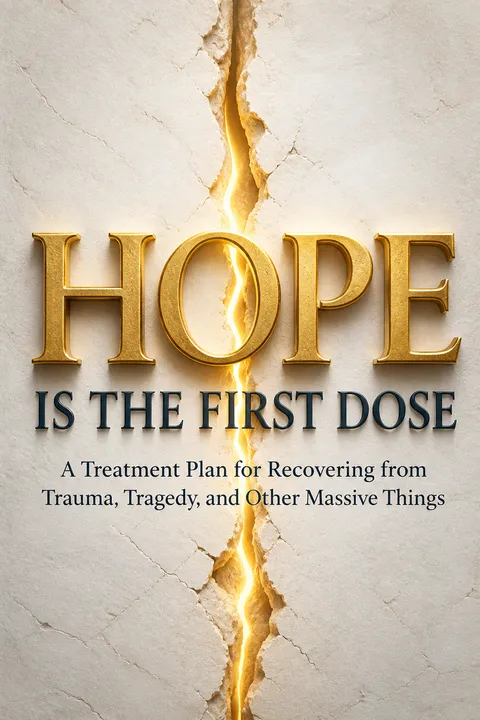
Key Takeaways
1. The Massive Thing (TMT) will eject you from your old life
This book is about what happens when life pulls the yellow handle before you’ve reached a safe altitude: You get ejected from everything you know and launched onto a dangerous and seemingly impossible trajectory...
The sudden ejection. Dr. Lee Warren uses the metaphor of a jet's ejection seat to describe "The Massive Thing" (TMT)—the sudden, catastrophic trauma that shatters your life. Whether it is the death of a loved one, a terminal diagnosis, or a sudden betrayal, TMT pulls the yellow handle, launching you into an unsurvivable freefall. You are instantly ejected from the comfortable altitude of your normal existence.
The double destruction. When TMT strikes, it causes a double destruction: it ravages your physical body, plummets your faith, and leaves you disoriented in a dark pit. The author experienced this firsthand on August 20, 2013, when his nineteen-year-old son, Mitchell, was tragically stabbed to death. The trauma triggers physical ailments, sleeplessness, and a persistent, nagging ache in your soul.
The natural response. In the wake of TMT, your brain naturally enters a state of shock, panic, and physical deterioration. To survive this freefall, you must recognize that:
- You can never return to your pre-trauma life.
- Your physical symptoms (heart racing, sleeplessness, shingles) are normal responses to emotional pain.
- Survival requires a structured, intentional treatment plan rather than passive waiting.
2. Hopelessness is deadlier than any physical disease
What I’ve learned is that it’s not impossible to live again. Somehow, God can deploy the chute and you can survive—find your feet, find your faith, and even find your happiness again.
The ultimate killer. As a neurosurgeon, Dr. Warren spent years treating patients with terminal brain tumors like glioblastoma multiforme (GBM). However, his clinical observations and personal tragedy revealed a startling truth: the deadliest disease known to humanity is not cancer, but hopelessness. Hopelessness rots the human spirit, paralyzing the mind and preventing any chance of emotional recovery.
The clinical contrast. Warren observed that patients who lost hope died long before their bodies failed, whereas those who maintained hope experienced a vastly superior quality of life, regardless of their medical outcome. Hopelessness is a cancer of the soul that spreads through toxic thinking, convincing you that your pain is permanent and that God has abandoned you.
The danger of despair. When TMT strikes, the primary danger is falling into a permanent state of hopelessness. This state is characterized by:
- Believing that your current pain is permanent and unalterable.
- Allowing a single tragic event to define the entire narrative of your life.
- Closing your ears to the voice of God and the possibility of future joy.
3. You must separate your happiness from your circumstances
In general, expectations lead to unhappiness.
The expectation trap. Human beings naturally couple their happiness with their external circumstances, believing that life must be pain-free to be good. When TMT shatters these expectations, we fall into despair because our worldview cannot reconcile a loving God with a broken world. We become angry at God for allowing the tragedy, demanding that He fix our circumstances before we agree to be happy again.
The four trajectories. Through his research, Dr. Warren categorized people's emotional responses to tragedy into four distinct groups: Crashers, Dippers, Untouchables, and Climbers. The defining factor between those who recover (Dippers and Climbers) and those who destroy themselves (Crashers) is the ability to uncouple happiness from circumstances. Crashers allow their tragedy to become the permanent baseline of their lives.
Uncoupling for survival. To survive the inevitable storms of life, you must learn to separate your internal peace from your external reality. This requires:
- Relinquishing the demand for a perfect, pain-free life.
- Recognizing that joy and sorrow can coexist simultaneously.
- Choosing to believe that God is good even when your circumstances are bad.
4. Faith lives in the gap between "against" and "hope"
Against all hope, Abraham in hope believed.
Warren's Gap Theory. Dr. Warren formulated "Warren's Gap Theory" to explain the mechanics of faith during tragedy. Faith does not exist in the absence of pain; rather, it lives in the agonizing gap between the objective hopelessness of your situation ("against") and the choice to trust God anyway ("hope"). It is the decision to believe in God's goodness before you see the outcome of your trial.
The choice to believe. When you are in the pit of trauma, everything in your physical reality screams that God has abandoned you. True faith is the active decision to bridge this gap, choosing to believe in hope even when all human reason is against it. This is the "but even if He doesn't" faith that allows you to stand firm in the furnace of suffering.
Bridging the gap. To operate within this gap, you must actively engage your mind to:
- Acknowledge the reality of your pain without letting it consume you.
- Rehearse the historical faithfulness of God in your life and in Scripture.
- Trust that the bottom will hold, even when you cannot see the floor.
5. The "And" mindset defeats the paralyzing "But"
We don’t have to live in 'but' as long as we can hold on to 'and.'
The linguistic shift. The words we use to frame our trauma dictate our emotional recovery. Most grieving people live in the land of "but"—acknowledging a blessing but immediately neutralizing it with their pain (e.g., "I have a beautiful family, but my son is dead"). This linguistic habit keeps us anchored to our tragedy, preventing us from experiencing genuine joy.
The power of "and." The breakthrough came for Dr. Warren through his two-year-old granddaughter, Scarlett, who was born on the day of Mitchell's funeral. When Scarlett innocently said, "And Mitch loves you," she taught her family to embrace the quantum reality of "and"—allowing immense joy and immense sorrow to exist together. We can grieve our losses and celebrate our blessings simultaneously.
Embracing quantum emotions. Transitioning from "but" to "and" allows you to:
- Mourn your devastating loss and celebrate your current blessings.
- Feel the deep ache of grief and experience genuine moments of laughter.
- Accept that your life is permanently scarred and still abundantly beautiful.
6. Prehab prepares the mind by rehearsing truth
Hope springs from truth rehearsed...
The concept of prehab. In medicine, "prehab" refers to the physical and mental preparation a patient undergoes before surgery to maximize their recovery. In the context of trauma, prehab is the daily discipline of building your "hope muscles" before the storm hits, or during the quiet spaces of your grief. It is the active preparation of your mind to face the inevitable trials of life.
Memory and movement. Prehab relies on two active components: memory and movement. Like the biblical writers Asaph and David, you must actively recall God's past faithfulness (memory) and take physical or mental action to lift your hands and seek Him (movement). Hope is not a passive feeling; it is an active verb that requires physical and mental exertion.
Building hope muscles. You can practice prehab daily by:
- Memorizing scripture and loading your brain with objective truth.
- Surrounding yourself with a supportive community that points you toward hope.
- Establishing daily routines of prayer, meditation, and gratitude.
7. Self-brain surgery begins with the bad-thought biopsy
We are taking prisoners of every thought, every emotion, and subduing them into obedience to the Anointed One.
The bad-thought biopsy. Dr. Warren introduces "self-brain surgery" as the process of changing your life by changing your mind. The foundational procedure of this surgery is the "bad-thought biopsy," where you pause to critically examine an intrusive, negative thought before emotionally reacting to it. You must treat your thoughts like tumor tissue, testing them for truth before letting them spread.
Feelings are not facts. Trauma floods your brain with toxic, untrue thoughts (e.g., "I am a failure," "God has abandoned me"). The biopsy forces you to ask, Is this thought objectively true? By separating your feelings from the facts, you prevent secondary emotional injuries from festering and taking root in your mind.
Performing the biopsy. To perform a bad-thought biopsy, you must:
- Capture the negative thought the moment it enters your mind.
- Compare the thought against the objective truth of God's Word.
- Transplant the toxic lie with a healthy, life-giving truth.
8. Rehab is the active, painful work of choosing to live
You can’t wait for the pain to go away before you start moving, because it never goes away.
The necessity of rehab. Just as physical surgery requires painful postoperative rehabilitation to restore function, self-brain surgery requires emotional rehab. You cannot wait until you feel better to start moving; the act of moving is what eventually makes you feel better. Rehab is the hard, daily work of choosing to live again despite your pain.
Refusing your own demise. Dr. Warren shares the story of Marcus Green, an 83-year-old paralyzed patient who had to push through excruciating pain in rehab to walk again. Marcus survived because he relentlessly refused to participate in his own demise, choosing the pain of recovery over the comfort of slowly dying. You must make the same choice in your grief.
The work of recovery. Emotional rehab requires you to:
- Push through the pain of daily life even when you feel numb.
- Unlearn old, destructive coping mechanisms (like isolation or substance abuse).
- Actively participate in your community and serve others who are hurting.
9. There are no old beaches; you must move forward with your scars
We will get there, won’t we, Nuri?
The illusion of the past. On a family trip to Kiawah Island, Dr. Warren realized that he was desperately trying to find his dead son in the memories of the beach they had once shared. But he realized a profound truth: there are no old beaches. The tide constantly refreshes the sand, washing away the past. You cannot find healing by trying to recreate your pre-trauma life.
Moving forward with scars. You cannot find healing by living in constant fear of future pain. Like Jacob wrestling with God, you will emerge from the furnace of suffering with a permanent limp, but you must keep walking. Your scars are proof of survival, not signs of defeat. They are the price of admission to a deeper, more resilient life.
Stepping into the future. To move forward, you must:
- Release your demand to return to the way things were.
- Accept your scars as proof of survival, not as signs of defeat.
- Step onto the fresh sand of today, trusting that God is already in your tomorrow.
Review Summary
Download PDF
Download EPUB
.epub digital book format is ideal for reading ebooks on phones, tablets, and e-readers.








































