
Key Takeaways
1. The biblical and scientific unity of the human family exposes the fallacy of racial slavery.
Noah was not inspired when he pronounced his curse against Canaan, for the sufficient reason that it was not fulfilled.
Common human origin. The book opens by dismantling the theological and pseudo-scientific justifications for slavery, particularly the "curse of Canaan." Williams argues passionately for the biblical and scientific unity of the human race, asserting that all civilizations share a single, common origin.
Dismantling the curse. The author exposes the logical flaws of using Noah's curse to justify African slavery. He points out several historical realities:
- The curse was pronounced on Canaan, not Ham.
- Canaan's descendants (Canaanites, Carthaginians) were powerful, free, and highly civilized.
- The Shemites (Hebrews) were actually enslaved by the Hamites (Egyptians) for centuries.
Scientific and biblical alignment. By aligning biblical ethnology with modern anatomical and physiological science, the book asserts that racial variations are merely the result of climate and geography. The globule of human blood remains identical across all races, proving a shared brotherhood under one Creator.
2. Ancient Nile and West African empires prove the historical depth of Negro civilization.
Egypt borrowed her light from the venerable Negroes up the Nile.
Cradle of civilization. Williams traces the roots of human culture back to the ancient Negro empires along the Nile, particularly the historic city of Meroe in Ethiopia. He argues that these black civilizations were the true pioneers of art, science, law, and architecture, which were later adopted by Egypt, Greece, and Rome.
Advanced African empires. Long before European contact, Africa boasted highly organized, powerful kingdoms with sophisticated political and military structures. These included:
- Benin: Known for its early diplomatic relations with Portugal and artistic bronze work.
- Dahomey: Famous for its highly disciplined army, including regiments of female warriors (Amazons).
- Yoruba: Renowned for its agricultural prosperity and capacity for rapid social development.
- Ashantee: A formidable empire that successfully resisted British military incursions for years.
The cause of decline. The subsequent decay of these great empires is attributed to the corrupting influence of the foreign slave-trade and the introduction of idolatry. As tribes turned against each other to capture prisoners for European traders, their agricultural, mechanical, and social systems crumbled into decay.
3. Sierra Leone and Liberia demonstrated the capacity of black people for successful self-government.
The surrounding Africans are aware of the nature of the colony, taking refuge when persecuted by the few neighboring slave-traders.
A noble refuge. The book highlights the establishment of Sierra Leone and Liberia as bold, practical experiments in black self-government and colonization. Founded by philanthropists and free people of color, these territories aimed to prove that African-Americans could successfully manage a modern republic while civilizing the African continent.
Triumph over adversity. Despite facing deadly tropical fevers, local tribal hostilities, and financial ruin, these colonies developed into thriving, orderly societies. Key achievements included:
- The suppression of the local slave-trade along hundreds of miles of the West African coast.
- The translation of the Bible and educational texts into native languages like Vei and Grebo.
- The establishment of robust agricultural and commercial networks exporting palm-oil, cam-wood, and ivory.
Proof of capability. The success of these republics served as a powerful, living refutation of the pro-slavery argument that black people were incapable of self-government. Visitors and naval officers universally praised the orderliness, sobriety, and high moral tone of these settlements.
4. The New England colonies established a profound moral paradox by legalizing slavery.
This article gives express sanction to the slave-trade, and the practice of holding Negroes and Indians in perpetual bondage, anticipating by many years any thing of the sort to be found in the statutes of Virginia or Maryland.
Puritan inconsistency. Williams exposes the deep moral hypocrisy of the New England colonies, particularly Massachusetts, which was the very first colony to formally legalize slavery by statute in its 1641 "Body of Liberties." While the Puritans loudly demanded their own civil and religious liberties from the British Crown, they simultaneously codified the perpetual bondage of Negroes and Indians.
Economic and legal mechanisms. Slavery in New England was driven by economic pragmatism rather than agricultural necessity. The legal and social systems of these colonies treated slaves with a bizarre mixture of patriarchal care and brutal commercialism:
- Slaves were legally rated and taxed alongside "horses, hogs, and other beasts."
- The slave-ship Desire was fitted out by the colonial authorities themselves to exchange captured Pequod Indians for African slaves.
- Severe "pass systems" and night curfews restricted the movement of both slaves and free Negroes.
The struggle for legal freedom. Despite these oppressive laws, New England became the birthplace of the legal battle against slavery. Through "freedom suits" in the mid-to-late 18th century, courageous slaves successfully sued their masters for their liberty, arguing that the royal charters guaranteed equal rights to all British subjects.
5. Southern colonies built their entire economic and legal systems on brutal human chattelhood.
South Carolina has the unenviable reputation of being the only colony in North America where by positive statute the Negro was doomed to perpetual bondage.
Chains in the soil. In the Southern colonies—Virginia, the Carolinas, and Georgia—slavery was the absolute economic foundation of the plantation system. The massive production of tobacco, rice, and indigo required an endless supply of cheap, forced labor, leading to the creation of the most draconian slave-codes in the New World.
Dehumanizing legislation. Southern laws stripped the Negro of every vestige of humanity, legally defining them as "chattels personal" to be bought, sold, and executed without a jury. Key features of these codes included:
- The legal doctrine of partus sequitur ventrem, ensuring that children inherited the slave status of their mothers.
- Brutal physical punishments, including branding, nose-slitting, and dismemberment for running away or striking a white person.
- Absolute prohibition of education, with heavy fines for anyone attempting to teach a slave to read or write.
The Georgia struggle. The history of Georgia is particularly instructive, as its trustees originally banned slavery to encourage a hardy white military buffer against Spanish Florida. However, the relentless greed of the planters and the neighboring influence of South Carolina eventually forced the trustees to capitulate, proving the near-irresistible political power of the slave system.
6. The Middle Colonies maintained a highly complex and contradictory legal landscape for slaves.
The Dutch, the Quakers, and the English held slaves. But the system was milder here than in any of the other colonies.
Milder Dutch origins. In the Middle Colonies—New York, New Jersey, and Pennsylvania—slavery began under Dutch rule with a relatively mild, patriarchal character. Slaves under the Dutch West India Company enjoyed certain civil rights, such as owning small plots of land, marrying legally, and possessing a realistic hope of eventual manumission.
English hardening. When the English seized control of these colonies, they systematically hardened the slave-codes to maximize commercial profits. This transition resulted in highly contradictory legal landscapes:
- New York established a notorious slave-market on Wall Street and passed severe restrictive curfews.
- New Jersey, conversely, allowed Negroes the unique right of "trial by jury" in capital cases.
- Pennsylvania became a battleground between the aggressive slave-importation policies of the Crown and the quiet, persistent opposition of the Quakers.
The Quaker crusade. The Society of Friends in Pennsylvania became the first organized religious body in the world to officially protest against the slave-trade. Their early memorials and internal discipline laid the groundwork for the gradual emancipation acts that would eventually sweep through the Middle and Eastern States after the Revolution.
7. Negro soldiers rendered heroic and decisive military service during the Revolutionary War.
In the regiments at Roxbury, the privates are equal to any that I served with in the last war... and, in action, many of them have proved themselves brave.
Valorous pioneers. From the very first clash of arms, Negro soldiers played a vital and heroic role in the struggle for American independence. Despite official hesitation and legal prohibitions, black men—both bond and free—rallied to the revolutionary standard, proving their courage on every major battle-field of the war.
Distinguished heroes. The book immortalizes several black soldiers whose extraordinary exploits earned them the respect of their white officers and the nation:
- Peter Salem: The intrepid private who shot the British Major Pitcairn at the Battle of Bunker Hill.
- Salem Poor: A soldier whose "gallant and distinguished" conduct at Bunker Hill led fourteen officers to petition the General Court for his reward.
- Prince: The brave Negro who physically forced open the door to capture British Major-General Prescott in Rhode Island.
The Black Regiment. The Rhode Island Negro Regiment, commanded by Col. Christopher Greene, became legendary for its "desperate valor." At the Battle of Rhode Island, this regiment successfully repulsed three furious charges by highly disciplined Hessian mercenaries, saving the American army from certain capture.
8. The American Revolution maintained a glaring double standard by fighting for liberty while preserving chains.
I wish most sincerely there was not a slave in the province; it always appeared a most iniquitous scheme to me to fight ourselves for what we are daily robbing and plundering from those who have as good a right to freedom as we have.
Glaring hypocrisy. Williams relentlessly exposes the profound moral contradiction at the heart of the American Revolution. While the colonists issued the glorious words of the Declaration of Independence, proclaiming that "all men are created equal," they continued to buy, sell, and hold half a million black human beings in hopeless, perpetual bondage.
Military opportunism. The enlistment of Negroes was driven by desperate military necessity rather than a sudden awakening of human sympathy. Both sides of the conflict used the promise of freedom as a strategic weapon:
- Lord Dunmore offered freedom to any rebel-owned slaves who would join the British forces, causing thousands to flee to his standard.
- Gen. Washington, initially opposed to enlisting Negroes, reversed his policy to prevent them from joining the enemy.
- Northern States began purchasing slaves to fill their military quotas, promising them freedom at the end of the war.
Post-war betrayal. When the war ended in a glorious victory for American liberty, the vast majority of black soldiers and their families were betrayed. Many who had fought heroically were forced back into servitude by their former masters, proving that the new republic valued property rights far above the natural rights of its black defenders.
9. The extraordinary achievements of self-taught black scholars shattered contemporary theories of racial inferiority.
Nobody wishes more than I do to see such proofs as you exhibit, that Nature has given to our black brethren talents equal to those of the other colors of men...
Defying the stereotype. To counter the pervasive pro-slavery argument that Negroes were naturally inferior and lacked intellectual capacity, Williams highlights the lives of three extraordinary black scholars. Operating under the most hostile social and legal conditions, these individuals achieved international renown in highly complex scientific fields.
Intellectual giants. The book details the remarkable achievements of these self-taught geniuses:
- Benjamin Banneker: A master astronomer and mathematician who constructed a striking clock from a borrowed watch, published highly accurate almanacs, and helped survey the District of Columbia.
- Thomas Fuller: Known as the "Virginia Calculator," an illiterate slave who could instantly solve complex mathematical problems, such as calculating the exact number of seconds in seventy years.
- James Derham: A fluent multilingual physician who built a highly lucrative medical practice in New Orleans and earned the deep respect of Dr. Benjamin Rush.
A powerful argument. The achievements of these men served as an unanswerable, living refutation of the racial prejudices of their time. Their intellectual triumphs proved that the apparent limitations of the Negro race were entirely the artificial products of the degrading institution of slavery, rather than any inherent natural incapacity.
10. The United States Constitution officially codified and protected the institution of slavery.
Mr. Madison said "he thought it wrong to admit in the Constitution the idea of property in men."
The constitutional bargain. Williams provides a detailed, critical analysis of the debates during the 1787 Constitutional Convention in Philadelphia. He reveals how the delegates from the Northern and Southern States struck a series of cynical political bargains that officially codified the institution of slavery into the organic law of the new nation.
The three compromises. To secure the union of the States, the convention agreed to three major concessions that deeply compromised the moral integrity of the republic:
- The Three-Fifths Compromise: Counting five slaves as three free men for the purposes of congressional representation and taxation.
- The Slave-Trade Clause: Prohibiting Congress from banning the importation of slaves for twenty years (until 1808).
- The Fugitive Slave Clause: Requiring that escaped slaves be delivered up to their masters, even if they fled to free States.
The poison of the monster. By placing these pro-slavery provisions directly into the Constitution, the founding fathers inoculated the young republic with a deadly moral poison. This tragic compromise laid the legal and political foundation for the subsequent decades of sectional strife, culminating in the flames of the Civil War.
Review Summary
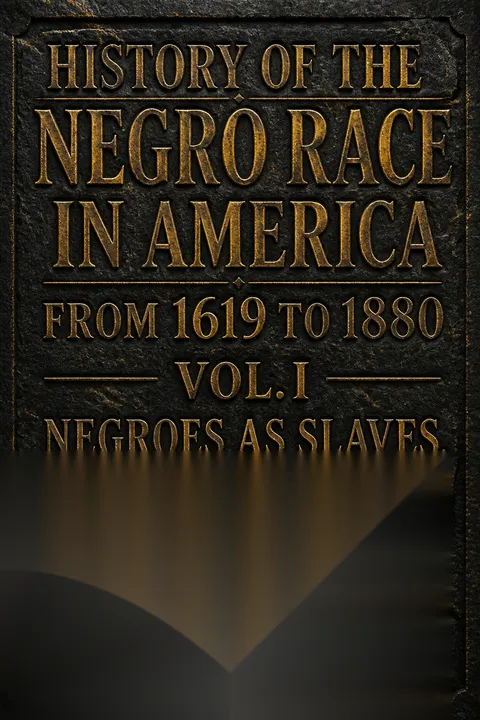
The History of the Negro Race in America From 1619 to 1880. Vol 1 Negroes as Slaves, as Soldiers, and as Citizens holds an overall rating of 4.03 out of 5 across 29 reviews. Readers note the challenging nature of the book's 1870s perspective on race, though many appreciate the extensive scholarship and detailed documentation of colonial and revolutionary war slavery, including original documents in the footnotes. One reviewer highlights Ohio's connection to the author, while another found the book too difficult to complete.
Download PDF
Download EPUB
.epub digital book format is ideal for reading ebooks on phones, tablets, and e-readers.








































