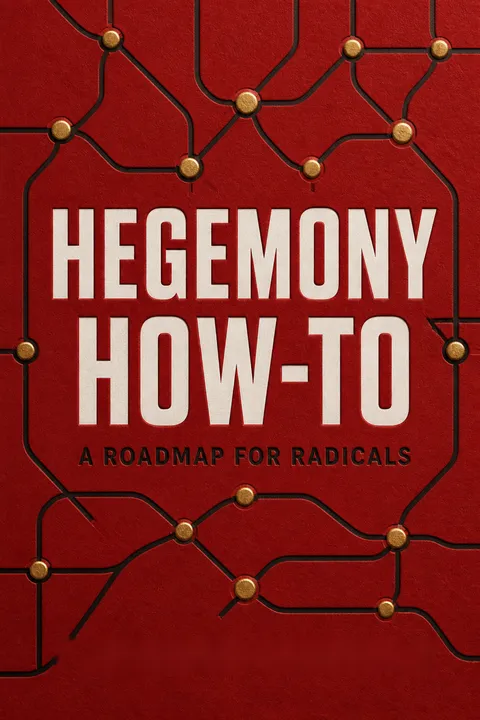

Key Takeaways
1. "Activism" as a label isolates movements and limits impact.
When people refer to me as an activist, I have taken to correcting them: “I dislike the label activist,” I politely explain, “It lets everyone else off the hook!”
A new social category. The term "activism" is a surprisingly recent invention, emerging significantly in the 1960s and gaining prominence in the 80s and 90s. Unlike older labels like "abolitionist" or "unionist" which referenced specific causes, "activist" is a content-less distinction that separates participants from society. This generic label often carries negative stereotypes, deterring popular support and excusing sympathizers from joining.
Self-imposed marginalization. Many idealistic young people, seeking community and a sense of purpose, voluntarily remove themselves from mainstream institutions and social networks by adopting this "activist" identity. This creates a niche subculture that, while offering belonging, severely limits political impact by alienating potential allies and failing to engage everyday spaces. The author's own journey from a conservative background highlights this shift from broad engagement to subcultural immersion.
Beyond the niche. To challenge entrenched power, movements need more than self-selecting individuals; they need large segments of society. This requires politicizing everyday spaces and weaving collective action into the social fabric, rather than retreating into an "activist clubhouse." Abandoning the label and its prescribed cultural niche is crucial for strategically engaging the broader political terrain.
2. Movements often prioritize internal group life over external political goals.
Collective ritual serves as a remedy to the paralysis caused by isolation. It provides connection, community, a sense of belonging—and there can be no politics without this collective sense.
The "life of the group." Social movements, while ostensibly aiming for external change, also fulfill deep psychological needs for community, belonging, and meaning, especially in alienating modern societies. This "life of the group" is cultivated through collective rituals—protests, meetings, shared language—that affirm identity and solidarity. This can be therapeutic and motivating, but also problematic if it overshadows instrumental goals.
Insularity and encapsulation. Unchecked, the distinctiveness of a group's subculture can become self-referential and incoherent to outsiders, leading to insularity or even "encapsulation." This phenomenon, seen in groups like SDS, means members develop strong cohesion but lose interest in external growth or influence, content with maintaining their isolated existence. This is particularly damaging as it affects the most dedicated core participants.
The political identity paradox. Movements need strong internal identity for commitment, but this same cohesion can isolate them from potential allies. This paradox requires leaders to balance "bonding" (internal ties) with "bridging" (external connections). Without conscious effort, groups risk prioritizing internal validation and ritual over strategic engagement with broader society, limiting their capacity for real-world change.
3. "Prefigurative politics" can devolve into utopian self-indulgence, not strategy.
“There is a danger. Don’t fall in love with yourselves. We have a nice time here. But remember, carnivals come cheap. What matters is the day after, when we will have to return to normal lives. Will there be any changes then?”
Utopianism without a roadmap. Occupy Wall Street's "prefigurative politics" aimed to model a better society in its encampments, with direct democracy and communal living. While inspiring, this often confused process and self-expression with political strategy. Gramsci critiqued such "utopianism" not for its vision, but for its inability to connect means to ends, becoming "idle whims, dreams, longings" rather than genuine political struggle.
The lifeworld's allure. Habermas's concept of the "lifeworld" suggests that in advanced capitalism, people seek refuge from pervasive bureaucratic and capitalist logics by creating intact, cohesive communities. This drive for psychic completion can lead movements to prioritize constructing their particularized lifeworld over achieving external political outcomes. The internal "utopia" becomes the goal, eclipsing the drive to affect larger political change.
Post-political paralysis. When movements become "post-political," they risk losing interest in strategic calculus, leadership, and organization—elements seen as tainted by the "system." This allergic reaction to power, while stemming from valid critiques, can paralyze a movement, preventing it from building anything larger than a "radical clubhouse." Occupy's internal debates and resistance to traditional organizing structures exemplify this self-stunting tendency.
4. Embrace an "ethic of responsibility" to engage and wield political power.
“Power properly understood is nothing but the ability to achieve purpose. It is the strength required to bring about social, political and economic change… And one of the great problems of history is that the concepts of love and power have usually been contrasted as opposites—polar opposites—so that love is identified with a resignation of power, and power with a denial of love… Now, we’ve got to get this thing right. What is needed is a realization that power without love is reckless and abusive, and love without power is sentimental and anemic… It is precisely this collision of immoral power with powerless morality which constitutes the major crisis of our times.”
Beyond sideline critique. Martin Luther King Jr. highlighted the crisis of separating love from power, leading to "powerless morality." Many on the left, repulsed by power's abuses, retreat into "resigned sideline critique," celebrating moral purity over political efficacy. This manifests in self-expressive dissent, like the bumper sticker "I'M ALREADY AGAINST THE NEXT WAR," which proclaims resignation rather than strategic intent to prevent future conflicts.
Weber's ethical distinction. Max Weber distinguished between an "ethic of ultimate ends" (doing the right thing regardless of outcome) and an "ethic of responsibility" (considering foreseeable consequences). While the former might lead to righteous but futile stands, the latter demands strategic engagement, understanding that political change requires building power and influencing outcomes. It means asking: "What can we do now in order to be able to do tomorrow what we are unable to do today?"
No unilateral disarmament. To achieve social justice, movements cannot "unilaterally disarm" in the realm of politics. This means accepting that some level of coercion is necessary to challenge entrenched interests and that moral appeals alone are insufficient. An ethic of responsibility compels us to build collective force, incentivize participation, and strategically intervene in the messy terrain of power, rather than seeking personal purity or retreating from the fight.
5. Aspire to hegemony, don't just critique it.
“Things could always be otherwise and every order is predicated on the exclusion of other possibilities. Any order is always the expression of a particular configuration of power relations. What is at a given moment accepted as the ‘natural’ order, jointly with the common sense that accompanies it, is the result of sedimented hegemonic practices.”
Contesting common sense. Hegemony is the predominant influence of one group, often maintained by shaping "common sense"—what everyone intuitively knows without needing to be said. This "common sense" is a political construct, not neutral, and always reflects particular interests. Aspiring to hegemony means actively contesting this common sense, aiming to fill it with values of compassion, social justice, and equality, rather than just denouncing existing hegemonies.
Form over content. The author argues that hegemony is more a "form" than an inherent "content." Something will always be the prevailing common sense; the question is, "what?" If progressive forces do not challenge the existing common sense, opponents will win by default. This requires constructing alternative "metanarratives" that can realign society, understanding that these "fictions" are powerful tools for shaping social and material reality.
Symbolic and institutional contests. Hegemonic struggle involves two intertwined contests: the "symbolic contest" over narratives, meanings, and common sense, and the "institutional contest" over structures, policies, and power distribution. Winning the symbolic contest (e.g., Occupy's "99%") is crucial for legitimacy, but insufficient without a strong "ground game" in the institutional contest to translate cultural victories into tangible change. To win, movements must engage both.
6. Build collective power by activating a broad base, not just a dedicated core.
To organize, in the political sense, is not to organize an event, a protest, or even an occupation. It is not just to create an autonomous project. Political organizing may very well involve all of the above activities, but its essence is not itself these activities—all of which can be carried out without necessarily building or being accountable to a substantial social base.
Beyond the "low plateau." Movements often get stuck on a "low plateau" of familiar faces and limited capacity. To achieve large-scale change, they must move beyond their "kinetic force" (visible active groups) and activate their "potential force"—the vast numbers of sympathetic but unmobilized people and existing institutions. This requires a growth trajectory, shifting passive allies to active, and neutrals to passive.
Organizing vs. mobilizing. Political organizing is about building a social bloc into a political force, articulating its goals, and inspiring aligned action. It's not just about events or protests, but about creating structures and "on-ramps" for broad engagement. Occupy, for example, initially succeeded in mobilizing individuals but struggled to organize existing groups and institutions, limiting its long-term impact.
Engaging existing infrastructure. Rapid movement growth often comes from "bloc recruitment"—organizing within existing social networks and institutions (e.g., churches, unions) rather than building everything from scratch. This allows people to participate as who they already are, leveraging pre-existing infrastructure and resources. Organizers must reach out, build relationships, and provide manageable, meaningful roles for diverse participants.
7. Strategic communication requires understanding and engaging existing narratives.
“Narrative insurgency” is more or less a fancy way of saying “Listen to people and attempt to understand where they’re coming from before you try to persuade them of something.”
Beyond the "banking model." The left often approaches society like an "expert teacher" depositing knowledge into "ignorant students," attempting to convey a full radical analysis at once. This "banking model" of communication alienates broader audiences. Instead, movements need a pedagogical approach that creates experiences, sparks curiosity, and builds on existing knowledge, much like a good campaign engages its "students."
Narrative insurgency. Rather than directly attacking someone's worldview ("narrative attack"), "narrative insurgency" seeks common ground within their existing narrative. It identifies allied beliefs, reinforces them, and foments "homegrown insurgency" from within. For example, appealing to a creationist's mandate to care for God's creation when discussing environmental issues, rather than attacking their religious beliefs.
Befriending ambiguity. While clarity is important for core leaders, ambiguity can be a powerful strategic tool for broader engagement. When a message's meaning is somewhat unclear, it intrigues people, prompting them to engage and re-examine their assumptions. This "courtship" approach, unlike "proposing on the first date," allows for gradual persuasion and broader identification, essential for attracting diverse social forces.
8. Overcome negative stereotypes and "inoculation" through savvy branding.
“People think that to have a movement against the war, you just have to show up on a day and do something,” Dougherty continued, “And [they] don’t really realize all of the work that goes into organizing and planning things. It doesn’t get you on the news; it doesn’t get you headlines. You know, you can’t make a headline every day if you’re serious about building a movement. It’s hard and it’s hard to figure out; and it’s a lot harder to actually do the organizing and think about a campaign and think about how your tactics build upon one another. What’s your goal? How [are you] going to have an impact? That stuff is all way harder than just … showing up at a rally…”
The "inoculation" effect. Negative stereotypes about "protesters" and "activists" act like a weak virus, inoculating the public against genuine collective action. People, even sympathizers, recoil from these caricatures, believing they "wouldn't see themselves as the kind of person that would go to a march." This cognitive block prevents broad participation, as movements are perceived as self-expressive rather than politically effective.
Strategic branding. Organizations need a conscious "branding strategy" to create positive associations in people's minds. This involves everything from logos and mottos to spokespeople and aesthetics. The Lancaster Coalition for Peace & Justice, for example, adopted a mainstream, familiar brand, using city council chambers for "Town Hall Meetings" instead of "protests," and featuring local veterans. This "cognitively disarmed" people and drew in "unusual suspects."
Usurping the "officialization effect." By presenting themselves as mainstream and familiar, movements can tap into the "officialization effect"—the aura of legitimacy typically enjoyed by those in power. This reassures potential participants and allows new, positive associations about collective action to emerge. It's about making the movement relatable and accessible, rather than reinforcing alienating stereotypes.
9. Define an inclusive "we" to foster broad-based solidarity and alignment.
“Within each such social group, a feeling of solidarity prevails, a compelling need to work together and a joy in doing so that represent a high moral value.”
The "we" in politics. Politics is fundamentally about groups and the "we"—the collective identity to which individuals feel belonging and allegiance. Political contenders compete to define this "we," its boundaries, values, and perceived threats. The most compelling political narratives appeal to this deep human longing for belonging and capacity for solidarity, rather than individualistic desires.
Inclusive vs. exclusive "we." Effective challengers must use an "inclusive we" that invites broad identification, like Occupy's "We are the 99%!" This contrasts with an "exclusive we" (e.g., "We in the environmental community") that alienates those outside the immediate group. Elites, conversely, often use an inclusive "we" to legitimize their power while otherizing challengers as a "they."
Articulating solidarity. Social unification is a "fiction" that requires a compelling story to align fragmented social elements. This involves translating abstract grievances into potent messages that resonate locally, connecting organic solidarity values to larger abstractions. The success of "Black Lives Matter" moving from hashtags to pulpits demonstrates this process of local internalization of a broad "we."
10. The next left zeitgeist demands leaderful, organized, and politically astute movements.
There is nothing “radical” about an attachment to outsiderness and marginality. And what is more radical than believing that everyday people can come together and organize a collective vehicle powerful enough to remake the world?
Beyond "leaderless" myths. The "leaderless" ideology, prevalent in movements like Occupy, is self-sabotaging. While aiming for horizontal power, it inadvertently discourages initiative and creates a "circular firing squad" culture. The next left zeitgeist needs "leaderful" movements, where many are encouraged to step up, learn organizing skills, and take initiative, fostering a proliferation of diverse leaders.
Rebuilding infrastructure. The progressive left suffers from decades of decline in civic, labor, and political infrastructure, leaving many "political orphans." Despite favorable shifts in public opinion (e.g., millennials identifying with socialism), this lack of capacity prevents political leverage. Rebuilding this infrastructure through concrete struggles, leadership development, and strategic organization is crucial to capitalize on political openings.
Contestation, not withdrawal. The future demands a "politics of contestation," not the "politics of withdrawal" that characterized much of the radical left post-1968. This means stepping out of the "activist clubhouse" and into the terrain of politics, threading together morality and political power. It's about building collective vehicles powerful enough to claim and contest our culture, commons, government, and future, making a left hegemonic project a realistic possibility.
People Also Read








Download PDF
Download EPUB
.epub digital book format is ideal for reading ebooks on phones, tablets, and e-readers.








































