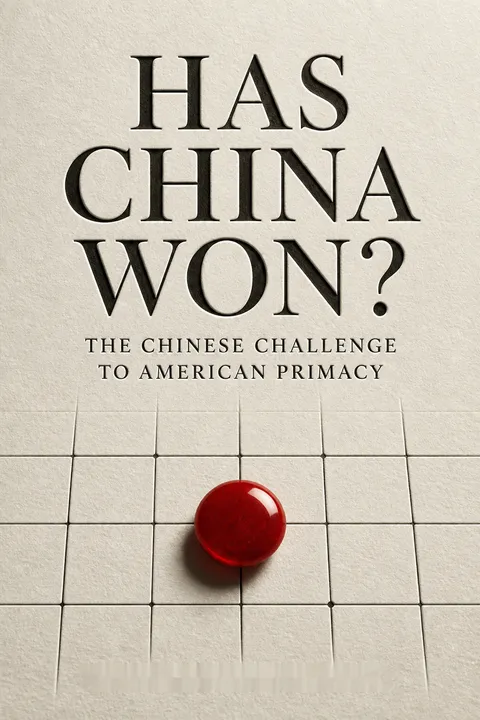

Key Takeaways
1. The US-China Contest: Inevitable Yet Avoidable
It is a paradox of the great geopolitical contest that will be played out between America and China in the coming decades that it is both inevitable and avoidable.
Inevitable clash. The geopolitical contest between America and China is inevitable due to policymakers' zero-sum game psychology, where one nation's gain is perceived as another's loss. This mindset drives tactical decisions that escalate competition, such as China's naval deployments in the South China Sea leading to increased US presence. The current bipartisan consensus in America views China as a threat, further solidifying this confrontational trajectory.
Avoidable conflict. Despite the escalating tensions, a full-blown clash is avoidable if both sides prioritize rational, long-term thinking and understand each other's core interests. There are no fundamental conflicts of interest in many areas, such as ensuring freedom of navigation in international waterways, where China, as the world's largest trading nation, has a greater stake than the US. The key lies in moving beyond emotional reactions and short-term tactical gains to develop comprehensive, global strategies.
Global expectations. The combined populations of the US and China represent less than 25% of the world's total, and the remaining 75% expect both powers to act responsibly. There will be little tolerance for extreme or irrational measures from either side, emphasizing the need for a "decent respect for the opinions of mankind." This global perspective underscores the potential for cooperation on shared challenges rather than destructive rivalry.
2. China's Strategic Missteps: Alienating Key US Constituencies
With US and China at the precipice of a truly adversarial relationship, no group has really stepped forward to defend US-China relations, much less defend China.
Lost advocates. China's biggest strategic mistake was alienating major American constituencies, particularly the business community, which historically advocated for strong US-China relations. Despite American companies like Boeing and General Motors making significant profits in China, they largely remained silent when President Trump launched his trade war. This lack of defense signaled a profound shift in sentiment.
Contributing factors. This alienation stemmed from several issues:
- Lack of reciprocity: Foreign firms faced demands for technology transfer, intellectual property theft, and non-tariff barriers.
- Hubris post-2008: Chinese officials displayed arrogance after the global financial crisis, believing their "way is right."
- Weak central leadership (2000s): Beijing failed to rein in provincial and city chiefs who engaged in unfair practices, leading to a perception of a rigged playing field.
Rectifiable errors. This strategic mistake is rectifiable. China needs to abandon its "Middle Kingdom" mentality and become the most open economy for foreign businesses, including American ones. This would rebuild a crucial political buffer and strengthen globalization, a force that has propelled China's own rise.
3. America's Strategic Blunders: A Lack of Comprehensive Vision
The US had a comprehensive bipartisan strategy towards China from the opening in 1972 until recently—to integrate China into the world, politically, economically and culturally. But in recent years, that strategy produced complications and complexities—helped usher in a new, more powerful China that did not conform to Western expectations. In the wake of this transformation, the US has been frozen. It has not been able to conceive of a new comprehensive strategy toward the Middle Kingdom.
Strategic vacuum. America lacks a comprehensive, long-term strategy for dealing with China, a stark contrast to its well-formulated containment strategy during the Cold War. This strategic vacuum has led to uncoordinated, impulsive actions, such as President Trump's trade war, which have often served China's long-term interests by diminishing America's global standing. The bipartisan support for Trump's aggressive stance, despite its flaws, highlights this strategic paralysis.
Erosion of trust. Trump's "America First" policy and unilateral approach have alienated key allies and friends, undermining the global coalitions essential for counterbalancing China. Walking away from agreements like the Trans-Pacific Partnership (TPP) was a "geopolitical gift to China," allowing China to lead new multilateral initiatives like the Belt and Road Initiative (BRI) and the Asian Infrastructure Investment Bank (AIIB). This shift has eroded global trust in America as a reliable partner.
Ignoring economic realities. American leaders, including Trump, have ignored fundamental economic principles, such as the fact that trade deficits are often a result of domestic macroeconomic decisions, not unfair trade practices. This disregard for economic wisdom, coupled with impulsive tariff impositions, has harmed American companies and consumers more than Chinese counterparts, further demonstrating a lack of coherent strategy.
4. The Weaponization of the Dollar: America's Achilles' Heel
The most dangerous thing that Donald Trump has done is to create a strong incentive for other countries to stop relying on the US dollar as the dominant global reserve currency.
Exorbitant privilege. The US dollar's status as the dominant global reserve currency grants America an "exorbitant privilege," allowing it to finance twin fiscal and current account deficits by essentially printing money. This privilege is sustained by global trust in the dollar and its indispensability for international trade and financial transactions. This trust has historically been a cornerstone of American power and prosperity.
Eroding trust. Recent US administrations, particularly the Trump administration, have weaponized the dollar through unilateral sanctions and extraterritorial application of domestic laws, punishing foreign banks for trading with sanctioned countries like Iran. This has created a powerful global incentive for countries to seek alternatives, as evidenced by European efforts to establish INSTEX for non-dollar trade with Iran. Such actions risk undermining the dollar's long-term global standing.
Emerging alternatives. While the Chinese Renminbi (RMB) is not yet a viable alternative, China's aggressive push into blockchain technology and digital currencies could eventually offer a credible alternative for global trade transactions. If the dollar's role in financing global trade diminishes, it could destabilize the entire complex international financial system, potentially crippling America's ability to finance its deficits. This cavalier use of a critical strategic asset for short-term gains is a profound strategic error.
5. China's Defensive Stance: Misunderstood as Expansionism
The long two-thousand-year record of Chinese history clearly shows that China is fundamentally unlike America as it is reluctant to use the military option first.
Historical context. Western perceptions often portray China as aggressive and expansionist, particularly regarding the South China Sea. However, China's historical record, spanning two millennia, suggests a fundamentally defensive, rather than militaristic, civilization. Unlike European powers or even its Mongol neighbors, China rarely sought to conquer distant overseas territories, even when it possessed the world's strongest navy under Admiral Zheng He.
Defensive motivations. China's actions, such as land reclamation in the South China Sea or its stance on Taiwan, are often driven by a deep-seated historical obsession with securing its borders and sovereignty, stemming from its "century of humiliation." The militarization of the Spratly Islands, for instance, followed US naval provocations, not a unilateral aggressive intent. China's defense white paper explicitly emphasizes "safeguarding... national sovereignty and territorial integrity" as part of a "defensive" policy.
Taiwan's significance. Taiwan is a core issue for China, viewed as the last vestige of its century of humiliation. China's desire for reunification is seen as restitution, not expansion. Any perceived American support for Taiwanese independence provokes a strong national reaction, boxing in Chinese leaders. A wise approach would involve strong American discouragement of Taiwanese independence movements to reduce tensions and allow for Taiwan's continued autonomy.
6. America's Inability to Make U-Turns: Structural Rigidities
The key argument of this chapter is that the rigidity and inflexibility of American decision making has become structurally entrenched, and this is especially visible in the way that the United States approaches military conflict.
Locked-in processes. America's decision-making processes have become rigid and inflexible, preventing rational U-turns in key areas. Despite the irrationality of escalating defense spending when an all-out war with China is unthinkable, the US cannot reduce its military budget due to powerful defense contractor lobbies. This wasteful spending, driven by domestic political considerations rather than strategic necessity, serves as a "geopolitical gift to China."
Unnecessary interventions. America remains entangled in costly and futile conflicts in the Islamic world, draining trillions of dollars and distracting from its strategic focus on China. This post-Cold War surge in military interventions, from Afghanistan to Iraq and Syria, contrasts sharply with China's four-decade avoidance of major foreign wars. This inability to disengage, despite clear strategic disadvantages, highlights a deep-seated groupthink within Washington's strategic establishment.
Weakened diplomacy. America's diplomatic capabilities have been undermined by:
- Ambassadorial postings often going to political donors rather than career diplomats.
- Budget cuts to the State Department.
- A lack of flexibility for American negotiators due to conflicting domestic agency demands.
This weakening of diplomacy, coupled with an overreliance on military solutions, leaves America ill-equipped for a geopolitical contest that will likely be won in the diplomatic, not military, arena.
7. The CCP's Paradoxical Role: Delivering Global Public Goods
It can be argued that strong central control of China by the Chinese Communist Party under Xi Jinping is producing at least three “global public goods” that the world is indeed benefiting from.
Stable governance. The Chinese Communist Party (CCP), despite its authoritarian nature, provides strong central control that delivers stability to 1.4 billion people, preventing chaos (luàn) that has historically plagued China. This stability is a global public good, as a chaotic China would have immense negative repercussions worldwide. The CCP has evolved into a meritocratic system, attracting "the best and brightest" to its ranks, leading to effective governance and significant improvements in citizens' well-being.
Rational global actor. The CCP acts as a rational actor in addressing pressing global challenges, such as climate change. Unlike the US withdrawal from the Paris Agreement, China has committed to its obligations, aiming for an "ecological civilization." This pragmatic approach, prioritizing long-term national and global interests over short-term political pressures, contrasts with the often impulsive decisions of some democratic leaders.
Status quo power. The CCP has demonstrated strategic restraint, evolving from a revolutionary power supporting communist parties globally to a status quo power. It has largely refrained from intervening in other states' internal affairs, unlike the Soviet Union or even some Western powers. This non-interventionist stance, driven by a focus on domestic stability and national rejuvenation, contributes to a more predictable and less disruptive international order.
8. The Myth of American Virtue: Internal Challenges Undermine Primacy
The idea that the United States is uniquely virtuous may be comforting to Americans. Too bad it’s not true.
Self-congratulatory myth. America's belief in its unique virtue and exceptionalism, often portrayed as a "shining city on a hill," blinds it to its own significant internal flaws. This self-congratulatory narrative, while comforting, prevents a realistic assessment of its global role and domestic challenges. This myth is deeply embedded in the American psyche, making it difficult for leaders to question fundamental assumptions.
Declining well-being. Contrary to the myth of universal prosperity, America is the only major developed society where the average income of the bottom 50% has stagnated or declined over the past three decades. This has led to a "sea of despair" among the white working class, marked by family dysfunction, addiction, and social isolation. This stark inequality, where the wealth disparity between the richest 100 households and the bottom 90% rivals that of Roman senators and slaves, contradicts the ideal of a just society.
Plutocracy, not democracy. The American political system, while maintaining democratic rituals, has functionally transformed into a plutocracy. Supreme Court decisions, like Citizens United, have legalized the use of vast sums of money to influence elections and public policy, effectively hijacking the votes of ordinary citizens. This means that legislative decisions often serve the interests of a moneyed aristocracy and well-funded special interest groups, rather than the majority population, undermining the core principles of democracy and equal opportunity.
9. Global Hedging: Nations Prioritize Self-Interest in the Rivalry
Many countries “are carefully defining their own positions, pushing back against pressure to choose sides between the US and China.”
Strategic autonomy. Other nations are not passively aligning with either the US or China but are actively hedging their bets and prioritizing their own long-term interests. This is evident in the continued pursuit of free trade agreements (FTAs) like the CPTPP and RCEP, even as the US withdraws from such initiatives. Countries like Australia, the EU, Japan, India, and ASEAN are navigating the rivalry by balancing economic ties with China and security relationships with the US.
Existential challenges. Many countries face unique geopolitical challenges that dictate their foreign policy choices. Europe, for instance, is increasingly concerned with African migration and sees China as a crucial partner in Africa's development, despite US objections to the BRI. Australia, deeply tied to the US culturally and militarily, finds its economic future inextricably linked to China, making a choice between the two powers economically suicidal.
Respect and pragmatism. India, while a democracy, has resisted US attempts to impose human rights clauses in trade agreements, valuing its sovereignty and pragmatic economic growth over ideological alignment. Similarly, Japan, despite its alliance with the US, recognizes the long-term necessity of a stable relationship with its powerful neighbor, China. These examples highlight that geopolitical decisions are driven by a complex interplay of national interest, cultural identity, and pragmatic calculations, not just ideological affinity.
10. Overcoming Subconscious Biases: The "Yellow Peril" and Civilizational Fusion
The time has come for an honest discussion of the “yellow peril” dimension in US-China relations.
Subconscious fears. Deep-seated, often subconscious, fears of the "yellow peril" within the Western psyche influence American reactions to China's rise. This historical bias, rooted in past events like Mongol invasions and perpetuated through cultural caricatures, can distort rational analysis of China's intentions. Acknowledging and addressing these subconscious impulses is crucial for a more objective and effective US-China relationship.
Civilizational non-clash. Despite Samuel P. Huntington's warnings, there is no inherent "clash of civilizations" between the West and China. Modern civilizations are increasingly interconnected and share common aspirations for education, prosperity, and stable communities. Chinese leaders, like President Xi Jinping, emphasize the beauty in all civilizations and the potential for diverse cultures to flourish together, advocating for dialogue over confrontation.
Fusion, not division. The world is experiencing a "fusion of civilizations," where Western modernity has been absorbed by other cultures, including China, without abandoning their unique roots. This pragmatic problem-solving approach, driven by reason and a desire for progress, makes a stable, rules-based global order possible. Recognizing this fusion, rather than fearing civilizational differences, can foster cooperation and mutual understanding.
11. Humanity's Ultimate Challenge: Cooperation on Global Commons
The final question will therefore not be whether America or China has won. It will be whether humanity has won.
Shared destiny. The fundamental national interest of both America and China should be the well-being of their people, which is inextricably linked to the health of the planet. Wasting trillions on foreign wars, as the US has done, or prioritizing geopolitical rivalry over global cooperation, is akin to "rearranging the deck chairs on the Titanic" while the planet faces existential threats like climate change.
Climate imperative. Climate change is a "global commons" challenge that demands immediate cooperation. While historical emissions vary, all industrialized nations bear responsibility. China and India's commitment to the Paris Agreement, even after the US withdrawal, highlights a global recognition of this shared peril. Cooperation on climate and other Sustainable Development Goals is essential for the survival and prosperity of all 7.5 billion people.
Beyond ideology. Despite ideological differences, there are fundamental noncontradictions between the US and China in areas like combating terrorism and promoting global stability. Both nations have experienced the devastating impact of terrorism and share an interest in a stable Islamic world. Focusing on these common challenges and opportunities, rather than ideological preaching or mutual accusations of human rights violations, can pave the way for collaboration and a safer future for their populations and humanity as a whole.
Review Summary
Has China Won? by Kishore Mahbubani receives mixed reviews (4.07/5). Supporters praise its challenging perspective from a Singaporean diplomat, offering non-Western insights into US-China relations and advocating cooperation over confrontation. Critics argue the book exhibits pro-China bias, downplaying human rights abuses and treating Chinese policies too leniently while harshly criticizing American mistakes. Readers appreciate Mahbubani's analysis of both nations' strategic errors and his call for mutual understanding. The book is considered thought-provoking for Western audiences, presenting China's rise as inevitable and urging realistic, collaborative approaches rather than zero-sum competition.
People Also Read






Download PDF
Download EPUB
.epub digital book format is ideal for reading ebooks on phones, tablets, and e-readers.








































