
Plot Summary
Grasshopper Jungle Origins
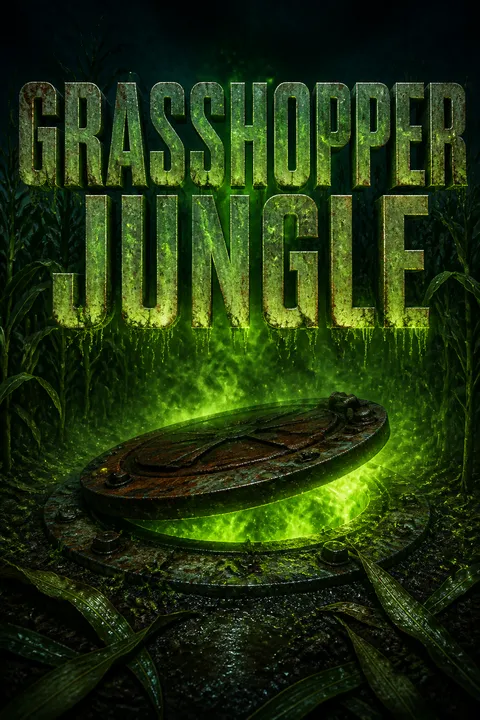
Austin Szerba, a Polish-American teen obsessed with recording history, narrates life in Ealing, Iowa—a town defined by its dying mall, endless cornfields, and the close bond between Austin, his best friend Robby, and girlfriend Shann. Their BMX bike trails become the foundation for the town's mall, symbolizing how their childhood shapes the landscape. Austin's family history, stretching back to Poland, weaves through his present, connecting personal and global events. The town's decline mirrors the characters' own uncertainties, setting the stage for a story where the mundane and the extraordinary collide. Austin's compulsion to document everything foreshadows the chaos to come, as the seeds of disaster are sown in the overlooked corners of Ealing.
Blood, Bikes, and Bullies
Austin and Robby's day takes a violent turn when they're attacked by local bullies, the Hoover Boys, who mock their friendship and perceived sexuality. The assault leaves them bloodied and humiliated, their shoes and skateboards stranded on a mall rooftop. This incident is more than a typical act of teenage cruelty—it's the catalyst that sets the novel's apocalyptic events in motion. The blood spilled in Grasshopper Jungle becomes a literal and symbolic trigger for the disaster to come. Despite the pain, Austin and Robby's bond deepens, their shared suffering forging a resilience that will be tested as the world unravels. The chapter captures the raw vulnerability of adolescence and the unpredictable consequences of violence.
Love, Lust, and Confusion
Austin's internal struggle with his feelings for both Robby and Shann intensifies. He's caught between desire and confusion, unsure if he's gay, straight, or something else entirely. The trio's dynamic is fraught with jealousy, longing, and unspoken questions. Austin's attempts to connect with Shann are complicated by his fantasies involving Robby, and vice versa. Their shared history—dancing lessons, first kisses, and awkward confessions—underscores the complexity of teenage love. The chapter explores the fluidity of identity and the pain of not fitting into clear categories. Austin's relentless honesty, both in his notebooks and narration, exposes the messiness of growing up and the impossibility of simple answers.
The Trapdoor Discovery
Driven by curiosity and a need to reclaim their belongings, Austin and Robby climb onto the mall roof and stumble upon a trapdoor leading into Shann's stepfather's consignment store. Inside, they discover a hidden office filled with grotesque scientific relics: jars of preserved body parts, mutant insects, and a mysterious glowing globe labeled as a "contained plague." The boys' trespass is both literal and metaphorical—they're crossing boundaries into adult secrets, scientific hubris, and the unknown. Their discovery is interrupted by the return of the bullies, who unwittingly steal and later break the plague globe, setting off a chain reaction. The trapdoor becomes a portal to the past's buried dangers and the future's unfolding catastrophe.
The Plague Unleashed
The stolen globe, containing the dormant Plague Strain 412E, is dropped and shattered by the bullies, mixing with Robby's blood on the alley pavement. Unbeknownst to anyone, this act unleashes a genetically engineered mold designed decades earlier as a Cold War weapon. The infection spreads silently, first claiming the bullies, then a homeless man known as Hungry Jack, and others. The plague's effects are monstrous: victims transform into giant, ravenous, sexually driven mantis-like bugs. The chapter marks the true start of the apocalypse, as the consequences of forgotten experiments and teenage violence converge. The ordinary world of Ealing is irrevocably altered, and the characters' personal dramas are subsumed by a global threat.
History's Abbreviations
Austin reflects on the impossibility of recording everything, acknowledging that all history is an abbreviation—a selective, subjective account. He draws connections between his family's immigrant past, the town's decline, and the unfolding disaster. The act of writing becomes both a coping mechanism and a way to impose order on chaos. Austin's notebooks are filled with drawings, confessions, and attempts to make sense of events too large to comprehend. The chapter meditates on the power and futility of storytelling, the ways in which personal and collective histories are shaped, and the inevitability of forgetting. As the world ends, Austin's compulsion to document persists, even as he questions its purpose.
Haunted by the Past
The narrative delves into Austin's family history—Polish ancestors, wars, migrations, and secrets. Stories of survival, loss, and forbidden love echo in the present, shaping Austin's identity and choices. His brother Eric's deployment and injury in Afghanistan, his great-grandfather's exile, and the legacy of violence and resilience all inform Austin's worldview. The past is not dead; it haunts the present, manifesting in both personal struggles and the literal monsters unleashed on Ealing. The chapter explores how trauma is inherited, how history repeats, and how individuals are both products and prisoners of their lineage. Austin's search for meaning is a search for connection across time.
Silo Secrets Unearthed
Shann, Austin, and Robby investigate a mysterious message from a teletype machine hidden in Shann's wall, leading them to the long-forgotten McKeon silo on her family's property. Inside, they find a vast underground bunker—Eden Project—built during the Cold War as both a fallout shelter and a laboratory for genetic experiments. The silo is a time capsule of 1970s paranoia, stocked with supplies, scientific equipment, and cryptic instructions. The trio's exploration reveals the extent of Dr. Grady McKeon's ambitions and the government's complicity in dangerous research. The silo becomes both sanctuary and prison, a place where the past's mistakes must be confronted to survive the present.
Eden Project Awakens
As the plague spreads above, Austin, Robby, and Shann retreat into Eden, joined by Shann's parents and others. The bunker offers safety, resources, and a surreal sense of normalcy—showers, food, music, and even a bar. Yet, the pressure to "breed" and repopulate humanity, as dictated by the bunker's orientation films, adds new layers of tension to their relationships. The trio grapples with their roles as potential saviors and progenitors of a new human race. The Eden Project, intended as a utopia, is haunted by the same flaws and desires that doomed the world above. The chapter explores the paradox of starting over while carrying old wounds.
Unstoppable Soldiers Rise
The infected victims—now giant, unstoppable mantis soldiers—wreak havoc on Ealing, devouring and mating with terrifying efficiency. The bugs are nearly invulnerable, immune to conventional weapons, and multiply rapidly. The survivors realize that the only way to stop them is with the blood of their "creator"—a genetic quirk that makes Robby, whose blood was present at the plague's release, the bugs' new "god." Armed with paintball guns filled with Robby's blood, Austin and Robby become unlikely heroes, hunting the monsters through the ruined town. The battle is both physical and symbolic—a fight against the consequences of human hubris, secrecy, and violence.
Love Triangles and Loyalties
The pressure of survival intensifies the emotional entanglements between Austin, Robby, and Shann. Secrets are revealed, hearts are broken, and loyalties are tested. Austin's inability to choose between Robby and Shann causes pain for all three, yet their bond endures. The apocalypse strips away pretense, forcing the characters to confront their desires, fears, and the messy reality of love. Forgiveness becomes essential, as does the recognition that family is not just blood, but chosen through shared struggle. The chapter highlights the resilience of friendship and the possibility of healing, even in the face of unimaginable loss.
Apocalypse in Ealing
Ealing descends into chaos as the bugs overrun the town, killing indiscriminately and laying eggs that promise further devastation. The National Guard's intervention is futile, and the few survivors are forced to flee or hide. Familiar landmarks—homes, schools, the mall—are reduced to ruins. The apocalypse is both literal and metaphorical, representing the end of innocence, the failure of institutions, and the collapse of the world the characters once knew. Amidst the carnage, moments of dark humor and absurdity persist, reflecting the novel's irreverent tone. The survivors' only hope lies in the knowledge and courage they've gained through suffering.
The Blood of God
Robby's blood, now the key to defeating the bugs, becomes both a weapon and a symbol of sacrifice. With the help of Shann's mother, a nurse, they draw Robby's blood and load it into paintball guns. The act is fraught with fear and tenderness, underscoring the depth of Robby and Austin's friendship. The plan works: the bugs, confronted with the blood of their "god," disintegrate. The victory is bittersweet, as it comes at great personal cost and does not undo the destruction already wrought. The chapter explores the intersection of science and faith, the power of selflessness, and the possibility of redemption.
The Battle for Survival
Armed with their makeshift weapons, Austin and Robby confront the remaining bugs in a climactic battle on Kelsey Creek Bridge. The fight is desperate and chaotic, blending horror with moments of absurd heroism. Allies are lost, sacrifices are made, and the line between victory and survival blurs. The battle is not just against monsters, but against despair, guilt, and the weight of history. In the aftermath, the survivors regroup, mourning the dead and reckoning with what they've become. The chapter affirms the value of courage, the necessity of action, and the enduring strength of human connection.
New Humans Underground
With the surface world lost to chaos and infestation, the survivors retreat permanently into Eden. There, they form a new society—imperfect, but resilient. Austin and Shann have a child, symbolizing the hope for renewal. Robby and Austin's bond deepens, evolving into a partnership that defies easy labels. The group adapts to their new reality, making rules, sharing stories, and finding meaning in small joys. The past is never far away, but the future is unwritten. The chapter explores the challenges of starting over, the persistence of love, and the possibility of building something better from the ruins.
The End and the Beginning
Years later, Austin continues to record the history of their world, now a closed ecosystem beneath the earth. His son, Arek, grows up surrounded by the stories and artifacts of the old world. The survivors venture out on "cigarette runs," exploring the empty surface and bringing back relics. The world above is wild and dangerous, but life persists. The novel ends with a vision of bison returning to Iowa—a symbol of nature's resilience and the possibility of renewal. Austin's final reflections acknowledge the limits of history, the necessity of confusion, and the enduring power of love and friendship. The end of the world is also a beginning.
Analysis
Grasshopper Jungle is a wild, genre-defying exploration of adolescence, sexuality, and the end of the world
At its core, the novel is about the impossibility of simple answers—whether in love, identity, or history. Andrew Smith uses the absurd premise of giant, horny mutant bugs to satirize both the chaos of teenage life and the failures of adult society. The book challenges binaries—gay/straight, male/female, past/present, hero/monster—and insists on the messiness of real experience. Through Austin's compulsive storytelling, the novel interrogates the limits of memory, the necessity of abbreviation, and the power of narrative to both illuminate and obscure. The apocalypse is both literal and metaphorical, forcing the characters to confront their own desires, regrets, and hopes. Ultimately, Grasshopper Jungle is a celebration of resilience, friendship, and the possibility of starting over, even when the world seems irreparably broken. Its lesson is that history is always unfinished, love is always complicated, and survival depends on embracing confusion, connection, and the courage to keep telling the story.
Review Summary
Reviews of Grasshopper Jungle are deeply divided. Fans praise its wildly unique premise, distinctive narrative voice, and surprising emotional depth, comparing it favorably to Vonnegut. Critics, however, take issue with excessive repetition, underdeveloped female characters, and the protagonist's relentless focus on horniness and sexual anatomy. Many note it appeals more to teenage boys than other demographics. The blend of bisexual identity exploration, apocalyptic giant praying mantises, and small-town Iowa atmosphere is either brilliantly original or exhaustingly indulgent, depending on the reader.
People Also Read

Characters
Austin Szerba
Austin is the heart and voice of the novel—a Polish-American teen whose compulsion to record history shapes both the narrative and his identity. Torn between his love for Robby and Shann, Austin embodies the confusion and fluidity of adolescent sexuality. His relentless honesty, self-doubt, and humor make him both relatable and unreliable. Austin's family history, marked by exile, trauma, and resilience, informs his worldview and actions. As the world collapses, Austin's role shifts from passive observer to active participant, forced to confront the limits of storytelling and the necessity of choice. His journey is one of self-acceptance, forgiveness, and the recognition that history is always an abbreviation.
Robby Brees
Robby is Austin's best friend and the novel's emotional anchor. Openly gay, Robby faces bullying and isolation with wit and courage. His unrequited love for Austin is a source of both pain and strength, complicating their friendship and the trio's dynamic with Shann. Robby's artistic talents, intelligence, and selflessness make him indispensable, especially as his blood becomes the key to humanity's survival. Despite his own struggles, Robby consistently puts others first, embodying the novel's themes of loyalty and sacrifice. His journey is one of quiet heroism, resilience, and the search for belonging in a world that often rejects difference.
Shann Collins
Shann is Austin's girlfriend and the third point of the central love triangle. Intelligent, assertive, and compassionate, she challenges Austin and Robby to confront their feelings and secrets. Shann's curiosity leads to the discovery of the Eden Project, and her practical skills help the group survive. Her own desires and insecurities are often overshadowed by the boys' drama, but she remains a vital, grounding presence. Shann's willingness to forgive and adapt is crucial to the group's cohesion. Her journey is one of self-assertion, vulnerability, and the negotiation of love's complexities in extraordinary circumstances.
Johnny McKeon
Johnny is Shann's stepfather and the owner of the consignment store where the plague is unleashed. A well-meaning but oblivious figure, Johnny's collection of scientific relics and lax security inadvertently trigger the apocalypse. His connections to the McKeon family legacy tie the present to the past's dangerous experiments. As the crisis unfolds, Johnny becomes a protector and provider, guiding the survivors into Eden and supporting their efforts to rebuild. His journey is one of redemption, adaptation, and the recognition of unintended consequences.
Dr. Grady McKeon
Though long dead, Dr. McKeon's presence looms over the novel as the creator of the Plague Strain 412E and the Eden Project. Driven by Cold War paranoia and scientific ambition, he embodies the dangers of unchecked experimentation and the hubris of trying to control nature. His orientation films, diaries, and preserved artifacts haunt the survivors, offering both guidance and warnings. McKeon's legacy is one of brilliance and madness, a cautionary tale about the costs of progress and the limits of human control.
Connie Brees
Robby's mother, Connie, is a background figure whose struggles with addiction and loneliness mirror the town's decline. Despite her flaws, she provides stability and acceptance for Robby and, later, the group in Eden. Her relationships—with Robby, Louis, and the others—highlight the importance of chosen family and the possibility of healing. Connie's resilience and adaptability make her a quiet pillar in the new society underground.
Louis (Ah Wong Sing)
Louis, known as the cook at The Pancake House, is an immigrant whose presence adds diversity and humor to the cast. His friendship with Connie and the others, as well as his survival instincts, make him a valuable member of the group. Louis's perspective as an outsider parallels the characters' own feelings of alienation and displacement. His journey is one of integration, acceptance, and the redefinition of home.
Eric Szerba
Austin's brother Eric serves as a distant but powerful influence. His deployment and injury in Afghanistan represent the broader themes of violence, sacrifice, and the costs of history. Eric's absence and suffering haunt Austin, shaping his fears and desires. The brothers' relationship, marked by love, rivalry, and misunderstanding, underscores the novel's exploration of masculinity and vulnerability.
Hungry Jack (Charles Hoofard)
Hungry Jack is a Vietnam veteran whose transformation into the first Unstoppable Soldier marks the true beginning of the apocalypse. His life story—marked by trauma, addiction, and alienation—mirrors the novel's themes of forgotten people and unintended consequences. Hungry Jack's fate is both horrifying and pitiable, a reminder of the human cost of neglect and the randomness of disaster.
The Unstoppable Soldiers
The giant mantis-like bugs are both literal monsters and metaphors for the dangers of unchecked ambition, secrecy, and violence. Created by human hands, they are driven by primal urges to eat and reproduce, indifferent to the world they destroy. Their near-invulnerability and rapid multiplication make them a force of nature, challenging the survivors to confront their own limitations and responsibilities. The bugs' existence forces the characters to reckon with the past and fight for a future.
Plot Devices
Nonlinear, Self-Referential Narrative
The novel's structure mirrors Austin's obsession with history—jumping between past and present, personal and global, fact and fiction. The narrative is fragmented, looping, and self-aware, often breaking the fourth wall to comment on its own construction. This device emphasizes the subjectivity of memory, the impossibility of total truth, and the ways in which stories shape reality. The blending of genres—coming-of-age, science fiction, horror, and dark comedy—reflects the chaos of adolescence and apocalypse alike.
Foreshadowing and Recursion
Seemingly minor incidents—bullying, spilled blood, forgotten experiments—set off a chain reaction that leads to the end of the world. The novel repeatedly draws connections between personal choices and historical events, suggesting that nothing is isolated. Recurring motifs—bicycles, cigarettes, masturbation, family legends—create a sense of inevitability and interconnectedness. The past haunts the present, and the future is always shaped by what came before.
Symbolism and Metaphor
The Unstoppable Soldiers are both literal threats and symbols of uncontrollable urges, societal failures, and the dangers of repression. The Eden Project represents both sanctuary and the impossibility of escaping history. Objects like the Saint Kazimierz medal, the grimacing lemur mask, and the Nightingale urinal carry layered meanings, linking characters across time and space. The novel uses humor and grotesque imagery to explore serious themes—identity, sexuality, trauma, and the search for meaning.
Satire and Absurdity
The novel's tone is irreverent, blending gross-out comedy with poignant insight. Institutions—schools, families, governments—are lampooned for their hypocrisy and incompetence. The absurdity of the apocalypse is matched by the absurdity of everyday life, suggesting that survival depends as much on laughter as on courage. The characters' banter, pop culture references, and self-deprecating wit provide relief from horror and a means of resistance.
Download PDF
Download EPUB
.epub digital book format is ideal for reading ebooks on phones, tablets, and e-readers.








































