
Key Takeaways
1. The Republican Party was forged by a "Free Labor Ideology."
For the concept of “free labor” lay at the heart of the Republican ideology, and expressed a coherent social outlook, a model of the good society.
Core belief. The Republican Party, before the Civil War, was fundamentally united by a "free labor ideology." This wasn't merely a political slogan but a comprehensive worldview that defined the ideal society. It articulated a vision of the North as a dynamic, expanding capitalist society where hard work, frugality, and individual enterprise were rewarded, leading to widespread prosperity and social advancement. This ideology served as the moral and economic bedrock upon which the party's anti-slavery stance was built.
Unifying force. This concept provided a crucial unifying theme for a party composed of diverse factions, including former Whigs, Democrats, and abolitionists. While these groups often disagreed on specific economic policies like tariffs or banking, their shared commitment to the dignity of labor and the opportunities of a free society allowed them to coalesce. The glorification of labor, seen as the source of all value and progress, transcended internal differences, enabling collective action against what they perceived as threats to this ideal.
Beyond economics. "Free labor" encompassed more than just economic activity; it was a social and moral philosophy. It celebrated the independent farmer, the small businessman, and the skilled artisan as the backbone of a virtuous republic. This vision contrasted sharply with the perceived stagnation and aristocratic hierarchy of the slaveholding South, positioning the North as the embodiment of progress and individual liberty.
2. Northern "Free Labor" championed opportunity and social mobility for white men.
The opportunity for social advancement, in the Republican view, was what set Americans apart from their European forebears.
Aspiration for advancement. Central to the free labor ideology was the fervent belief in social mobility and the boundless opportunities available in the North. Republicans saw their society as a "race of life" where industrious and frugal individuals could rise from humble beginnings to property-owning independence. Figures like Abraham Lincoln, a "child of labor," were held up as living proof that "honest industry and toil" were invariably rewarded, distinguishing American society from the fixed class structures of Europe.
Economic independence. The ultimate goal of this social advancement was not immense wealth, but rather economic independence—owning one's own farm, business, or shop. Wage labor was often viewed as a temporary status for "beginners" or young men, a stepping stone to self-employment. This aspiration reflected a deeply middle-class ethos, where true freedom meant having economic choices and not being permanently dependent on wages for one's livelihood.
Westward expansion as safety valve. The promise of abundant, cheap land in the West was seen as crucial to maintaining this upward mobility. Republicans believed that westward migration provided a "safety valve" for eastern laborers, reducing competition, raising wages, and offering a realistic path to farm ownership. This expansion was essential to prevent the growth of a permanent, dependent working class, ensuring that the North remained a society of independent producers.
3. Republicans viewed the South as a stagnant, aristocratic society built on slavery.
Instead, the southern economy seemed stagnant to Republicans, the southern class structure an irrevocably fixed hierarchy, and southern society dominated by an aristocracy of slaveholders.
Economic backwardness. Republicans consistently portrayed the South as economically backward and stagnant, a stark contrast to the North's dynamic growth. Travelers like William H. Seward and Frederick Law Olmsted observed:
- "exhausted soil, old and decaying towns, wretchedly-neglected roads"
- "an absence of enterprise and improvement"
This economic inferiority was directly attributed to slavery, which was seen as a "blight" that "polluted" the soil and hindered diversified economic pursuits like manufacturing and mining.
Degradation of labor. The core of this critique lay in slavery's impact on labor itself. Republicans argued that slavery deprived enslaved people of the incentive and education necessary for productive work, reducing them to "brute" labor. Furthermore, the institution fostered a contempt for manual labor among white Southerners, making any work performed by enslaved people unfit for white men. This disdain for labor, coupled with a lack of educational opportunities, trapped poor whites in a cycle of "ignorance, poverty, and degradation."
Aristocratic social order. The South's social structure was depicted as an "irrevocably fixed hierarchy," lacking the vibrant middle class that characterized the North. Republicans believed that a small "aristocracy of slaveholders" monopolized political power and social status, leaving the mass of non-slaveholding whites with no hope of upward mobility. This aristocratic system, antithetical to Northern egalitarian ideals, was seen as fostering "pride, indolence, luxury, and licentiousness," further cementing the image of the South as a decadent, alien society.
4. The "Slave Power" conspiracy fueled Northern fears of slavery's expansion.
Once anti-slavery men accepted the view that the original policy of the government had been overturned, it was an easy step to blame this reversal on a conspiracy of slaveholders, who had captured control of the national government and were determined to use federal power to foster the institution’s growth.
Subversion of founders' intent. Republicans widely believed that a conspiratorial "Slave Power"—a small, unified aristocracy of slaveholders—had seized control of the federal government. This cabal, they argued, was actively subverting the anti-slavery intentions of the nation's founders, who supposedly deplored slavery and hoped for its eventual demise. The "Slave Power" was seen as manipulating national policy to expand slavery beyond its existing borders, threatening the very principles of liberty and democracy.
Aggressive expansionism. The Kansas-Nebraska Act of 1854, which repealed the Missouri Compromise and opened western territories to slavery, was a pivotal event that solidified this conspiracy theory. Republicans interpreted it as undeniable proof of the "Slave Power's" aggressive designs, aiming to convert free territory into slave territory and nationalize the institution. This perceived aggression fueled fears that slavery would not only spread westward but eventually infiltrate the free states themselves, undermining Northern liberties.
Threat to Northern interests. The "Slave Power" was not just a moral threat; it directly imperiled Northern economic and political interests. Republicans feared that Southern dominance in the federal government would block vital economic development programs (like tariffs and internal improvements) and that the expansion of slavery would close off western lands to free white labor. This blend of moral outrage, economic concern, and political resentment made the "Slave Power" a potent symbol, uniting diverse Northern factions against a common enemy.
5. Republicans asserted a constitutional vision of "Freedom National," not "Slavery National."
"Freedom is national; slavery only is local and sectional,” and “freedom national” became the rallying cry of the Republican party.
Founders' anti-slavery intent. Influenced heavily by Salmon P. Chase, Republicans developed a constitutional interpretation asserting that the nation's founders intended to restrict slavery and keep the federal government entirely separate from it. They pointed to:
- The Declaration of Independence's principles of liberty
- The Northwest Ordinance
- The Constitution's careful avoidance of the word "slave," treating enslaved individuals as "persons"
This implicitly limited slavery to state jurisdiction.
Slavery as a local institution. The core of this legal argument was that slavery was a "creature of local law," existing only where explicitly sanctioned by state legislation. Therefore, any enslaved person entering federal jurisdiction—such as the District of Columbia, national territories, or the high seas—should automatically become free. This directly challenged the Southern claim that the Constitution protected slavery everywhere and that only positive law could exclude it from territories.
Constitutional crisis. This clash of interpretations created a profound "constitutional crisis." Republicans viewed the Dred Scott decision, which declared that Congress could not prohibit slavery in the territories, as a blatant perversion of the Constitution by the "Slave Power." Their rallying cry of "Freedom National" expressed their determination to restore what they saw as the founders' true intent, ensuring that the federal government would actively promote liberty rather than protect and expand slavery.
6. Radical Republicans pushed for uncompromising, moral opposition to slavery's "ultimate extinction."
"Let it be distinctly understood,” Wilson declared, “that our object is the emancipation of the bondsmen in America.”
Moral imperative. Radical Republicans, many influenced by evangelical abolitionism, viewed slavery primarily as a moral sin that demanded uncompromising opposition. Leaders like Charles Sumner, Joshua Giddings, and Owen Lovejoy consistently stressed the cruelties and injustices inflicted upon enslaved people, using inflammatory speeches to keep the moral dimension of the issue at the forefront. They believed that compromise with such a profound evil was itself a sin, driving their relentless pursuit of anti-slavery action.
Program for abolition. While respecting constitutional limits on direct federal interference in slave states, radicals developed a comprehensive program aimed at the "ultimate extinction" of slavery. This included:
- Prohibiting slavery in all federal territories and the District of Columbia
- Ending the interstate slave trade
- Refusing admission to new slave states
They believed that by "penn[ing] it up," slavery would inevitably decline and die out, as it required constant expansion to survive.
Political agitation and influence. Radicals saw themselves as political agitators, using every opportunity to introduce the slavery question into national debate and exacerbate sectional cleavages. They were willing to abandon parties that failed to advance the anti-slavery cause, viewing political organizations as means to an end. Their unwavering commitment to principle, often expressed through fiery rhetoric and a refusal to compromise, gave them significant influence within the Republican Party, pushing it towards a more aggressive anti-slavery stance.
7. Former Democrats brought fierce Unionism and anti-southern fervor to the Republican cause.
"The warmest defenders of the church are said to be the new converts,” observed a Kansas Republican, “and a Democratic-Republican from Minnesota explained his uncompromising anti-slavery position by saying, “I am so ashamed of staying so long in the Democratic party that I admire especially the early anti-Slavery men.”"
Jacksonian heritage. A significant portion of the early Republican Party consisted of former Democrats, particularly "Jacksonians" who felt their party had been corrupted by Southern influence. These Democratic-Republicans brought with them a fierce, uncompromising Unionism, rooted in Andrew Jackson's stance against nullification and secession. They viewed Southern threats of disunion not as legitimate grievances but as treason, to be met with force if necessary, and were unalterably opposed to any concessions that might weaken the Union.
Anti-southern resentment. These former Democrats harbored deep resentment against the South for what they saw as its aggressive attempts to dominate national politics and force pro-slavery views upon the party. The defeat of Martin Van Buren in 1844 and the Kansas-Nebraska Act were seen as prime examples of the "Slave Power's" manipulation. They believed the Democratic Party had become a "tool of a slaveholding oligarchy," and their defection lent powerful credibility to Republican claims of Southern political overreach.
Shaping Republican policy. The Democratic-Republicans significantly influenced the new party's direction. They pushed for the submergence of traditional economic issues (like tariffs and banking) that had divided Whigs and Democrats, allowing anti-slavery to become the unifying focus. Their strong anti-southern and pro-Unionist sentiments, combined with their political experience, made them a vital force in shaping the Republican ideology and ensuring its commitment to both free soil and the preservation of the Union.
8. Moderate and Conservative Republicans balanced Unionism with anti-slavery principles.
The majority of us are opposed to the fugitive slave law, but for the sake of peace we say let it be enforced; but when an attempt is made to open up the slave trade, or force slavery into the territories . . . there is no difference of opinion here.
Union as paramount. Moderate and conservative Republicans, largely former Whigs, prioritized the preservation of the Union above all else. They admired statesmen like Daniel Webster and Henry Clay, who sought to conciliate the South to avoid sectional strife. While disliking slavery, they often viewed it as a political-economic problem rather than a moral one, and were wary of abolitionist "fanaticism" that threatened national harmony.
Reluctant anti-slavery. Despite their Unionist leanings, these factions were increasingly pushed towards an anti-slavery stance by what they perceived as Southern aggressions. The Kansas-Nebraska Act, the Dred Scott decision, and the Lecompton controversy convinced many that the "Slave Power" was indeed threatening Northern interests and the balance of power. They joined the Republican Party not to abolish slavery outright, but to prevent its expansion and restore federal control from Southern dominance, hoping this would ultimately resolve the sectional conflict.
Strategic middle ground. Moderates, exemplified by Abraham Lincoln, sought a pragmatic middle ground between radical abolitionism and conservative appeasement. They were committed to non-extension of slavery and believed a Republican victory would initiate its gradual decline, but they opposed direct federal interference in slave states. In the secession crisis, they rejected both radical calls for immediate abolition and conservative proposals for extensive compromise, holding firm to the twin goals of preserving the Union and containing slavery.
9. The Republican Party ultimately rejected nativism to embrace a broader anti-slavery coalition.
The Republican party is opposed to any change in our naturalization laws, or any state legislation by which the rights of citizens hitherto accorded to immigrants from foreign lands shall be abridged or impaired; and in favor of giving a full and efficient protection to the rights of all classes of citizens, whether native or naturalized, both at home or abroad.
Nativism's initial appeal. Nativist sentiments, fueled by anti-Catholic prejudice, fears of immigrant political power (often aligned with Democrats), and concerns about urban social ills, initially found traction among some native-born Protestant Republicans. The Know-Nothing movement, which briefly surged in the mid-1850s, offered a platform to address these anxieties and, for some conservatives, a way to divert attention from the divisive slavery issue.
Anti-slavery priority. However, the Republican Party, particularly its radical and Sewardite factions, largely resisted incorporating nativist political platforms. They viewed Know-Nothingism as a "distracting crusade" that diverted attention from the paramount anti-slavery cause and threatened to alienate crucial immigrant voters, especially Protestant Germans. Many Republicans, including Seward, championed immigrant rights, seeing them as essential for the nation's economic expansion and the settlement of the western territories with free labor.
Strategic rejection. By 1860, the Republican Party had largely shed its nativist leanings, adopting a platform that explicitly affirmed the equal rights of all citizens, regardless of birthplace or religion. This strategic rejection of nativism, despite its lingering cultural appeal for some, was crucial for building a broad anti-Democratic coalition. It allowed the party to unite diverse Northern groups under the banner of anti-slavery and free labor, recognizing that the need for a growing workforce and a unified anti-slavery front outweighed anti-immigrant sentiments.
10. Republican racial attitudes were deeply ambivalent, balancing civil rights with pervasive prejudice and colonization.
In some respects she is certainly not my equal, but in her natural right to eat the bread she earns with her own hands without asking leave of anyone else, she is my equal, and the equal of all others.
Pervasive prejudice. Despite their anti-slavery stance, most Republicans shared the widespread racial prejudices of their era. Tocqueville's observation that prejudice was stronger in the North than the South held true, with Black people facing discrimination in voting, education, and employment. Democrats frequently exploited these prejudices, accusing Republicans of advocating "Negro equality" to undermine their political standing, forcing many Republicans to deny intentions of social or political integration.
Limited civil rights. While generally opposing full social and political equality, Republicans did advocate for certain basic civil rights for Black people. They affirmed the essential humanity of Black individuals, insisting they were included in the Declaration of Independence's promise of equality in natural rights. This translated into support for legal protections for Black people's lives, liberty, and property, including:
- The right to testify in court
- The right to hold property
- Access to public education
They also rejected the Dred Scott decision's denial of Black citizenship.
Colonization as a solution. The widespread support for colonization plans, particularly the Blair family's proposal to settle Black Americans in Central America, highlighted the deep ambivalence. While framed as a humanitarian solution to racial prejudice and a means to encourage Southern emancipation, it was fundamentally rooted in the belief that the United States should be a "nation of white men." This paradoxical vision saw Black Americans as capable agents of empire abroad, yet undesirable as equal citizens at home, reflecting the profound contradictions within the free labor ideology regarding race.
11. The "Irrepressible Conflict" stemmed from two fundamentally clashing social systems.
We are not one people. We are two peoples. We are a people for Freedom and a people for Slavery. Between the two, conflict is inevitable.
Clash of civilizations. The core of the sectional conflict, as articulated by Republicans like William H. Seward, was an "irrepressible conflict" between two fundamentally antagonistic social systems: the dynamic, free-labor civilization of the North and the stagnant, aristocratic slave society of the South. This went beyond mere political disagreements; it was a clash of values, interests, and visions for the nation's future. Republicans believed their system, based on individual liberty, social mobility, and economic progress, was inherently superior and destined to prevail.
Expansion as existential necessity. Both North and South believed their respective social systems required expansion not only for their own survival but also to prevent the expansion of the other. For the North, westward expansion was crucial for maintaining free labor opportunities and democratic institutions. For the South, expansion was seen as vital to sustain slavery and its associated social order, which they viewed as a "positive good." This made the territorial question not just a "skirmish line" but the central battleground for the nation's soul.
Incompatible futures. The election of 1860, and Lincoln's victory, represented an irreversible turning point. For the South, remaining in the Union under a Republican administration meant accepting the "ultimate extinction" of slavery, a direct challenge to their entire ideology and way of life. For the North, compromising on the containment of slavery would betray the core principles of free soil and majority rule. The deep-seated sense of difference and growing hostility between these two expansive, yet incompatible, civilizations made civil war, in the Republican view, an inevitable outcome.
Review Summary
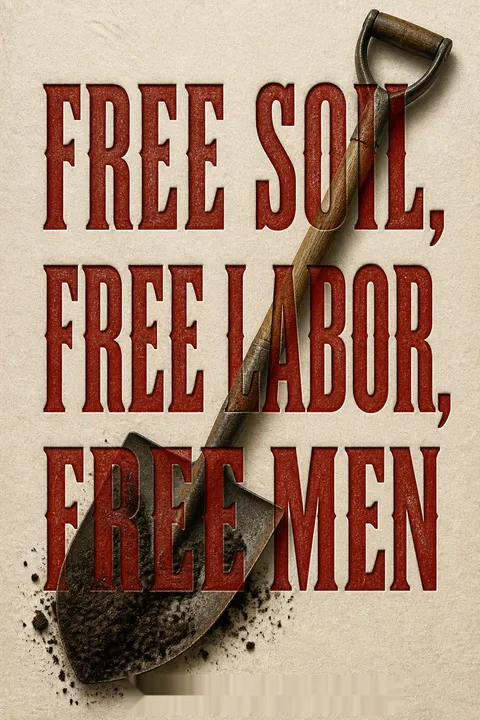
Free Soil, Free Labor, Free Men examines the Republican Party's ideology before the Civil War, tracing how diverse anti-slavery groups coalesced into a powerful political force. Eric Foner analyzes the party's various factions—radicals, moderates, and conservatives—showing how "free labor" ideology united former Whigs, Democrats, abolitionists, and Know-Nothings despite their differences. Reviewers praise Foner's exhaustive research and insightful analysis, though some find the writing dry and academically dense. The book reveals that Republican anti-slavery positions often stemmed from economic concerns and racism rather than pure morality, making it essential reading for understanding Civil War causation.
People Also Read




About the Author


Download PDF
Download EPUB
.epub digital book format is ideal for reading ebooks on phones, tablets, and e-readers.








































