
Key Takeaways
1. Capitalism's "Free Gift of Nature" is Foundational, Not Accidental.
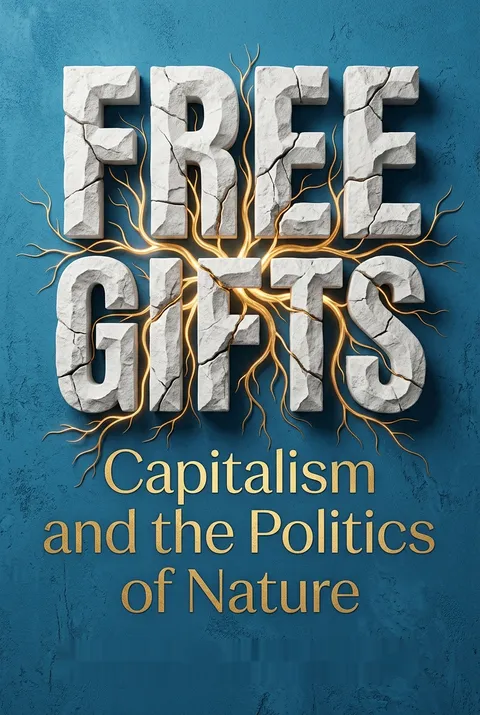
Capitalism, this book argues, systematically treats nature as a "free gift": something that can be taken without payment or replenishing; something that is materially useful but that tends not to appear in exchange.
A core paradox. The book argues that capitalism's persistent failure to value nonhuman nature is not an oversight but fundamental to its operation. This "free gift of nature" is defined as something materially useful but priced at zero, a distinctively capitalist social form that exists in contrast to the commodity. This paradox is crucial for understanding contemporary ecological challenges.
Beyond ideology. This isn't merely a "worldview" or an act of violent expropriation, though those exist. Instead, the free gift is a "real abstraction"—a concept that structures actions by default, whether consciously recognized or not. It emerges from the everyday act of exchange, where things without a price are implicitly valued at zero, shaping our relationship with the nonhuman world.
Commodity's shadow. The free gift is the commodity's shadow, revealing the limits of commodification set by the market itself. It highlights activities with clear material effects that don't register in the "economy," drawing attention to the physical reality underlying social forms. This dual character—material usefulness and lack of economic value—is central to how capitalism functions.
2. The Devaluation of Nature Stems from Capitalism's Valuation of Human Labor.
The social relation of value draws a stark line between human beings and all other entities.
Human-centric value. Capitalism's systematic devaluation of nature is intrinsically linked to its unique valuation of human labor. Marx's critique of political economy highlights how capitalism constitutes human labor as "abstract labor"—commensurable, wage-earning, and value-producing—while simultaneously constituting nonhuman nature as its opposite: the "free gift," constitutively wageless and excluded from the foundational relations of exchange.
The anthropocentrism of the wage. The ability of humans to sell their labor power, distinguishing it from their physical selves, is unique. Nonhuman agents, lacking this capacity, cannot receive a wage, making them unable to participate in market-mediated sociality. This "anthropocentrism of the wage" means nonhumans cannot express preferences in the market or acquire what they need, rendering them dependent on human valuation.
Capitalism's humanism. Capitalism is a "humanism" not in a moral sense, but because its core features—private ownership, wage labor, market dependence—rely on distinctively human qualities. Nature's lack of value is thus a byproduct of the value relation connecting human laborers, a consequence of relationships among people that unfold beyond conscious control.
3. Capitalism Imposes Unfreedom Through Class and Market Rule.
Capitalism limits our ability to treat nonhuman nature as something other than a free gift.
Beyond individual choice. The book argues that capitalism makes us unfree, distorting our ability to make genuine decisions about valuing and relating to the nonhuman world. This unfreedom stems from two main components: class rule and market rule, which together constitute a system that constrains individual and collective agency.
Class rule's reach. Class rule is the power of the few over the many, rooted in private ownership and control over investment. This extends beyond workplace domination to shaping the physical world itself—deciding what is produced, where, and how, often without public consultation. It also manifests in the power to neglect projects that don't promise adequate returns, regardless of societal need.
Market rule's mute compulsion. Market rule describes how decisions are structured by generalized market exchange and competition. It's a "process without a subject," where individual choices aggregate into outcomes no one intends but everyone must obey. This "axiarchy"—rule of value—limits our ability to express our values, forcing us to prioritize market prices over other considerations, leading to a pervasive sense of helplessness.
4. Pollution and Social Costs are Perverse Outcomes of Market Rule.
Pollution, then, is an odder phenomenon than is often recognized... Pollution is "matter out of place": matter that is not where it is supposed to be.
The illusion of "free lunch." The concept of "no such thing as a free lunch" applies to nature: its costs always appear elsewhere. Pollution, or "social costs," are the material byproducts of commodity production that have no exchange value and often no use value. They are "surplus matter" that no one wants to buy but everyone consumes, revealing the perverse, unintended consequences of market rule.
Externalities as market's norm. Economists like Pigou and Coase theorized "externalities" as market failures, but the book argues they illuminate how markets normally function. Coase's insight that "social costs" are reciprocal and that the "right to do something which has a harmful effect... is also a factor of production" reveals that pollution is an unpaid factor of production, appropriated by capital.
Class rule in byproduction. The ability to impose pollution on others is an aspect of class rule, allowing capital to profit by shifting costs onto society, particularly the poor and marginalized. This "absorption power"—the use of human bodily capacities as sinks for dis-use values—is a "free gift of nature" to capital. This systematic cost-shifting, rather than intentional malice, is a core driver of environmental injustice and "slow violence."
5. Reproductive Labor's Low Value Reflects its Resistance to Capitalist Subsumption.
The reproduction of human beings is not only natural, of course. Theorists of social reproduction are right to emphasize that reproduction isn’t just a matter of sustaining life but of making people, developing human capacities, and recreating a broader set of social relations.
The "naturalization thesis" critiqued. Feminist critiques often argue that reproductive labor is devalued because it's ideologically "naturalized" as women's work. However, the book argues this "naturalization thesis" is insufficient. It overemphasizes ideology and overlooks the material realities of labor processes, failing to explain why nature itself is treated as free or why certain waged work remains poorly paid.
Life processes resist subsumption. The low value of reproductive labor stems from its inherent resistance to capitalist "real subsumption"—the process of mechanizing and rationalizing production for efficiency. Like agriculture, reproductive labor is a "nature-based sector" tied to biophysical processes (gestation, growth, care) that unfold in "concrete time" and are difficult to standardize, automate, or accelerate.
Capital's abdication. Capital tends to abdicate responsibility for human reproduction, leaving it to workers and paracapitalist agents like the family. This "abdication" is not a defeat for capital but a strategy to offload risks and costs associated with labor-intensive, unpredictable processes. The "cost disease" in services, where productivity gains lag, further explains why care work remains expensive and underprovided, even when waged.
6. Ecosystem Services are "Natural Communia" that Resist Commodification.
What is most striking today, however, is not the extent to which ecosystemic natures have been commodified, but the fact that they largely have not been.
Nature's planet-making work. Ecosystems provide essential "life support systems" like carbon cycling, water purification, and soil fertility—planet-making activities vital for human and nonhuman life. While classical economists noted nature's contributions, these broader, interconnected services often go unvalued, leading to their decline.
The limits of pricing nature. Efforts to price nature as "natural capital" or "ecosystem services" aim to make its value visible, but face significant challenges. Many services are too mobile (air, migrating birds) or too interconnected (ecosystem webs) to be easily enclosed, monopolized, or sold as private property. This makes them "natural communia"—common goods that resist commodification.
Abdication and "surplus species." Capital's disinterest in commodifying these services leads to their "erosion" rather than enclosure. Ecosystems are "underprovided" because no one has a financial incentive to conserve them if they can't charge for their use. This results in "surplus species" and ecosystems—those irrelevant to capital—being neglected and destroyed, a form of "market abjection" and disorganized abandonment.
7. True Freedom Requires Politically Re-evaluating Values Beyond Market Logic.
To continually reevaluate the way we live in the world isn’t a tragedy, but the very expression of freedom itself.
Beyond tragic freedom. The book challenges the notion that freedom is inherently tragic or dependent on transcending nature. While modern freedoms are linked to fossil fuels, simply condemning this connection or retreating to a romanticized "freedom within necessity" is insufficient. Instead, it calls for a re-evaluation of values, recognizing that capitalism limits our ability to genuinely choose how to live.
Ambiguous freedom in a finite world. Drawing on Simone de Beauvoir's concept of "ambiguous freedom," the book argues that freedom is always situated—enabled and constrained by both social and material conditions. This means accepting finitude and interdependence, not as limits to be escaped, but as conditions within which we must consciously choose our projects and take responsibility for them.
Conscious planet-making. Moving beyond the "free gift" means embracing "conscious planet-making"—politically deciding how to organize our shared world, rather than leaving it to market whims. This involves recognizing ecosystems as public infrastructures, supporting labor that sustains life, and making collective choices about resource use and environmental protection. This ongoing, often conflictual, re-evaluation of values is the essence of freedom in a damaged, yet open, future.
8. Embracing Ambiguous Freedom Means Conscious Planet-Making, Not Escaping Nature.
To be free is not to have the power to do anything you like; it is to be able to surpass the given toward an open future.
Freedom as a project. The book concludes by emphasizing that freedom is not a fixed state or an escape from material reality, but an ongoing project. It's about continually re-evaluating our collective ways of life and the values they reflect, especially in the face of planetary challenges. This "ambiguous freedom" acknowledges both human agency and material constraints.
Beyond determinism. Rejecting both the "materialist pessimism" that sees nature as an insurmountable limit and the "social optimism" that ignores material conditions, ambiguous freedom insists that while our choices are constrained, they are never fully determined. We are not forced to accept a bleak future; rather, we must take responsibility for the choices we make, even when options are difficult.
The task of a free society. Conscious planet-making means actively shaping our world, recognizing that ecosystems are not just resources but vital infrastructures. This involves political decisions about what to protect, restore, transform, and cultivate, integrating nonhuman well-being into our collective life. This continuous process of evaluation and action, rather than a definitive solution, is the true expression of freedom in a complex, interconnected world.
People Also Read




Download PDF
Download EPUB
.epub digital book format is ideal for reading ebooks on phones, tablets, and e-readers.








































