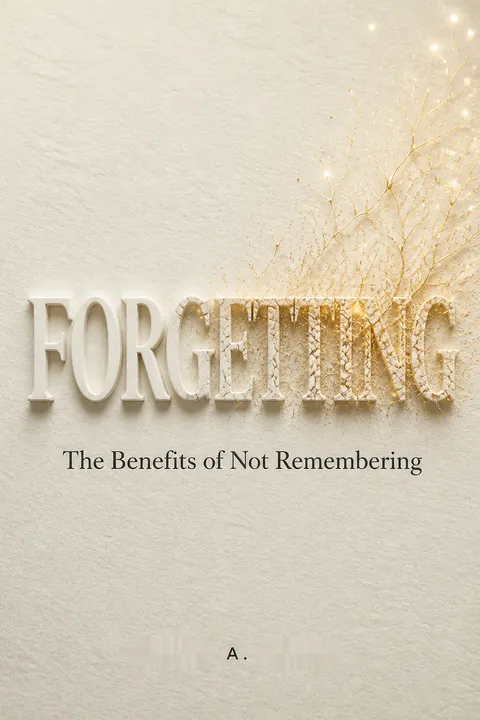

Key Takeaways
1. Forgetting: A Beneficial Feature, Not a Flaw
We now know that forgetting is not just normal but beneficial to our cognitive and creative abilities, to our emotional well-being, and even to societal health.
Challenging perception. For decades, forgetting has been widely viewed as a glitch in our memory systems, a nuisance to be prevented and fought. As a memory specialist, the author initially shared this common scientific and public perspective, believing that a better memory was always the noble goal. However, recent research has fundamentally shifted this understanding.
The burden of total recall. The fictional character Funes, the Memorious, who remembered every leaf on every tree and every instance of perceiving it, illustrates the nightmare of a mind that never forgets. His total recall led to psychic chaos, an inability to generalize, and a life sequestered in a darkened room to minimize sensory overload. This literary insight foreshadowed scientific discoveries about the true benefits of forgetting.
A cognitive gift. Forgetting, when balanced with memory, is now understood as a natural cognitive power essential for navigating our complex, ever-changing world. It sculpts cognition by allowing flexibility and abstraction, fosters emotional well-being by letting go of resentments and fears, and lightens the mind for creative insights. The "right to be forgotten" is not just a legal concept but a biological imperative for a healthy brain.
2. The Active Mechanisms of Memory and Forgetting
Discovering that Nature granted us separate molecular toolboxes actively dedicated to memory on the one hand and forgetting on the other clearly refutes the common view that forgetting is just failing memory.
Memory's architecture. Our brains store, save, and retrieve memories using three main anatomical actors: the posterior area for storage, the hippocampus for saving new memories, and the prefrontal cortex for retrieval. The basic unit of memory storage is the dendritic spine, tiny protrusions on neurons that strengthen connections when stimulated, forming new memories.
- Posterior Area: Stores cherished memories.
- Hippocampus: Saves new memories, acting as a "teacher" to stabilize cortical connections over weeks.
- Prefrontal Cortex: Retrieves memories, acting like a "librarian."
Beyond passive decay. Forgetting is not merely a passive fading or malfunction of memory. Recent neurobiological research has uncovered a distinct "forgetting toolbox" of molecules that actively disassembles and shrinks dendritic spines. This active process, triggered by desynchronized or overridden inputs, is crucial for maintaining synaptic plasticity and preventing cognitive overload.
A dynamic balance. Synaptic plasticity, the ability of neuronal connections to change strength, requires both an accelerator (memory toolbox for spine growth) and a brake (forgetting toolbox for spine shrinkage). This dynamic balance ensures that our brains can adapt to new information while retaining essential knowledge, making forgetting an active and beneficial process rather than a passive defect.
3. Forgetting Enables Cognitive Generalization and Behavioral Flexibility
To think is to forget a difference, to generalize, to abstract.
The challenge of sameness. Children with autism, like Freddy, often exhibit an "obsessive desire for the preservation of sameness," becoming agitated by slight changes in routine or surroundings. This behavioral inflexibility is linked to diminished forgetting, making it difficult for them to generalize—to see the "forest for the trees" rather than fixating on individual parts.
Sculpting cognition. Behavioral flexibility, the ability to adapt to continuous alterations in existing memories, relies heavily on active forgetting. Animal studies show that turning up the "forgetting control knob" allows for faster learning of alternate routes in a maze, demonstrating that forgetting acts as a "chisel" to sculpt and modify existing memories more efficiently than simply adding more memory.
AI's lesson. Computational science has validated forgetting's role in generalization. Successful facial recognition algorithms in AI incorporate "dropout"—a form of artificial forgetting—to prevent over-fixation on minute details. This ensures that the system can recognize a face despite infinite subtle variations, mirroring how human brains generalize by storing the "gist" rather than every pointillist detail.
4. Emotional Forgetting Liberates Minds from Pain
Too much memory or too little forgetting imprisons with pain.
The amygdala's role. The amygdala, the brain's central command for perceived threats, processes and codes emotional information, particularly negative emotions like fear, rage, and misery. It integrates into memory networks, painting factual memories with emotional color. When this system malfunctions, as in PTSD, it can lead to "intrusive" and distressing memories.
Healing trauma. PTSD symptoms, such as flashbacks and hypervigilance, are characterized by a defect in "extinction"—the ability to forget trauma. The general approach to treatment, like exposure therapy, aims to reprogram the amygdala by activating normal forgetting mechanisms, overriding chronic hypersensitivity. Humor and social connection, through oxytocin release, can also dampen amygdala activity and facilitate emotional forgetting.
Beyond psychopathology. Emotional forgetting is crucial for overall emotional well-being, freeing us from the "prisons of pain, anguish, and resentments." It helps us let go of traits like spite, vindictiveness, and righteous indignation, which are often driven by an overactive amygdala. Ultimately, emotional forgetting allows for forgiveness, enabling us to release seething resentments without necessarily factually forgetting the offending event.
5. Fear Forgetting Cultivates Prosocial Temperament
If fear memories help drive our antisocial fear responses, then it’s plausible that Nature engineered a braking system into the amygdala engine to countervail our fear memories with fear forgetting in the service of social bonding.
Chimp vs. Bonobo. Chimpanzees (C) and bonobos (B), our closest genetic cousins, exhibit diametrically opposed social temperaments: chimps are ruthless and fearful, while bonobos are prosocial, empathetic, and fearless. MRI studies show that the amygdala, the brain's danger management center, is significantly larger in chimps, suggesting a link between amygdala activity and social disposition.
The fear engine. Fear and rage, often intertwined, are driven by the amygdala, which forms and stores fear memories through dendritic spine growth. A chronically hyperactive amygdala, potentially due to perpetual fear and rage, can lead to "emotional brain scarring" and antisocial behaviors. This aligns with the observation that fear is a key adaptive trait for chimps in their harsh environments.
Braking fear. Rapid fear forgetting can be induced by drugs that act on specific amygdala nuclei, effectively pressing the "brake pedal" on its activity. Oxytocin, a naturally produced "love hormone," also dampens amygdala activity, mediating social bonding. This suggests that evolution equipped the amygdala with a braking system to temper fear memories, allowing for the formation of trust and social connections, essential for prosocial traits.
6. Sleep-Induced Forgetting Fuels Creativity
We are most creative when associations of what we do remember are kept loose and playful by sleep-induced forgetting.
Crick's hypothesis. The biological purpose of sleep, particularly dreaming, remained a mystery until Francis Crick proposed in 1983 that "we dream in order to forget." This "smart forgetting" hypothesis suggests that while dreaming, the hippocampus replays and reinforces only the gist of daily experiences, stabilizing a few privileged cortical spines.
Cortical refresh. The vast majority of newly grown dendritic spines, formed in response to daily experiences, are left unstimulated during sleep and subsequently wilt back down. This wholesale spine shrinkage effectively "cleans and clears the cortical slate," refreshing the cortex to accommodate future memories and preventing cognitive overload.
- Spine growth: Occurs during wakefulness with new experiences.
- Spine shrinkage: Occurs during sleep, erasing extraneous information.
- Net effect of sleep: Forgetting, allowing for regulated sensory processing.
The creative crucible. Creativity is not about generating something entirely new, but about forging unexpected associations among existing elements. Psychologists have shown that sleep-induced forgetting loosens these associations, making them "loose and playful." This allows for "combinatory play" and "cognitive alchemy," where elements can collide and interlock in novel ways, leading to creative insights and "aha moments."
7. A Doubtful Memory Fosters Intellectual Humility
Compared with someone who is confident in their superior hippocampal function, someone doubtful like Dr. X would be more inclined to reflect on their first decisions, to have greater “intellectual humility” and to truth-track more carefully.
Cognitive shortcuts. Decision-making is often influenced by "cognitive heuristics"—mental shortcuts that speed up thinking but can lead to irrational decisions and "cognitive illusions." These heuristics often rely on our memories, and our minds tend to prefer them even when slow, deliberate thinking is possible, due to cognitive laziness.
The role of the hippocampus. While traditionally thought to be independent of implicit memories, recent research shows that hippocampal function drives the formation of many cognitive heuristics, including "preference by association." Stronger hippocampal activity can make individuals more susceptible to these biases, leading to quick, confident, but potentially incorrect decisions.
The benefit of doubt. Dr. X, a renowned diagnostician with below-average hippocampal memory but a superior prefrontal cortex, hypothesized that his "poor memory" fostered intellectual humility, making him less confident in his initial judgments and more inclined to "truth-track" by slowly re-evaluating cases. This suggests that a "doubtful mind," less reliant on strong, potentially biased memories, can lead to more accurate decision-making, especially in complex situations.
8. Communal Forgetting is Essential for Ethical Society
Amnesty, from the Greek amnestia, is by definition a form of forgetfulness.
Memory and ethics. Caring about others is central to ethical behavior, and this caring relies heavily on the hippocampal-dependent memory system to form intimate associations—a face with a name, infused with emotion. Forgetting a name, more than other details, can imply a lack of care, devastating relationships.
The dangers of hypermnesia. Hofer's 17th-century concept of "nostalgia" as a "melancholic delirium" caused by "too many memories" of one's homeland, though not a true disorder, serves as a powerful metaphor. An "all-consuming homeland hypermnesia" can lead to "moral stupidity," where an ethical love for one's own people perverts into an immoral hatred of outsiders, as seen in xenophobia and extreme nationalism.
Collective healing. Just as emotional forgetting helps individuals heal from trauma, communal forgetting is vital for societal health. Public dialogues, memorialization, and even the symbolic "blotting out" of names (like renaming a street) can facilitate reconciliation and social amnesty. This process requires flexibility in communal memory, allowing societies to let go of seething resentments and restore ethical balance.
9. Distinguishing Normal from Pathological Forgetting
The resolution of the etiological ambiguity can also help the medical field find the cause of normal age-related memory decline on the one hand, and Alzheimer’s disease on the other.
A century of confusion. For much of the 20th century, Alzheimer's disease was largely neglected, and "senile dementia" was considered a normal part of aging. The discovery that the same amyloid plaques and neurofibrillary tangles found in rare early-onset cases were also present in common late-onset dementia revolutionized understanding, but also led to an overswing, classifying all age-related memory decline as Alzheimer's.
Anatomical dissociation. The author's lab resolved this debate by demonstrating that normal age-related memory decline and Alzheimer's disease, while both affecting the hippocampus, target distinct neuronal populations.
- Alzheimer's disease: Primarily affects the entorhinal cortex.
- Normal aging: Primarily affects the dentate gyrus.
This "double dissociation" provides a clear anatomical distinction between the two pathologies.
Molecular clues to cure. This anatomical specificity allows researchers to pinpoint the defective proteins responsible for each condition. In normal aging, the issue lies with proteins that act as the "on switch" for memory formation. In Alzheimer's, defective proteins hinder the stabilization of new memories and contribute to plaque and tangle formation. Identifying these "rogue proteins" is the crucial step towards developing targeted therapies and ultimately finding cures for these distinct forms of pathological forgetting.
Review Summary
Reviews for Forgetting are generally positive, averaging 3.76 out of 5. Readers appreciate the book's accessible exploration of why forgetting is a beneficial brain function, covering topics like autism, PTSD, sleep, and Alzheimer's disease. Many praise the author's clear writing style and use of patient anecdotes to illustrate scientific concepts. Common criticisms include the book feeling unfocused or meandering, with some feeling the second half strays too far into general neurology and Alzheimer's research rather than staying focused on the core thesis about forgetting's benefits.
People Also Read









Download PDF
Download EPUB
.epub digital book format is ideal for reading ebooks on phones, tablets, and e-readers.








































