

Key Takeaways
Apply the same moral law to governments that binds individuals
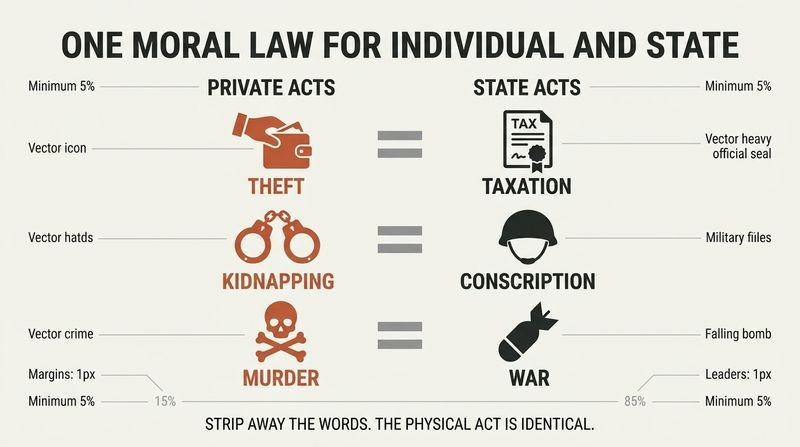
The nonaggression axiom is the whole creed. Rothbard builds everything on one principle: no person or group may initiate force or the threat of force against anyone's person or property. What makes libertarians distinct is not opposing crime (everyone does that) but refusing to grant the State a moral exemption. When a private gang seizes money, we call it theft. When it kidnaps young men, we call it slavery. When it slaughters civilians abroad, we call it murder.
The State survives on relabeling. Rothbard's provocation is definitional consistency: taxation is robbery, conscription is enslavement, war is mass murder. He invokes the child who points out that the emperor has no clothes. Strip away the mystical vocabulary of "sovereignty" and "public welfare," and the acts look identical to crimes.
What's striking is how Rothbard weaponizes ordinary moral intuition rather than novel ethics. The move resembles Tolstoy and Thoreau, but Rothbard pushes it to anarchism. The strongest objection comes from social contract theory (Hobbes, Locke, Rawls): perhaps collective coercion differs from private coercion because it is authorized through consent and reciprocity. Rothbard preempts this by denying tacit consent has meaning under a monopoly of force. Behavioral economics complicates his picture too: humans reliably free-ride on public goods, suggesting some coercion may solve collective-action problems his voluntarism underrates. Still, as a consistency test that exposes double standards in how citizens judge power, the axiom cuts deep.
Your right to property flows from owning yourself first
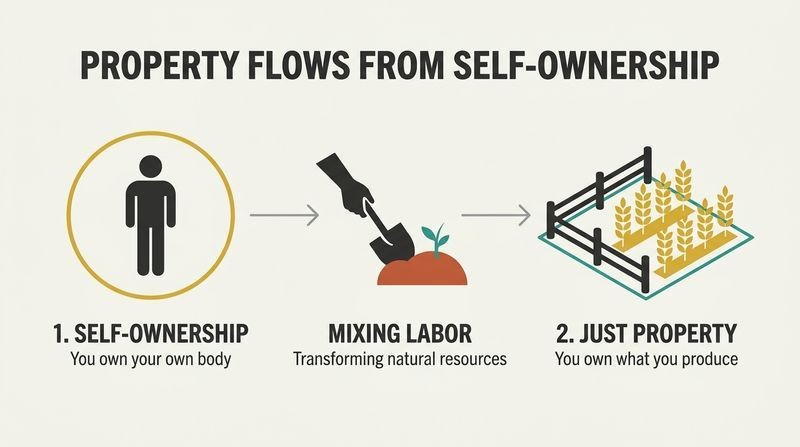
Self-ownership plus homesteading generates everything. Rothbard derives all rights from two axioms. First, each person owns their own body by virtue of being human. He argues the only alternatives are absurd: either one class owns another (which denies the owned class their humanity), or everyone owns an equal fraction of everyone else (which makes all action impossible and collapses into rule by a bureaucratic oligarchy anyway).
Mixing labor claims the unowned. The second axiom, borrowed from Locke, holds that when you transform nature-given resources through your effort (a sculptor shaping clay, a farmer clearing land), you come to own the product. Rothbard rejects Henry George's idea that land itself cannot be owned: the homesteader who first cultivates soil is as much a producer as the miner or manufacturer. A Pakistani infant has no moral claim on an Iowa wheatfield someone actually cleared.
The self-ownership argument by elimination is elegant but leans on a false trichotomy: real societies negotiate partial, overlapping, and conditional ownership (usufruct, commons management, easements) that Rothbard treats as unstable. Elinor Ostrom's Nobel-winning fieldwork showed communities governing shared resources durably without either full privatization or state control, complicating his claim that unowned means doomed to ruin. The Lockean proviso (leave "enough and as good" for others) also haunts homesteading: what happens when the frontier closes? Rothbard sidesteps this. Yet the deeper insight endures: rights to speech and rights to property are not separable categories, because exercising any freedom requires controlling physical resources.
There are no human rights separate from property rights
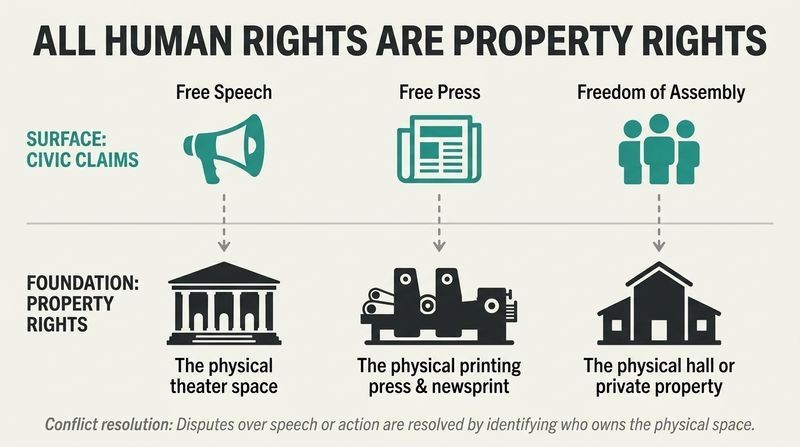
Free speech is a property claim in disguise. Rothbard dissolves the liberal split between "human rights" (sacred) and "property rights" (negotiable). A free press means nothing if the government owns all the newsprint and printing presses, because whoever owns the resource decides its use. Freedom of assembly is the right to rent or own a hall. Every civil liberty, traced to its root, turns out to be an application of who controls physical property.
This resolves apparent conflicts. Take Justice Holmes' famous line about falsely shouting "fire" in a crowded theater. Rothbard argues this needs no exception to free speech. The shouter is either the owner (defrauding patrons who paid for a performance) or a patron (violating the owner's and other guests' property rights). Identify the property rights and the puzzle vanishes.
This is one of Rothbard's most analytically fertile moves, and it anticipates later law-and-economics scholarship (Coase, Demsetz) showing that well-defined property rights resolve disputes markets otherwise cannot price. The theater example is genuinely clarifying. But the framework strains under public goods that resist parceling: clean air, herd immunity, systemic financial stability. It also assumes an uncontested prior distribution of property, which critics from the left note is itself the product of historical force. If original titles are unjust, the whole edifice inherits that injustice. Rothbard acknowledges this problem via his homesteading theory of restitution, but applying it to real-world tangled titles is dauntingly complex.
Trace every social crisis and you find government's fingerprints
One thread runs through every failure. Rothbard surveys the problem areas of American life and finds a common denominator he calls the "red thread": government. Crime happens on government streets, policed by government cops, tried in government courts. Traffic congestion occurs on government roads. Air and water pollution foul resources government owns and fails to defend. Failing schools, postal deficits, urban fiscal crises, inflation, the military-industrial complex, all are either run by or heavily shaped by the State.
Galbraith drew the wrong lesson. Rothbard notes that economist John Kenneth Galbraith recognized the public sector was the locus of social failure, then bizarrely concluded we needed to pour more resources into it. Rothbard asks the question Galbraith never did: is there something inherent in government operation that manufactures the very failures we observe?
The diagnostic is rhetorically powerful and often correct: government monopoly does breed the pathologies of monopoly. Public-choice theory (Buchanan, Tullock), which Rothbard cites, gives this rigorous grounding by modeling bureaucrats and politicians as self-interested actors rather than benevolent servants. Yet the "red thread" risks selection bias: it catalogs where government operates and finds problems, without a controlled comparison to where markets operate and also produce failures (2008 financial collapse, monopoly abuses, environmental externalities). Correlation is not mechanism. The strongest version of his claim is narrower but still bracing: services shielded from profit-and-loss feedback and consumer exit lack the error-correction that competition supplies.
Conscription is slavery, so end it and hire soldiers
The draft is forced labor at below-market pay. Rothbard defines slavery as being forced to work at tasks a master chooses, for less than one would voluntarily accept. Conscription fits exactly. He notes the government never faces a "shortage" of generals, typists, or truck drivers, because it pays them market wages. The shortage of privates existed only because their pay was roughly half of civilian earnings. Pay soldiers a competitive wage plus hazard compensation, as we do for test pilots and firefighters, and enlistees appear.
Involuntary servitude hides everywhere. Rothbard extends the analysis: compulsory jury duty, coerced witness testimony, the withholding of income tax (which conscripts employers as unpaid tax collectors), and even the term of military enlistment that jails deserters for quitting a job. He also condemns the compulsory commitment of mental patients "for their own good" as incarceration of people who committed no crime.
History vindicated the practical claim: the United States abolished the draft in 1973 and sustained an all-volunteer force, exactly as market-wage logic predicted. Milton Friedman, whom Rothbard elsewhere criticizes, championed this reform on the same grounds. The Szasz-inspired critique of psychiatric detention also aged well; deinstitutionalization and due-process protections followed. The weaker link is Rothbard's absolutism about all coerced civic duty: jury service by willing, paid volunteers might introduce selection bias (professional jurors, ideological skew) that undermines the impartiality juries exist to provide. The insight that "free labor is happier and more efficient than slave labor" is sound; whether every civic obligation reduces to slavery is more contestable.
Legalize victimless crimes and police corruption largely disappears
Corruption blooms where law forbids voluntary trade. Rothbard points to the 1971 Knapp Commission on New York police corruption: nearly every case involved cops taking payoffs from gambling, prostitution, and drug operations, businesses the public patronizes but government outlawed. The common law distinguished a malum in se (an act evil in itself, like murder) from a malum prohibitum (an act made criminal by decree). Police corruption concentrates entirely in the second category, where officers effectively sell licenses to operate.
Drug prohibition creates the crime it condemns. Rothbard argues addicts commit theft because prohibition inflates drug prices, not because drugs cause crime; narcotics actually render users passive. Alcohol, legal, correlates far more with violence. Legalize the trade, prices collapse, and addict-driven crime evaporates. He applies identical logic to gambling and guns: banning objects punishes only the law-abiding, since determined criminals ignore the ban.
The economic analysis of prohibition is now mainstream and empirically robust. The end of alcohol Prohibition in 1933 gutted organized crime's largest revenue stream, and decades of drug-war data confirm that criminalization inflates prices, enriches cartels, and diverts policing. Portugal's 2001 decriminalization, which cut overdose deaths and HIV infection without exploding usage, is a natural experiment Rothbard would have relished. His gun-control section cites Kates and studies suggesting bans fail to reduce homicide; that literature remains genuinely contested, with later meta-analyses reaching mixed conclusions. The durable core is his insight that outlawing consensual transactions manufactures black markets, and black markets manufacture the violence reformers then blame on the substance.
Government schooling exists to mold obedient, uniform citizens
Compulsion breeds uniformity, and uniformity was the point. Rothbard argues public schools inherently stamp out diversity, because a government monopoly must apply one policy to all: one stance on religion, integration, discipline, and curriculum, leaving large minorities deprived of the education they want. He traces the historical motive back to Martin Luther and the Calvinist Puritans of Massachusetts Bay (who created the English-speaking world's first compulsory schooling in 1642) and to reformers like Horace Mann who wanted to "Americanize" immigrants and crush Catholic parochial schools.
The Oregon case reveals the impulse. In 1922 Oregon outlawed private schools entirely, forcing all children into public ones. The Supreme Court struck it down in 1925, declaring the child "is not the mere creature of the State." Tellingly, the law's champion was the Ku Klux Klan, eager to dissolve Catholic and immigrant identity into a Protestant mold.
The revisionist history is provocative and partly corroborated: mass schooling did serve nation-building and assimilation goals, as historians like Michael Katz documented. Rothbard's confusion-of-schooling-with-education point echoes Ivan Illich's Deschooling Society, published the same era. Yet the argument underweights the genuine coordination and equity functions of common schooling: universal literacy, a shared civic vocabulary, and mobility for children whose parents cannot or will not educate them. The charter-school and homeschooling movements have since tested his diversity thesis, with mixed results on both innovation and stratification. His deeper warning stands: whoever controls curriculum controls minds, which is precisely why curriculum fights are so ferocious.
Welfare rolls swell because benefits outbid low-wage work
Welfare has a positive supply function. Rothbard applies basic economics: raise the reward for being on welfare relative to working, and more people choose welfare. Between 1952 and 1970, welfare rolls quintupled while average benefits doubled, outpacing inflation. When a benefit check approaches or exceeds the take-home pay of a marginal worker, the rational choice is to stop working, and the stigma that once deterred applicants was dismantled by social workers who reframed welfare as a "right."
Private charity solved this better. Rothbard contrasts the Mormon Church's welfare plan, which aims to return recipients to self-support as fast as possible and sternly discourages public relief, with the Albanian-American and Polish Northside communities, where cultural pride kept welfare rolls near zero despite low incomes. His verdict on the guaranteed annual income (then championed by Nixon and Friedman): by making the dole automatic and shame-free, it would trigger a vicious spiral as ever-higher earners quit to join it.
The supply-response insight is economically sound and later informed real welfare reform: the 1996 U.S. overhaul added work requirements and time limits precisely to counter dependency incentives, with contested but real employment effects. However, Rothbard's Banfield-derived culture-of-poverty framing (present-orientation as the root cause) has aged poorly against evidence that poverty itself degrades planning horizons, as Mullainathan and Shafir's Scarcity demonstrates: cognitive bandwidth shrinks under financial stress, reversing his causal arrow. His guaranteed-income doom loop also ignores modern negative-income-tax experiments and UBI pilots showing modest work reductions, not collapse. The Mormon model genuinely impresses, but it relies on dense social capital and religious commitment that cannot simply be legislated into existence.
Government printing, not corporate greed, drives chronic inflation
Blaming greed or unions cannot explain inflation. Rothbard asks: if businessmen are greedy enough to raise prices 10% a year, why not 50%? Something holds them back, namely the money in consumers' pockets. Trace prices across the whole economy and, since the supply of goods keeps rising, prices should be falling (as they did through most of the nineteenth century). Inflation must come from the demand side, and the dominant demand-side factor is the total money supply.
The Fed is a legalized counterfeiter. Rothbard explains fractional-reserve banking: the Federal Reserve buys assets (mainly government bonds) with money created from nothing, adding to bank reserves. Banks then pyramid roughly six dollars of new checkbook money atop each reserve dollar through lending. Abandoning the gold standard (domestically in 1933, internationally in 1971) removed the last restraint, and double-digit inflation of 1973-1974 followed. He calls it granting one family a monopoly to print dollars and expecting restraint.
The monetarist core (inflation as a monetary phenomenon) aligns with Friedman's empirical work and is now textbook, even if the money-supply-to-price link proved looser than 1970s monetarists hoped, as the post-2008 era of QE without runaway inflation showed. Rothbard's Austrian gloss goes further than Friedman, tying credit expansion to malinvestment. The gold-standard nostalgia is his most contested stance: mainstream economists counter that gold's rigidity amplified the Depression and denies central banks tools to fight liquidity crises. Yet his demystification of money creation, showing that most "money" is bank-created credit conjured in the act of lending, remains a genuinely clarifying lens most citizens still lack.
Booms feel prosperous but are the disease; busts are the cure
Cheap credit sends false signals. Rothbard's Austrian business-cycle theory (from Mises and Hayek) holds that when the central bank artificially lowers interest rates through credit expansion, it lies to entrepreneurs. A low rate normally signals that people have saved more and want future goods, so businesses invest in long-term capital projects. But if the low rate came from money-printing rather than real saving, the resources to complete those projects do not exist.
The depression is the correction, not the catastrophe. When workers spend their new wages on consumption rather than saving, the malinvestments in capital-goods industries are exposed as unprofitable. The bust liquidates these errors and redirects resources toward what consumers actually want. This explains two things rival theories cannot: why errors cluster suddenly (they were induced by a shared false signal), and why capital-goods industries swing more violently than consumer goods. Rothbard's prescription: government should do nothing, stop inflating, and let the adjustment finish fast.
The malinvestment framework offers a genuinely distinctive account of why errors cluster, which purely monetary theories struggle to explain, and it found new adherents after the 2008 housing bubble, which fit the low-rate-fueled-overbuilding pattern uncannily well. The theory's Achilles heel is its policy nihilism: the claim that liquidation should run unchecked ran into the mass unemployment of the 1930s, and most economists (including many who respect Austrian insights) argue that debt-deflation spirals can overshoot, destroying viable firms alongside malinvestments. Keynes's retort, that in the long run we are all dead, targets exactly this. The diagnostic is sharper than the prescription.
Even courts and police could be supplied by competing firms
Protection is a service, not a fixed quantity. Rothbard argues there is no single commodity called "police protection" any more than a single thing called "food." In a stateless order, street owners, merchants, landlords, and insurance companies would supply policing calibrated to demand, competing on efficiency and courtesy because brutalizing customers drives them away. He points to the railway police, who by 1929 had cut freight-theft claims 93%, and to private arbitration, already handling tens of thousands of disputes annually.
History offers a working model. For roughly a thousand years, ancient Celtic Ireland had no state: no legislature, no police, no public prosecutors. Disputes went to private professional jurists (brehons) chosen for their reputations, and judgments were enforced through voluntary surety networks and the threat of ostracism. Merchant law and admiralty law likewise developed in private courts before governments absorbed them.
This is Rothbard's most radical and most vulnerable claim, and its honesty is notable: he concedes libertarian society assumes no magically transformed human nature. The Irish and medieval-merchant-law examples are real and understudied, and modern scholarship on polycentric legal orders (Tom Bell, Bruce Benson) has extended them. The hard problem is the security dilemma: competing armed agencies with genuine disagreements may escalate rather than arbitrate, and the equilibrium of universal arbitration is not obviously stable, as Robert Nozick argued in deriving a minimal state precisely from anarchist premises. Rothbard's rebuttal (war is bad for business) underrates how monopoly on force can emerge from competition, not despite it.
Pollution is trespass; defend property rights instead of regulating
Nineteenth-century courts sold out property owners. Rothbard reframes air and water pollution not as market failures requiring regulation but as uncompensated invasions of property. Historically, when factory smoke blighted farmers' orchards, courts abandoned common-law nuisance protections in the name of "public policy" and industrial progress, effectively licensing the trespass. Legislatures then barred class-action suits, so a factory poisoning thousands faced no practical liability, though poisoning one neighbor could be sued.
Absent ownership, resources get plundered. Rivers and oceans are polluted and depleted because government "owns" them but, unable to sell or capitalize them, has no incentive to defend their value. Rothbard contrasts privately owned European forests (conserved) with government-leased American ones (stripped), and the open-range dust bowl (nobody owned the grass) with fenced private land. His remedy is not pollution taxes or permits (which he says merely license the invasion) but injunctions and full liability: a laissez-faire polluter, he insists, is a contradiction in terms.
The property-rights-as-environmental-protection thesis is the intellectual seed of free-market environmentalism (Anderson and Leal) and of tradable-rights fisheries schemes that later reversed some stock collapses, echoing his ocean-enclosure argument. His trespass framing productively reframes pollution as aggression rather than mere externality. But the approach hits real limits with diffuse, multi-source harms like greenhouse gases, where identifying which molecule from which emitter injured which victim is causally intractable, exactly the coordination problem Pigouvian taxes and cap-and-trade were designed to solve. Rothbard dismisses the Coasean-Friedmanite bargaining solutions, yet Coase's own insight (that with transaction costs, institutional design matters) arguably supports the very pricing mechanisms Rothbard rejects.
Analysis
For a New Liberty is the founding systematic manifesto of modern American anarcho-capitalism, and its power lies in method as much as conclusion. Rothbard is a thesis-driven axiomatic builder: from a single premise (nonaggression) plus self-ownership and Lockean homesteading, he deduces an entire political architecture, then applies it relentlessly to draft, schools, welfare, money, courts, pollution, and war. The book's rhetorical engine is consistency-as-provocation. By refusing the State any moral exemption ordinary people deny to private actors, he forces readers to confront double standards they never noticed. This is philosophy as a series of controlled shocks.
The work's greatest strength is its integration. Where conservatives defend markets but embrace militarism, and progressives defend civil liberties but embrace economic control, Rothbard claims the only non-contradictory position: liberty in every sphere. His fusion of libertarian economics (Mises, Hayek) with a natural-rights ethics and a revisionist history of American empire was genuinely original in 1973 and seeded movements (the Cato Institute, the Libertarian Party, later Ron Paul) that reshaped political vocabulary. His predictions on the volunteer army, drug prohibition, and monetary inflation aged notably well.
The weaknesses are structural, not incidental. The axiomatic method inherits the contestability of its axioms: if self-ownership or original property titles are questioned, the edifice wobbles. Public-goods and collective-action problems (which Ostrom, Olson, and behavioral economics take seriously) get dismissed rather than solved. The anarchist endgame underrates Nozick's demonstration that states can emerge from anarchy without rights violations. And the Austrian refusal of any countercyclical action collides with debt-deflation dynamics.
Yet even skeptics gain from Rothbard's central discipline: ask whether an act would be criminal if a private citizen did it, and notice how often the answer indicts the State. As a stress test for political intuitions, few books cut deeper or more consistently.
Review Summary
For a New Liberty receives strong praise from most readers, who admire Rothbard's consistent, logical framework for libertarian philosophy and its applications to economics, governance, and society. Many find it transformative and prophetic. Critics, however, point to selective historical reasoning, oversimplified arguments, questionable omissions from cited sources, and weak solutions to practical governance challenges. Some dismiss it as utopian or morally troubling. Despite ideological divides, even skeptical readers acknowledge its intellectual significance as a foundational libertarian text.
Glossary
Nonaggression axiom
No initiating force against othersRothbard's foundational principle that no individual or group may initiate the use or threat of physical violence against the person or property of anyone else. Aggression equals invasion. Defensive force is permitted; the initiation of force is not. All libertarian positions, from opposing conscription to opposing taxation, are derived as applications of this single axiom.
Self-ownership
Absolute right to own yourselfThe axiom that every human being, by virtue of being human, has the absolute right to own and control their own body free of coercive interference. Rothbard argues the only logical alternatives (one class owning another, or everyone owning an equal fraction of everyone) are either self-contradictory or unworkable, collapsing into rule by an oligarchy.
Homesteading principle
First user owns unowned resourcesAdapted from John Locke, the idea that a person acquires legitimate ownership of previously unowned natural resources by mixing their labor with them: clearing land, mining ore, taming an animal. The transformer becomes the just owner. Rothbard extends this to land itself, rejecting Henry George's claim that land cannot be privately owned.
Austrian business-cycle theory
Credit expansion causes boom-bustThe Mises-Hayek explanation that government-driven bank credit expansion artificially lowers interest rates, falsely signaling to businesses that more saving exists. Firms overinvest in long-term capital projects that cannot be completed. The bust is the necessary corrective liquidation of these malinvestments. It uniquely explains the clustering of business errors and the greater volatility of capital-goods industries.
Malum in se vs. malum prohibitum
Real crime versus decreed crimeA common-law distinction Rothbard uses to separate acts evil in themselves (murder, theft, assault, which invade person or property) from acts made criminal only by government decree (gambling, drug use, prostitution). He argues police corruption and unenforceable law concentrate entirely in the second category, and that victimless crimes should be legalized.
Fractional-reserve banking
Banks lend more than reservesThe system in which banks create new checkbook money (demand deposits) by lending out multiples of their actual reserves, roughly six to one in Rothbard's account. Backed by the Federal Reserve, which can create reserves from nothing by buying assets, this pyramiding is Rothbard's mechanism for chronic monetary inflation.
Positive supply function of welfare
Higher benefits attract more recipientsRothbard's application of supply-and-demand to welfare: as the income available from welfare rises relative to wages from work, and as the stigma of dependency is removed, more people rationally choose welfare over employment. He uses it to explain why welfare rolls quintupled from 1952 to 1970 despite falling poverty rates.
Court intellectuals
Thinkers who justify State powerRothbard's term for the intellectual class that, throughout history, has supplied ideological justification for State rule in exchange for power, prestige, and security. Once priests invoking divine right, they are now technocratic experts and economists invoking the public welfare and the multiplier effect, weaving the emperor's invisible clothes.
Isolationism (peaceful coexistence)
Political nonintervention plus free exchangeRothbard's foreign-policy stance: total political and military noninterventionism abroad combined with economic and cultural internationalism (free trade, migration, exchange). He argues this is the foreign-policy counterpart of laissez-faire at home, and that anti-war thinkers from Cobden to the classical liberals were the true internationalists, not isolationists in the pejorative sense.
About the Author
Other books by Murray N. Rothbard
Download PDF
Download EPUB
.epub digital book format is ideal for reading ebooks on phones, tablets, and e-readers.








































