
Key Takeaways
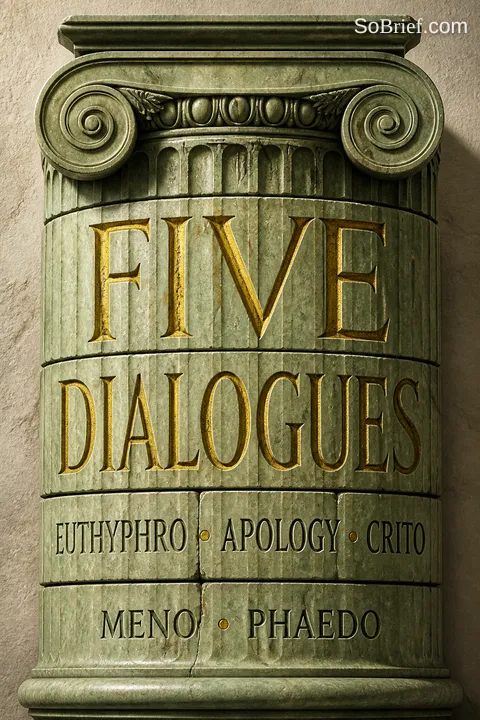
1. Piety requires an objective standard beyond mere divine approval
Is the pious being loved by the gods because it is pious, or is it pious because it is being loved by the gods?
The Euthyphro Dilemma. Socrates challenges the popular religious belief that morality is defined solely by divine command. By questioning Euthyphro, he demonstrates that if the gods love something because it is already pious, then piety must have an independent, objective standard that exists outside of divine whim. If piety is merely defined by what the gods love, then morality becomes arbitrary and subject to the shifting, often conflicting preferences of different deities.
Defining ethical terms. Socrates seeks a universal definition (the "form") of piety rather than a mere list of pious actions. He rejects Euthyphro's attempts to define piety through subjective examples, such as prosecuting his own father, or through transactional relationships with the gods. A true definition must identify the essential characteristic that makes all pious actions pious, serving as a reliable model for moral judgment.
Key lessons on definition:
- A true definition must identify the essential characteristic (eidos) that makes all instances of a concept what they are.
- Subjective approval, even by divine entities, cannot serve as the foundational basis for objective moral truths.
- True moral inquiry requires moving past superficial traditions to find rational, stable principles.
2. True wisdom begins with the recognition of one's own ignorance
I am wiser than this man; it is likely that neither of us knows anything worthwhile, but he thinks he knows something when he does not, whereas when I do not know, neither do I think I know; so I am likely to be wiser than he to this small extent, that I do not think I know what I do not know.
Socratic ignorance. Socrates explains his life's mission, which began when the Delphic oracle declared that no man was wiser than him. To investigate this riddle, he questioned politicians, poets, and craftsmen, only to discover that their claims of expertise in all matters exposed their profound ignorance. While they falsely believed they possessed ultimate wisdom, Socrates realized his own advantage lay simply in knowing that he knew nothing.
Intellectual humility. True wisdom does not consist of possessing absolute knowledge of all things, but in recognizing the limits of one's understanding. By exposing the false wisdom of others, Socrates sought to encourage a culture of intellectual humility and continuous self-examination. This process of clearing away false assumptions is a necessary prerequisite for genuine intellectual and moral growth.
The path to truth:
- Acknowledging what we do not know is the necessary first step toward genuine learning and intellectual growth.
- Arrogance and false expertise block the path to truth by making individuals resistant to questioning.
- Socratic questioning serves as a tool to clear away false assumptions and lay a foundation for real inquiry.
3. The unexamined life is not worth living for human beings
...the unexamined life is not worth living for men...
The philosophical mandate. Socrates declares that his philosophical mission is a divine command that he cannot abandon, even under the threat of death. For him, human existence loses its core value if one does not actively question, evaluate, and seek to understand virtue and truth daily. A life lived on autopilot, guided merely by habit and societal expectations, fails to fulfill the unique rational potential of human beings.
Active self-reflection. Living a meaningful life requires constant self-examination and dialogue with others rather than passive conformity to societal expectations. Socrates argues that wealth, status, and physical comfort are meaningless if one's soul remains neglected and unexamined. True happiness is found not in external success, but in the active pursuit of wisdom and moral clarity.
Core principles of reflection:
- Philosophy is not an abstract academic pursuit but an active, daily practice of self-evaluation.
- Conforming blindly to public opinion deprives an individual of moral autonomy and intellectual freedom.
- A life spent pursuing material success without moral clarity is a wasted opportunity for the soul.
4. Virtue is a matter of soul-care, not material wealth or reputation
Wealth does not bring about excellence, but excellence makes wealth and everything else good for men, both individually and collectively.
Prioritizing the soul. Socrates admonishes the citizens of Athens for prioritizing the accumulation of money, reputation, and honors over the state of their souls. He views himself as a divinely appointed "gadfly" sent to stir the sluggish city into prioritizing moral excellence over material gain. The health of the soul is the ultimate measure of a successful life, and it must be guarded against the corrupting influence of greed and ambition.
True value of virtue. Virtue is the ultimate good that gives value to all other aspects of life, including wealth and physical health. Without a virtuous soul to guide their use, material possessions and social power can easily become harmful and destructive. True success is not measured by what we own, but by who we are and how we treat others.
Socrates' moral hierarchy:
- The soul is the most valuable part of a human being and must be protected from moral corruption at all costs.
- External goods like wealth and status are morally neutral and only become beneficial when directed by a virtuous soul.
- True harm is not physical death or financial loss, but the moral degradation of one's own character.
5. Citizens have a moral obligation to honor their tacit agreements with the state
We say, however, that whoever of you remains, when he sees how we conduct our trials and manage the city in other ways, has in fact come to an agreement with us to obey our instructions.
The social contract. In the Crito, Socrates personifies the Laws of Athens to explain why escaping his execution would be unjust. He argues that by choosing to live in Athens, raise his children there, and enjoy the benefits of its legal system, he entered into a binding, tacit agreement to respect its judicial decisions. To break the law now, simply because the verdict is unfavorable, would be a betrayal of that agreement.
Preserving legal order. Disobeying a legal verdict simply because it is personally inconvenient or unfavorable threatens to destroy the authority of the laws and the stability of the state. Socrates asserts that a citizen must either persuade the state to change its laws or obey its commands. To do otherwise is to promote anarchy and undermine the very foundation of civilized society.
Obligations to the state:
- Citizenship involves a reciprocal relationship of benefits received and obligations owed to the community.
- An individual cannot selectively choose which laws to obey based on personal convenience or self-interest.
- Honoring agreements, even when they lead to personal sacrifice, is a cornerstone of justice and civic virtue.
6. One must never return an injustice or do harm in response to harm
One should never do wrong in return, nor do any man harm, no matter what he may have done to you.
Rejecting retaliation. Socrates introduces a revolutionary moral principle: retaliation is never justified, even when one has been deeply wronged. He rejects the common ancient Greek belief that justice consists of helping one's friends and harming one's enemies, arguing that doing harm is always unjust. To return an injury is simply to commit a new act of injustice, compounding the moral damage.
The corrupting nature of harm. Harming another person, even in self-defense or as payback, corrupts the soul of the person who inflicts the harm. Since the soul's health is the most important thing, committing an injustice to escape physical suffering is a self-destructive trade. True moral strength is demonstrated by enduring injustice rather than perpetrating it.
Socrates' non-retaliation framework:
- Doing wrong is inherently harmful to the wrongdoer, regardless of the circumstances or provocations.
- Returning an injustice does not neutralize the original wrong; it merely doubles the amount of evil in the world.
- True moral strength is demonstrated by enduring injustice rather than perpetrating it.
7. Learning is a process of recollecting innate, eternal truths
As the soul is immortal, has been born often, and has seen all things here and in the underworld, there is nothing which it has not learned; so it is in no way surprising that it can recollect the things it knew before, both about virtue and other things.
The theory of recollection. To resolve Meno's paradox—that one cannot search for what one does not know—Socrates proposes that the soul is immortal and already possesses all knowledge. What we call "learning" is actually the process of recovering or "recollecting" this latent knowledge through guided questioning. The soul, having existed before birth, carries within it the eternal truths of the universe.
The slave boy demonstration. Socrates demonstrates this theory by guiding an uneducated slave boy through a complex geometric problem using only questions. Without being directly taught, the boy is able to recognize the correct mathematical relationships, proving that the truths were already present within his mind. This demonstration serves as a powerful metaphor for all intellectual and moral inquiry.
Implications for inquiry:
- The mind is not a blank slate to be filled, but a repository of latent, eternal truths waiting to be uncovered.
- Socratic dialogue acts as a midwife, helping individuals bring their own innate understanding to light.
- Genuine knowledge is characterized by internal recognition and understanding, rather than passive memorization.
8. Virtue is a form of wisdom, making it beneficial rather than harmful
Therefore, in a word, all that the soul undertakes and endures, if directed by wisdom, ends in happiness, but if directed by ignorance, it ends in the opposite?
Wisdom as the director. Socrates and Meno analyze the qualities of the soul, such as courage, moderation, and mental quickness, to determine if they are inherently good. They conclude that these qualities are only beneficial when directed by wisdom; without understanding, courage becomes recklessness, and moderation becomes foolishness. Wisdom is the essential key that unlocks the true value of all other virtues.
Virtue as knowledge. Since virtue is always beneficial, and all beneficial things in the soul depend on wisdom, virtue must be a form of wisdom or knowledge. However, Socrates notes a paradox: if virtue is knowledge, there should be teachers of it, yet no reliable teachers of virtue can be found. This tension leads to the hypothesis that virtue may instead be a divine gift accompanied by right opinion.
The structure of virtue:
- Natural talents and physical goods are morally neutral and require wisdom to be used beneficially.
- Ignorance is the root cause of bad actions, as people only choose the bad when they mistake it for the good.
- True virtue requires intellectual clarity and a deep understanding of what is genuinely beneficial.
9. True philosophers spend their lives preparing for the separation of soul and body
I am afraid that other people do not realize that the one aim of those who practice philosophy in the proper manner is to practice for dying and death.
Philosophy as preparation for death. On his final day, Socrates comforts his grieving friends by explaining that a true philosopher does not fear death. He defines death as the separation of the soul from the body, an event that the philosopher has spent his entire life practicing for by turning away from physical pleasures. The philosophical life is a continuous effort to free the mind from the limitations of the flesh.
The body as an obstacle. The physical body, with its constant demands, desires, and sensory illusions, is a major obstacle to the pursuit of truth. The philosopher seeks to purify the soul by freeing it from bodily distractions, allowing it to contemplate pure, unchanging realities. By minimizing the body's influence, the soul becomes attuned to the eternal realm of truth.
The purification process:
- Sensory perceptions are deceptive and must be bypassed in favor of pure, abstract reasoning.
- Physical desires and pleasures rivet the soul to the body, making it heavy, confused, and blind to reality.
- Death is not a tragedy but the ultimate liberation of the soul, allowing it to attain the pure wisdom it always sought.
10. The soul is immortal, indestructible, and defined by its affinity to eternal Forms
Then when death comes to man, the mortal part of him dies, it seems, but his deathless part goes away safe and indestructible, yielding the place to death.
The final proof. Socrates presents several arguments for the immortality of the soul, culminating in the theory of Forms. He argues that the soul, as the entity that brings the Form of Life to the body, can never admit its opposite, Death, and must therefore remain indestructible when the body perishes. The soul's very nature is incompatible with non-existence.
Affinity to the divine. The soul is akin to the divine, invisible, and unchanging realm of the Forms, while the body belongs to the visible, mortal, and changing world. Because of this natural affinity, the purified soul survives physical dissolution and journeys to a blessed realm of eternal truth. Our moral choices in life directly shape the soul's condition and determine its fate in the afterlife.
The soul's destiny:
- The soul is non-composite and uniform, meaning it cannot be scattered or dissolved like physical objects.
- Our moral choices in life directly shape the soul's condition and determine its fate in the afterlife.
- The ultimate reward of a philosophical life is the soul's eternal dwelling with the divine, free from human suffering.
Review Summary
People Also Read