

Key Takeaways
You can't always do what you love, but you can choose to love what you do
The central promise of the parable. The self-help culture tells us to chase our dream job, quit for the sailboat, and the money will follow. The authors call this partly a trap: it pushes fulfillment into an imagined future and lets us ignore the life happening right now. Most people have real constraints. Mortgages, sick parents, single parenthood, a calling that has not revealed itself.
The reframe. Instead of hunting for perfect work, find the deep well of energy and passion already inside the work you have. Ken Blanchard notes people spend roughly 75% of adult waking time in work-related activity. If "Thank God It's Friday" is your life philosophy, you are writing off three-quarters of your existence. The book's fictional fishmongers prove even cold, smelly, repetitive labor can be transformed from the inside out.

What's striking is how this inverts the dominant "follow your passion" gospel that Cal Newport later dismantled in So Good They Can't Ignore You, arguing passion follows mastery, not the reverse. The Fish stance is subtler than mere positive thinking. It separates two variables most people fuse: the content of work (often fixed) and the relationship to work (always negotiable). Viktor Frankl made the harder version of this claim from a concentration camp: the last human freedom is choosing one's attitude in any circumstance. The risk is that this logic can be weaponized by bad employers to demand cheerfulness instead of fixing broken conditions. Genuine buy-in, not coerced smiling, is the difference.
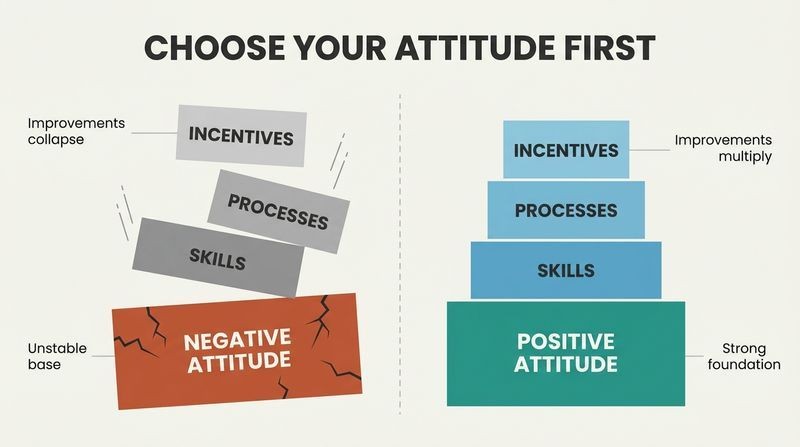
Choose your attitude first; every other improvement is wasted without it
The foundation ingredient. Of the four ingredients Lonnie the fishmonger teaches, this one comes first and underpins the rest. The principle, as Mary Jane writes in her notebook: there is always a choice about the way you do your work, even when there is no choice about the work itself. You bring an attitude through the door each morning the way you bring your keys. You can bring grouchy and irritate everyone, or bring energized and transform the day.
The dishwashing lesson. Lonnie's grandmother did not love washing dishes. She brought love to washing dishes, and grandkids fought to help. The distinction matters. The Pike Place crew even chose to be "world famous" rather than ordinary, because a day spent being world famous simply feels better. Mary Jane teaches this to a skeptical employee using road rage: you would never flip off a driver in a dangerous neighborhood, proving you always choose your response.
The road-rage example is quietly brilliant behavioral psychology. It exposes that what feels like an automatic reaction is actually a rapid cost-benefit calculation, which means it is a choice. This maps onto Stephen Covey's "stimulus and response" gap and cognitive behavioral therapy's core insight that emotions follow interpretations, not events. The honest caveat the book gestures at through the employee named Steve: choice requires self-control and courage, and people in genuine depression or trauma cannot simply will a mood. Attitude selection is a skill built through practice and supportive environment, not a switch. Naming it a choice restores agency without pretending the choosing is easy.
Inject play into serious work; energy and creativity are its byproducts
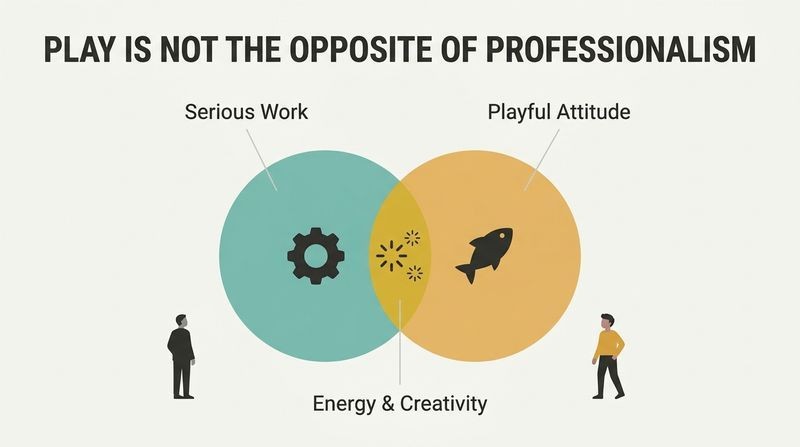
Play is not the opposite of professionalism. The Pike Place market is a profitable business that pays real salaries, yet the workers throw fish, juggle crabs, and banter with customers. The authors' point: you can be serious about your work without being serious about yourself. Brad, Mary Jane's young son, names the ingredient in one word when asked what he does at recess. Adults simply forget its importance as they grow "serious."
The payoff is measurable. The fishmongers list concrete benefits: low turnover, tedious work made bearable, deep friendships like a winning team, pride, and world fame. Mary Jane's staff eventually turns her drab third floor into a playground with a joke-of-the-month board, an aquarium, and a designated creativity zone called the Sand Box. Happy people treat others well, fun sparks creativity, and time flies. Work becomes a reward, not merely a means to rewards.
Modern organizational research backs this hard. Play activates the brain's reward circuitry and broadens cognition, consistent with Barbara Fredrickson's "broaden-and-build" theory, which shows positive emotion literally widens the range of ideas people consider. Google's famous 20% time and Pixar's campus culture are institutional bets on the same principle. The danger, well documented since the 2010s, is "mandatory fun," the ping-pong table that masks toxic overwork. Play energizes only when it is voluntary and self-generated, which is exactly why the book insists employees invent their own games rather than have HR impose them. Authenticity is the active ingredient, not the balloons.
Make someone's day by pulling them into your fun, not just serving them
Engagement over transaction. The third ingredient shifts attention outward. When the fishmonger Wolf sells a child a "smiling sushi" fish head for a penny, or when a shy customer is invited behind the counter to catch a salmon and gets a standing ovation, the crew is not just selling. They are creating memories that customers retell for years. The key word Lonnie repeats is engage: respectfully include people in the good time rather than perform at them.
A gift to the giver. Mary Jane realizes the psychology cuts both ways. Focusing on making another person's day produces a steady flow of positive feeling in yourself. Her team applies it internally, treating other departments as customers worth delighting: staggered coverage hours, service awards nominated by customers, a task force devoted to surprising people. The plaque in the lobby ends with the surefire remedy for a lapsing spirit: find someone who needs a hand or a good ear, and make their day.
The insight anticipates a robust finding in positive psychology: prosocial spending and acts of kindness reliably boost the giver's mood more than self-directed treats, per Elizabeth Dunn and Michael Norton's research. There is also a Zeigarnik-like memory effect at work. Emotionally charged, participatory experiences encode far more durably than passive service, which is why the fish-catching customer never forgets it. One nuance worth flagging: "making their day" as a service philosophy can curdle into performative hospitality that exhausts frontline staff, the emotional-labor problem Arlie Hochschild identified. The book's safeguard is that the joy is genuine and mutual, generated from an already energized team rather than demanded of a depleted one.
Be fully present; divided attention quietly starves every relationship
Presence is the fourth ingredient. Mary Jane discovers it by contrast. She recalls standing at a store counter with two cranky kids while clerks chatted about car modifications, ignoring her. The fishmongers are the opposite: between customers their eyes scan for the next person to help, and when they talk to you, they look at you like a long-lost friend. Lonnie describes a grocery meat counter where staff were having a great time, but with each other, not the customer. They had play but missed presence.
The cost of absence. An employee named John shares that for four years he told his daughter he would take her to the park "later," until she turned fifteen and lost interest in the park and in him. The team adopts a code phrase, "you seem distracted," to gently flag when someone has drifted, and everyone vows to stop answering email while on the phone.
This lands harder now than in 1996. The smartphone turned partial attention into the default human condition, and researchers like Sherry Turkle document how mere phone presence on a table measurably degrades conversation quality and felt empathy. Presence is also the engine of "flow," Mihaly Csikszentmihalyi's state of absorbed, timeless engagement that correlates with both performance and happiness. John's park story is the emotional core because it reframes presence as irreversible: attention withheld is not deferred, it is lost. The practical genius here is the code phrase, which converts a vague virtue into a concrete social ritual that a team can actually enforce without shame.
Culture spreads like a contagion; a leader must reform herself first
The toxic energy dump. First Guarantee's third floor is a place so lifeless colleagues joke it could win a Nobel Prize for discovering life there. Employees let phones ring seven times before cutting them off, hide files to punish people who rush them, and doze in the break room. Crucially, the culture is self-replicating: new hires arrive with a spark and lose it within weeks. Environment overwhelms individual intention.
Leadership begins internally. Mary Jane, a grieving widow who has lost faith in herself, realizes she is part of the problem. Listening to poet David Whyte's line about building our own prisons, and John Gardner's warning about people who "go to seed" and stop growing, she sees she must "wind up her own clock" before winding up anyone else's. Her first act is not a memo but a decision: she chooses faith and confidence, then speaks to her staff from the heart about her own fear.
Organizational behavior confirms culture is caught, not taught. Behaviors and even emotions transmit through social networks, a phenomenon Nicholas Christakis and James Fowler traced across friendships and workplaces. The book's sharpest move is refusing the hero-manager fantasy. Mary Jane cannot install energy top-down; she must model a shift she has genuinely undergone, which aligns with authentic-leadership theory: followers detect and mirror congruence between a leader's inner state and outer message. The Gardner framing about "going to seed" adds a developmental lens often missing in business books. Stagnation is not laziness but a wounded self-confidence that stopped believing growth was possible, a diagnosis more compassionate and more useful than blame.
Don't lecture people into change; engineer conditions for self-discovery
The teaching that sticks. Lonnie's parting advice to Mary Jane is counterintuitive for a manager under deadline pressure: do not simply tell your staff the Fish Philosophy. Let them discover it for themselves. The chapter's epigraph captures it: she told me, and then I discovered it for myself.
Discovery in action. Rather than mandating change, Mary Jane takes her team on a field trip to watch the market, then forms four employee teams, one per ingredient, each with six weeks, a $200 budget, and freedom to design their own presentations. She resists taking control even when asked. The results outstrip anything she could have dictated: a shy employee catches a fish and becomes an evangelist, a father reconnects with his daughter, and staff return to the market voluntarily on weekends. Ownership, not instruction, generates the energy.
This is the book's most underrated management lesson and its most empirically supported. Self-determination theory (Deci and Ryan) shows autonomy is a basic psychological need; behavior chosen freely is vastly more durable than behavior complied with. The "IKEA effect" in behavioral economics shows people value what they help build. Adult learning research (Knowles's andragogy) finds grown-ups internalize through experience, not transmission. Mary Jane's restraint, giving a budget and a deadline rather than a script, is essentially good scaffolding: enough structure to move, enough space to own. The tension worth naming is speed. Discovery-based change is slower than decree, a luxury not every crisis affords, though the book bets it is faster in the end because it actually holds.
Refuse victimhood; even shattered lives can choose to live fully
Wolf's story. A grandfatherly fishmonger with an unruly mane, Wolf was headed for a professional racing career when a serious accident ended it. He wallowed, his girlfriend left, friends stopped calling. Then he faced a stark choice: let life slip away in missed opportunities, or choose to live fully every single day. He has chosen fully ever since. His story converts "choose your attitude" from a slogan into lived proof for skeptical employees.
Investment in being a victim. Lonnie admits he once had "too much invested in being a victim," a chip on his shoulder and a life out of control, until an older colleague explained the choice one monger to another. The employee Steve realizes his life has become "a series of reactions" and resolves to confront a bad relationship. Choosing your attitude and acting like a victim, the team concludes, are mutually exclusive.
The phrase "invested in being a victim" is psychologically acute. Victimhood offers real secondary gains: sympathy, lowered expectations, and freedom from responsibility, which is why it can be strangely hard to relinquish. This resonates with research on "learned helplessness" (Martin Seligman), where organisms that once could not escape pain stop trying even when escape becomes possible, and with its antidote, learned optimism. The care the book takes matters: Gardner's earlier plea for compassion ("life is hard, sometimes just keeping on is an act of courage") prevents this from becoming victim-blaming. The message is not that suffering is a choice, but that the response to suffering, eventually, can be reclaimed. Wolf earns the right to say it because he lived it.
Meaning is not discovered like buried treasure; you assemble it yourself
Gardner's definition. In the passage Mary Jane keeps in her journal, John Gardner insists meaning is not something you stumble upon like the answer to a riddle. You build it out of your past, your loyalties, your talents, the people you love, and the values you would sacrifice for. The ingredients are already present; only you can arrange them into a pattern that is your life. Get that right, Gardner argues, and the particular balance of success or failure matters less.
The parable's full arc. A year on, Mary Jane's dead department has become the place everyone in the company wants to transfer to. She wins the Chairwoman's Award, requests copies for every employee and every fishmonger, marries Lonnie (who proposes with a ring tucked in a fish head), and realizes the energy was inside her people all along. It took outsiders throwing salmon to reveal it.
Gardner's constructivist view of meaning is philosophically closer to existentialism than to most business writing. Sartre and Camus insisted that in a universe with no pre-given purpose, meaning is authored rather than found, and Frankl's logotherapy made meaning-making the central human drive. What the Fish parable adds is that this authorship happens not in grand gestures but in the daily micro-choices of how one shows up to ordinary work. The closing image is deliberately unglamorous: transformation begins in a back-office transaction-processing department, the least romantic setting imaginable. If meaning can be built there, the authors imply, the excuse that your circumstances are too dull no longer holds. The setting is the argument.
Analysis
Fish! (1996) is a business fable, the genre pioneered by co-author Ken Blanchard's One Minute Manager, which smuggles management principles inside a story rather than a lecture. Its structure is deliberate: an emotionally grounded protagonist (widowed single mother Mary Jane Ramirez) faces a concrete crisis (a dead-weight department branded a "toxic energy dump"), and a mentor figure (Lonnie the fishmonger) dispenses a four-part framework across escalating visits. The real Pike Place Fish market lends documentary credibility to an invented plot.
The framework's elegance is its parsimony: four verbs, one of them foundational. Choose Your Attitude, Play, Make Their Day, and Be Present are memorable precisely because they are behaviors, not abstractions, and because a child could name most of them. This is also the book's vulnerability. The philosophy is nearly content-free about the harder questions: what if the work is genuinely exploitative, the pay unjust, the leadership abusive? Bill, the SOB boss, softens implausibly fast. The book locates nearly all dysfunction in employee attitude and almost none in structural conditions, a framing that can serve management interests more than workers'. The clumsiest real-world applications of Fish! became exactly the coerced cheerfulness the book, at its best, warns against. Yet the deeper material is more durable than the fish-throwing gimmick suggests. The David Whyte poetry and John Gardner essays elevate the parable into a meditation on faith, stagnation, and self-authored meaning. Mary Jane's arc is really about a grieving woman recovering agency, and the management lessons ride on that emotional spine. The insistence on self-discovery over instruction, and on the leader reforming herself first, aligns with self-determination theory and authentic-leadership research decades ahead of their popularization. Read generously, Fish! is less a customer-service manual than a small philosophy of showing up. Its enduring value is the reframe that fulfillment is a present-tense choice available in the dullest job, not a future reward reserved for the lucky.
Review Summary
Fish receives mixed reviews, with an average rating of 3.93 out of 5. Supporters praise its simple but effective lessons on improving workplace attitude and culture. Critics argue it's oversimplified, unrealistic, and potentially manipulative. Many find the writing style poor and the story contrived. Some readers appreciate the core message of choosing a positive attitude, while others feel it ignores deeper workplace issues. The book's brevity is seen as both a strength and weakness. Overall, reactions range from enthusiastic endorsement to outright dismissal.
People Also Read







FAQ
What's "Fish: A Proven Way to Boost Morale and Improve Results" about?
- Parable of Workplace Transformation: The book is a fictional story about a manager named Mary Jane Ramirez who transforms a demotivated department into an energetic and effective team.
- Inspiration from Pike Place Fish Market: The story draws inspiration from the real-life Pike Place Fish Market in Seattle, known for its lively atmosphere and excellent customer service.
- Four Key Principles: The narrative introduces four principles—Choose Your Attitude, Play, Make Their Day, and Be Present—that are used to revitalize the workplace.
- Broader Life Lessons: Beyond business, the book offers insights into how these principles can improve personal interactions and overall life satisfaction.
Why should I read "Fish: A Proven Way to Boost Morale and Improve Results"?
- Practical Business Lessons: The book provides actionable strategies for improving workplace morale and productivity, applicable to any organization.
- Engaging Storytelling: It uses a compelling narrative to illustrate its points, making the lessons memorable and easy to understand.
- Universal Application: The principles can be applied not only in professional settings but also in personal life to enhance relationships and personal fulfillment.
- Proven Success: The methods have been successfully implemented in various organizations, as evidenced by the real-life success of the Pike Place Fish Market.
What are the key takeaways of "Fish: A Proven Way to Boost Morale and Improve Results"?
- Choose Your Attitude: You have the power to choose your attitude every day, which can transform your work experience and interactions.
- Play: Incorporating play into work can boost creativity, energy, and job satisfaction, making work more enjoyable.
- Make Their Day: Engaging with others and making their day can create positive experiences and foster a supportive work environment.
- Be Present: Being fully present in interactions enhances communication and strengthens relationships, both at work and in personal life.
How does the "Choose Your Attitude" principle work in "Fish"?
- Personal Accountability: It emphasizes personal responsibility in choosing how you respond to situations, regardless of external circumstances.
- Impact on Environment: By choosing a positive attitude, you can influence the mood and energy of your workplace.
- Daily Practice: It requires conscious effort and practice to consistently choose a positive attitude, especially in challenging situations.
- Foundation for Other Principles: This principle is the core that supports the other three principles, making it essential for overall transformation.
What is the "Play" principle in "Fish" and why is it important?
- Boosts Creativity and Energy: Playfulness at work can lead to increased creativity and energy, making tasks more enjoyable and less monotonous.
- Fosters Team Spirit: It encourages camaraderie and teamwork, as employees engage in fun activities together.
- Reduces Stress: Incorporating play can alleviate stress and create a more relaxed and open work environment.
- Enhances Productivity: When employees enjoy their work, they are more likely to be productive and committed to their tasks.
How can the "Make Their Day" principle be applied in the workplace according to "Fish"?
- Focus on Others: It involves looking for opportunities to make a positive impact on colleagues and customers, enhancing their experience.
- Creates Positive Memories: Engaging with others in meaningful ways can create lasting positive memories and strengthen relationships.
- Encourages Engagement: By making others' days, employees become more engaged and invested in their work and the success of the team.
- Improves Customer Service: This principle can lead to better customer interactions, as employees strive to exceed expectations and create memorable experiences.
What does "Be Present" mean in the context of "Fish"?
- Full Engagement: Being present means giving your full attention to the task or person at hand, without distractions.
- Improves Communication: It enhances communication by ensuring that you are truly listening and responding to others.
- Strengthens Relationships: Being present fosters trust and respect, as people feel valued and understood.
- Mindfulness Practice: It encourages mindfulness, helping individuals to focus on the present moment and reduce stress.
What are some of the best quotes from "Fish" and what do they mean?
- "There is always a choice about the way you do your work, even if there is not a choice about the work itself." This quote emphasizes the power of attitude and perspective in transforming your work experience.
- "We can be serious about our work without being serious about ourselves." It highlights the importance of maintaining a sense of play and humor in the workplace.
- "Find someone who needs a helping hand, a word of support, or a good ear—and make their day." This quote underscores the value of kindness and support in building a positive work environment.
- "Today is a gift. That is why we call it the present." It reminds readers to appreciate the present moment and be fully engaged in it.
How does Mary Jane Ramirez transform her department in "Fish"?
- Adopts Fish Philosophy: She implements the four principles of the Fish Philosophy—Choose Your Attitude, Play, Make Their Day, and Be Present.
- Engages Employees: Mary Jane involves her team in the transformation process, encouraging them to take ownership and contribute ideas.
- Creates a Positive Culture: By fostering a culture of positivity and engagement, she turns a demotivated department into a vibrant and effective team.
- Leads by Example: She models the behaviors she wants to see, demonstrating the power of attitude and presence in leadership.
What role does the Pike Place Fish Market play in "Fish"?
- Source of Inspiration: The market serves as the inspiration for the Fish Philosophy, showcasing how a lively and engaging work environment can lead to success.
- Real-Life Example: It provides a real-world example of how the principles can be applied to create a positive and productive workplace.
- Symbol of Transformation: The market symbolizes the potential for transformation in any organization, regardless of industry or challenges.
- Engagement and Energy: It exemplifies the energy and engagement that can be achieved when employees are empowered to choose their attitude and play.
How can the principles in "Fish" be applied outside of work?
- Improves Personal Relationships: The principles can enhance personal relationships by encouraging positive interactions and presence.
- Increases Life Satisfaction: By choosing a positive attitude and engaging in play, individuals can increase their overall life satisfaction and happiness.
- Encourages Mindfulness: Being present helps individuals focus on the moment, reducing stress and improving mental well-being.
- Fosters Community Engagement: Making others' days can extend to community involvement, creating a ripple effect of positivity and support.
What impact has "Fish: A Proven Way to Boost Morale and Improve Results" had on organizations?
- Widespread Adoption: Many organizations have adopted the Fish Philosophy to improve morale, productivity, and employee engagement.
- Proven Results: Companies that have implemented the principles report increased job satisfaction, lower turnover, and improved customer service.
- Cultural Shift: The book has inspired cultural shifts in workplaces, emphasizing the importance of attitude, play, and presence.
- Enduring Influence: The principles continue to influence leadership and management practices, highlighting the timeless relevance of the book's message.

Download PDF
Download EPUB
.epub digital book format is ideal for reading ebooks on phones, tablets, and e-readers.








































