

Key Takeaways
You don't imagine a finished film, you discover it by drawing
Katz dismantles the pop-psychology notion of visualization as picturing a perfect result, the way an athlete mentally rehearses a routine already mastered. The artist has no fixed goal yet, so visualization is the search for one, and it happens in the hand: sketching, writing, cutting. As he puts it, imagination is led by the hand, not the other way around. Once an idea lands on paper it becomes a mirror, revealing possibilities invisible until that moment.
He names two rhythms that drive the process:
1. Immediacy: rapidly generating and comparing shot ideas in one uninterrupted burst.
2. Reflection: a good night's sleep between drafts that restores perspective.
Even writing his opening chapter took three drafts. The takeaway: make crude images fast, because making generates ideas thinking alone never surfaces.
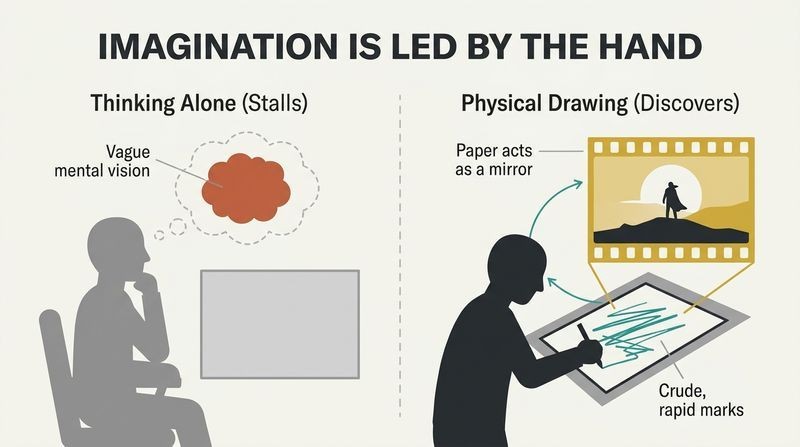
This anticipates what design theorists call thinking through making, and Donald Schon's reflective practitioner. Sketching externalizes working memory, freeing cognition to spot new relationships, a principle now backed by research on cognitive offloading. What is striking is how Katz separates artistic visualization from athletic visualization: the athlete rehearses the known, the filmmaker gropes toward the unknown. One friendly challenge: some auteurs claimed near-complete mental blueprints before shooting. Yet even they, on inspection, drafted obsessively. The deeper point stands across disciplines, from architecture to jazz: expertise lives in iterative externalization, not in a flash of finished inspiration.
Learn the continuity rulebook precisely so you can break it well
Katz argues that image, sound, language, and continuity are fragmented across director, writer, cinematographer, and editor for efficiency, but that they are really one unified craft he calls shot flow: the kinetic effect of shots in sequence. The continuity style is the invisible Hollywood grammar that stitches shots into a seamless illusion of continuous space and time, so the audience feels present inside the scene rather than watching a surface.
His surprising stance for 1991, when film theory prized rule-breaking, is that mastering this conventional vocabulary does not stifle experimentation, it enables it. Artists driven to rewrite the rules are never stifled by first learning them. Directors like Ozu, Bresson, and Godard broke continuity deliberately and coherently precisely because they understood what they were violating.
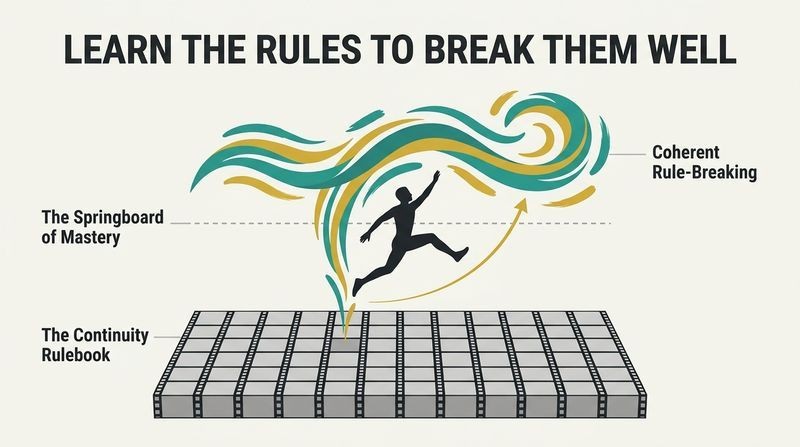
The claim mirrors how musicians learn scales before improvising or how painters study anatomy before abstraction. Cognitive film scholar David Bordwell independently mapped this same Hollywood grammar and showed audiences process it almost automatically, which supports Katz. The counterpoint worth noting: rules internalized too deeply can become invisible cages, and some avant-garde power comes from artists who never learned the conventions at all. Still, Katz's position is the safer bet pedagogically. Fluency in a shared language lets a director collaborate with a crew of dozens, and knowing the default frees attention for the exceptions that actually carry meaning.
Films are planned on paper far more than directors admit
The romantic image of a director inventing brilliance spontaneously on set is, Katz insists, largely a myth perpetuated by directors, critics, and publicity departments. Hitchcock, who trained as an art director, storyboarded so thoroughly he claimed his films were finished before a frame was shot, and rarely bothered looking through the viewfinder. John Huston admitted he storyboarded The Maltese Falcon partly so the crew would think he knew what he was doing.
Storyboards, which Katz calls the diary of the film, serve two jobs: previsualizing ideas through successive drafts like a writer, and communicating a precise plan to the whole team. They are not just for action spectacle. Small dramatic films benefit too, helping refine mood, pacing, and even exposing a dishonest line of dialogue before expensive shooting begins.
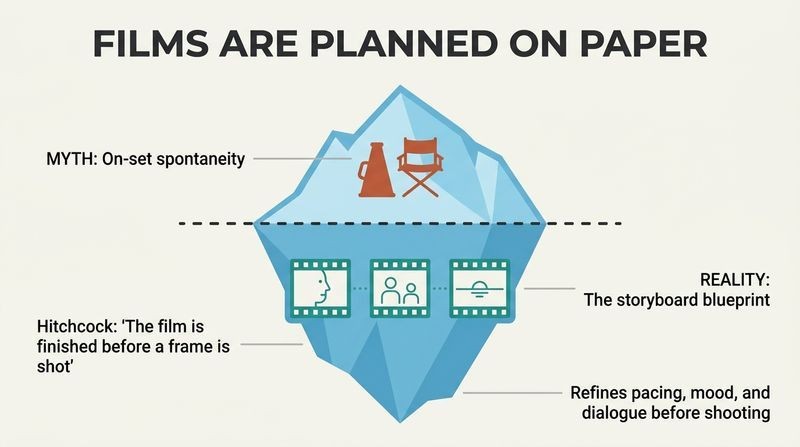
The insight punctures a persistent industry mystique that inflates directorial genius while erasing storyboard artists, who under the old studio system were often forbidden to sign their work. Katz's Empire of the Sun case study is illuminating: comparing novel, two screenplay drafts, storyboard, and final cut shows Spielberg condensing a boy's semaphore signaling into a single flashlight-and-toy-plane image, and later merging three shots into one hinged-mirror reflection. The visible lesson is that cinematic power comes from ruthless compression discovered on paper. A modern extension: previsualization software and animatics have only deepened this reality, vindicating Katz decades ahead of the tools.
Shot size is not framing, it is emotional distance
Katz reframes the basic vocabulary of long shot, medium shot, and close-up. These are not just picture boxes of different widths, they are measures of how physically and therefore emotionally close the viewer stands to the subject. Because the camera is the audience's point of view, a close-up forces an intimacy usually reserved for close family, which is why news crews prying into grief with telephoto lenses feel like violations.
He illustrates with a hypothetical Civil War scene: Union soldiers watching General Lee ride to surrender. Because Lee remains their mortal enemy, the director never frames him closer than a full shot. He must stay inscrutable, so the audience strains to read his face. Distance itself carries the meaning. Choosing a shot size is choosing a relationship.
This translation of a technical term into a psychological one echoes anthropologist Edward Hall's proxemics, which mapped how physical distance encodes intimacy, threat, and status across cultures. Katz essentially argues cinema hijacks that hardwired spatial instinct. The close-up's dominance today, driven first by small television screens and now by phones, has arguably flattened this expressive range, making everything intimate and therefore nothing distinctive. Katz's Lee example is a fine reminder that withholding closeness can be more powerful than granting it, a principle equally true in prose, portraiture, and even negotiation, where restraint often signals more than exposure.
The 180-degree line keeps your audience from getting lost
To preserve consistent screen direction, the continuity style draws an imaginary line of action between two subjects, usually along their sight line, and keeps the camera within the 180-degree arc on one side. Cross it, and a character suddenly appears to face the wrong way, breaking the spatial illusion. Katz pairs this with the triangle system: three camera points on one side of the line yield every standard setup (angular singles, over-the-shoulder shots, two-shots, point-of-view shots, and profiles).
But he refuses to treat the rule as sacred. Audiences, he argues, are far more spatially astute than the convention assumes, and directors like Ozu built entire styles on crossing the line without confusing anyone. The line is a tool for clear thinking about geography, not an aesthetic commandment.
The line of action is the single most taught and most fetishized rule in film schools, so Katz's measured skepticism is refreshing. Empirical work in the decades since suggests viewers tolerate far more spatial discontinuity than mid-century editors believed, partly because television and music videos trained everyone to read fragmented space. There is a useful general principle here about conventions in any craft: they often lag behind the audience's actual competence. The risk in dismissing the line too casually is that clarity, once lost, is expensive to rebuild, so the pragmatic move is Katz's, know exactly why the rule exists before deciding a scene is better without it.
Edit by planting questions and delaying the answers
Katz locates the engine of editing not in pretty compositions but in structure: what the viewer knows and when. Borrowing novelist E. M. Forster's distinction, a sequence of events becomes a plot only when linked by cause and effect. He recasts continuity editing as a chain of questions and answers. A shot of someone looking offscreen (question) is answered by a shot of what they see. Rearrange the order, withhold the answer, or answer before asking, and you manufacture suspense, surprise, or dramatic irony.
The famous Kuleshov experiment anchors this: the same blank actor's face, intercut with soup, a coffin, or a child, seemed to express hunger, grief, or tenderness. Meaning was created entirely by juxtaposition. Structure, not the individual image, shapes how an audience feels.
This is Katz quietly siding with the Soviet montage tradition while folding it into Hollywood practice, arguing they are variations of one question-and-answer principle rather than opposites. Modern cognitive narratology agrees: viewers are prediction machines, constantly forming and testing hypotheses, and suspense is the managed gap between question and resolution. Hitchcock's bomb-under-the-table lesson is the same idea. One nuance Katz honors that many imitators miss: the Kuleshov effect works only because the face is neutral. Give the actor a strong expression and the trick collapses. Meaning is co-authored by image and cut, not dictated by editing alone.
Choose between camera cutting and coverage on purpose, not by default
Katz names two opposing shooting philosophies. Camera cutting means shooting only the exact shots your storyboard specifies, editing effectively done in the camera, which demands a near-perfect plan and offers no safety net. Coverage means shooting a programmed menu of wide, medium, and close-up angles for every beat so any logical sequence can be assembled later, which is safe but often uninspired and postpones creative decisions to the editor.
Most features blend both. The real cost is time: lighting and blocking eat hours, so a director shooting full coverage may be forced to abandon an ambitious tracking shot. Katz's point is that the payoff of confident visualization is not saved film stock, it is the extra time freed to attempt bolder staging, riskier performances, and shots worth remembering.
The tradeoff maps neatly onto a broader planning-versus-optionality dilemma found in software, architecture, and military strategy: commit early for elegance and speed, or hedge with redundancy at the cost of ambition. Coverage is the industrial default precisely because it de-risks the producer's investment, which is why so many competent films feel anonymous. Katz's insight that time, not money, is the true currency on set is shrewd and underappreciated. The director who knows in advance what will cut together spends fewer setups covering themselves and more attempting the one audacious sequence shot that a coverage-first mentality would never allow onto the schedule.
Place actors using three simple patterns and their positions
To tame the overwhelming number of ways to arrange people and cameras, Katz offers a building-block system. Actors group into three patterns, named for the shapes they form seen from above: the I pattern (two people, the basic unit), the A pattern (a lone figure flanked by two others), and the L pattern (a lone figure set off to one side). Patterns determine camera placement via the line of action.
Within any pattern, position refers to which way subjects face, and this governs the composition of the frame. He catalogs ten two-person positions, from face-to-face profiles to figures at right angles to back-to-back stances that build tension through the absence of eye contact. Because every larger grouping reduces to the two-person I pattern when you find the line, mastering two subjects scales to crowds.
The elegance here is reductive in the best sense: a combinatorial explosion of options collapses into a learnable grammar, much as chess openings or musical chord voicings compress infinite possibility into memorable forms. Katz's repeated caution is that these are a springboard, not a menu of stock answers, and the danger of any such system is exactly that lazy users treat it as a checklist and produce staginess. His observation that withheld eye contact generates dramatic tension is psychologically astute and echoes how, in real conversation, averted gaze signals conflict, shame, or concealment. The pattern vocabulary is essentially a proxemics of the frame.
Think in a circle of action, then work the depth of the frame
Katz proposes the circle of dramatic action: the space a scene's movement actually covers. The decisive choice is whether the camera sits inside that circle (intensifying identification, forcing pans and shifting shot sizes as actors approach or recede) or outside it (a distanced, neutral observer holding a steady view). A parade coming toward you fills all three depth planes, foreground, middleground, and background, while a parade crossing your path occupies only a thin band.
Staging in depth lets a director skip cutting entirely and control emphasis within one shot. He contrasts two masters: Renoir moved actors from background to foreground so characters intersect, while Welles in Citizen Kane stranded Kane and Susan at opposite ends of vast rooms, imprisoning them in space to dramatize emotional isolation. Depth is a storytelling instrument, not just a look.
The Renoir-versus-Welles contrast is a small masterclass: same technical tool, deep-focus staging, deployed toward opposite emotional ends, intersection versus isolation. This is the kind of comparison that teaches taste rather than technique. The circle of action also usefully reframes the perennial follow-the-subject reflex, reminding directors that the space defines the subject as much as the subject defines the scene. A modern caveat: faster film stocks and now digital sensors made deep focus trivially easy, which paradoxically drained it of the effortful expressivity it carried when Gregg Toland fought for it. Ubiquity can dilute a technique's meaning, a recurring theme across Katz's craft.
Point of view is a dial, not a switch, tuned by the cut on the look
Katz distinguishes involvement (how close the viewer gets) from point of view (whom the viewer identifies with), and insists identification is a matter of degree. Borrowing literary terms, he names first-person subjective (seeing through a character's eyes), third-person restricted (an ideal observer, Hollywood's default), and omniscient. The single most powerful cueing device is the cut on the look: a character glances offscreen, and the next shot is what they see.
Crucially, the closer a subject's sight line runs to the lens, the more we identify with them. Nudge the camera a few degrees inside a character's eye-line and an ordinary shot becomes a modified subjective one. Identification is shaped by two controls: graphic (composition and sight lines) and narrative (which character escorts us into and out of a scene, and who gets more screen time).
Treating identification as a continuous variable rather than a binary is genuinely sophisticated and predates much academic writing on cinematic subjectivity. Katz's finding that screen time and sight-line proximity quietly steer allegiance aligns with later empirical work on how audiences form character alignment through access to knowledge and perceptual point of view. There is a practical ethics buried here too: Katz notes all framing manipulates the viewer, and that so-called objective distancing techniques championed by radical filmmakers are no less manipulative than intimacy. Honesty, he implies, lies in the filmmaker's intentions, not in any technique that pretends to be neutral.
To vary a scene, move the camera or move the actor
Fred Astaire summed up the entire problem of mobile staging when he arrived in Hollywood: either the camera will dance, or he will. Katz builds on that. Instead of cutting between multiple static setups, a director can achieve the same shifts in framing within a single unbroken shot by repositioning the actors, moving the camera, or choreographing both together. Having an actor simply turn around delivers the frontal view that would otherwise require a new shot.
He treats a long sequence shot as storyboard panels linked by motion, using techniques like the counter move (camera and subject traveling opposite directions), retracking (the camera reversing over ground it covered while pointed a new way), and cross-pans that hand attention from subject to subject. Movement must always be motivated, arising from real behavior, never invented busywork.
Astaire's line is the perfect mnemonic because it collapses a whole discipline into a binary choice, and the deeper lesson is that cutting and camera movement are interchangeable solutions to the same problem of directing attention. Katz's insistence that movement be motivated separates expressive staging from the empty virtuoso crane shots that technology tempts directors into, a temptation only intensified by today's gimbals, drones, and Steadicam rigs. His most durable warning is that resourceful staging beats brute technical force: work with the location, let obstacles become framing devices, rather than muscling equipment over difficult terrain to slavishly follow a subject.
Analysis
Katz's 1991 manual endures because it treats film directing as a teachable spatial craft rather than an ineffable gift. Its governing thesis, that image, sound, and continuity form a single discipline he calls shot flow, quietly resists the industrial fragmentation of authorship into director, writer, cinematographer, and editor. The book's method, side-by-side illustrated and photographic storyboards showing dozens of variants of the same staging, is itself an argument: mastery comes from working through possibilities on paper, not from memorizing stock answers.
Historically, the book arrived at a charged moment. Academic film theory and the post-Godard avant-garde had spent decades attacking classical continuity as ideologically suspect and manipulative. Katz's calm, almost contrarian defense, that no style is superior and that learning the rules empowers rather than imprisons, reads as a practitioner's rebuke to the seminar room. His position has aged well. Cognitive film scholars such as David Bordwell later demonstrated that continuity grammar exploits genuine perceptual and predictive mechanisms, which is precisely why audiences parse it effortlessly.
The book's most underrated contribution is conceptual translation: shot size becomes emotional distance, editing becomes a question-and-answer game, point of view becomes a dial calibrated by sight lines. These reframings convert jargon into intuition, which is why the volume functions as pedagogy rather than mere reference. Its dated sections, camera angle projection by hand, early desktop-video speculation, are ironically its most prophetic, because Katz clearly saw digital previsualization coming and welcomed the democratization of tools.
The limitation is scope. Katz brackets performance, sound design, and the messy human labor of directing actors, treating staging as geometry. That abstraction is the book's strength and its blind spot. A shot flows on paper, but a scene lives in behavior. Read alongside a book on working with actors, it remains one of the most lucid craft texts ever written.
Review Summary
Film Directing Shot by Shot receives mostly positive reviews for its comprehensive coverage of filmmaking techniques, particularly for beginners. Readers appreciate the detailed explanations, visual aids, and practical advice on composition, camera work, and pre-production. Some criticize its dated technology references and occasional lack of narrative focus. The book is praised for its accessible language and thorough exploration of visual storytelling. While some find it overly technical, many consider it an essential resource for aspiring filmmakers and a valuable reference for experienced professionals.
Glossary
Shot Flow
Kinetic effect of sequenced shotsKatz's term for the unified craft of designing how shots combine into a rhythmic, spatial, and dramatic whole. He argues that composing, staging, and editing are not separate specialties but one continuous discipline, and that shot flow, not the beauty of any single frame, is what determines whether a sequence works.
Continuity Style
Invisible Hollywood editing grammarThe dominant narrative film convention that stitches shots together to create a seamless illusion of continuous space and time, avoiding techniques that call attention to the film's surface. Rooted in nineteenth-century theater and illustration, it now functions as an international storytelling grammar built on cause-and-effect logic and consistent spatial cues.
Presence
Feeling of being insideA term Katz borrows from critic Andre Bazin describing the moviegoer's sensation of occupying the same space and time as the image on screen, rather than viewing a flat surface as with painting or photography. Katz treats this immersive illusion of depth as cinema's defining perceptual property.
Line of Action
180-degree screen-direction ruleAn imaginary line, usually drawn along the sight line between two subjects, that defines a 180-degree arc within which the camera must stay to preserve consistent screen direction. Crossing it makes characters appear to face the wrong way. Katz treats it as an organizing tool rather than an inviolable law.
Triangle System
Three-point camera placement schemeA shorthand for positioning cameras on one side of the line of action, using three points that form a triangle. From these points a director can obtain all standard dialogue setups: angular singles, master two-shots, over-the-shoulder shots, point-of-view singles, and profile shots, any of which can cut together cleanly.
Camera Angle Projection
Plans turned into perspective previewsThe Michelson method for converting a set's architectural plan and elevation into a perspective drawing showing exactly how the finished set will look to a given lens, camera position, and aspect ratio. It lets designers preview framing and avoid overbuilding before construction begins.
Circle of Dramatic Action
Space a scene's movement coversKatz's concept for the area occupied by a scene's action. The key directorial choice is whether to place the camera inside the circle, intensifying identification and forcing shifting shot sizes, or outside it, producing a detached, neutral, steadier observation of the same events.
Patterns and Positions
System for staging actorsKatz's staging vocabulary. Patterns (the I, A, and L shapes actors form seen from above) determine camera placement through the line of action, while positions (which direction subjects face) determine frame composition. Every larger grouping reduces to the two-person I pattern, making the system scalable to crowds.
Sequence Shot
One unbroken choreographed takeA single continuous traveling shot in which choreographed actor movement and camera movement replace the cutting that would normally break an action into separate shots. Katz shows how such shots can be planned as linked storyboard panels connected by motion rather than by edits.
Cut on the Look
Glance followed by objectThe editing device of following a shot of a character looking offscreen with a shot of what they see. Katz calls it the most powerful cueing tool for point of view, and notes that the closer the character's sight line runs to the lens, the stronger the viewer's identification with them.
Camera Cutting versus Coverage
Precise plan versus safe menuTwo shooting philosophies. Camera cutting shoots only the exact storyboarded shots, editing done in-camera with no safety net. Coverage shoots a formulaic set of wide, medium, and close-up angles so any sequence can be assembled later. Most films blend both, trading elegance and time against safety.
Kuleshov Experiment
Meaning created by juxtapositionA 1920 Soviet demonstration in which the same neutral shot of an actor's face was intercut with soup, a coffin, and a child. Audiences read hunger, grief, and tenderness into the identical expression, proving that editing juxtaposition, not the image alone, generates emotional meaning.
FAQ
What is Film Directing Shot by Shot by Steven D. Katz about?
- Comprehensive visual storytelling guide: The book is a detailed manual on visualizing and directing films, focusing on staging, camera movement, and shot composition from concept to screen.
- Emphasis on continuity style: Katz explains how spatial and temporal connections are created through staging, camera angles, and editing to maintain narrative clarity.
- Blend of theory and practice: It combines practical advice, storyboards, and theoretical concepts, making it a valuable resource for filmmakers seeking to master visual storytelling.
Why should I read Film Directing Shot by Shot by Steven D. Katz?
- Master visualization and planning: The book offers a thorough understanding of how to visualize a film from concept to screen, a skill often underrepresented in film education.
- Bridges theory and application: Katz connects theoretical aspects of film directing with practical tools like storyboards, production design, and shot composition.
- Industry insights: Includes interviews and examples from renowned production illustrators and directors, providing real-world perspectives and advice.
What are the key takeaways from Film Directing Shot by Shot by Steven D. Katz?
- Visualization is essential: The book stresses the importance of previsualizing shots and sequences to solve narrative and visual problems before filming.
- Continuity style foundation: Understanding Hollywood’s continuity style is crucial for creating clear, engaging films and developing a critical cinematic eye.
- Practical tools and techniques: Katz provides actionable advice on storyboarding, staging, camera movement, and editing, supported by diagrams and real-world examples.
How does Steven D. Katz define and explain visualization in filmmaking?
- Merging imagination and craft: Visualization is the process where the act of making (drawing, writing, editing) merges with imagination, revealing new ideas through creation.
- Immediacy and reflection: It involves both the immediate creation and evaluation of ideas, as well as reflection and refinement after breaks.
- Necessity of tangible mediums: Katz emphasizes hands-on picture making—such as storyboards and photoboards—to make ideas visible and actionable before shooting.
What is the role and importance of storyboards in Film Directing Shot by Shot by Steven D. Katz?
- Storyboards as a diary: They serve as a private record of the film’s visual planning, documenting the director’s visualization process.
- Dual purpose: Storyboards help filmmakers previsualize and refine ideas, and communicate these ideas clearly to the production team.
- Techniques for motion: Katz explains how to depict camera moves and transitions in static storyboards using frames within frames, arrows, and overlapping panels.
How does Film Directing Shot by Shot by Steven D. Katz approach production design and production illustration?
- Visual plan responsibility: The production designer and art department are responsible for the film’s mise-en-scène, including sets, props, costumes, and overall visual style.
- Three categories of illustrations: These include concept/final design illustrations, architectural drawings, and continuity sketches/storyboards.
- Camera angle projection and models: Specialized techniques like camera angle projection and the use of models/miniatures help visualize sets and plan complex scenes.
What are the key elements of the continuity style in Film Directing Shot by Shot by Steven D. Katz?
- Shot size and spatial unity: The book explains how long shots, medium shots, and close-ups overlap to create spatial connections and narrative flow.
- Line of action (180-degree rule): Maintaining consistent screen direction and spatial orientation is fundamental for clarity.
- Triangle system and flexibility: Katz introduces the triangle system for camera placement and encourages experimentation beyond the rules.
How does Steven D. Katz explain staging patterns and positions for dialogue in Film Directing Shot by Shot?
- I, A, and L patterns: These are fundamental arrangements for actors in dialogue scenes, each offering different spatial and emotional dynamics.
- 10 basic two-player positions: Katz identifies essential positions for two actors, focusing on eye contact, spatial relationships, and emotional impact.
- Frontality and master shots: The use of frontal staging and master shots is foundational for clear and effective dialogue sequences.
What does Film Directing Shot by Shot by Steven D. Katz say about mobile staging and moving camera techniques?
- Mobile staging defined: Moving actors within the frame creates dynamic shots without cutting, often combined with camera movement for fluid storytelling.
- Choreographing camera and actors: The book details how to connect static shot patterns into continuous shots through coordinated actor and camera movement.
- Storyboards and aerial views: Katz provides visual examples to illustrate complex sequence shots and tracking choreography.
How does Film Directing Shot by Shot by Steven D. Katz address depth of frame and deep focus?
- Dramatic circle of action: This concept helps directors decide camera placement relative to the action’s spatial limits.
- Staging in depth: Using foreground, middleground, and background strategically can reduce the need for cuts and emphasize dramatic elements.
- Deep focus vs. deep staging: Katz distinguishes between deep focus (a cinematographic technique) and deep staging (a compositional choice), showing how both can be combined.
How are camera angles, viewer placement, and framing treated in Film Directing Shot by Shot by Steven D. Katz?
- Angles shape narrative: Camera angles influence mood, point of view, and psychological impact, affecting how the audience perceives the story.
- Sequential perspective: Shot sequences create a spatial experience, guiding the viewer’s movement and attention.
- Open vs. closed framing: Katz discusses how open framing creates realism and involvement, while closed framing offers a staged, distanced effect.
What are the main editing and transition techniques covered in Film Directing Shot by Shot by Steven D. Katz?
- Seven basic transitions: The book covers cut, dissolve, wipe, fade out, fade in, white-in, and white-out, each serving different narrative and emotional functions.
- Action wipes and match shots: Techniques like action wipes and graphic matches help maintain continuity and viewer engagement.
- Montage and split-screen: Katz discusses montage for condensed storytelling and split-screen as a compositional device, exploring their historical and modern uses.
Download PDF
Download EPUB
.epub digital book format is ideal for reading ebooks on phones, tablets, and e-readers.








































