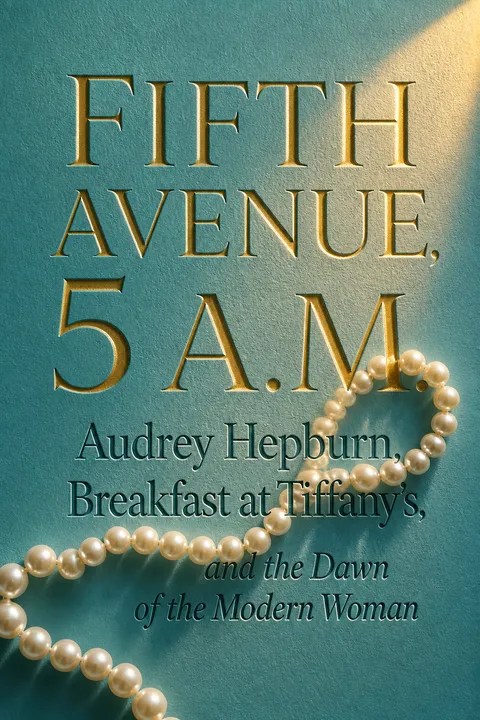
Key Takeaways
1. Breakfast at Tiffany's redefined the cinematic portrayal of single women and sexual freedom.
Being single actually seemed shame-free.
A cultural shift. Before the film's release in 1961, Hollywood strictly divided women into virtuous, marriage-bound "good girls" and punished, amoral "bad girls." Breakfast at Tiffany's shattered this rigid dichotomy by presenting a single, sexually active woman whose lifestyle was portrayed as glamorous and fun rather than shameful.
Redefining the rules. The film allowed mainstream audiences to envision a life of independence where women could live alone, enjoy nightlife, and make their own choices without societal condemnation. This cinematic revolution was achieved by:
- Decoupling female independence from moral ruin or tragic endings.
- Showing that a woman could be glamorous without relying on a husband's wealth.
- Normalizing the concept of a single woman navigating a major metropolis on her own terms.
A democratic fantasy. By presenting Holly Golightly as a self-made woman who overcame poverty through style, the film made glamour accessible to everyone. It offered a new, democratic ideal of femininity that contrasted sharply with the unattainable perfection of previous Hollywood stars.
2. Holly Golightly was a complex composite of Truman Capote's personal trauma and his high-society "swans."
For the better part of Capote’s career as a novelist, that bottle—what was left of his mother—would be the wellspring of most of his creations.
Personal wellspring. Truman Capote's creation of Holly Golightly was deeply rooted in his childhood abandonment by his mother, Nina, who constantly chased high society at the expense of her son. Holly's transient nature and deep-seated anxiety mirrored Capote's own emotional wounds and his lifelong search for a stable home.
The high-society muse. To flesh out Holly's character, Capote drew heavily from his inner circle of glamorous Manhattan socialites, whom he affectionately termed his "swans." These women provided the raw material for Holly's sophisticated persona:
- Babe Paley, the ultimate symbol of chic but deeply unhappy high-society perfection.
- Carol Marcus, whose late-night conversations and personal style directly inspired Holly's dialogue.
- Gloria Vanderbilt, whose Upper East Side brownstone served as the physical model for Holly's apartment.
A shield against pain. By transforming his personal trauma and the lives of his friends into literature, Capote sought to capture a fleeting type of modern woman. Holly became a symbol of the transient, beautiful girls who briefly conquered New York before disappearing into anonymity.
3. Audrey Hepburn's casting transformed a risky, amoral character into a universally beloved icon.
Audrey Hepburn, backed by everyone else on Breakfast at Tiffany’s, was about to shake up absolutely everything.
The perfect paradox. Casting the elegant, seemingly chaste Audrey Hepburn as a high-class call girl was a massive risk that ultimately saved the film. Hepburn's innate innocence and aristocratic poise neutralized the potentially offensive aspects of Holly's lifestyle, making her palatable to conservative audiences.
A new feminine ideal. Hepburn's unique physical features—her slim frame, short hair, and expressive eyes—challenged the busty, highly sexualized standards of 1950s beauty. She offered a fresh alternative to the dominant archetypes of the era:
- Doris Day's hyper-virtuous, marriage-obsessed virginity.
- Marilyn Monroe's overt, childlike sexual availability.
- The traditional expectation that glamorous women must possess an hourglass figure.
Subversive charm. By playing against type, Hepburn managed to make nonconformity look elegant and desirable. Her performance allowed audiences to embrace a morally ambiguous character because they simply could not help but love the actress playing her.
4. The collaboration with Hubert de Givenchy democratized high fashion and created the modern concept of chic.
Givenchy and Audrey gave us a very realistic, very accessible kind of class.
A historic partnership. The symbiotic relationship between Audrey Hepburn and French designer Hubert de Givenchy reached its zenith in Breakfast at Tiffany's. By bypassing traditional studio costuming, they introduced authentic Parisian haute couture to an American film set in New York.
The little black dress. The iconic black gown worn by Hepburn in the opening scene redefined modern fashion by proving that simplicity is the ultimate form of sophistication. This look revolutionized how women dressed by:
- Emphasizing clean lines and natural body shapes over restrictive corsetry.
- Making high-fashion elegance accessible and easy to emulate for everyday working women.
- Transforming black from a color of mourning or villainy into the ultimate symbol of modern chic.
Democratic glamour. Givenchy's designs celebrated Hepburn's physical "imperfections," such as her prominent collarbones and slim waist, rather than hiding them. This approach proved that true style comes from self-possession and individuality, rather than conforming to a generic cultural mold.
5. Screenwriter George Axelrod and director Blake Edwards successfully bypassed strict censorship through clever subversion.
The bulk of my sex-comedy career was done with this enormous handicap: not being allowed to have any sex.
Navigating the code. Screenwriter George Axelrod faced the monumental task of adapting an amoral novel under the watchful eye of the Production Code Administration. To appease the censors, Axelrod and director Blake Edwards had to rely on sophisticated innuendo and structural changes rather than overt sexuality.
Strategic compromises. The filmmakers transformed the story from a bleak character study of a call girl and a gay narrator into a heterosexual romantic comedy. They bypassed censorship through several clever narrative adjustments:
- Making the male lead, Paul, a kept man to mirror Holly's financial-sexual arrangements.
- Using the "powder room" euphemism to soften the reality of Holly's transactional relationships.
- Focusing the central conflict on the fear of emotional commitment rather than physical abstinence.
A mature comedy. Despite the forced sanitization, Edwards and Axelrod managed to deliver a film that felt remarkably adult and honest for its time. By keeping the characters' sexual activities off-screen but clearly implied, they pushed the boundaries of what mid-century cinema could depict.
6. Henry Mancini and Johnny Mercer's "Moon River" captured the melancholic, authentic core of the story.
Your music has lifted us all up and sent us soaring.
The sound of longing. Henry Mancini composed the melody of "Moon River" specifically to fit Audrey Hepburn's limited vocal range of an octave and one. The resulting song provided a crucial window into Holly's vulnerable, rural past, stripping away her sophisticated Manhattan facade.
Poetic nostalgia. Johnny Mercer's lyrics perfectly captured the transient, searching spirit of both Holly and the film's narrator. The song's success was rooted in its ability to evoke a deep sense of wanderlust and emotional complexity:
- The phrase "Huckleberry friend" paid homage to Mercer's Southern roots and childhood memories.
- The simple, white-key melody contrasted beautifully with the film's otherwise jazzy, cosmopolitan score.
- The performance on the fire escape humanized Holly, making her relatable to the audience.
Saving the masterpiece. Despite studio executives initially wanting to cut the song for being too slow, the filmmakers fought passionately to keep it in the final cut. "Moon River" went on to win the Academy Award and became an immortal cultural touchstone that defined the film's emotional legacy.
7. The film's production was a battleground of conflicting creative visions, egos, and personal relationships.
In those days, everyone fell in love with Audrey.
On-set friction. Behind the glamorous facade of Breakfast at Tiffany's lay a highly tense production marked by clashing personalities and creative disputes. Director Blake Edwards struggled constantly with male lead George Peppard, whose rigid, self-important acting style alienated the cast and crew.
Personal complications. Audrey Hepburn's performance was heavily influenced by her controlling husband, Mel Ferrer, who frequently attempted to counter-direct her from behind the scenes. Edwards had to navigate these delicate dynamics to protect Hepburn's performance:
- Peppard's demands led to significant cuts in Patricia Neal's role as the dominant older woman.
- Edwards issued an ultimatum to Hepburn to trust his direction over her husband's domestic critiques.
- The crew shot two different endings to satisfy both the screenwriter's realistic vision and the studio's demand for romance.
A unified triumph. Despite these intense conflicts, the creative team managed to channel their friction into a cohesive masterpiece. The resulting film seamlessly blended slapstick comedy, high-fashion elegance, and genuine romantic drama.
8. The marketing of Holly as a "kook" sanitized her amoral lifestyle for conservative mid-century audiences.
The star is Audrey Hepburn, not Tawdry Hepburn.
The sanitization campaign. To protect Audrey Hepburn's pristine public image, Paramount's publicity department launched a massive campaign to rebrand Holly Golightly. Instead of being portrayed as a high-class prostitute, Holly was marketed to the public as a harmless, eccentric "kook."
Redefining eccentricity. The term "kook" was popularized to distance Holly from the politically charged, anti-establishment "beatnik" movement of the late 1950s. This marketing strategy successfully reframed her amoral behavior through a series of quirky, non-threatening traits:
- Keeping a pet fish in a birdcage and naming her cat "Cat."
- Eating a pastry while staring into the window of an expensive jewelry store at dawn.
- Wearing oversized sunglasses and high-fashion gowns in casual, everyday settings.
A safe rebellion. This deliberate rebranding allowed conservative moviegoers, particularly mothers and daughters, to enjoy the film without feeling morally compromised. It transformed a potentially scandalous character into a beloved, whimsical trendsetter.
9. Breakfast at Tiffany's marked the transition from conservative fifties conformity to the liberated modern woman.
This was not an age of innocence anymore.
The dawn of liberation. The release of Breakfast at Tiffany's in 1961 served as a cultural bridge between the rigid domesticity of the 1950s and the feminist liberation of the 1960s. It gave visual and narrative form to a growing, yet still unspoken, desire among women for independence.
A new blueprint. For young women entering the workforce, Holly Golightly became an inspiring, albeit imperfect, role model for self-determination. The film offered a new blueprint for female adulthood that did not require immediate marriage:
- Validating the choice to live alone and manage one's own finances in a major city.
- Normalizing premarital relationships and female sexual agency without moral punishment.
- Using personal style and fashion as a tool for self-expression and social mobility.
An enduring legacy. By showing that a woman could be independent, stylish, and happy on her own terms, the film helped catalyze the modern feminist movement. It remains a landmark cultural achievement that forever changed the depiction of women in popular media.
Review Summary
Download PDF
Download EPUB
.epub digital book format is ideal for reading ebooks on phones, tablets, and e-readers.








































