

Key Takeaways
His request to be dominated is an invitation to be served, not a performance demand
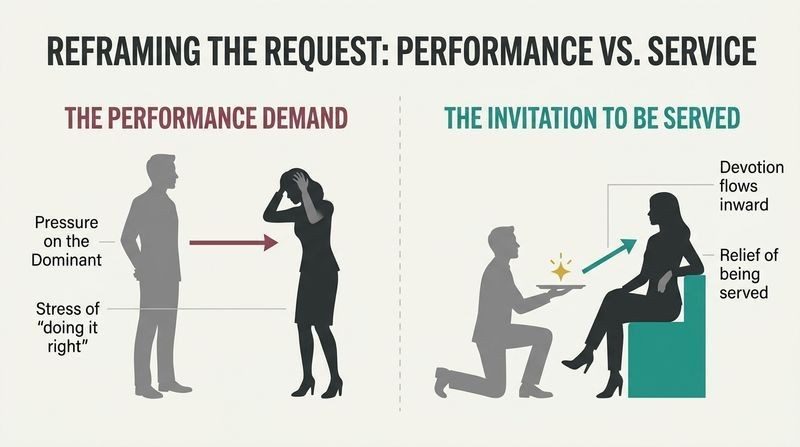
The reframe that dissolves the fear. Fairbourne opens with a woman panicked that her partner wants her to "take charge." The book's core move is flipping the interpretation: if you read his request as "I must do naughty things for him," you inherit stress and an impossible job. If you read it as "I get to make him do things for me, and he will adore me for permitting it," the burden lifts.
Dominant You is the attraction. A submissive man is drawn to servitude, meaning he wants to provide erotic and practical service to you, not receive a scripted show. If he only wanted commands to follow, he could print a list off the internet. What he craves cannot be counterfeited: your genuine commanding presence. Your needs, and your pace, always come first.
What's striking is how the book weaponizes reframing, the same cognitive technique cognitive-behavioral therapists use to defang anxiety. The felt problem ("I'm not kinky enough") is dissolved by reinterpreting the same facts. This mirrors research on appraisal theory: emotions follow interpretation, not events. The insight also inverts a common cultural script that equates dominance with theatrical costume and cruelty. Fairbourne's claim that authenticity beats performance echoes findings in intimacy research, where perceived partner responsiveness predicts satisfaction more than technique. One caution: the book assumes the woman secretly wants this once reframed, which may not hold for everyone, and consent to reframe is itself a choice.
Craving surrender is common in men, and often strongest in the most successful
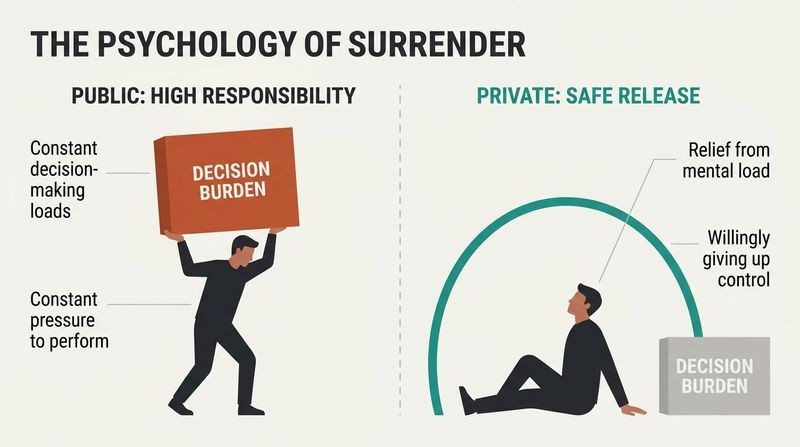
Submission is not weakness or brokenness. The book insists the male desire to be controlled by a strong, loving woman is a widespread trait, not a perversion. Frequently it is the confident, high-responsibility man who most hungers for the vulnerability of total surrender in private. For someone carrying constant decision-making burdens, being rendered helpless is precisely the relief he cannot get elsewhere.
These needs are deep and permanent. Fairbourne frames submissive desire as possibly rooted in childhood and impossible to shrug off. His real options were a secret fantasy life (or worse) or honesty with you. That he confessed at all signals deep trust, since he has been rehearsing the confession for weeks. Female dominance can satisfy these needs but cannot erase them, so ignoring them is not a neutral choice.
This maps onto a recurring theme in sexuality research: the "powerful man who wants to surrender" is well documented, sometimes called the executive-submissive pattern by clinicians. The psychological logic resembles what psychoanalyst Robert Stoller and later researchers noted about erotic reversal, where the burdened seek relief in inversion of their daytime role. The permanence claim deserves nuance: desires can shift across a lifespan and relationship contexts. Still, the destigmatizing frame is valuable and evidence-aligned. Treating a partner's disclosure as trust rather than threat reflects sound attachment principles, since how a confession is received shapes whether intimacy deepens or the person retreats back into secrecy and shame.
Grant pleasure as unpredictable boons, never as rewards he can bank
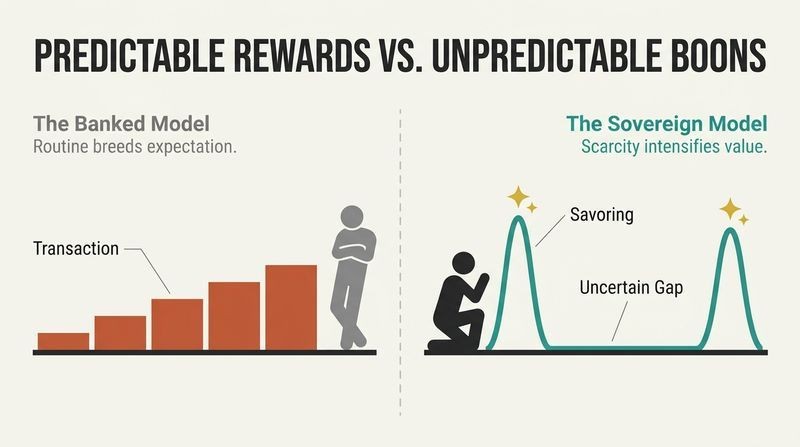
A boon is a favor from superior to inferior. Fairbourne defines it as a period you set aside to accept his submission and gift him your dominance, entering a shared mental "Mistress space." The power comes from scarcity and uncertainty: he can never be sure when the next one arrives, so each is savored intensely and remembered long after. If you indulge a boon so often he starts expecting it, reassert that you may suspend or withdraw it anytime.
The menu spans four flavors. Boons deepen his sense of enslavement through:
1. Physical punishment (erotic pain)
2. Erotic servitude and sacrifice (foregoing his comfort for yours)
3. Degradation of status (stripping his normal standing)
4. Verbal humiliation (the risky one)
Boons need not include his orgasm, and can be granted purely for your pleasure.
The boon mechanic is behavioral psychology dressed in medieval language. Its engine is the variable-ratio reinforcement schedule, the same intermittent, unpredictable reward that makes slot machines and social media notifications compulsive. Skinner showed unpredictable rewards produce far more persistent behavior than reliable ones. By refusing to let service become a transaction he can bank, Fairbourne prevents the dynamic from decaying into a chore-for-sex economy, which would collapse the power differential the whole thing depends on. The framework also cleverly borrows the courtly-love vocabulary of knights begging favors, giving a modern kink a romantic, narrative shell that may feel less clinical and more mythic to hesitant participants.
Frame errands as meeting your needs, and mundane chores become submission
The magic is in the wording. A Quest or Task is servitude of the mind: he runs an errand while privately worrying he might disappoint you. Fairbourne contrasts three versions of asking him to cook. "I'm short on time" gives him nothing to hang submission on. But "I've been craving your homemade burgers" or "so I can focus on our guests" names a real stake, so his success or failure means something to you.
Signal Mistress space, then close the loop. Use a consistent trigger phrase like "I have a chore for you," claim ownership ("my front door," not "our"), and reference consequences ("don't disappoint me"). Afterward deliver the Verbal Completion Bonus: confirm you noticed, that he served you, that you are satisfied. His entire emotional payoff hinges on that acknowledgment.
This is a quietly sophisticated insight about motivation. Self-determination theory distinguishes autonomous motivation from external pressure, and Fairbourne is engineering the former by making the man feel his effort matters to someone he values. The "stakes" framing resembles goal-setting research: specific, personally meaningful outcomes drive performance far better than vague requests. The Verbal Completion Bonus is essentially positive reinforcement timed to closure, which learning theory says is when feedback sticks best. There is also a shrewd domestic-labor subtext: reframing housework as erotic service could equalize a lopsided chore burden. Critics might note this instrumentalizes ordinary partnership, but the book insists both parties consent to and enjoy the game.
Dread does more work than the whip, so stretch the anticipation
The mind is the real instrument. Fairbourne argues extended anticipation can feel as powerful as punishment itself. Tell him hours or days ahead exactly what awaits, or hint and let imagination fill the void. Vary the approach to keep it fresh. Make him fetch the implement himself, touching only the striking end so the handle stays yours, perhaps carrying it in his mouth on all fours.
Pacing amplifies everything. Once positioned, pause. Let him tremble. Tease with strokes of your hand, muse aloud about changing your mind. When you begin, vary tempo: flurries of light blows, then rest, then a hard stroke. These unpredictable intervals let his own mind torment him, so you achieve deep submissive fulfillment with far less actual force. Target the padded "sweet spot" low on the buttocks, never the tailbone.
Neuroscience backs the anticipation claim emphatically. Dopamine, popularly miscast as the pleasure chemical, actually spikes during expectation of reward, often more than at delivery. Robert Sapolsky's work on anticipation and the classic studies on reward prediction show the wanting phase is neurologically potent. Fairbourne intuitively exploits this: uncertainty about timing and severity keeps the anticipatory circuit firing, which is why unpredictable pacing outperforms steady blows. The practical upshot, achieving intensity through psychology rather than brute force, is genuinely safety-enhancing, lowering physical risk for beginners. The anatomical guidance (padded zones only, avoid bone and kidneys) reflects standard responsible practice in the kink community's own safety literature.
Never bring real anger to the whip; punishment is a disguised gift
Erotic punishment is not conflict resolution. Fairbourne draws a hard line: do not use physical punishment to respond to genuine real-world failures or grievances. If he actually upset you, handle it through ordinary adult conversation. Expressing real anger through the whip risks importing psychological sickness into the bedroom. As she puts it, make-up sex works after a fight, but not the end of a whip.
Manufacture the pretext, keep it playful. Legitimate reasons for punishment all live inside Mistress space: a "failed" task you chose to find fault with, a broken standing order, backtalk, or simply your own desire to see him suffer for your arousal. You can invent an imaginary speck of missed dirt so he understands the offense is fiction. Punishment is essentially a reward wrapped in scolding, so the reason should be understood by both as theater.
This is the book's most important safety and ethics principle, and it aligns with a firm consensus in relationship psychology. John Gottman's research shows contempt and punitive score-settling are the strongest predictors of relationship breakdown. Channeling genuine resentment into physical acts would fuse pain with real hostility, potentially traumatizing rather than titillating. By quarantining erotic punishment inside a consensual fiction, Fairbourne preserves the crucial distinction between play and abuse. The recommended alternative for real anger, withdrawing erotic attention rather than inflicting it, is emotionally healthier than it sounds, though it flirts with using intimacy as leverage. The insistence on separating fantasy from grievance is what keeps the entire practice psychologically clean.
Degrade his status freely, but attack his self-worth with extreme caution
Two words that look identical but aren't. Fairbourne's sharpest distinction: degradation lowers his rank and dignity through physical acts, such as stripping his right to clothes, collaring him, shaving his pubic hair, or making him fetch his own whip. This is inevitable and fulfilling, since dominance requires him to hold lower status. Humiliation, by contrast, attacks his sense of self-worth through belittling words: telling him he is useless, unlovable, or has a tiny penis.
Humiliation is edge play. The reason some men crave it is exactly why it is dangerous: self-worth is the foundation of personal power, so demolishing it produces total powerlessness. But what arouses him mid-scene may mortify him the next day when the words replay in his head. Avoid strong humiliation unless certain he is not vulnerable, and never skip aftercare when you use it.
The degradation-humiliation split is the book's most intellectually valuable contribution, and it anticipates a distinction trauma researchers make between transient role-play and identity-level injury. The key variable is whether the diminishment lives in the fiction (his body, his temporary rank) or lodges in his self-concept ("in one's own eyes," per the dictionary definition she cites). This resembles the psychological difference between guilt (I did a bad thing) and shame (I am bad), where Brené Brown's research shows shame is corrosive and rarely productive. Fairbourne's warning that arousing humiliation can curdle into next-day mortification reflects genuine clinical risk, sometimes called "drop." Prudent, and more nuanced than most popular treatments of the topic.
Own his orgasms and his whole libido starts working for you
Chastity aligns two drives. Left alone, most men masturbate to discharge erotic tension, spending energy that could be directed at you and rehearsing impossible dominatrix fantasies. By controlling when and whether he ejaculates, you fuse his ordinary sex drive with his kink for submission, so both push him to please you. Fairbourne offers two routes:
1. Honor-based chastity (he simply refrains on command)
2. Device-based chastity (a lockable cage, you hold the key)
Active teasing is mandatory. Locking him up and forgetting him fails. He needs you to flaunt your control, tease him to the edge, and deny release. Advanced tools include the ruined orgasm (stopping all stimulation the instant he tips over, producing a muted, unsatisfying release) and orgasm on command (training him to climax on your verbal cue). Beware indulging fantasies of months-long denial, which carries prostate-health risks.
The underlying folk theory, that conserved sexual energy redirects into devotion, resembles the "transmutation" ideas floated everywhere from Napoleon Hill to nofap forums. The hard science on semen retention boosting energy is thin, but the behavioral mechanism Fairbourne describes is real and separate: whoever controls access to a potent reward gains enormous influence over the seeker, straightforward operant conditioning. What's clever is her insistence that denial without engagement backfires, since the reward's value comes from the controller's active, teasing presence, not mere deprivation. The health caveat about regular ejaculation and prostate function reflects actual epidemiological findings. The orgasm-on-command goal is more aspirational than reliable, and she honestly flags that not every man can learn it.
Repeat an erotic act until ritual turns the routine electric
Familiarity charges the act. A ritual is a sequence performed identically until it gains symbolic weight, like religious liturgy binding a congregation. Keep rituals simple so they flow without conscious thought, which frees both minds from deciding what comes next and lets anticipation build. Repeated inside an erotic context, the ritual itself becomes charged, until skipping it feels like a loss. Examples: he brings your morning drink a fixed way, kneels while you fasten his collar, or kisses the paddle before punishment.
Role-play scales the fantasy. Beyond basic Mistress and slave, you can stage fuller scenarios (the stern headmistress, the captured soldier, the interrogated heretic) complete with props and a planted "secret" you extract. Sketch the plot in advance so neither of you freezes improvising. If live theater feels daunting, online role-play removes the pressure of props and dialogue, and can bridge long-distance relationships.
Ritual's power here is well grounded in behavioral science. Rituals reduce cognitive load and anxiety, which is why athletes and performers use them before high-pressure moments; the fixed sequence quiets the deliberative mind. Anthropologist Victor Turner's work on liminality is relevant: repeated symbolic acts create a threshold space set apart from ordinary life, exactly the "Mistress space" the book invokes. Recent studies by Michael Norton and colleagues show even arbitrary rituals genuinely increase enjoyment and felt control. Fairbourne extends this into eroticism intuitively. The role-play advice, plan structure but improvise dialogue, mirrors how improv theater actually works: constraints paradoxically free spontaneity by removing the terror of the blank page.
Aftercare is not optional; intense play leaves both partners exposed
The crash is real for both. After even moderate dominance play, the submissive may be shaking, exhausted, spacey, or flooded with guilt and inadequacy, sometimes convinced you only endured the scene to please him. He might feel ashamed of what he needed. Practical remedies include water or a sports drink, a chocolate bar for energy, cuddling, and reassurance. Verbal humiliation especially can leave him depressed for days.
You need care too. Fairbourne stresses the Mistress often crashes as well: seeing welts on his skin, she may worry she went too far and need his reassurance that she stayed in pleasure, not damage. She may simply need to know she still holds his love despite the cruelty. Nobody can predict another person's needs, so both partners take whatever time is required to return to normal and reassure each other that neither was abandoned.
Aftercare is where this book quietly aligns with the most responsible strand of contemporary kink practice, and the recognition that the dominant also needs care is more sophisticated than many treatments. "Top drop," the emotional dip experienced by the person administering the scene, is increasingly documented and often overlooked because attention defaults to the submissive. The physiological picture is plausible: intense scenes trigger adrenaline and endorphin surges, and the subsequent hormonal crash resembles a comedown, which is why sugar, fluids, warmth, and reconnection help. What elevates Fairbourne's version is the framing of aftercare as mutual reassurance rather than one-way service, reinforcing that the whole enterprise rests on a caring relationship, not just technique.
Analysis
This is a niche instructional manual, framework-based and workbook-driven, aimed squarely at reluctant women whose male partners have disclosed submissive desires. Its structural signature is the "guided journal" after each chapter, positioning it as a reflective self-audit rather than a how-to checklist. The difficulty in summarizing it is twofold: much of the value lives in the reflection prompts (which resist compression), and the explicit erotic content must be rendered into transferable principles without losing accuracy. What emerges, once the leather-and-crop surface is stripped away, is a surprisingly coherent psychology of consensual power exchange. Fairbourne's real subject is not spanking but interpretation, motivation, and trust. Her central intellectual move, reframing a partner's request from burden to opportunity, is a textbook cognitive reappraisal, and much of the book is applied behaviorism: variable reinforcement (boons), meaningful goal-framing (quests), anticipation as reward (dopamine of the wait), and ritual as anxiety-reducing structure. The book's most durable contribution is conceptual clarity where popular culture is muddy: the degradation-versus-humiliation distinction (body and status versus self-worth), and the firm quarantine between erotic punishment and genuine anger. Both reflect mature harm-reduction thinking that predates and parallels the kink community's own "safe, sane, consensual" ethos. Its limitations are worth naming. The book universalizes a particular male psychology ("the successful man who craves surrender") and assumes the woman will discover latent desire once reframed, which may pressure ambivalent readers. Its physiological claims about chastity and redirected libido are folk theory more than evidence. And its gendering is rigidly heteronormative, female Mistress and male slave, though the mechanics generalize. Still, for its intended reader the guidance is unusually humane: her comfort first, his needs second, honest communication throughout, and mutual aftercare as non-negotiable. Beneath the taboo packaging sits a study of how power, when consciously and lovingly negotiated, can deepen rather than distort intimacy.
Review Summary
Reviews of Femdom for Nice Girls are mixed. Some readers find it educational and insightful, praising its focus on caring dominance and demystification of BDSM concepts. Others criticize it for being too basic, lacking information on aftercare, and focusing primarily on slave dynamics. Positive reviews highlight its usefulness for establishing femdom households and addressing both partners' needs. Negative reviews mention misleading expectations and shallow psychological depth. The book appears to be a beginner's guide to femdom, with varying opinions on its effectiveness and comprehensiveness.
People Also Read



Glossary
Boon
Discretionary gift of dominanceA period the Mistress sets aside to accept her partner's submission and grant her dominance, entering a shared "Mistress space." Boons are given unpredictably at her whim, never demanded as a right, and their scarcity makes them precious. They range from punishment and servitude to sexual worship, and need not include the slave's own orgasm or even be pleasurable for him.
Quickie Boon
Brief spontaneous dominant momentA short piece of dominant play, lasting seconds to minutes, that the Mistress springs on a whim to demonstrate control. Examples include a proprietary grope, three quick paddle strokes, or a forceful kiss. Like all boons it is at her discretion, and should stay unpredictable so the slave never treats it as something he can earn on demand.
Mistress space
Shared mental dominance zoneThe imaginary, ritualized headspace both partners enter during female-led erotic activity, separate from ordinary daily life. Signaled by specific language, ownership claims, and consequence references, it establishes that the Mistress fully controls the encounter, including its boundaries. Keeping it distinct protects the areas of life where the man must be strong and independent.
Quest or Task
Chore framed as submissionA command to perform an errand or duty, framed so the slave believes it meets a real need of the Mistress, engaging his service-oriented, sacrificial side. Unlike a boon it is mental rather than physically erotic. Success earns acknowledgment; the frisson comes from his fear of disappointing her.
Verbal Completion Bonus
Confirming acknowledgment after a taskThe Mistress's closing feedback after a completed Quest or Task, confirming within Mistress space that she noticed his service and is satisfied. This acknowledgment is the slave's main emotional payoff, and without it the task loses its submissive charge. It can be followed by a minor quickie boon before returning to normal life.
Degradation vs Humiliation
Status-lowering versus self-worth attackFairbourne's key distinction. Degradation lowers the slave's rank and dignity through physical acts (nakedness, collaring, menial service) and is an inevitable, fulfilling part of submission. Humiliation attacks his sense of self-worth through belittling words and is risky "edge play," since arousing insults may mortify him afterward and damage his psyche.
Honor-based chastity
Voluntary refraining from orgasmA form of orgasm control where the slave simply refrains from masturbation and ejaculation on the Mistress's command, relying on his own submissive self-discipline. Simpler than device-based chastity, it requires no equipment but depends on trust and his ability to obey.
Device-based chastity
Locked cage, Mistress holds keyOrgasm control enforced by a lockable device securing the penis, with the Mistress as keyholder. It converts submission from voluntary to compelled and intensifies the power exchange, but is more demanding, may chafe or prove less than escape-proof, and requires the Mistress's active teasing rather than mere confinement.
Ruined orgasm
Interrupted, unsatisfying forced climaxAn orgasm deliberately interrupted at the instant of climax by stopping all stimulation, producing a muted ejaculation stripped of full pleasure and release. Best administered after extended chastity when the slave is hypersensitive, it functions as punishment, control demonstration, or, for some, a paradoxical reward, and can help him recover and last longer.
Orgasm on command
Climaxing on verbal cueA trained response, achievable with practice, where the slave delays climax until the Mistress orders it and then delivers promptly, triggered by her command plus his known "hot buttons." Unlike a ruined orgasm it is fully satisfying. The goal is for the verbal command itself to eventually become the primary trigger.
Safe word
Signal to stop playAn easily remembered, irrelevant word (such as "giraffe") the slave can use to genuinely halt or pause a scene, allowing him to beg for mercy in-role without the Mistress fearing he truly needs to stop. Beginners should always use one; experienced pairs may forgo it to heighten intensity, relying instead on close observation.
FAQ
What’s "Femdom for Nice Girls" by Lucy Fairbourne about?
- Self-Guided Femdom Manual: The book is a practical, self-guided manual for women who want to explore or have been asked to take on a caring, dominant role in a female-led relationship, especially with a submissive male partner.
- Focus on Caring Dominance: It emphasizes a nurturing, loving approach to female dominance, debunking stereotypes of the harsh, leather-clad dominatrix.
- Workbook and Reflection: Each chapter includes guided journal sections to help readers reflect on their feelings, boundaries, and desires regarding dominance and submission.
- Comprehensive Coverage: Topics include boons (rewards), tasks, punishment, rituals, role-play, and orgasm control, all tailored for beginners and those hesitant about femdom.
Why should I read "Femdom for Nice Girls" by Lucy Fairbourne?
- Beginner-Friendly Guidance: The book is designed for women who are new, hesitant, or unsure about taking a dominant role, offering reassurance and step-by-step advice.
- Focus on Mutual Fulfillment: It stresses that female dominance should be pleasurable and empowering for the woman, not just a service to the man’s fantasies.
- Realistic and Practical: The advice is grounded in real-life dynamics, communication, and consent, making it accessible and safe for couples.
- Workbook Approach: The reflective exercises help readers clarify their own needs and boundaries, making the experience personal and growth-oriented.
What are the key takeaways from "Femdom for Nice Girls" by Lucy Fairbourne?
- Dominance Is a Gift: Female dominance is a boon or gift, not an obligation, and should be given on the woman’s terms.
- Communication Is Essential: Honest discussion of needs, boundaries, and comfort zones is crucial for a healthy femdom relationship.
- Submissive Men Want to Serve: True male submission is about serving and pleasing the woman, not just acting out scripted fantasies.
- Self-Reflection Matters: The book encourages women to explore their own desires and comfort levels, ensuring the dynamic is mutually satisfying.
What are the best quotes from "Femdom for Nice Girls" by Lucy Fairbourne and what do they mean?
- “Your needs, including your need to proceed at a pace that’s comfortable for you, always come first.” — Emphasizes that the woman’s comfort and desires are paramount in a femdom relationship.
- “A boon is a favor granted by a superior to an inferior.” — Highlights the concept of dominance as a discretionary gift, not an entitlement.
- “The important thing for both of you is that you get to decide on both the menu and timing, not him.” — Reinforces the woman’s control over the dynamic.
- “There are no right answers! … there are only your answers.” — Encourages personal reflection and authenticity rather than following rigid rules.
How does "Femdom for Nice Girls" by Lucy Fairbourne define and use the concept of "boons"?
- Boons as Erotic Favors: A boon is a special favor or reward granted by the Mistress to her submissive, such as a sexual act, punishment, or privilege.
- Mistress’s Discretion: Boons are always at the woman’s discretion and should never be expected or demanded by the submissive.
- Variety of Boons: Examples include spanking, humiliation, service, or even simple acts like being allowed to massage her feet.
- Maintaining Control: The unpredictability and rarity of boons enhance their value and reinforce the power dynamic.
What are "quests and tasks" in "Femdom for Nice Girls" by Lucy Fairbourne, and how should they be used?
- Service-Oriented Assignments: Quests and tasks are non-erotic or everyday chores assigned to the submissive, framed as acts of service to the Mistress.
- Emotional Fulfillment: The submissive gains satisfaction from meeting the Mistress’s real needs, not just performing arbitrary chores.
- Mistress Space Language: Using specific language or rituals to distinguish tasks as part of the dominant dynamic enhances their erotic charge.
- Feedback and Acknowledgment: Positive feedback or minor rewards after task completion reinforce the submissive’s motivation and the Mistress’s authority.
How does "Femdom for Nice Girls" by Lucy Fairbourne approach erotic punishment and aftercare?
- Punishment as a Boon: Erotic punishment (e.g., spanking, stress positions) is framed as a reward or ritual, not as a response to real-life failures.
- Safe Words and Limits: The book stresses the importance of safe words and respecting boundaries, especially for beginners.
- Anticipation and Ritual: Building anticipation and using ritualized punishment enhances the submissive’s experience and the Mistress’s control.
- Aftercare Is Essential: Emotional and physical aftercare is necessary for both partners to process intense scenes and maintain trust.
What is the role of rituals and role-play in "Femdom for Nice Girls" by Lucy Fairbourne?
- Rituals for Structure: Rituals (repeated, symbolic acts) help establish and reinforce the dominant-submissive dynamic, making it comforting and erotic.
- Degradation vs. Humiliation: The book distinguishes between physical degradation (status reduction) and psychological humiliation (attacks on self-worth), urging caution with the latter.
- Role-Play Scenarios: Role-play allows couples to explore different power dynamics and fantasies, from simple to elaborate scenarios.
- Personalization Encouraged: Rituals and role-play should be tailored to the couple’s preferences and comfort levels, with clear communication and consent.
How does "Femdom for Nice Girls" by Lucy Fairbourne address orgasm control and male chastity?
- Orgasm Control as Power: Taking control of the submissive’s orgasms is presented as a powerful form of dominance and ownership.
- Honor-Based vs. Device-Based: The book explains both honor-based chastity (self-control) and device-based chastity (physical restraint), with pros and cons for each.
- Teasing and Denial: Teasing, denial, and ruined orgasms are discussed as tools for increasing erotic tension and reinforcing the power dynamic.
- Consent and Health: The author cautions against extreme or unhealthy practices and emphasizes the importance of mutual agreement and well-being.
What advice does "Femdom for Nice Girls" by Lucy Fairbourne give for handling boundaries, comfort zones, and consent?
- Mistress’s Comfort First: The woman’s comfort, boundaries, and pace always take priority in any femdom activity.
- Reflective Exercises: The book provides guided questions to help women identify their own and their partner’s comfort zones.
- No Obligation to Conform: There’s no need to fit stereotypes or perform acts that feel wrong; authenticity and mutual satisfaction are key.
- Handling Pressure: If the submissive pressures the Mistress for more or different activities, she is encouraged to assert her boundaries and control.
How does "Femdom for Nice Girls" by Lucy Fairbourne suggest dealing with submissive men’s fantasies and expectations?
- Distinguishing True Submission: The book warns against men who only want to act out scripted fantasies rather than genuinely serve.
- Communication Is Key: Open discussion about desires, expectations, and limits is essential to avoid disappointment or resentment.
- Mistress’s Needs Matter: The Mistress should not feel obligated to fulfill every fantasy; her enjoyment and consent are paramount.
- Flexibility and Growth: Over time, both partners may discover new interests or boundaries, and the dynamic can evolve accordingly.
What are the "Ten Basic Rules" outlined in "Femdom for Nice Girls" by Lucy Fairbourne?
- Comfort Is Non-Negotiable: Nothing happens unless the Mistress is comfortable with it.
- Dominance Is a Gift: Male submission is a desire; female dominance is a boon.
- Boons Can Be Mutual: Acts of worship, servitude, and punishment can be pleasurable or useful for the Mistress.
- Recognition and Ritual: The submissive longs for acknowledgment, and rituals can deepen the dynamic.
- Anticipation and Orgasm Control: Building anticipation and controlling orgasms maximize erotic tension and submission.
What practical tools and resources does "Femdom for Nice Girls" by Lucy Fairbourne provide for readers?
- Guided Journal Sections: Each chapter ends with reflective questions to help readers clarify their feelings and boundaries.
- Printable Workbook: A free PDF workbook is available for download to facilitate journaling and self-exploration.
- Sample Scripts and Scenarios: The book offers sample language, rituals, and role-play ideas to help beginners get started.
- Safety and Communication Tips: Emphasis is placed on safe words, aftercare, and ongoing communication for a healthy, enjoyable femdom relationship.
Download PDF
Download EPUB
.epub digital book format is ideal for reading ebooks on phones, tablets, and e-readers.








































