
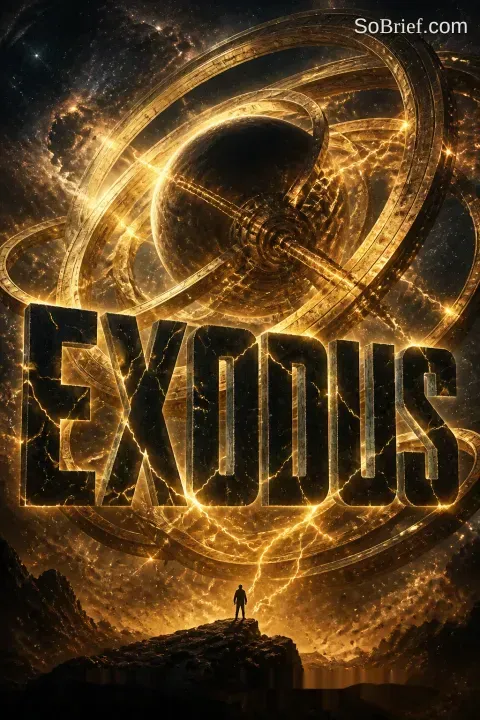


Plot Summary
The Sky Prisoner
Finn Jalgori-Tobu,1 a uranic noble turned freelancer on Anoosha, is captured after a botched corporate raid. His team is entombed in xeefoam, and his treacherous partner Liliana9 has him stripped, bound, and kicked off a plane into the Camurdy Mountains.
A rescue module deploys, but Finn1 helplessly plummets before his chute snags in a tree, leaving him inverted and freezing. A woman in a hooded coat, Ellie Aponi,2 finds him, cuts him free, and drags his wounded body to a campsite.
Her grandfather Josias,7 owner of the ancient arkship Diligent, greets him with amusement. Finn,1 near hypothermic, uses his uranic ability to force a livestone outcrop into a warm shelter, saving his life and forging an unexpected bond with these interstellar exiles.
This opening crystallizes Finn's core contradiction: a man born to privilege, now stripped to raw survival. The fall is both literal and symbolic, severing him from his former life while exposing the fragility beneath his uranic arrogance. Ellie's pragmatic rescue establishes her as a capable outsider, while the livestone sculpting demonstrates the genetic legacy that makes Finn useful to powers he doesn't yet understand. The scene primes the theme of dependence on ancient Celestial technologies and the precariousness of human agency in a world where even the ground you stand on can be commanded.
Hafnir's Bargain
Finn1 escorts Ellie2 and Josias7 to Gondiar, where he presents them to his mother, Marchioness Mary Kathleen Jalgori-Tobu. His proposal to sell Hafnir to the arkship settlers in exchange for the Diligent horrifies his family; humans cannot own land in the Crown Dominion except through uranic privilege, and Finn1 is squandering an estate that has been a burden for centuries.
Josias,7 the shrewd financier, negotiates aggressively, promising economic growth that will stabilize Gondiar. The marchioness, after calculated deliberation, agrees.
Finn1 obtains a starship, but the transaction alienates him further from his heritage and plants the seeds of political upheaval as the new Hafnir community demands self-rule and ownership, concepts foreign to the Celestial order.
The trade reconfigures power dynamics on Gondiar. Finn bartered his birthright for a dream of escape, yet the exchange also imports Josias's disruptive ideology of democratic ownership into a static feudal-human society. The marchioness's approval reveals her pragmatism; she sees the deal as a controlled release valve for human discontent. But it is also a familial fracture, accelerating Finn's estrangement while binding his fate to the Aponis. The Diligent, a relic of Old Earth, becomes both a literal vessel and a metaphor for humanity's longing for self-determination.
The Archon's Recruit
In Santa Rosa, probationary constable Terence Wilson-Fletcher3 arrests a gang member wielding a Remnant Era weapon. His station commander, Lenertz Mo, recruits him into a covert operation: running informants to feed intelligence to Archon Makaio-Faraji5 of Wynid.
Terence3 turns the prisoner Younes and begins building a web of informers across the criminal underworld and political movements. Over years, he monitors the Human Liberation movement and Q-I-X fanatics, detecting anomalies: offworld funding, advanced Celestial tech, and a mysterious figure named Dagon11 who meets Travelers.
Terence's3 quiet diligence exposes the invisible presence of rival archon networks manipulating Gondiar's society, placing him at the center of a multi-faction espionage struggle.
Terence's journey from beat cop to archon agent mirrors the book's exploration of controlled societies. His moral bargains: trading immunity for information, ignoring crimes to catch bigger fish, blur the line between protector and oppressor. The recruitment scene shows how Celestials co-opt humans into self-policing, creating a hierarchy of consent. Terence's commitment to stability, initially noble, becomes complicity as he witnesses injustice. His arc foreshadows the collapse of that very stability when the hidden Game erupts into open catastrophe.
A Planet Called Dolod
Archon Makaio-Yalbo5 meets Olomo of the Heresy Dominion in secret within the Pillar of Zeus nebula. Olomo reveals that a gas giant named Dolod, an iron exotic, was observed altering course millennia ago and is now headed into the Kelowan system.
Its close approach to the star in forty years will allow atmospheric harvesting of iron rain, disrupting the mining economy of Anoosha and threatening the balance of power among the Crown Dominion's Grand Families.
Makaio5 grasps the implications: rival queens, especially Carolien-Amaia of Verak, will exploit the new resource, perhaps with Talloch-Te backing, while the Heresy seeks to counter this by leaking the intelligence. The revelation sets in motion a centuries-long Game of economic warfare, with humans as the ultimate pawns.
Dolod functions as a Chekhov's gun on a planetary scale, a slow-moving crisis that exposes the brittleness of Celestial politics. The iron exotic's potential to reshape economies reveals how even immortal queens remain trapped in zero-sum contests over finite resources. Makaio's dilemma reflects the archon's role: to anticipate chaos and preempt it through information control. Yet his dependence on human agents like Terence underscores the empire's vulnerability, its lofty strategy ultimately reliant on flawed mortal instruments.
The Burning Wreck
Finn1 and Ellie2 travel to the Terrik Papuan system aboard the Lestari to retrieve a ZPZ generator from a Celestial wreck. On approach, the ship is attacked by the Arcadia's Moon, a stealthed mercenary vessel.
Finn,1 using his uranic connection to the ship's Celestial fusion engines, discovers latent high-efficiency routines. He reconfigures the containment fields and spins the ship, slashing twin relativistic plasma beams across space. The beams destroy the incoming missiles and critically damage the attacker, forcing it to flee.
The victory allows them to secure the generator from the wreckage, but the mission costs lives and leaves them with the knowledge that someone powerful wants the Diligent crippled, foreshadowing a deeper conspiracy.
This battle showcases Finn's emergent talent as a techno-intuitive, his uranic heritage granting him a form of warfare beyond human design. The victory is pyrrhic; it proves the Diligent's vulnerability and the lethal stakes of the Generator quest. The space combat also introduces the theme of adaptation: Renmant technology becomes a double-edged sword, accessible to any who can salvage it, eroding the Celestials' monopoly on power. Finn's role as a reluctant weapons operator marks his transition from spoiled heir to consequential actor.
Ghosts in the Moat
On the dead world of Kajval, Finn,1 Ellie,2 Gyvoy,11 and a mercenary squad assault a Celestial compound to steal a drop ship needed for the Dolod mission. The assault goes awry when the compound's moat, filled with air crystals, disgorges millions of sabrestone creatures that chew through armor and flesh. Ghosts and traps decimate the team.
Ellie's2 desperate tactical call leads them to topple colossal rock pillars with nuclear warheads, creating a causeway of rubble. They reach the drop ship through a gauntlet of carnage, and Finn1 interfaces with its network to fly them out under heavy fire. The harrowing escape leaves several dead but secures the craft.
Kajval epitomizes the lethal legacy of Remnant wars, where even abandoned defenses remain hyper-aggressive. The sabrestones, a bioweapon designed for a forgotten conflict, illustrate the indifference of Celestial engineering to human suffering. Ellie's initiative marks her coming of age as a combatant, earning respect, while Finn's reliance on his neural gifts becomes a crutch. The operation deepens his partnership with the fake Gyvoy, the architect who subtly ensures Finn survives to play his future role.
Kingsnest's Deep
The Diligent reaches Kingsnest, an ancient transparent sphere where clouds and life intertwine. Finn,1 Ellie,2 and Gyvoy11 hire an airboat and descend thousands of kilometers through shifting winds and predatory birds. Deep in the dark, they board an Archimedes Engine factory overgrown with airkombu.
Finn1 locates an interface bulb and merges his mind with the vast Celestial CI, downloading the operational knowledge to control planetary momentum. Nightweid swarms attack, and pirates ambush them outside, but Finn1 uses his neural command to turn the nightweid against the pirates, sacrificing the Ovar pilots. They escape with the priceless knowledge but are forever marked by the deep's horrors.
Kingsnest represents the sublime terror of a post-human universe, its beauty inseparable from its lethal alienness. Finn's mental immersion in the engine's logic is a form of transcendence, yet it also colonizes his consciousness, blurring his own will with the machine's cold calculus. The nightweid's reprogramming demonstrates the dark potential of neural induction, mirroring how Finn himself will later be 'programmed' by the fake Gyvoy. The ruin of the Ovar pilots, willing sacrifices, underscores the human cost of wielding godlike power.
Thyra's Coup of Blood
Congregant Thyra,4 raised in isolation and trained by her father Bekket8 in hidden neural techniques, ambushes Queen Helena-Chione during a spawning meditation. Using enhancement webs and powerful mental compulsions, she forcibly extracts the queen's entire mindline, killing the ancient personality and absorbing her memories.
Thyra4 emerges from the steam room as Helena-Thyra,4 passing the imperātrix antithesis authentication because she possesses all of Helena's codes. She appoints her father8 as Master of the Court and begins reshaping Wynid's power structure, placing her family's allies in key positions. Her coup goes undetected, as the court accepts the succession, setting the stage for her to execute a plan centuries in the making.
Thyra's usurpation is the inverse of Finn's rebellion. Both use inherited abilities to overthrow their designated roles, but Thyra does so with cold-blooded precision. Her act of neural murder echoes the original sin of the Crown Dominion: the execution of Queen Zuberi. The imperātrix antithesis, meant to prevent such coups, is shown to be fallible, a check reliant on trust rather than infallible technology. Thyra's success reveals the ultimate vulnerability of the immortal aristocracy: their power rests on a continuity of personality that can be stolen and perverted.
Collapse of the Marchioness
General Avone-Valerio, envoy of Empress Carolien-Amaia, lands on Gondiar with a full military task force. He imposes martial law, roundups thousands, and uses YouBusters on detainees, creating human vegetables. The marchioness's palace is seized, and she and her husband flee to Hafnir. Under the manipulation of Liliana9 and Toše,10 the assassin kills two Ghosts and triggers a Knight's missile response.
The missile demolishes the mansion, killing the marchioness and her husband as their daughters watch in horror. The surviving Jalgori-Tobu children are only saved by Terence Wilson-Fletcher,3 the archon agent who smuggles them off-world. The atrocity galvanizes anti-Celestial sentiment and primes Finn1 for the final betrayal.
The marchioness's death marks the terminal point of the old order on Gondiar. She represented the uranic collaboration that sustained eight centuries of fragile peace, but that model is obliterated by forces beyond her control. The timing of her murder, precisely when Josias's rhetoric has inflamed tensions, shows the conspirators' mastery of provocation. For Finn, the personal loss is weaponized, turning his legitimate desire for freedom into a cataclysmic revenge that serves the very powers he would oppose.
The Face Beneath
After the invasion, Terence3 searches the abandoned Dark Paradise nightclub, once a gang stronghold. Using Celestial sensor units and his newly acquired neural induction web, he locates a regrowth scar in the livestone floor. Forcing the stone to open, he discovers a decades-old skeleton with a powerblade wound to the heart.
DNA analysis confirms the body is Gyvoy Enfoe, the Traveler who supposedly sailed with Finn.1 The man on the Diligent is a surgically altered impostor, a Celestial agent named Dagon11 who has been steering Finn1 toward catastrophe. Terence3 transmits his findings to the surviving archon channels, but the revelation forces him to become a fugitive.
This exhumation literalizes the novel's central motif: the theft of identity. Gyvoy's corpse is a ghost haunting the entire narrative, the original sin of the conspiracy. Terence's forensic triumph is also his moral nadir; by exposing the truth, he endangers his family and confirms that his decades of service served a lie. The discovery recontextualizes every interaction Finn had with 'Gyvoy', revealing how his trust was systematically abused, his emotions engineered to produce the desired outcome.
A Rider in the Skull
On a balcony in the Governor's Mansion, Makaio-Faraji5 meets Terence.3 He has been stripped of most of his duties but wants to complete the investigation. As they discuss the conspiracy, a concluder round fired by the sniper Toše10 punches through the archon's shoulder and detonates his torso.
In his dying seconds, Makaio-Faraji5 clamps his giant hand around Terence's3 skull and forces a neural transfer, implanting a rider, a compressed version of his personality and knowledge, into the human's brain. The Celestial's head then self-destructs to prevent memory extraction. Terence3 escapes with a ghostly adviser, access to Makaio's5 hidden resources, and a burning quest for justice.
The assassination encapsulates the brutality of the Great Game, where even archons are disposable pieces. Makaio's final act is both a profound violation and a supreme gift, a forced intimacy that leaves Terence permanently altered. The rider becomes a narrative device for exploring Celestial consciousness within a human host, raising questions about the nature of self and memory. Terence's grief and guilt are compounded by the literal voice of the dead echoing in his thoughts.
The Grief Engine
Racked by the news of his parents' slaughter, Finn1 descends to Dolod with Gyvoy11 (the impostor) and the Silicate Daves. Inside an Archimedes station, he connects to the planet's massive CI. The system, warm and inviting, offers him the power to alter orbits. But Gyvoy11 has spent years subtly amplifying Finn's1 darker impulses through neural contact, and the fresh grief ignites a fury Finn1 cannot contain.
In a fugue of righteous anger, he issues a new directive: to transfer Dolod's momentum to Boksrock, altering that small world's trajectory so that it will eventually collide with Kelowan, the heart of the Crown Dominion, annihilating the Celestial capital and its billions.
Finn's choice is the tragic climax of his arc. He becomes an instrument of mass destruction while believing he is striking a blow for justice. The scene illustrates how emotional vulnerability can be exploited, turning empathy into a weapon. The cognitive dissonance he experiences, where his own thoughts feel alien, reflects the novel's concern with autonomy. He is simultaneously the most powerful human in the galaxy and the most helpless, a prisoner of his own manipulated psyche.
Kestrel Sprites Strike
As Boksrock's new trajectory is confirmed, panic erupts on Kelowan. Empress Carolien-Amaia boards her private high-speed evacuation craft to reach her dreadnaught. Unbeknownst to her security, thousands of kestrel sprites, molecular-scale devices originally seeded years ago, have gathered above the palace and attached to the craft.
During ascent, the sprites infiltrate the power and data systems, sabotaging the antimatter containment. The subsequent blast vaporizes the ship, killing the empress and her immediate entourage. With Carolien dead, the succession falls to the next queen: Helena-Thyra.4 The long-planned regicide is executed flawlessly, clearing the path for Thyra4 to claim the Imperial throne.
The assassination via kestrel sprites is a masterclass in patience and precision, demonstrating the technological asymmetry between the conspirators and their victims. The sprites are the ultimate expression of Celestial warfare: invisible, inevitable, and indifferent to the life they erase. Thyra's willingness to sacrifice an entire capital world and its sovereign to gain power illustrates the pathological narcissism at the core of immortal dominance. The scene also fulfills the Chekhov's gun of the palace's no-fly zone, making its very security the instrument of its destruction.
The Anchor Ship Flight
The fake Gyvoy,11 having secured the operating system knowledge and a cargo of antimatter, abandons Finn1 and the Daves on the Archimedes Engine station, flying off in the drop ship. Stranded, Finn1 realizes his compatriot was never human. Using his connection to the station's systems, he discovers the station's complement of anchor ships, vessels originally designed to deploy the quintessence net around a star.
Finn,1 the Daves, and the surviving equipment board one, and he pilots it out of Dolod's crushing atmosphere under punishing acceleration, enduring four gees for hours. The anchor ship limps toward the Diligent's rendezvous as navy frigates close in, with Finn's1 body battered but his resolve hardened by betrayal.
The escape on the anchor ship is a raw physical ordeal that mirrors Finn's psychological stripping away of illusions. He is forced to rely entirely on his own abilities after being used and discarded, a reversal of his earlier dependency on Gyvoy's guidance. The anchor ship, a piece of the very engine he corrupted, becomes a symbol of unintended consequences and possible redemption. His survival against the crushing gravity is a testament to the will to live, now reshaped from a desire for freedom to a need for accountability.
Memories of a Theft
Aboard the Diligent, Ellie2 is troubled by a Gath worker's comment that she cried out when encountering Gyvoy11 days before the drop mission. Unable to recall the event, she retrieves the rekaul flask from the clinic and inhales a small dose, targeting that evening. Under the Browntime immersion, she relives walking into the owner's quarters to find Gyvoy11 standing over a compliant Finn,1 his hand glowing with neural enhancement webs, issuing mental commands.
Gyvoy11 spots her and paralyzes her with a nervejam, then clamps his hands on her head, suppressing her memories of the incident. The revelation confirms that Finn1 has been subjected to prolonged neuropsychological manipulation, their entire mission twisted by a Celestial infiltrator.
Ellie's rekaul trip is a literal and metaphorical recovery of suppressed truth. The drug, which Finn abused to escape his past, becomes the tool for confronting the present's hidden horror. The scene inverts the power dynamic: the uranic Finn, so proud of his mental abilities, is the one being controlled. Ellie's memory retrieval also reasserts her agency, transforming her from a supportive partner to an active investigator, and it introduces the disturbing possibility that any human mind can be overwritten, a vulnerability that erodes the entire concept of consent.
Relativistic Gambit
Back on the Diligent, pursued by navy frigates and converging archon warships, Finn1 connects the ZPZ generator to the ongoing momentum transfer from the Archimedes Engine. In a split-second of brilliant improvisation, he reconfigures the ship's stasis field and siphons a fraction of Dolod's rotational energy.
The Diligent is locked in place and accelerated at ten thousand gees, vanishing from sensors. The devastating forces are absorbed by the ZPZ framing, enabling the old ark ship to streak across the system toward the Capo Frois ingress Gate. The maneuver succeeds, but it leaves the vessel and its crew as fugitives, blamed for the impending destruction of a world.
The relativistic escape is the ultimate expression of Finn's gift and curse. He bends physics to his will, yet remains trapped in a narrative crafted by others. The stunt saves the immediate lives of his family and the Gath, but it solidifies their outlaw status and grants the conspirators exactly the scapegoat they need. The scene is a breathtaking fusion of high-concept physics and desperate human emotion, showcasing how even in flight, Finn cannot outrun the consequences of his manipulated actions.
A City of Ashes
Across the system, observatories confirm the worst: Boksrock has been propelled from its orbit and is hurtling toward Kelowan on a three-week impact trajectory. The Imperial Palace, half-destroyed by the empress's failed launch, becomes a frantic command center. Nerves among the remaining queens fray as they realize the scale of the disaster.
The population begins a chaotic evacuation up the orbital towers, but for hundreds of millions, there is no escape. The Crown Dominion, founded on stability and eternity, faces a cataclysm that will shatter its capital world and plunge the entire realm into chaos. On the Diligent, the fleeing humans watch the unfolding catastrophe, knowing they will be blamed for genocide.
This turning point forces the abstract politics of the preceding narrative into brutal visceral reality. The destruction of Kelowan is not merely a strategic blow but a cultural apocalypse, erasing millennia of history and lives. The queens' paralysis reveals how their immortal perspective has atrophied their capacity for crisis response. For the humans, the irony is devastating: seeking liberation, they have become the unwitting agents of a horror that will be used to justify their subjugation or extermination for centuries to come.
Into Capo Frois
The Diligent reaches the Capo Frois ingress Gate intact and begins its frame jump, fleeing the Kelowan system. On board, Finn1 and Ellie2 process their staggering losses and the revelation of Dagon's11 long con. They are joined by Otylia,6 Zelinda, and their surviving families, all refugees from a home that no longer exists.
Terence,3 his wife Jimena, his daughter Vanilda, and the former agent Medusa14 follow in the Aeacus, aiming to rendezvous. The Diligent carries the anchor vessel with its antimatter cache, a bargaining chip or a weapon. Finn1 knows he must one day return to expose the truth, but for now, survival and the search for sanctuary suffice.
The flight to Capo Frois is an ending that is also a beginning, the classic space opera open conclusion. Finn's arc has circled from escape to entanglement, and now to a fugitive exile that may finally grant him the freedom he sought, but at a cost that makes it hollow. The novel closes on a note of desperate hope, the characters' resilience undimmed despite their victimization. The conspiracy remains hidden, the real villains ascendant, leaving the reader with the unsettling knowledge that justice is not guaranteed, and sometimes the only victory is to survive and remember.
Analysis
Exodus: The Archimedes Engine is a staggering synthesis of space opera and psychological thriller, mapping the collision between human ambition and post-human immortality. Its core insight is that stability, the Crown Dominion's sacred principle, is not a natural state but an imposed equilibrium that stifles the very qualities it claims to protect. The queens' mindline continuity, meant to preserve wisdom, instead fossilizes personality, making them predictable to those patient enough to play the long Game. Thyra's4 coup demonstrates that the system's true vulnerability is not external attack but internal corruption of its founding myths.
The novel's human characters struggle within a framework they cannot see, their quests for freedom and justice co-opted by immortal actors. Finn's1 tragedy is that his desire for escape, so understandable, is the very lever used to destroy his world. His neural talents, a gift of Celestial genetics, become the chains that bind him to a catastrophe. Terence's3 arc, mirroring the reader's gradual comprehension, shows that even the most diligent investigator can uncover a truth too late to prevent it.
Hamilton's treatment of memory and identity is particularly potent. The rekaul trips, the extracted mindlines, the riders, and the forced compulsions all converge on a single question: if your thoughts can be edited, your emotions amplified, your memories stolen, what remains of you? The answer, tentatively offered by Ellie's2 recovery and Terence's3 resolve, is that the will to seek truth, even if it yields only pain, is the irreducible core of personhood.
The novel is a sprawling indictment of empire, whether Celestial or human, and a sober meditation on the price of progress. It suggests that the Centauri Cluster is a graveyard of civilizations that mistook stasis for peace, and that change, however terrifying, is the only genuine constant. The refugees aboard the Diligent, carrying their guilty cargo of forbidden tech and gnawing conscience, embody the precarious hope that humanity might yet write its own future, not as pawns, but as authors of their own flawed, striving, and irreducibly free story.
Review Summary
Exodus: The Archimedes Engine is a massive space opera set 40,000 years in the future. Readers praise Hamilton's worldbuilding, intricate plot, and hard science fiction elements. The book features multiple storylines and characters, which some found challenging to follow. While the length and complexity divided opinions, many appreciated the epic scope and imaginative universe. Some criticized character development and pacing. Overall, reviewers found it an engaging, if demanding, read, with most eagerly anticipating the sequel and associated video game.
People Also Read
Characters
Finn (Finbar Charlot Louis Griffin Jalgori-Tobu)
Haunted uranic starship ownerA young aristocrat of the uranic human class, gifted with neural induction abilities inherited from Celestial ancestors. Finn despises his predetermined life of bureaucratic duty on Gondiar and rebels by becoming a mercenary and eventually a Traveler. His arc moves from narcissistic flight to a desperate quest for freedom and meaning, but his emotional vulnerabilities and the trauma of his family's destruction make him susceptible to manipulation. He acquires the Diligent and the power to control the Archimedes Engine, but his actions are always half his own, half the product of a Celestial conspiracy. Finn's tragedy lies in his earnest desire to protect humans being weaponized against them, making him both perpetrator and victim.
Eleanor (Ellie) Aponi
Arkship officer turned TravelerA descendant of the Diligent's original crew, born and raised in interstellar space. Ellie is pragmatic, skilled in zero-gee operations, and initially bewildered by the Centauri Cluster's complexity. She becomes Finn's1 lover and partner, gradually matching his ambition while grounding his wilder impulses. Her own genetic lineage includes organic computer enhancements (osees), giving her logical precision. After her mind is violated by the fake Gyvoy11, she uses the drug rekaul to recover the suppressed memory, an act of courage that reveals the conspiracy. Ellie's arc represents the theme of recovered agency, moving from passive observer to active resister.
Terence Wilson-Fletcher
Crown Dominion police agentA Santa Rosa detective recruited by Archon Makaio-Faraji5 to run a network of informants. Terence is methodical, morally reflective, and fiercely loyal to his family. Over four decades, he uncovers two rival archon networks operating on Gondiar, gradually realizing that the stability he enforces is a fragile lie. The neural rider implanted by the dying Makaio5 grants him access to Celestial resources and a ghostly advisor, but also isolates him from ordinary life. His pursuit of the conspirators transforms him from a dutiful state servant into a fugitive revolutionary, driven by the murder of his partner Lućia and the destruction of his home world.
Helena-Thyra (Thyra)
Usurping Queen of WynidA princess congregant of Queen Helena-Chione, discovered to possess extraordinary neural abilities, including the power to forcibly extract mindlines. Thyra is the culmination of a secret bloodline descended from Zuberi, the exterminated queen of Kelowan. She is intelligent, ruthless, and patient, executing a centuries-long plan to avenge her ancestor and seize the Imperial throne. Using stolen memories and perfected genetic compulsions, she infiltrates the crown, assassinates the empress, and orchestrates the planet-wide cataclysm to blame on 'human rebellion.' She represents the dark side of Celestial immortality: the perspective that views individual lives as expendable components in a grand historical narrative.
Makaio-Faraji (formerly Makaio-Yalbo)
Archon of Wynid, human-affairs specialistAn Imperial Celestial who has served the Crown Dominion for over three hundred years, monitoring human worlds through proxy agents. Makaio is contemplative, burdened by the weight of his long existence, and one of the few Celestials who genuinely appreciates human qualities. His dismissal by Helena-Thyra's4 new regime and his eventual assassination by Toše10 mark the collapse of the old order. In his final act, he transfers a neural rider into Terence Wilson-Fletcher3, an extreme act that preserves his investigative imperative. His symbiote-encrusted body reflects his struggle with tradition versus pragmatism.
Otylia Jalgori-Tobu
Finn's twin sister, reformerFinn's1 vivacious twin, equally rebellious but channelling her energy into social reform. She becomes a patron of the Gath Changelings, advocating for their rights and eventually marrying Josias Aponi7, the former owner of the Diligent. Otylia's idealism and organizational skills make her the architect of Hafnir's independent community, a project that inadvertently provides fertile ground for political agitation. Her marriage to Josias7 crumbles under his infidelities and ambition, but she remains a steadying force for her family after the invasion kills her parents. Otylia embodies the possibility of uranic evolution away from stagnant aristocracy.
Josias Aponi
Old Earth billionaire turned demagogueThe man who built the Diligent and slept through forty thousand years of voyaging. Josias is a brilliant opportunist with a genius for economics and rhetoric. On Gondiar, he founds the Regal Democrat party, campaigning for liberalization and property ownership, mobilizing the human discontents that the old system suppressed. His personal narcissism and moral flexibility make him easy for the conspirators to exploit, as he becomes a figurehead for the rebellion without fully understanding its manipulation. His speeches, broadcast by the fake Gyvoy's11 network, inflame tensions and provide the Celestials a pretext for brutal suppression.
Lord Bekket (Count Bekket)
Consort and conspirator, Thyra's fatherA minor noble from the backwater world Uixic who seduced Queen Helena-Chione and fathered Thyra4. Bekket is secretly an agent of the exiled Zuberi bloodline, carrying ancient neural techniques that he passes to his daughter. He grooms Thyra4 for power from infancy, teaching her to conceal her true mind from the queen's inspections and eventually to usurp the throne. Appointed Master of the Court after the coup, he represents the patient generational conspiracy that infiltrates the highest echelons of Imperial society, his humble exterior masking lethal ambition.
Liliana
Double agent and assassinA mercenary from Lidon who first betrays Finn1 on Anoosha, then resurfaces as a key operative of the conspirators. Liliana is a shapeshifter of loyalties, capable of seduction and murder in equal measure. She runs the fake Gyvoy's11 network on Gondiar for decades, coordinating the bombings and the manipulation of Josias7. Her skill with Remnant Era technology and her personal Cherenkov blade make her dangerous, but her allegiance is ultimately to the Zuberi restoration plan. Her ruthlessness highlights the expendability of human agents in Celestial Games.
Toše
Freelance sniper and saboteurA security specialist with Lidon bioware enhancements, including a detachable ocular wasp for targeting. Toše is the triggerman for many of the conspiracy's most violent acts, including the orbital tower capsule bombing that kills hundreds and the assassination of Archon Makaio-Faraji5 with his augmented concluder rifle. He is also present on the Diligent's early voyages, helping Finn1 survive while subtly advancing the impostor Gyvoy's11 agenda. Toše represents the cold instrumentalism of the conspirators, reducing complex human conflicts to the simple mechanics of targeted violence.
Dagon (the fake Gyvoy)
Celestial infiltrator posing as Gyvoy EnfoeA Celestial agent of the Zuberi faction who surgically replaces the real Gyvoy Enfoe and spends decades befriending Finn1, guiding him toward the Archimedes Engine knowledge while slowly poisoning his mind with compulsion-enhanced grief. Dagon is urbane and charismatic, a master of long-term manipulation whose patience is fueled by immortal perspective. He steals antimatter from the Dolod station and escapes to continue the next phase of the conspiracy. His true name and origin remain hidden, but his role as the architect of Finn's1 betrayal marks him as one of the novel's primary antagonists.
Captain Dejean
Elderly commander of the DiligentThe practical, weary captain of the ancient ark ship. Dejean has spent her entire life aboard the Diligent and is initially skeptical of the Celestial-dominated Cluster. She allows the ship to be retrofitted as a starship and provides steady leadership during the chaotic voyages, accepting the Gath as crew and becoming a maternal figure to the younger generation.
Pablo
Gath Changeling and refugeeA Gath who was brutalized in cage fights on Gondiar before being rescued by Otylia6 and brought to the Diligent as part of the maintenance crew. His innocent observation of Ellie's2 distress leads her to uncover the memory suppression, making him an unwitting catalyst for the truth. His gentle nature and gratitude embody the Gath's capacity for loyalty when treated with dignity.
Medusa
Talloch-Te agent turned informantA flamboyant mercenary with weaponized hair who serves as Archon Sahdiah's primary agent on Anoosha. Captured and neurally interrogated by Terence3, she switches allegiance in exchange for survival. Her knowledge of the rival networks is crucial to identifying Liliana9 and Toše10. She subsequently fakes her death and accompanies Terence's3 family on the Aeacus, her cynicism a counterpoint to the idealists around her.
Plot Devices
Neural Induction Pads
Mind-to-mind communication and machine controlBiological upgrades that allow Celestials and uranics to share memories, issue commands, and interface with technology through palm contact. Finn1 uses his to sculpt livestone, control ships, and access the Archimedes Engine. Thyra4 uses enhanced webs to dominate Awakened animals and extract mindlines. The pads are the fundamental interface of the setting, but they also create vulnerabilities, as minds can be read, rewritten, or stolen. The technology blurs the line between person and machine, making identity a contested territory.
ZPZ Generator (Stasis Field)
Enables near-lightspeed Gate travelA relic Elohim device that frames a starship in temporal stasis, allowing it to survive the immense acceleration of Gate transit. Salvaged from an ancient warship, the generator turns the Diligent into a true interstellar vessel. Finn1 later repurposes it to channel momentum from the Archimedes Engine, enabling a relativistic escape without a Gate. The generator symbolizes the borrowed power that defines humanity's existence in the Cluster: a tool they can use but never fully understand, making them dependent on a technology they cannot replicate.
Archimedes Engine
Planet-moving megastructure systemA network of stations and anchor ships that manipulate planetary momentum through quintessence lines, originally built by the Elohim to terraform star systems. Finn1 accesses its operating system in Kingsnest, learning to control the transfer of kinetic energy. The Engine's ability to change planetary orbits is weaponized when Finn1, manipulated by Dagon11, uses it to fling Boksrock toward Kelowan. It represents the ultimate powers of creation and destruction, wielded by beings whose morality has not evolved to match their capabilities.
Rekaul
Memory-reliving neurochemical drugExtracted from the brain glands of living Moaksha Changelings, rekaul allows users to relive past experiences in perfect sensory detail. Finn1 uses it to escape his present, revisiting lost loves. Ellie2 uses it to recover her suppressed memories of Dagon's11 neural violation. The drug's addictive and revelatory properties make it both a psychological trap and an investigative tool, highlighting the theme that memory is the only true possession, and its manipulation is the ultimate violation.
Imperātrix Antithesis Authentication
Succession verification codeA unique neural code shared between a queen and her security chief to confirm a genuine mindline transfer. Thyra4, having stolen Helena-Chione's memories, passes the authentication, fooling the court into accepting her usurpation. The code's inadequacy exposes the ceremonial nature of Imperial security, where trust and tradition are the real safeguards, and those can be subverted by any agent with sufficient patience and neural capability. It serves as the lock that cannot hold against the key of stolen identity.
FAQ
Synopsis & Basic Details
What is Exodus: The Archimedes Engine about?
- Humanity's Exodus to the Stars: Forty thousand years after fleeing a dying Earth, humanity's arkships arrive in the Centauri Cluster, encountering advanced Celestial civilizations.
- Clash of Civilizations: The story explores the tensions between the technologically advanced Celestials and the newly arrived humans, focusing on the struggle for resources and power.
- A Quest for Freedom: The narrative follows Finn Jalgori-Tobu, a rebellious human seeking to escape his predetermined life, as he becomes entangled in a complex web of political intrigue and interstellar conflict.
Why should I read Exodus: The Archimedes Engine?
- Intricate World-Building: Peter F. Hamilton crafts a detailed and immersive universe with complex political systems, advanced technology, and diverse cultures.
- Compelling Characters: The story features a cast of well-developed characters with their own motivations, flaws, and ambitions, making their journeys engaging and thought-provoking.
- High-Stakes Conflict: The narrative is filled with tension, betrayal, and high-stakes conflict, keeping readers on the edge of their seats as the characters navigate a dangerous and unpredictable universe.
What is the background of Exodus: The Archimedes Engine?
- Distant Future Setting: The story is set in the Centauri Cluster, thousands of years after humanity's exodus from Earth, where humans have evolved into the Celestial species.
- Celestial Dominions: The Celestials have established powerful interstellar empires, each with its own unique culture, technology, and political structure.
- Arrival of Arkships: The arrival of human arkships from the past disrupts the established order, creating tensions and conflicts as the newcomers struggle to find their place in a universe dominated by Celestials.
What are the most memorable quotes in Exodus: The Archimedes Engine?
- "We sail on the edge of lightspeed, where time moves differently.": This quote from the Traveler's Creed encapsulates the themes of time dilation and the sacrifices made by those who venture into the vastness of space.
- "For darkness to draw the eye, it must possess its own brand of majesty.": This line, spoken by Makaio-Yalbo, highlights the complex nature of power and the allure of the unknown, reflecting the story's exploration of morality and ambition.
- "It is not the quality of the glass that matters, only the wine that it holds.": This quote, used by Makaio-Yalbo, emphasizes the importance of the mindline and the continuity of consciousness over the physical body, a key theme in the novel.
What writing style, narrative choices, and literary techniques does Peter F. Hamilton use?
- Epic Scope and Detail: Hamilton employs a grand, sweeping narrative style, meticulously detailing the complex political, social, and technological aspects of his universe.
- Multiple Perspectives: The story is told from various characters' viewpoints, providing a comprehensive understanding of the events and their impact on different factions.
- Foreshadowing and Callbacks: Hamilton uses subtle foreshadowing and callbacks to create a sense of interconnectedness and to enhance the reader's understanding of the story's themes and plot.
Hidden Details & Subtle Connections
What are some minor details that add significant meaning?
- The Bloodstone Symbiote: The bloodstone growths on Imperial Celestials, initially presented as a fashion trend, become a symbol of their mindline immortality and the rigid societal structures they uphold.
- The Traveler's Creed: The Traveler's Creed, mentioned in the beginning, foreshadows the themes of exploration, sacrifice, and the breaking of empires, which are central to the story.
- The Use of "Uranic": The term "uranic" is used to describe humans with neural interfaces, highlighting their second-class status and their dependence on Celestial technology, while also hinting at their potential for unique abilities.
What are some subtle foreshadowing and callbacks?
- The Ozan Job: Finn's first job sabotaging Ozan's trucks foreshadows his later involvement in more complex and dangerous missions, highlighting his growing skills and ambition.
- The Alsatian Dogs: Finn's ability to control the Awakened Alsatian dogs foreshadows his uranic ability to connect with and manipulate other systems, including the livestone.
- The Mechas Trees: Helena-Chione's nostalgic mention of the mekas trees on the palace mountain foreshadows her desire to return to a more traditional and stable past, a theme that runs throughout the novel.
What are some unexpected character connections?
- Liliana and Lidon: Liliana's origin on Lidon, a world known for its earthdragon bioware, connects her to the Remnant Era technology that Finn is so fascinated by, highlighting the hidden connections between different human cultures.
- Makaio-Yalbo and Olomo: The secret meeting between the archons of Wynid and Heresy reveals a hidden alliance and a shared concern about the Crown Dominion's stability, highlighting the complex political landscape.
- Finn and Iyane Enfoe: The connection between Finn and Iyane Enfoe, both younger sons of prominent families, highlights the shared desire for freedom and recognition that drives many of the characters.
Who are the most significant supporting characters?
- Lord Gahiji-Calder: As the chief archon of Wynid, he represents the power and influence of the Celestial court, and his interactions with Helena-Chione reveal the complex political dynamics of the Crown Dominion.
- Major Siskala-Ingrid: As the commander of the Royal Tiger Guard, she embodies the loyalty and military strength of the Wynid Royal House, and her presence highlights the importance of family and tradition in Celestial society.
- Lady Teehong-Saz: As the keeper of the royal wardrobe, she represents the rigid structure and traditions of the Celestial court, and her interactions with Helena-Chione reveal the queen's complex personality and her adherence to protocol.
Psychological, Emotional, & Relational Analysis
What are some unspoken motivations of the characters?
- Helena-Chione's Fear of Instability: Despite her outward confidence, Helena-Chione's actions are driven by a deep-seated fear of instability, which motivates her to maintain control and suppress any potential threats to the Crown Dominion.
- Josias Aponi's Desire for Legacy: Josias's actions are driven by a desire to leave a lasting legacy for his people, which motivates him to seek a new home and establish a self-sustaining community.
- Finn's Yearning for Purpose: Finn's reckless actions are driven by a deep yearning for purpose and meaning, which he seeks to find through adventure and rebellion against his predetermined life.
What psychological complexities do the characters exhibit?
- Makaio-Yalbo's Internal Conflict: Makaio-Yalbo struggles with the conflict between his duty as an archon and his personal desires, as he grapples with the implications of his mindline immortality and the approaching death of his current host body.
- Thyra's Ruthless Ambition: Thyra's ambition is tempered by her desire to serve her queen, creating a complex psychological profile that is both calculating and devoted.
- Terence Wilson-Fletcher's Moral Dilemma: Terence struggles with the moral implications of his work as a police officer and an archon's agent, as he grapples with the ethical compromises he must make to achieve his goals.
What are the major emotional turning points?
- Finn's Betrayal: Finn's betrayal by Liliana is a major emotional turning point, forcing him to confront the consequences of his ambition and the harsh realities of the world he seeks to navigate.
- Josias's Realization of Human Limitations: Josias's realization that humans are second-class citizens in the Crown Dominion is a major emotional turning point, fueling his desire for a truly independent society.
- Helena-Chione's Encounter with Bekket: Helena-Chione's encounter with Bekket, a new life Celestial, sparks a sense of longing for something more than her rigid existence, highlighting the emotional complexities of her long life.
How do relationship dynamics evolve?
- Finn and Ellie's Growing Bond: Finn and Ellie's relationship evolves from a reluctant alliance to a deep bond based on shared experiences and mutual respect, highlighting the importance of human connection in a vast and often hostile universe.
- Makaio-Yalbo and Faraji's Complex Relationship: Makaio-Yalbo's relationship with his son, Faraji, is a complex mix of love, duty, and the weight of mindline immortality, highlighting the challenges of passing on a legacy.
- Helena-Chione and Her Daughters: Helena-Chione's relationships with her congregant daughters are a mix of affection, control, and the weight of responsibility, highlighting the complexities of power and family in Celestial society.
Interpretation & Debate
Which parts of the story remain ambiguous or open-ended?
- The Nature of the Elohim: The true nature and motivations of the Elohim, the ancient Celestials who created the Eden worlds, remain ambiguous, leaving readers to speculate about their role in the universe.
- The Mara Yama's True Intentions: The Mara Yama's true intentions and goals remain unclear, leaving readers to wonder about their role in the unfolding events and their potential impact on the Centauri Cluster.
- The Fate of the Diligent: The Diligent's ultimate fate and the future of its crew are left open-ended, leaving readers to speculate about their success in establishing a new home and their place in the universe.
What are some debatable, controversial scenes or moments in Exodus: The Archimedes Engine?
- The Treatment of Humans by Celestials: The Celestials' treatment of humans as second-class citizens raises questions about power, equality, and the ethics of a society that values stability over individual freedom.
- The Use of YouBusters: The use of YouBusters, which erase a person's memories and personality, raises ethical questions about the nature of identity and the right to control another's mind.
- The Violence of the Celestial trials: The violence and ruthlessness of the Celestial trials, particularly the First Trial, raise questions about the morality of a society that values strength and power above all else.
Exodus: The Archimedes Engine Ending Explained: How It Ends & What It Means
- The Diligent's Escape: The Diligent escapes the Crown Dominion, carrying Finn, Ellie, and the Gath, but their future is uncertain, leaving readers to wonder about their ultimate destination and their ability to create a truly free society.
- The Manipulation of Dolod: Finn's manipulation of the Archimedes Engine to alter Dolod's course highlights the potential for human agency and the ability to challenge Celestial power, but also raises questions about the consequences of such actions.
- The Uncertain Future of the Crown Dominion: The ending leaves the Crown Dominion in a state of flux, with the empress's authority challenged and the future of human-Celestial relations uncertain, setting the stage for further conflict and change in the Centauri Cluster.
Archimedes Engine Series Series
Download PDF
Download EPUB
.epub digital book format is ideal for reading ebooks on phones, tablets, and e-readers.








































