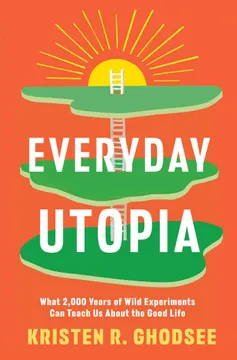
Key Takeaways
1. Utopian dreaming is a necessary catalyst for social progress
By studying the history of social dreams, we can reject the bad bits and keep the good: challenging ourselves to explore alternatives for how we live, love, own our things, choose our families, and raise children.
Social dreaming drives progress. Throughout history, moments of profound political, scientific, or ecological upheaval have served as fertile ground for utopian visions. When the status quo is disrupted, ordinary people are shaken from their inertia and forced to question realities they once believed were fixed and immutable.
Overcoming status quo bias. Behavioral economists note that humans naturally prefer things to stay the same to avoid regret, a tendency known as status quo bias. Utopian thinking acts as a vital intellectual tool to expand our imagination of what is politically and socially possible.
Historical precedents of change. Many social safety nets and rights we take for granted today were once dismissed as dangerous, unrealistic fantasies. For example:
- The concept of no-fault divorce
- Universally available public kindergartens
- The abolition of chattel slavery
- The implementation of a universal basic income
2. The single-family home isolates us and perpetuates gender inequality
Our architectural options today reflect a specific set of choices about the ideal habitat for human flourishing, choices often born of our past attachments to patrilineal and patrilocality traditions.
The isolation of suburbs. Modern postindustrial societies are currently suffering from a medically proven pandemic of loneliness, heavily exacerbated by our architectural choices. Cordoning off families into private, mortgaged single-family homes isolates individuals from their neighbors and traps them in cycles of debt.
Inefficient domestic duplication. The design of the individual household forces the duplication of domestic labor and appliances, placing a disproportionate burden on women. We waste immense energy and resources by maintaining private kitchens, washing machines, and lawns that sit unused for most of the week.
The cohousing alternative. Modern cohousing, pioneered by Danish feminists in the 1960s as bofællesskab, offers a sustainable balance between privacy and community. By sharing common spaces, tools, and chores, residents experience:
- Reduced domestic labor times for women
- Lower individual carbon footprints
- Enhanced social connection and safety for children
- Protection from real estate speculation
3. Children are public goods that should be raised collectively
Every member of society—and that means every working woman and every citizen, male and female—has the right to demand that the state and community concern itself with the welfare of all.
The cost of isolation. Raising children within the isolated nuclear family places an exhausting, often impossible financial and emotional burden on parents. Because children represent the future taxpayers, workers, and consumers who will sustain society, they are fundamentally public goods whose care should be funded collectively.
Benefits of multiple caregivers. Evolutionary anthropology and child psychology demonstrate that human children are naturally adapted to thrive under the care of multiple stable, loving adults. Rather than weakening the parent-child bond, alloparental care expands a child's social sphere and enhances cognitive and emotional resilience.
Successful historical models. Various societies have successfully experimented with collective child-rearing to liberate parents and enrich children's lives. Notable examples include:
- The "Children's Department" of the 19th-century Oneida Community
- The daytime metapelet system of the Israeli kibbutzim
- The state-funded, universal Krippen and kindergartens of East Germany
- The high-quality, publicly subsidized crèches of modern France
4. Education must foster cooperation, self-reliance, and shared values
Our education must therefore indicate a sense of commitment to the total community and help the pupils to accept the values appropriate to our kind of future, not those appropriate to our colonial past.
Schooling under capitalism. In capitalist societies, formal schooling often functions as a sorting mechanism that mirrors the hierarchies of the corporate world. Instead of nurturing creativity and critical thinking, schools frequently prioritize conformity, standardization, and individual competition to prepare students for the labor market.
Integrating labor and learning. Utopian educational reformers have long argued that true education must combine mental and manual labor to eliminate class divisions. By teaching children practical skills alongside academic subjects, schools can foster a deep respect for all forms of work and cultivate self-reliance.
Reimagining the curriculum. To build a more harmonious society, schools must intentionally teach values like cooperation, empathy, and ecological responsibility. This pedagogical shift is illustrated by:
- Anton Makarenko's self-governing student detachments in the Gorky Colony
- Julius Nyerere's "Education for Self-Reliance" program in Tanzania
- The integration of organic farming at the Olney Friends School
- The public teaching of ethics and moral philosophy in German schools
5. Sharing resources and decommodifying property liberates communities
A Utopian father... is not afraid of the misery of his children, nor is he contriving how to raise a portion for his daughters; but is secure in this, that both he and his wife, his children and grandchildren, to as many generations as he can fancy, will all live both plentifully and happily.
Property versus possession. To understand the utopian critique of ownership, we must distinguish between personal possessions and private, productive property. While personal possessions meet our immediate individual needs, private property is often used to extract rent and exploit the labor of those who own nothing.
The trap of debt. In societies where basic resources like housing are commodified, the poor are forced to transfer their wealth to the rich through rents and mortgage interest. This systemic inequality keeps families exhausted by the daily hustle, preventing them from cooperating or building strong community bonds.
The power of sharing. Decommodifying our resources and sharing our possessions can liberate us from the materialist treadmill and reduce environmental destruction. We can foster a true sharing economy through:
- Income-sharing intentional communities like Twin Oaks and the Bruderhof
- Tool, toy, and book libraries that put public space back into the commons
- The legal protection of shared assets under 501(d) tax codes
- Digital commons projects like Wikipedia, maintained by volunteer labor
6. The nuclear family is an ecologically and historically contingent construct
The cross-cultural empirical record supports that the family is a highly flexible social organization that is transiently, culturally and ecologically adaptable...
A recent invention. The isolated, two-parent nuclear family is often held up as a timeless, natural ideal, but it is actually a relatively recent historical development. For the vast majority of human history, our ancestors lived in flexible, extended, and cooperative breeding networks that shared the responsibilities of survival.
Imposing monogamy for property. Historically, the transition to strict monogamy and patrilocality was driven by the rise of private property and the desire of men to guarantee paternity for the transfer of wealth. State and religious authorities have long policed female sexuality and family structures to protect these inheritance lines.
The cost of the ideal. Forcing families into the rigid mold of the nuclear household has created a fragile system that is highly vulnerable to economic shocks and domestic abuse. This structural fragility is evidenced by:
- The dramatic rise of domestic violence during pandemic lockdowns
- The high rates of child poverty in single-parent households lacking societal support
- The overwhelming stress placed on couples as each other's sole emotional support
- The abandonment of older children under Nebraska's loophole-ridden Safe Haven law
7. Expanding our definitions of family creates robust networks of care
The ideal of the bourgeoisie was the married couple, where the partners complemented each other so completely that they had no need of contact with society.
Beyond the couple. To alleviate the immense pressures placed on the modern couple, we must decouple our romantic mating practices from our child-rearing arrangements. By expanding our intimate networks, we can cultivate "comradely love" and find emotional, intellectual, and physical companionship in a wider circle of friends.
Legitimizing chosen families. The LGBTQIA+ community has long pioneered the concept of "chosen families," demonstrating that non-biological bonds can be as strong and supportive as genetic ones. Recognizing these relationships legally allows individuals to share caregiving responsibilities and navigate life's precarities together.
Innovative parenting models. Around the world, people are actively experimenting with alternative family structures to distribute the joys and burdens of raising children. These emerging models include:
- Platonic co-parenting partnerships between friends
- Legally recognized triparenting and multi-parenting arrangements
- Polyamorous triads sharing custody and domestic responsibilities
- The integration of godparents, padrinos, and compadres into daily care
8. Radical hope and militant optimism are essential to defeat dystopian despair
To hope is to give yourself to the future, and that commitment to the future is what makes the present inhabitable.
The trap of dystopia. Modern popular culture is saturated with dystopian narratives that warn us against the dangers of trying to change the world. By portraying every attempt at social engineering as a slide into totalitarian hell, these stories breed cynicism, anxiety, and a passive acceptance of the status quo.
Hope as an active practice. Ernst Bloch's concept of "militant optimism" reminds us that history is not a static force that happens to us, but a collective project we actively construct. Hope is not passive wishful thinking; it is a cognitive capacity to visualize better pathways and find the willpower to pursue them.
Building everyday utopias. We do not have to wait for a grand, state-level revolution to begin living differently. By making small, deliberate changes in our private lives, we can reclaim our agency and build stronger, more resilient communities. We can practice radical hope by:
- Sharing our homes, tools, and wardrobes with friends and neighbors
- Cultivating deep, non-transactional platonic friendships
- Supporting local public education and collective childcare initiatives
- Resisting the capitalist pressure to measure our worth by material accumulation
Review Summary
About the Author
Other books by Kristen R. Ghodsee
Download PDF
Download EPUB
.epub digital book format is ideal for reading ebooks on phones, tablets, and e-readers.








































