

Key Takeaways
Diagnosis is medicine's hidden detective work, done while patients die waiting
The linchpin nobody sees. A healthy 22-year-old named Crystal Lessing lay dying in an ICU after routine wisdom-tooth extraction. A dozen doctors and scores of tests produced no answer. Dr. Walerstein succeeded where others failed by refusing to read her chart first (to avoid inheriting their errors), sitting at her bedside, taking the story fresh, feeling her swollen liver, and recognizing an unusual pattern: liver failure plus destruction of red blood cells. The culprit was Wilson's disease, a rare inherited disorder in which copper floods out of the liver and demolishes organs.
Uncertainty is the water doctors swim in. Diagnosis is inference under incomplete, sometimes contradictory information. Roughly 10-15% of primary-care patients get the wrong diagnosis, and diagnostic mistakes account for about 17% of adverse events.
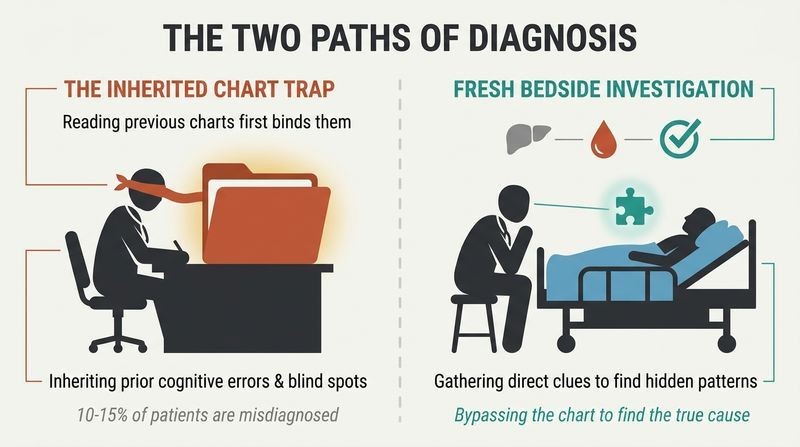
What's striking is how invisible this process is compared to treatment. Modern medicine has industrialized therapy through randomized trials and guidelines, yet the upstream decision (naming the disease) remains stubbornly artisanal. Cognitive scientists would recognize Walerstein's move as combating anchoring bias, the tendency to fixate on initial framing. His refusal to read prior notes mirrors how forecasters and intelligence analysts deliberately seek disconfirming evidence. The Wilson's case also illustrates base-rate tension: rare diseases are missed precisely because they are rare, and no clinician can hold two million medical facts in memory. Expertise here is less encyclopedic recall than knowing which thread to pull.
Stop interrupting: the patient's story alone yields most diagnoses
The oldest tool is the best. Between 70 and 90% of diagnoses can be made from the patient's story alone, a higher batting average than any scan or blood test. Yet in taped encounters, doctors interrupted patients in three quarters of visits, on average after just 16 seconds, some after only 3. Once cut off, fewer than 2% of patients ever resumed their narrative.
Interrogation loses the plot. Treating history-taking as extracting facts (name, place, time) misses the whys and hows. Surveys found doctors and patients disagreed about the reason for the visit 25-50% of the time. A resident missed a young woman's herpes diagnosis because she was too rushed to hear the embarrassing detail. Good histories reduce tests, referrals, and lawsuits without adding time.
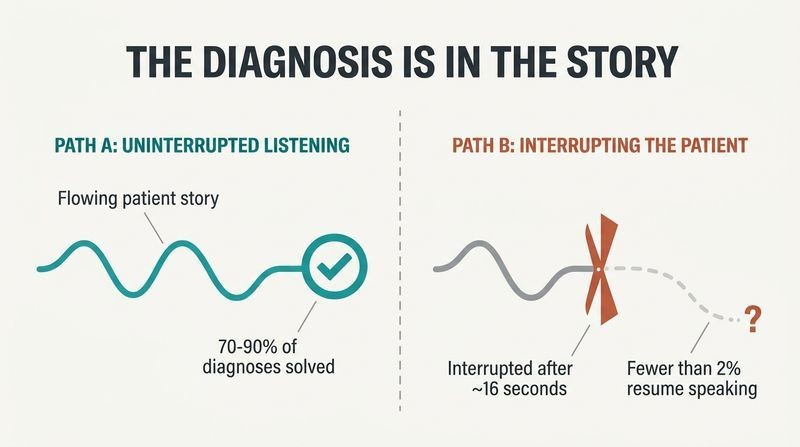
This finding has aged into a movement. The 16-second statistic became a rallying cry, and follow-up studies suggest the interruption clock has barely improved. The deeper point connects to narrative medicine, championed by Columbia's Rita Charon: illness is not a symptom list but a story embedded in a life, and meaning shapes what patients report. Behavioral economics adds nuance: patients also edit their own stories, minimizing feared symptoms or hiding stigmatized ones. So the fix is not merely silence but psychological safety. A doctor who signals judgment, as House's 'everybody lies' persona does, guarantees the incomplete account he then blames on the patient.
Translate the diagnosis back into the patient's life, or healing fails
Naming is only half the job. Once a doctor decodes symptoms into medical language, she must translate that story back so the patient can absorb it into the larger narrative of his life. Maria Rogers had cyclic vomiting relieved only by scalding showers, which Googled to cannabinoid hyperemesis, a rare reaction to chronic marijuana use. The diagnosis was correct, but the patient rejected it flatly, walked out, and stayed sick.
Pain versus suffering. Physician Eric Cassell distinguished pain (an affliction of the body) from suffering (an affliction of the self). Randy Whittier, a young man whose memory vanished, turned out to have a brain-attacking complication of Hodgkin's lymphoma. A medical student built a story he could understand, and though chemotherapy cured his body, the story healed his sense of self.
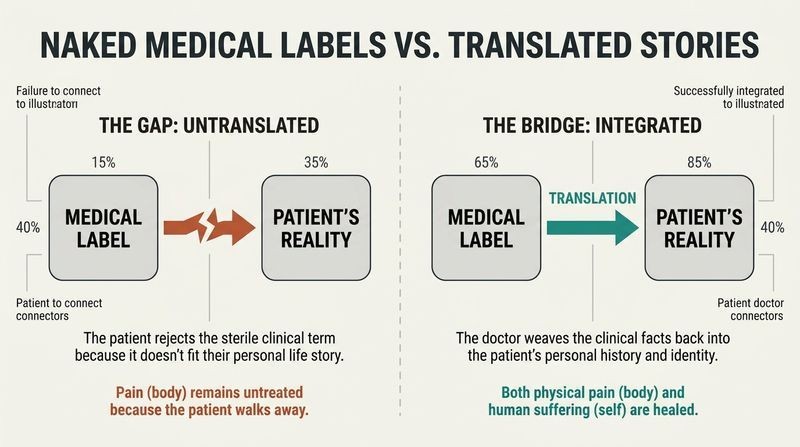
The pain-suffering split is one of the book's most portable ideas and resonates far beyond medicine. Viktor Frankl argued that suffering becomes bearable the moment it acquires meaning, and palliative care research confirms that patients fear loss of control and identity as much as physical agony. Maria's rejection is a case study in why compliance fails: a diagnosis that indicts a patient's lifestyle without offering a story she can accept lands as accusation, not explanation. Modern shared-decision-making frameworks formalize this, treating the patient as co-author. The limitation worth noting: some true diagnoses are simply unwelcome, and no amount of narrative craft guarantees acceptance.
Doctors diagnose by matching your case to stripped-down illness scripts
Idealized disease templates. An illness script is a doctor's mental prototype of a disease: the typical patient, the usual symptoms, the unusual tells, and the underlying biology. Physicians strip a messy human story down to its skeleton and match it against these scripts. The richer a doctor's script library, the sharper the diagnosis. Training exists largely to accumulate them, which is why seeing more patients makes better doctors.
Clinical pearls are compressed scripts. Memorable aphorisms package pattern recognition: the classic gallbladder patient (female, fat, forty, fertile, fair), or the warning that a hypothermic body isn't dead until it's warm and dead. A specialist diagnosed Lemierre's disease (a throat infection that clots the jugular) over the phone in seconds, from a one-line description, purely by recognizing the pattern another doctor had failed to.
Illness scripts are the medical instance of what psychologist Gary Klein calls recognition-primed decision-making, the way expert firefighters and chess masters read a situation at a glance rather than deliberating. The upside is speed; the downside is that scripts encode base rates and stereotypes, so an atypical presentation of a common disease slips through the net. There is also a dehumanizing cost the book names honestly: the retired Latin teacher becomes 'the dementia in room 703.' The best clinicians hold both registers, the compressed script for pattern-matching and the full human story for care, switching between them without confusing the map for the territory.
The physical exam is dying, and doctors' skills have quietly collapsed
A generation that cannot listen. When researcher Salvatore Mangione tested doctors on twelve common heart sounds, most medical students recognized only two. Residents, despite extra years, did no better, and even cardiology fellows missed six of twelve. Skills flatline after medical school: residents, faculty, and community doctors scored no higher than graduating students.
Structural forces killed it. Several trends eroded bedside teaching:
1. Hospital stays shrank from over a week in 1980 to about three days by 2004, so instructive patients vanish fast.
2. The 80-hour resident workweek cut time with patients (interns spend under ten minutes daily per patient).
3. Early treatment means fewer dramatic findings (rheumatic heart disease nearly disappeared).
4. A 'hidden curriculum' teaches trainees that only the echocardiogram report matters, so learning stops.
The collapse is a textbook case of a skill atrophying once a technological substitute exists, echoing how GPS eroded navigation and calculators eroded mental arithmetic. But the medical version carries higher stakes and a subtler trap: deskilling becomes self-reinforcing because doctors who cannot examine well stop believing the exam is worth doing, which guarantees they never improve. Economists call this a competency trap. There is genuine debate whether some of this loss is rational triage, since many old maneuvers were never validated. The honest position is that medicine let a two-century-old craft decay by neglect rather than by evidence, discarding the useful along with the useless.
Skilled hands and eyes catch killers that scans would miss or delay
Touch as lifesaver. Dr. Steven McGee, palpating a confused elderly man's belly, felt a pulsating mass and diagnosed a rupturing aortic aneurysm on the spot, sending him to surgery. Three quarters of such patients die en route. In Brendan Reilly's study, a careful exam changed the diagnosis and treatment in 26 of 100 hospitalized patients, and in nearly half of those the answer would not have surfaced through routine testing until the patient worsened.
No one looked. Charlie Jackson arrived with a dangerously slow heart and failing kidneys. Doctors chased heart attacks and drug errors for hours. The real cause: an obstructed bladder swollen to eight cups (normal holds about one), shutting down his kidneys. Five clinicians saw him; none examined his distended belly until it was nearly too late.
The Reilly and McGee findings reframe the exam not as nostalgia but as a triage filter that points expensive imaging in the right direction, saving both time and money. This dovetails with research on diagnostic efficiency: unfocused test-ordering generates incidental findings and false positives that spawn further tests, a cascade. The appendicitis data elsewhere in the book sharpens the paradox, showing CT scans sometimes delayed surgery and doubled perforation rates. The nuance worth flagging: the exam's value depends entirely on operator skill, which the previous insight shows is vanishing. A revived exam must be evidence-based and selective, keeping the maneuvers that outperform machines and discarding the theater.
You see only what you expect, so unexpected clues become invisible
The gorilla you missed. In a famous experiment, viewers counting basketball passes fail to notice a person in a gorilla suit strolling through the frame, beating its chest. More than half miss it entirely. Researchers call this inattention blindness: absorbed in one task, the brain filters out even dramatic, unexpected events. We see what we are looking for and little else.
Expectation and diagnosis. Michael Kowalski's fevers, joint pain, and salmon-colored rash pointed to adult Still's disease, but doctors overlooked the rash for days because it was outside their set of expectations. Yale's Dr. Braverman found that teaching first-year students to describe paintings (forcing pure observation without medical labels) improved their diagnostic observation scores by an average of 56%, far more than a standard lecture.
Inattention blindness, documented by Simons and Chabris, is one of psychology's most reproducible and unsettling findings, and its clinical translation is profound: the classic sign is worthless if the clinician's attention is pre-committed elsewhere. This connects to radiology studies where experts scanning for lung nodules failed to spot a gorilla image inserted into the scan. The counterintuitive fix is not trying harder but broadening attention deliberately and, as Sherlock Holmes's model Joseph Bell insisted, training oneself to notice, not merely see. Braverman's art intervention is a clever transfer-of-skill hack, though whether museum-honed observation durably survives the pressures of a 12-hour shift remains an open empirical question.
Tests measure proxies, not truth, and craving certainty breeds phantom diseases
Antibodies are not bacteria. Lyme disease cannot be cultured, so its two tests (ELISA and Western blot) detect the body's antibodies, not the bug itself. Those antibodies linger for years after a cure, so the test stays positive long after the infection is gone. It measures exposure, not present illness.
The phantom. 'Chronic Lyme disease' is a diagnosis given to tens of thousands, treated with months or years of antibiotics. Three rigorous placebo-controlled trials found antibiotics no better than saltwater. In one study of 200 patients diagnosed with Lyme, 60% had no evidence of ever having it; many had rheumatoid arthritis, lupus, or Lou Gehrig's disease instead. Carol Ann DeVries suffered two years on antibiotics before a doctor recognized her real illness, polymyalgia rheumatica, which vanished on prednisone.
The chronic Lyme saga is a masterclass in how uncertainty intolerance corrupts reasoning on both sides. Dismissive doctors abandon patients with 'medically unexplained symptoms,' leaving a vacuum that 'Lyme literate' practitioners fill with a confident, unfalsifiable narrative and endless treatment. Philosophers of science would note the movement's telltale unfalsifiability: negative tests are dismissed as unreliable, so no evidence can disconfirm the belief. This is the same epistemic structure seen in other contested illnesses. The humane lesson cuts deeper than debunking: patients need their suffering validated as real even when its cause is unknown, because the alternative is what pushes them toward pseudo-diagnoses that at least offer a name.
Premature closure is the deadliest error: always ask what else this could be
Thinking stops too soon. Premature closure is latching onto a diagnosis and shutting down consideration of alternatives before the evidence justifies it. David Powell, a 27-year-old weightlifter, visited emergency rooms four times with chest pain. Each time, the phrase 'chest pain' triggered what the book calls the 'MI express,' a reflexive cardiac workup. His numbness, weakness, and anemia were noted but ignored. The real diagnosis was pernicious anemia, a treatable vitamin B12 deficiency, reversed with injections.
Where thinking breaks. In Mark Graber's study of 100 diagnostic errors, cognitive mistakes contributed to most, and faulty synthesis (putting the pieces together wrong) outweighed faulty knowledge. Doctors are also biased by patient race, gender, and class: identical scripted cardiac cases got women fewer questions, tests, and correct diagnoses than men.
Premature closure is the medical face of confirmation bias, and its antidote (the disciplined question 'what else could this be?') functions like a cognitive checklist. Pat Croskerry's dual-process framing is useful here: fast intuitive pattern-matching is indispensable but error-prone, while slow analytic reasoning catches what intuition skips. The art is matching mode to task. The bias findings deserve emphasis because they complicate the ideal of colorblind medicine: some demographic weighting is medically legitimate (prostate cancer risk by race), while other weighting is pure prejudice that kills. Distinguishing the two requires exactly the metacognition (thinking about one's thinking) that fatigue and time pressure systematically destroy.
Computers and Google assist diagnosis but cannot replace bedside judgment
The dream deferred. In the 1970s, MIT's Peter Szolovits envisioned computers that would out-diagnose doctors. Decades later he concluded it wasn't feasible as imagined: machines crunch data but can't gather it from a living patient, can't integrate incompatible records, and doctors won't type it all in. Diagnostic software like DXplain got the right answer only 50-70% of the time.
Helpful backups, not oracles. The system Isabel, built after toddler Isabel Maude nearly died when doctors missed a flesh-eating complication of chickenpox, listed the correct diagnosis in 96% of test cases when a doctor entered key findings. Even Google found the right answer 58% of the time, best for rare diseases with distinctive symptoms. But such tools are consulted only when a doctor already feels uncertain, so premature closure hides their value.
The core obstacle is beautifully counterintuitive: computers excel exactly where humans do (pattern-matching on clean data) and fail where humans shine (extracting messy signal from a frightened, inarticulate body through five senses). This is Moravec's paradox applied to medicine, the observation that perception and embodied judgment are far harder to automate than symbolic computation. The book's sharpest point is a workflow problem, not a technology problem: a decision aid used only in moments of felt doubt never rescues the overconfident doctor who most needs rescuing. Genuinely useful systems would run silently in the background and flag anomalies unprompted, a design principle that predates and predicts today's ambient clinical AI.
Analysis
Lisa Sanders, the New York Times 'Diagnosis' columnist and House M.D. consultant, structures this book as a guided tour through the tools of diagnosis (history, physical exam, testing, cognition, and computers), diagnosing each tool's decay in turn. Its central and durable argument is that the most consequential act in medicine, naming the disease, remains a human, narrative, error-prone craft even as therapy has been industrialized by evidence and guidelines. The book's power lies in method: each abstract claim is anchored in a suspenseful case, and each case is dissected to reveal a transferable principle. This is diagnosis as detective fiction, and Sanders knows the debt, invoking Sherlock Holmes and his real-life model Joseph Bell repeatedly.
Written in 2009, the book now reads as prophetic and dated in illuminating ways. Its alarm over the dying physical exam and the deskilling of clinicians anticipated a decade of 'bedside medicine' revival movements and point-of-care ultrasound. Its critique of premature closure and cognitive bias foreshadowed the diagnostic-error field that the 2015 National Academies report 'Improving Diagnosis in Health Care' would legitimize. Its skepticism that computers could out-diagnose doctors looks partly vindicated (workflow and data-entry remain barriers) and partly overtaken by ambient AI scribes and large language models that address exactly the friction Szolovits identified.
The deepest thread is epistemic humility about uncertainty. Sanders shows uncertainty producing three failure modes: dismissal (abandoning patients with unexplained symptoms), false certainty (premature closure and phantom diagnoses like chronic Lyme), and the healthy middle (holding a differential open while acting). Her chronic Lyme chapter is a small classic on unfalsifiable belief. The book's most humane insight, drawn from Cassell, separates pain from suffering and argues that a coherent story heals even when it cannot cure, a claim the closing memoir of her sister's death makes personal and unforgettable.
Review Summary
Every Patient Tells a Story received mixed reviews, with an average rating of 3.96/5. Many readers appreciated the insights into medical diagnosis and patient stories, praising Sanders' writing style and medical expertise. Some found it fascinating and thought-provoking, especially for those interested in medicine. However, others felt disappointed by the lack of intriguing case studies and found parts of the book repetitive or dull. The book's focus on the importance of physical examinations and listening to patients resonated with many readers, while some expected more medical mysteries akin to the TV show House.
People Also Read


Glossary
Illness script
Mental template of a diseaseA doctor's idealized, loosely organized mental model of a specific disease, containing the typical patient, common and unusual symptoms, exam findings, and underlying biology. Physicians strip a patient's messy story down to its essentials and match it against these stored templates to make a diagnosis. Richer, more detailed scripts, built through seeing many patients, produce sharper and faster diagnoses.
Premature closure
Locking onto a diagnosis too earlyA cognitive error in which a physician settles on a diagnosis and stops considering alternatives before gathering enough evidence to justify it. Described as thinking stopping once a diagnosis is made. It is the most common diagnostic thinking error, illustrated by the reflexive cardiac workup ('MI express') triggered whenever a patient reports chest pain, which buries other clues.
Inattention blindness
Missing the unexpected while focusedA perceptual phenomenon, demonstrated by the invisible-gorilla experiment, in which people absorbed in one attention-demanding task fail to notice an unexpected object or event in plain sight. In diagnosis it explains why classic signs get overlooked: clinicians see what they expect and are looking for, so findings outside their expectations become effectively invisible.
Diagnostic momentum
A label that sticks unchallengedA form of medical groupthink in which a diagnostic label, once attached to a patient, becomes progressively stickier as each subsequent doctor accepts it rather than reevaluating the raw evidence. Doctors are taught to 'trust but verify' prior diagnoses, but fatigue and time pressure make starting fresh difficult, allowing mistaken labels to travel unchallenged through a patient's care.
Clinical pearl
Memorable diagnostic rule of thumbA short, often cleverly worded aphorism packaging a nugget of diagnostic wisdom about a typical patient or disease pattern, dating back to Hippocrates. Examples include the classic gallbladder patient profile and the reminder that a hypothermic person 'isn't dead until warm and dead.' Pearls compress illness scripts into memorable, teachable form.
Chronic Lyme disease
Contested, likely phantom, illness diagnosisA diagnosis given by self-described 'Lyme literate' doctors to patients with persistent nonspecific symptoms, attributed to a lingering Lyme infection and treated with prolonged antibiotics. Sanders presents it as almost certainly a phantom illness: three placebo-controlled trials found long-term antibiotics no better than placebo, and the diagnosis often masks other real, treatable diseases.
Pain versus suffering
Body affliction versus self afflictionA distinction drawn by physician Eric Cassell: pain is an affliction of the body, while suffering is a distress that arises when the integrity of the person is threatened. Childbirth can bring pain without suffering; a terminal diagnosis can bring suffering without pain. Sanders argues that giving a patient a coherent story of their illness can relieve suffering even when no cure exists.
Alvarado score
Appendicitis likelihood scoring systemA scoring method developed by Alfredo Alvarado that combines three symptoms, three physical exam findings, and one blood test into a maximum score of 10 to gauge appendicitis risk. Scores of 7 or more warrant surgery; 4 or under suggest another cause. Used well, it cut unnecessary appendectomies to under 5%, showing the exam's continued diagnostic power.
FAQ
What’s Every Patient Tells a Story by Lisa Sanders about?
- Explores the art of diagnosis: The book delves into the complex, detective-like process doctors use to diagnose medical mysteries, highlighting both the science and the art involved.
- Real patient cases: Sanders uses compelling real-life stories to illustrate how doctors gather clues from patient histories, physical exams, and tests.
- Focus on challenges and errors: The narrative emphasizes the difficulties, uncertainties, and frequent errors in diagnosis, as well as the human and systemic factors that contribute to them.
Why should I read Every Patient Tells a Story by Lisa Sanders?
- Insight into medical thinking: The book offers a rare look into how doctors approach difficult cases, making it valuable for both medical professionals and lay readers.
- Empowers patients: By demystifying the diagnostic process, it encourages patients to communicate more effectively with their doctors and understand their own role in care.
- Engaging storytelling: Sanders’ use of real cases makes complex medical concepts accessible and highlights the human side of medicine.
What are the key takeaways from Every Patient Tells a Story by Lisa Sanders?
- Diagnosis is both art and science: Effective diagnosis requires integrating patient stories, physical exams, and technology, while acknowledging human limitations.
- Physical exam remains vital: Despite technological advances, the physical exam provides unique, sometimes lifesaving information.
- Errors are common but reducible: Diagnostic mistakes are frequent, but awareness, education, and collaboration can improve outcomes.
- Communication is crucial: Both listening to patients and explaining diagnoses clearly are essential for effective care.
How do doctors make difficult diagnoses according to Lisa Sanders in Every Patient Tells a Story?
- Patient story as foundation: Doctors rely heavily on the patient’s narrative, which often provides the majority of diagnostic clues.
- Physical exam and targeted tests: A thorough exam and selective testing help confirm or refute diagnostic hypotheses.
- Pattern recognition and illness scripts: Experienced clinicians use mental models and pattern recognition to match symptoms to known diseases.
- Analytical and intuitive thinking: Effective diagnosis balances both logical reasoning and intuitive pattern recognition.
What role does the patient’s story play in diagnosis in Every Patient Tells a Story by Lisa Sanders?
- Primary diagnostic tool: The patient’s narrative is often the most reliable source of diagnostic information.
- Collaborative process: Effective history-taking involves active listening and co-creating a meaningful narrative with the patient.
- Communication challenges: Time pressures and interruptions can prevent patients from fully sharing their stories, leading to missed or incorrect diagnoses.
How does Lisa Sanders describe the importance and decline of the physical exam in Every Patient Tells a Story?
- Essential but fading skill: The physical exam remains crucial for diagnosis, but proficiency is declining among doctors due to reliance on technology and reduced bedside teaching.
- Consequences of decline: Missed diagnoses, unnecessary tests, and weakened doctor-patient relationships can result from poor exam skills.
- Revival efforts: The book highlights initiatives to improve physical exam training, such as hands-on courses and simulation tools.
What are common reasons for diagnostic errors discussed in Every Patient Tells a Story by Lisa Sanders?
- Knowledge gaps: No doctor can know everything, and rare diseases or atypical presentations are often missed.
- Cognitive errors: Mistakes like premature closure, bias, and failure to consider alternatives frequently lead to misdiagnosis.
- Systemic and data issues: Overlooked clues, lost records, and misinterpretation of abundant clinical data contribute to errors.
How does Every Patient Tells a Story by Lisa Sanders address cognitive biases and “sick thinking” in diagnosis?
- Premature closure: Doctors may stop searching for alternative diagnoses once a plausible one is found, leading to missed conditions.
- Bias and profiling: While some biases can aid diagnosis, stereotypes and assumptions often result in errors.
- Diagnostic momentum: Once a diagnosis is labeled, it tends to persist, making it hard for others to reconsider or challenge it.
- System and cognitive interplay: Many errors arise from a combination of flawed thinking and systemic failures.
What does Lisa Sanders say about the use of computers and digital tools in diagnosis in Every Patient Tells a Story?
- Early optimism, current limits: While computers were once expected to revolutionize diagnosis, practical challenges have limited their impact.
- Specialized expert systems: Tools like GIDEON and Isabel offer support for complex or rare cases but are not widely used in everyday practice.
- Integration challenges: Current systems require manual data entry and are not seamlessly integrated into clinical workflows.
- Google as a tool: Both patients and doctors use Google for rare diseases, but it is not a reliable or comprehensive diagnostic aid.
How does Every Patient Tells a Story by Lisa Sanders explain the challenges of diagnosing Lyme disease and other complex conditions?
- Testing limitations: Lyme disease diagnosis relies on antibody tests that can be delayed or persist after infection, complicating interpretation.
- Controversy over chronic Lyme: The book discusses the debate around “chronic Lyme disease,” highlighting the lack of evidence and risks of unnecessary treatment.
- Uncertainty and overdiagnosis: Difficulty confirming Lyme disease leads to overdiagnosis and patient suffering.
- Need for evidence-based diagnosis: Sanders advocates for careful interpretation of symptoms, exam findings, and test results to avoid phantom diagnoses.
What is the significance of observation and touch in diagnosis according to Every Patient Tells a Story by Lisa Sanders?
- Observation as first step: Doctors gather crucial information from how a patient looks, moves, and behaves, which can provide immediate diagnostic clues.
- Limits of perception: Selective attention and expectations can cause doctors to miss important signs.
- Healing power of touch: Physical examination by touch not only detects abnormalities but also conveys empathy and care, strengthening the doctor-patient bond.
What is the role and value of autopsy and postmortem examination in diagnosis, as described in Every Patient Tells a Story by Lisa Sanders?
- Historical importance: Autopsies have been essential for understanding disease and confirming diagnoses.
- Decline in use: Rates have dropped due to cost, cultural concerns, and overconfidence in technology, leading to missed learning opportunities.
- Value in unexpected deaths: Autopsies remain crucial for unexplained deaths, providing closure and insights for future care.
- Limitations: Some causes of death leave no autopsy evidence, highlighting the ongoing challenges of diagnosis.
About the Author
Other books by Lisa Sanders
Download PDF
Download EPUB
.epub digital book format is ideal for reading ebooks on phones, tablets, and e-readers.








































