

Key Takeaways
Porn isn't the problem, you are (and you're also the solution)
The core reframe of the entire book. Ley, a clinical psychologist, argues that blaming porn is a way of avoiding yourself. Porn can turn you on, but it does not override your values or hijack your behavior. Watch porn depicting something you find disgusting and it changes nothing. Watch something you already feel neutral or positive about and it slightly raises your willingness to try it. The people drawn to violent porn already lean toward violence.
Fewer than 1% report actual loss of control over their sexual behavior, though about 10% feel their desires are hard to control. Feeling out of control is not the same as being out of control. If you have a problem, the cause is high libido plus poor decisions made while aroused, not the videos themselves.
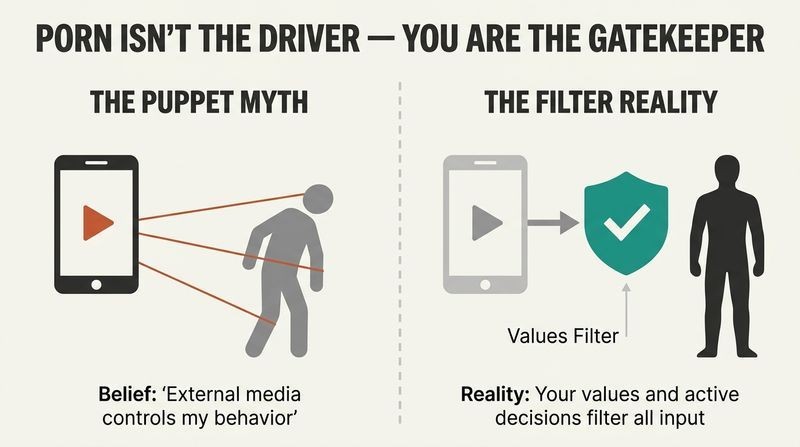
What's bracing here is the insistence on agency in a genre that usually sells helplessness. The claim echoes cognitive behavioral therapy's core move: distress comes from interpretation, not the stimulus. Ley's point that arousal degrades judgment aligns with Dan Ariely's research on how sexual arousal predictably shifts decision-making toward riskier choices. The weak spot is the tidy 1% versus 10% split, which flattens genuine compulsivity that neurological conditions can produce. Still, relocating responsibility from an external villain to the self is both empowering and uncomfortable, which is precisely why it resists the easy scapegoating that fuels most porn discourse.
Calling yourself a porn addict hurts more than the porn ever will
The label is the wound. Research Ley cites found that people who believe they are addicted to porn report more distress, anxiety, and shame regardless of how much they actually watch. The diagnosis itself, not the behavior, drives the pain. Adopting the identity tells you two damaging things: something is fundamentally wrong with you, and porn is more powerful than you are.
Sex and porn addiction have no accepted scientific basis and have been repeatedly rejected by mainstream medicine, yet they thrive because they feel intuitively true and are enormously profitable. Women actually show stronger physiological arousal responses to porn than men, so by addiction logic they should be more addicted, yet nearly every reported case is male. That asymmetry reveals the concept as a tool for policing male sexuality, not a real disorder.
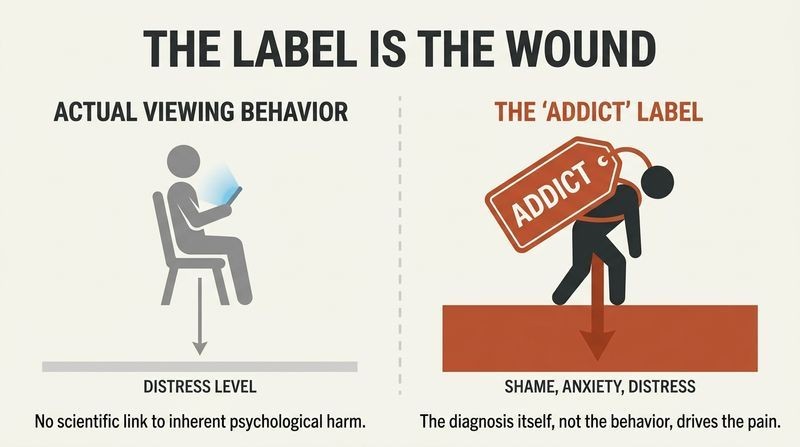
The distinction between distress caused by behavior versus distress caused by moral self-labeling is the sharpest blade in the book. Joshua Grubbs's work on perceived pornography addiction supports it: religiosity and moral disapproval predict feeling addicted far better than usage hours do. This parallels the broader critique of medicalizing ordinary behavior, from the addiction industry's $35 billion footprint to the pathologizing of grief. The gender asymmetry argument is genuinely clever. One caution: rejecting the addiction frame wholesale risks dismissing the minority who experience real compulsive distress. The honest position is that the label is overapplied, not that compulsion never exists.
Vote with your mouse: ethical porn is a verb, not a category
Ethical porn is something you do, not something that simply is. Ley borrows from performer Annie Sprinkle: the answer to bad porn is not no porn, it is better porn. Because porn is protected speech and has existed since humans carved erotic images into cave walls, banning it only drives it underground where performers lose the ability to consent safely. When organized crime ran the industry decades ago, boundaries meant nothing.
Every purchase is a vote. Support porn that is made legally, pays performers, respects their consent and copyright, and reflects human diversity. Framing ethics as striving rather than a fixed stamp means that when an ethical producer makes a mistake, the response is to keep trying, not to declare all porn irredeemable.
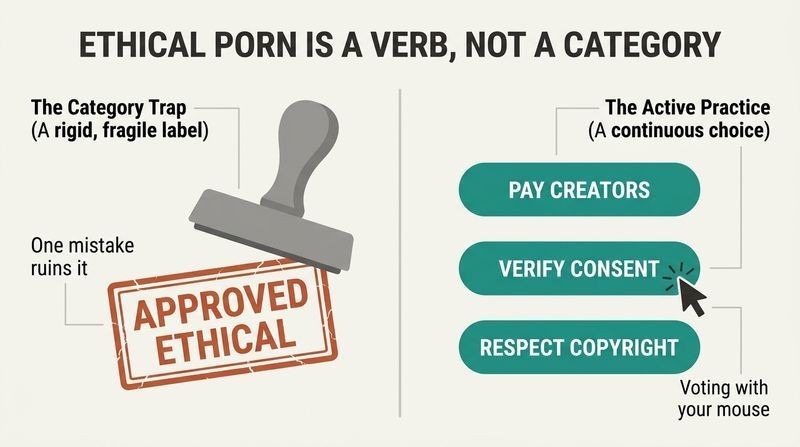
Treating consumption as a moral vote imports fair-trade and ethical-sourcing logic directly into sexuality, and the analogy is apt: consumers who demanded organic food and conflict-free minerals reshaped entire supply chains. The framing sidesteps the sterile pro versus anti debate by making the viewer a stakeholder. The friction point is practical. Ley concedes there is no reliable label for ethical porn, so the average user cannot verify sourcing the way a coffee buyer checks a certification seal. Intent outpaces infrastructure here. Still, positioning the audience as co-creators of industry norms is a more durable strategy than prohibition, which history shows simply relocates harm.
More porn access tracks with fewer sex crimes, not more
The counterintuitive data point that porn panic ignores. Across the United States and around the world, as men gained easier access to internet erotica, rates of sex crimes including rape, exhibitionism, and child abuse went down. The research is correlational but robust and repeatedly replicated. If porn were the corrupting agent activists claim, its near-universal availability would have produced a catastrophe of sexual violence. It has not.
Being able to masturbate to a fantasy appears to reduce acting on it. Gay men consume more porn than straight men yet show lower rates of sexual violence. Ley's model: many people are disposed toward aggression, but given a legal, private outlet, most choose it over harming someone. A small subset will offend regardless, because for them it was never really about sex.
This is the book's most provocative empirical claim, associated with researcher Milton Diamond's cross-national work. The catharsis hypothesis, that a safe outlet discharges an urge, has a contested history in psychology; media violence research often found the opposite. So the porn finding deserves scrutiny rather than celebration. Confounds abound: the same decades saw improved policing, DNA evidence, and shifting reporting norms. Correlation across societies undergoing simultaneous change is slippery. Ley is careful to flag it as correlational, which is intellectually honest. The steelman is that the burden of proof should fall on those claiming porn increases harm, and that evidence has never materialized either.
Your porn guilt is manufactured by your religion, not your habits
Attitudes predict distress better than usage. Ley cites research showing atheists rarely feel guilty about porn, while a person's religious beliefs about sex predict their shame far more accurately than how much they actually watch. The moral values driving that guilt were built for a world without contraception, when shame was the most efficient tool for controlling reproduction. Those rules are now largely obsolete.
The conflict, not the content, causes the harm. If you believe porn is degrading and then watch it anyway, you will suffer and then blame the porn. Utah illustrates the paradox: highly religious states consume more porn on average and run more addiction-treatment programs, while religious individuals watch less. Ley's prescription is blunt: if you truly find porn immoral, do not watch it. If you want to watch it, do the harder work of examining why the guilt exists.
The insight that psychological damage lives in the gap between behavior and belief, not in the behavior itself, is essentially cognitive dissonance theory applied to sexuality. Leon Festinger would recognize it instantly. The elegant implication is that there are two exits from suffering, change the behavior or change the belief, and Ley refuses to dictate which. That neutrality is rarer than it sounds in self-help. The Utah paradox is a compelling data hook, suggesting suppression may generate the very hunger it condemns, a dynamic familiar from abstinence-only education research. A fair challenge: for the devout, abandoning the belief may cost community and identity, making the choice far less symmetrical than framed.
Your darkest fantasies predict almost nothing about what you'll do
Fantasy and behavior are barely connected. Ley's most repeated line: sexual fantasies do not change behavior. The most common male fantasy, a threesome with two women, is endorsed by 70-90% of men, yet fewer than 5% ever have one. If fantasy drove action, those numbers would converge. He tells of a gentle Jewish grandmother whose parents died in the camps and who could only climax imagining Nazi doctors examining her. Disturbing, and completely healthy for her.
Everyone assumes they are more twisted than everyone else. Over 90% of people never share their fantasies with anyone. Liking violent or taboo porn does not make you a budding rapist or victim, it connects to something already in you, which is worth understanding rather than fearing. The men and women who never act on frightening fantasies vastly outnumber those who do.
Decoupling imagination from intent is one of the most therapeutically freeing claims in the book, and it maps onto research by Justin Lehmiller, whose survey of thousands found taboo fantasies are statistically normal and rarely enacted. The imposter-syndrome parallel is inspired: just as competent people secretly fear exposure, ordinary people secretly fear their libidos are uniquely monstrous. The gap between the threesome fantasy rate and its enactment rate is a genuinely persuasive statistic. The nuance Ley preserves is important: for a small number, fantasy plus disposition plus disinhibitors like alcohol does raise risk. The rule is that fantasy alone is inert, not that it is always harmless in every combination.
Policing your partner's desire manufactures the betrayal you fear
Control backfires. Ley calls it forbidden fruit syndrome, after the Eden story: forbid the apple and you create the craving. Research shows that trying to control a partner's sexuality makes them less satisfied, less committed, and more attentive to attractive alternatives. One husband in therapy said it plainly: his wife was so certain he would cheat that he figured he was already paying for a crime he had not committed, so why not.
Do the opposite of surveillance. Instead of demanding passwords and monitoring phones, strengthen the internal barriers to infidelity by attending to what you admire in your partner. What we attend to grows. Porn may actually reduce cheating by letting people scratch the itch of novelty at home. Better still, make homemade porn together to build the adventure that wandering usually seeks.
The reactance principle from social psychology underwrites this perfectly: humans respond to threatened freedoms by wanting the forbidden thing more, a finding as old as Jack Brehm's 1966 work. Ley extends it into intimate relationships with real clinical texture. The Gottman research tradition reinforces his positive prescription; attending to a partner's virtues, what Gottman calls building fondness and admiration, predicts marital stability better than vigilance ever could. The claim that porn reduces infidelity is more speculative and leans on the same contested catharsis logic. But the central move, that trust cannot be enforced and surveillance signals its absence, is psychologically sound and quietly radical advice for anxious couples.
Ease off the death grip to fix delayed orgasm during sex
A real, fixable dysfunction. Ley credits columnist Dan Savage with naming the death grip: men who masturbate with an intense, tight, high-pressure technique train their bodies to require stimulation no partner's body can replicate. The result is delayed ejaculation during sex or oral, which men then misread as porn breaking them. It is not damage, it is conditioning, and conditioning can be unlearned.
Retrain gradually. Loosen the grip, use just fingertips or the opposite hand, or try a wraparound sleeve toy that provides sensation without crushing pressure. Expect real frustration for the first few weeks because orgasm will take longer, and expect adaptation over a month or two. Men also fixate: 99% of the time they watch the same narrow genre and stroke the identical way, then wonder why their bodies got rigid.
This is the book's most concrete, testable, and least ideological advice, and it holds up. Sensate focus and stimulus-variation techniques are standard in sex therapy for exactly this presentation. The underlying mechanism is straightforward operant conditioning: the body optimizes for whatever it repeatedly rehearses, so idiosyncratic high-intensity input produces a narrow arousal template. What makes the framing valuable is diagnostic reassurance. Reframing delayed ejaculation as a learned habit rather than porn-induced brain damage removes the catastrophizing that itself worsens sexual performance through anxiety. The parallel Ley draws, that women needing clitoral stimulation to climax is normalized while men needing specific input is pathologized, exposes a real double standard.
Getting hard fast to porn but slow with a partner is normal, not broken
Erections respond to relaxation, not just desire. Alone with porn you are passive, receptive, and unmonitored, so blood flows easily. With a partner you are performing, worrying whether she is enjoying herself, whether you will stay hard, whether you are good enough. That vigilance is exactly what suppresses erection, because physiologically you must relax the blood vessels to get hard. A watched pot never boils.
Difficulty with a partner can mean you care more, not less. Ley interviewed a former anti-porn NoFap crusader who blamed porn for his erectile dysfunction. Two years porn-free, he still had ED, and finally concluded his problem was anxiety and moral conflict about sex, never the porn. Male sexuality is not a lie detector, and orgasm without a full erection proves the equipment works fine.
The reframe of performance anxiety as evidence of investment rather than failure is clinically useful and emotionally generous. It aligns with Barry McCarthy's work on the anxiety-erection loop, where fear of failure becomes self-fulfilling by activating the sympathetic nervous system that shuts down the parasympathetic response erections require. The NoFap ex-crusader anecdote is the book's most rhetorically powerful example because it undercuts the movement using one of its own former champions. The broader public-health worry deserves acknowledgment: some young men do report acquired arousal templates, and the science is genuinely unsettled. Ley's contribution is separating anxiety-driven ED, which is common and treatable, from the harder-to-prove porn-causation narrative.
Privacy is not secrecy: tell her you watch, not that you don't
Sexual privacy is healthy; lying is not. The fairy-tale ideal of a relationship with zero barriers between two souls is a myth, Ley argues, because people are not made of glass. Just as a woman fantasizes about others during sex without confessing every image, a man is entitled to a private sexual interior. But privacy earned through honesty differs completely from a secret maintained through deception.
Watching in secret is the real threat. Women rarely panic that a man has ever seen porn; they know he has. The wound is believing he chooses it now, in place of her, which reads as I am not enough. Approach the conversation with empathy for how thoroughly she has been taught to fear porn, plant seeds before asking her views, and reassure her that porn does not replace or diminish her. Say you watch, and hope she can accept it. Never claim you do not.
The privacy versus secrecy distinction is philosophically precise and undervalued in an age that treats total transparency as intimacy's gold standard. Sissela Bok's work on secrets makes the same cut: concealment becomes corrosive only when it involves deception about something the other party has a legitimate stake in. Ley's communication script is emotionally intelligent, essentially a de-escalation protocol that addresses the partner's underlying fear (replacement) rather than the surface object (porn). One critique: the advice tilts toward managing her anxiety, which risks casting the woman as the obstacle rather than an equal negotiator. The stronger frame, which Ley gestures toward, is mutual disclosure where both partners own private sexual lives.
Porn explains under 1% of what teenagers actually do
Stop catastrophizing about kids and porn. Ley cites Dutch research showing that pornography exposure accounts for less than 1% of the variance in adolescent behavior. Ninety-nine percent of why teens do what they do traces to poverty, mental health, education, and family environment, not the videos on their phones. Your teenage son is watching porn, and probably your daughter too. Panicking will not change that.
Inoculate instead of forbid. Age-verification and opt-in schemes are traps: someone must define porn (impossible) and someone must be trusted to censor (dangerous). When the UK tried filters, they blocked sex education, mental health, and LGBTQ resources. The better path is dialogue. Talk to kids about real sex, consent, and the gap between fantasy and reality, and warn them that sharing a nude of an underage friend can brand them a child pornographer. Demonize porn and they will only hide it.
The under-1% figure is the book's strongest rebuttal to media-driven parental panic, and it mirrors decades of media-effects research where content exposure consistently explains trivial variance compared to socioeconomic and family factors. The abstinence-education parallel is well chosen: prohibition without literacy reliably produces worse outcomes, as the teen-pregnancy data on abstinence-only curricula demonstrate. Ley's censorship critique is genuinely sharp, invoking real cases where filters swept up the exact educational content kids need most. The tension he leaves unresolved is developmental: acknowledging that violent or BDSM material genuinely can confuse an adolescent without the framework to process it, while opposing the tools that would restrict it, leaves parents carrying the entire burden through conversation alone.
Analysis
David Ley writes as a working clinician weaponizing empathy against an industry of fear, and the book's structure, a barstool monologue rather than a treatise, is itself an argument: shame dissolves in casual, honest talk. Its intellectual spine is a single inversion repeated across sexual anxieties, from ED to divorce to child porn accusations. The porn is never the variable that matters; the person, their beliefs, their communication, and their unexamined conflicts are. This is essentially a cognitive-behavioral and dissonance-theory framework applied to a domain usually governed by moral reflex. Ley's most defensible contributions are the psychological reframes: perceived addiction causing more distress than usage (well-supported by Grubbs), fantasy-behavior decoupling (supported by Lehmiller), performance anxiety as an erection killer (standard sex therapy), and the death-grip conditioning fix (concrete and testable). His most contestable claims lean on the catharsis hypothesis, that outlets reduce harmful action, which contradicts much media-violence research and rests on cross-societal correlations riddled with confounds. He flags these as correlational, which is honest, but the confident tone occasionally outruns the evidence. The book's blind spot is its own framing device. Written explicitly for men, with women often positioned as anxieties to be managed rather than equal sexual agents, it sometimes reproduces the gendered assumptions it critiques elsewhere, even while insisting female desire deserves the same respect. Its enduring value is not any single statistic but a posture: that sexuality is a domain for self-knowledge and responsibility rather than terror and outsourced blame. In a discourse dominated by both anti-porn crusaders and porn evangelists, Ley's refusal to do either, insisting instead that the reader is an intelligent adult capable of deciding, is genuinely rare and quietly humane. The ethical-consumption thesis, treating each purchase as a vote for better labor practices, offers a practical alternative to the sterile ban-versus-celebrate binary that has paralyzed the conversation for decades.
Review Summary
Ethical Porn for Dicks receives mostly positive reviews, with readers appreciating its non-judgmental approach to pornography consumption. Many found it informative, thought-provoking, and helpful in addressing shame and guilt associated with porn use. The book is praised for its casual writing style, easy readability, and emphasis on ethical consumption. Some reviewers noted its focus on straight males but found value for other audiences. A few critics felt it lacked a comprehensive treatment of the porn industry's negative aspects. Overall, readers appreciated the book's nuanced perspective on a controversial topic.
People Also Read







Glossary
Ethical porn
Responsibly made and consumed sexual mediaLey's central concept, framed as an ongoing action rather than a fixed category. It means supporting pornography that is legal, pays and respects performers, honors consent and copyright, and reflects human diversity, while the viewer consciously votes with their money for better practices. Because it is defined as striving, a producer's mistake becomes a reason to keep improving rather than proof porn is irredeemable.
Death grip
Overly tight masturbation causing delayed orgasmA term popularized by Dan Savage for the habit of masturbating with intense, high-pressure gripping that conditions the body to require stimulation no partner can replicate, producing delayed ejaculation during partnered sex. Ley presents it as learned conditioning, correctable over weeks by loosening technique, using fingertips or the other hand, or a sleeve toy, not as porn-induced damage.
Forbidden fruit syndrome
Control increases the desire to strayLey's name, drawn from the Eden story, for the finding that trying to control a partner's sexuality (monitoring phones, banning porn) backfires by reducing their relationship satisfaction and commitment while heightening attention to attractive alternatives. Prohibition manufactures craving. The remedy is strengthening internal barriers by attending to what one admires in a partner rather than policing them.
Pornified
Alleged porn-caused objectification of womenA pejorative claim that heavy porn use warps men into compulsively objectifying and sexualizing women. Ley disputes the causation, noting that objectification is a normal, momentary human process across many contexts and that men who chronically mistreat others do so for reasons predating any porn, not because videos rewired them.
Sperm competition
Evolutionary driver of gangbang porn appealAn evolutionary theory Ley uses to explain why internet porn is dominated by one woman with multiple men (FMM) despite men's stated preference for the reverse threesome fantasy. Research shows men viewing multiple-male scenes ejaculate harder, produce more sperm, and rearouse faster, suggesting cues of reproductive competition trigger a heightened response the free market discovered by accident.
Rule 34
If it exists, there's pornAn internet adage originating on 4chan stating that for anything imaginable, pornography of it exists. Ley invokes it, alongside Freud's polymorphous perversity, as evidence of the vast, harmless diversity of human sexual imagination, arguing that bizarre cartoon or fantasy porn reflects creativity rather than immaturity or danger.
Petro-porn
Ancient erotic rock artLey's coinage for the erotic rock carvings and cave art found worldwide, from the American Southwest to Pompeii to the Australian outback, depicting sex, masturbation, and orgasms across millennia. He uses these images to illustrate that both pornography and the impulse to suppress it (Catholic settlers carved crosses over explicit petroglyphs) are ancient, not modern, phenomena.
FAQ
What's "Ethical Porn for Dicks" about?
- Author's Perspective: "Ethical Porn for Dicks" by David J. Ley, Ph.D., is a guide for men on how to engage with pornography responsibly and ethically.
- Main Themes: The book addresses the shame and guilt often associated with porn use and challenges the notion of porn addiction.
- Purpose: It aims to provide a framework for men to incorporate pornography into their lives ethically, without compromising their values or relationships.
- Audience: While primarily targeted at men, the book also offers insights for women and anyone interested in understanding the dynamics of porn consumption.
Why should I read "Ethical Porn for Dicks"?
- Understanding Porn Use: The book demystifies common myths about pornography, helping readers understand its role in modern sexuality.
- Addressing Shame and Guilt: It offers strategies to overcome the shame and guilt often associated with porn use, promoting a healthier relationship with sexuality.
- Ethical Consumption: Readers learn how to identify and support ethical porn, contributing to a more responsible industry.
- Relationship Insights: The book provides advice on discussing porn use with partners, aiming to improve communication and intimacy in relationships.
What are the key takeaways of "Ethical Porn for Dicks"?
- Porn Isn't the Problem: The book argues that issues often blamed on porn are more about individual behavior and societal attitudes.
- Ethical Porn Exists: It emphasizes that porn can be consumed ethically, supporting performers' rights and promoting diverse sexual expressions.
- Communication is Key: Open discussions about porn use with partners can lead to healthier relationships and reduce misunderstandings.
- Self-Reflection: Readers are encouraged to reflect on their own sexual desires and how they align with their values and relationships.
How does David J. Ley define "ethical porn"?
- Respect for Performers: Ethical porn respects the rights and dignity of performers, ensuring they are paid fairly and work in safe conditions.
- Consent and Diversity: It includes diverse representations of sexuality and ensures all acts are consensual and respectful.
- Consumer Responsibility: Viewers are encouraged to support ethical porn by paying for content and avoiding pirated material.
- Continuous Improvement: The book suggests that ethical porn is an ongoing effort to make the industry better for everyone involved.
What is the author's stance on porn addiction?
- Myth of Addiction: David J. Ley argues that porn addiction is a pop psychology concept without legitimate scientific backing.
- Shame and Fear: The belief in porn addiction often stems from societal shame and fear surrounding sexual desires.
- Focus on Behavior: The book suggests focusing on individual behavior and choices rather than labeling porn as addictive.
- Empowerment: By understanding the real issues, individuals can take control of their porn use and make informed decisions.
How does "Ethical Porn for Dicks" address the impact of porn on relationships?
- Open Communication: The book emphasizes the importance of discussing porn use openly with partners to avoid misunderstandings.
- Privacy and Honesty: It advocates for a balance between privacy in sexual matters and honesty in relationships.
- Reassurance: Partners should reassure each other that porn use doesn't diminish their attraction or commitment.
- Shared Experiences: Watching porn together can be a way to explore fantasies and enhance intimacy if both partners are comfortable.
What advice does the book offer for talking to a partner about porn?
- Empathy and Understanding: Approach the conversation with empathy, acknowledging any fears or misconceptions your partner may have.
- Reassurance: Reassure your partner that porn use doesn't reflect a lack of attraction or love for them.
- Open Dialogue: Encourage an open dialogue about sexual desires and boundaries, making it a mutual exploration.
- Respect Privacy: Respect each other's privacy and understand that some aspects of sexuality can remain personal.
What are some best quotes from "Ethical Porn for Dicks" and what do they mean?
- "Porn is not the problem—YOU are." This quote emphasizes personal responsibility in managing porn use and making ethical choices.
- "It’s possible to be an ethical, responsible person and treat oneself and others with dignity and integrity, AND to watch hot, no-holds-barred sex on screen." It highlights the book's core message that ethical porn consumption is achievable.
- "Porn Can Be Ethical." This statement challenges the negative stereotypes about porn and encourages readers to seek out and support ethical content.
- "Watching Porn While Having, Not Being, a Dick." This playful phrase underscores the importance of consuming porn without compromising one's values or relationships.
How does the book suggest dealing with porn-related guilt?
- Identify Sources: Understand where the guilt comes from, whether it's societal, religious, or personal beliefs.
- Challenge Myths: Challenge myths and misconceptions about porn that contribute to feelings of guilt.
- Focus on Ethics: Shift focus to consuming porn ethically, supporting content that aligns with your values.
- Self-Acceptance: Work towards self-acceptance and understanding that sexual desires are a natural part of being human.
What does "Ethical Porn for Dicks" say about the role of porn in society?
- Cultural Reflection: Porn is seen as a reflection of cultural attitudes towards sex, power, and freedom.
- Scapegoat for Issues: The book argues that porn is often scapegoated for broader societal issues like sexual dysfunction and relationship problems.
- Potential for Good: It suggests that porn can have positive effects, such as reducing sex crimes and promoting sexual diversity.
- Need for Dialogue: There is a need for open, honest dialogue about porn's role in society and its impact on individuals.
How does the book address the concept of "pornified" individuals?
- Misconception: The idea that porn "pornifies" individuals, making them objectify others, is challenged as a misconception.
- Objectification in Context: The book discusses how objectification is a part of many human interactions, not just sexual ones.
- Self-Reflection: Readers are encouraged to reflect on their own attitudes and behaviors rather than blaming porn.
- Balanced View: It promotes a balanced view of sexuality, recognizing both the fantasy and reality of sexual interactions.
What strategies does "Ethical Porn for Dicks" offer for reducing porn use?
- Set Boundaries: Establish personal rules for when and how much porn to watch, focusing on moderation.
- Identify Triggers: Recognize triggers that lead to excessive porn use and find alternative coping strategies.
- Focus on Positives: Redirect energy towards positive activities and relationships that fulfill emotional and sexual needs.
- Self-Reflection: Reflect on the role of porn in your life and make conscious choices about its place in your sexuality.
Download PDF
Download EPUB
.epub digital book format is ideal for reading ebooks on phones, tablets, and e-readers.








































