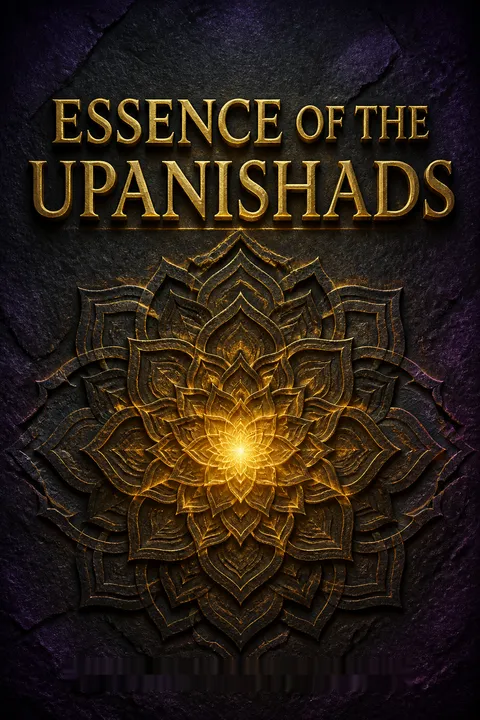

Key Takeaways
1. The Fundamental Choice: Pleasure (Preya) vs. Lasting Benefit (Shreya)
Perennial joy or passing pleasure? This is the choice one is to make always.
Life's constant dilemma. Every moment presents a choice between what is immediately pleasant (preya) and what is ultimately beneficial (shreya). Preya offers instant gratification but is fleeting, leading to eventual dissatisfaction. Shreya, though often challenging at first, yields lasting well-being and peace of mind. This fundamental choice shapes our destiny, as exemplified by Nachiketa's refusal of Yama's worldly temptations.
The Chariot Analogy. Our life is a chariot, with the body as the vehicle, the senses as wild horses, the mind as the reins, and the intellect as the driver. We, the Self, are the rider. When the senses are uncontrolled, they drag us towards immediate pleasures, overriding the intellect's judgment. Mastering this chariot means training the senses and mind to follow the intellect's guidance, allowing the Self to direct our journey towards lasting fulfillment.
Consequences of choice. Choosing preya leads to a life of constant seeking and eventual emptiness, as pleasure cannot endure. Choosing shreya, though it may involve initial discomfort or discipline, builds inner strength, clarity, and genuine happiness. This isn't a moral judgment but a practical observation: one path leads away from health, security, and peace, while the other leads directly to them.
2. You Are Not Your Body: The City of Eleven Gates
Your chariot is five foot seven. Your chariot has blue eyes, brown hair, and a mole. You are not your chariot.
Mistaken identity. Most of us mistakenly identify ourselves with our physical body, the "City of Eleven Gates," believing that when the body dies, we die. This is a colossal fallacy. The body is merely a temporary dwelling, a bustling city with senses as its gates, and we are its true ruler, the Self, residing in the innermost citadel of the mind.
Senses as open gates. We often live on "sentry duty" at the body's gates, letting every sense-impression barge in without scrutiny. This outward focus drains our vitality (prana) and leads to insecurity, as our moods and self-esteem become dependent on external appearances and fleeting sensations. This constant outflow of energy results in emotional lows and a fragmented sense of self.
Beyond physical appearance. Identifying with the body leads to superficial judgments of ourselves and others, magnifying minor physical differences and fostering alienation. This hypersensitivity to external appearances makes us vulnerable to the inevitable changes of aging and the ultimate fear of death. True well-being comes from realizing we are much more than our physical form, shifting our focus from external appearance to inner reality.
3. The Mind as a Field of Forces: Samskaras and Prana
Subtle is a highly complex field of forces, all made out of prana.
The subtle body. Beneath the physical "gross body" lies the "subtle body," a complex field of non-physical energy called prana, which constitutes our mind, feelings, desires, intellect, and will. This subtle body is as real as the physical, influencing our health and experiences, even though it's imperceptible to the senses. An unstable mind, due to imbalanced subtle forces, often manifests as physical problems.
Samskaras: conditioned patterns. Our personality is a dynamic interplay of samskaras – conditioned, automatic ways of thinking and responding. These begin as repeated thoughts, become habits, and eventually dictate our behavior, often unconsciously.
- Resentment, for example, starts as a small irritation and, through repetition, carves a deep channel in consciousness, making us prone to automatic negative responses.
- Dwelling on these samskaras cements them, making personality rigid and resistant to change.
Prana and vitality. Prana is the fundamental life energy that sustains both body and mind. Every thought, emotion, and desire draws on this finite reserve. Selfish desires, excitement, and negative mental states rapidly deplete prana, leading to insecurity, vacillation, and vulnerability to stress. Conversely, conserving prana through self-mastery enhances resilience, extends vitality, and promotes health, demonstrating that senility is not an inevitable consequence of age but often a result of depleted prana and a rigid mind.
4. Mastering Desire: The Power of Will
You are what your deep, driving desire is.
Desire as power. Desire is not merely a wish; it is a river of prana, a powerful force that shapes our will and destiny. Unfocused desires scatter our vitality, leading to a sense of futility. However, when desires are unified and directed towards a single, all-consuming goal, they become an irresistible force, capable of overcoming any obstacle, as seen in the lives of great achievers like Margot Fonteyn or Albert Einstein.
The Will Quotient (WQ). True strength comes not from physical capacity but from an indomitable will. Many failures in daily life stem from a weak will, which is often undermined by small, self-indulgent impulses. Procrastination, unkind words, and unnecessary complaints, though seemingly minor, chip away at the will's strength, making it fragile and unable to act when needed.
Training the will. The will can be systematically strengthened by resisting self-centered desires and impulses. This is not about deprivation but about gaining freedom. Every time we choose shreya over preya – being kind instead of irritable, getting up for meditation instead of dozing – we strengthen the will. This continuous training transforms the will from a "marshmallow" into an unbreakable force, allowing us to control our destiny rather than being dictated by our cravings.
5. Clear Seeing: The Role of the Discriminating Intellect
When will and intellect part company, it is not possible to see clearly.
Intellect's true purpose. The higher mind, or buddhi (discriminating intellect), is meant to see clearly, taking a long-term, holistic view to distinguish between what is pleasant and what is truly beneficial. However, when the will is weak, the intellect loses its focus, becoming easily captivated by immediate attractions and short-term promises, much like elephants rushing into a trap for sugarcane.
Infatuation's blindness. Selfish desire acts like a powerful glue, blinding the intellect and distorting perception. In romantic relationships, for instance, infatuation focuses on what one can "get" from the other, leading to unrealistic expectations, jealousy, and eventual disappointment. True love, by contrast, sees clearly, acknowledging weaknesses while supporting growth, and is free from the turmoil of selfish attachment.
Beyond narrow vision. An untrained intellect tends to narrow our vision, focusing on fragmented details rather than the whole picture. This leads to absurd conclusions and an inability to grasp larger truths or consequences, as seen in societal problems like weapons research or the pursuit of cancer cures without addressing root causes. By calming the mind through meditation, the intellect can transcend its limitations, see life whole, and make wise choices that benefit all.
6. The Stream of Thought: Breaking the Chains of Karma
Between two successive thoughts there is no connection at all.
Thoughts are discrete. Our "stream of consciousness" is not continuous; thoughts are discrete, separated by tiny gaps of "no-thought." This profound discovery reveals that the compulsive nature of our thinking is an illusion, and at every moment, we have a choice in what we think, say, and do. This insight empowers us to break conditioned responses.
Mastering the mind. The mind's rapid, unruly flow creates the illusion of continuous action and cause-and-effect. A "fast mind" misunderstands, exaggerates, and jumps to conclusions, constantly splicing in unnecessary footage of memories, fantasies, and worries. Meditation, by slowing this process, allows us to observe these gaps and defuse emotionally charged associations, while a mantram helps redirect attention away from negative thought patterns during the day.
Karma and choice. Every thought, word, and action creates karma, leaving a residue of conditioning in the mind. Karma is not external punishment but the inherent consequences of our choices. Selfish desires, anger, and fear generate negative karma, perpetuating cycles of suffering and making it easier to repeat mistakes. By learning to detach our responses from stimuli and choosing positive actions, we can break these karmic chains and transform our personality from the inside out.
7. Shadow and Self: Unveiling Your True Identity
Without exaggeration, it is the absence of personality.
The ego as a shadow. We mistakenly identify with the jiva, our individual personality, which is merely a shadow cast by the true Self (Purusha). This shadow-self is a constantly changing process, yet we cling to it as if it were solid and everlasting. The ego, though unreal in an ultimate sense, is very real in its capacity to cause trouble until it is extinguished through self-realization.
Jiva vs. Purusha. Jiva, the ego, is the "impression-taster," constantly sampling experiences and forming likes and dislikes, which cause it to swell and become "obese." It cannot truly enjoy anything because it is too busy rushing and judging. Purusha, the Self, is the detached observer, "smaller than the smallest, greater than the greatest," residing in the "secret cave of the heart." It is the source of lasting joy and fulfillment.
The path to the Self. To discover Purusha, we must embark on an inward journey, withdrawing consciousness from the senses, mind, and intellect. As the ego sheds its attachments and becomes "slimmer," the Self, our true nature, becomes apparent. This transformation is not the extinction of personality but its perfection, leading to a state where we are no longer the self-centered ego but a powerful, beneficial force.
8. Life as a Dream: Overcoming the Illusion of Maya
The world of the senses is real, but it belongs to a lower order of reality, very much as a dream is a lower reality in relation to the waking state.
The nature of reality. Only that which never changes is truly real. The phenomenal world, including our body and mind, is in ceaseless motion (samsara) and thus belongs to a lower order of reality, akin to a dream. Our senses perceive only a fraction of this ever-changing reality, and our mind further filters it, creating a subjective "shadow world" that we mistake for ultimate truth.
Maya: the cosmic illusion. This cosmic deception, called maya, is the creative power of the Godhead that conceals ultimate reality while diverting our attention to the external, ever-changing world of "name and form." Maya works through our desires, which keep us fixated on fleeting pleasures and prevent us from looking inward to the changeless Self.
Waking from the dream. Just as we awaken from a dream to a higher reality, spiritual practice allows us to "wake up" from the illusion of maya. By stilling the mind and withdrawing consciousness from sensory distractions, we can perceive the unity of all life, realizing that all creatures, though appearing separate, spring from the same root – the one Self. This shift in perception transforms our understanding of the world and our place within it.
9. The Journey to Immortality: Waking Up to the Self
When all desires that surge in the heart Are renounced, the mortal becomes immortal.
Death as a process. Death is not an event but a continuous process, a dismantling of the gross and subtle bodies. However, the Self is not affected by this. Just as we "die" every night in dreamless sleep, suspending the ego and resting in the Self, death is a temporary end to a temporary phenomenon, allowing the samskaras to rest before quickening in a new body.
The chasm of consciousness. Between the ego and the Self lies a chasm of consciousness, a battleground where the selfish and selfless aspects of our mind constantly war. This conflict, though painful, is positive because it signifies choice and the potential for growth. Grace, an inner force, aids this struggle, often manifesting as a profound desire to change the direction of one's life, especially during times of crisis.
The razor's edge. The path to Self-realization is "sharp like a razor's edge," requiring continuous concentration, superhuman endurance, and unwavering dedication. It involves letting go of intense personal attachments, which feels like a "healing wound" burning away the chains of self-will. This arduous journey, guided by an illumined teacher, leads to the unification of all desires into an overwhelming passion for the Self, culminating in the unitive state where all separateness vanishes.
10. The Ultimate Lesson: Love and Unity
Love; then do as you will.
The purpose of life. The culmination of evolution is to overcome death in this very life by breaking identification with the body and ego, realizing the changeless, eternal Self. This is not a dull, desireless existence but a life of abundant joy, where all selfish desires are transformed into selfless love, leading to the integration of personality in its full glory.
Living for all. When the partitions of the ego fall, we cease to be isolated individuals and become a lasting, beneficial force. Our capacity for love expands to embrace all creatures, not sentimentally, but practically, as a mother loves her only child. This means living as trustees of the world's resources, contributing more than we take, and working to alleviate the suffering of others as if it were our own.
The gift of immortality. The Lord offers the gift of immortality, but we must open our hands, letting go of our "pennies" – our petty, self-centered desires and attachments. This choice, though difficult, leads to an incomparable treasure: a life overflowing with joy, strength, and purpose, where every facet serves one overriding goal. We are meant to "break the bank" of limited existence, realizing the blessing of the Self that death can never touch.
Review Summary
Most readers found Essence of the Upanishads accessible and enlightening, praising Easwaran's ability to explain complex spiritual concepts simply. Many appreciated his use of contemporary metaphors and cross-cultural references. Common criticisms noted the book shifts from discussing the Katha Upanishad in early chapters to the author's personal spiritual philosophy later, disappointing those expecting a thorough academic analysis. Despite this, readers widely recommended it for those interested in Eastern spirituality, meditation, and Indian philosophy, particularly for beginners or those seeking practical applications of ancient wisdom.
People Also Read










About the Author


Download PDF
Download EPUB
.epub digital book format is ideal for reading ebooks on phones, tablets, and e-readers.








































