
Key Takeaways
1. Europe's Unique Fragmentation Defined Its Destiny
After the demise of the unified Roman empire in the fifth century CE, the greatest powers in Europe never laid claim to more than about one-fifth of its total population, a far cry from the four-fifths or more that had submitted to Roman rule.
A stark anomaly. For over 1,500 years, Europe diverged dramatically from other major Old World civilizations like China, India, and the Middle East. While these regions repeatedly saw the rise and fall of vast, hegemonic empires controlling 80-90% of their populations, post-Roman Europe remained persistently fragmented. This wasn't just a temporary phase; it became Europe's defining political characteristic.
Beyond mere oscillation. Unlike the cyclical pattern of imperial consolidation and collapse seen elsewhere, Europe experienced a unique "one-off empire" in Rome, followed by enduring polycentrism. This meant that no single power could consistently dominate the continent, fostering a dynamic environment of competing states and diverse political entities. This fundamental shift, termed the "First Great Divergence," set Europe on an entirely different historical trajectory.
A global outlier. This pattern is striking because regions capable of supporting large polities historically tended to do so repeatedly. Europe, however, broke this mold. Its sustained political fragmentation, both between and within states, became the indispensable precondition for the later economic, scientific, and social transformations that led to the modern world.
2. Rome's Rise: A Confluence of Rare, Unrepeatable Factors
Roman state formation thus turns out to have been both highly contingent (in terms of its foundational preconditions) and highly robust (once these preconditions were in place).
Unique advantages. The Roman Empire's initial success in unifying the Mediterranean basin stemmed from a rare combination of factors. Its core, the Roman Republic, mastered military mass mobilization on an unprecedented scale, integrating defeated enemies as citizens or allies. This allowed it to tap into Italy's vast manpower reserves, a capability unmatched by its contemporaries.
A sheltered periphery. Rome also benefited from its semi-peripheral location, distant enough from the powerful, older civilizations of the Near East to develop unhindered, yet close enough to eventually absorb their wealth and knowledge. Crucially, Rome achieved naval supremacy across the Mediterranean early in its expansion, securing supply lines and projecting power without significant challenge.
A narrow window. Counterfactual analysis suggests that while Rome's early expansion was highly contingent – a different outcome in the late 4th century BCE (e.g., Alexander the Great's survival) could have derailed it – once its system was established, its advantages became overwhelming. These specific conditions, from its unique mobilization model to its geopolitical isolation during its formative period, were never replicated in later European history.
3. Post-Roman Europe: A Millennium of Failed Imperial Returns
No plausible minimal rewrite of history was likely to lead to that particular outcome.
Persistent polycentrism. After the Western Roman Empire's collapse in the 5th century CE, numerous attempts to re-establish a hegemonic empire in Europe consistently failed. From Justinian's Byzantine reconquests to Charlemagne's Frankish realm, the German Empire, the Mongol incursions, Habsburg ambitions, Ottoman expansion, and Napoleon's conquests, none achieved lasting dominance comparable to Rome's.
Structural impediments. These failures were not due to a lack of ambition or military might, but rather deep-seated structural constraints.
- Byzantine efforts were thwarted by too many external challengers (Sasanians, Arabs, Slavs) and internal weaknesses.
- Arab conquests in Iberia and the Balkans were limited by internal divisions, fiscal decentralization, and strong local resistance.
- Carolingian and German empires suffered from aristocratic autonomy, fiscal weakness, and the custom of dividing realms among heirs.
- Mongol advances were checked by Europe's extensive stone fortifications, unsuitable ecology for steppe cavalry, and the Mongols' own internal political fragmentation.
- Habsburg and French aspirations faced a resilient system of balancing states, high costs of warfare, and the disruptive force of the Protestant Reformation.
Overdetermined outcome. The cumulative weight of these factors made the re-emergence of a Roman-scale empire in Europe virtually impossible. The continent's political landscape became increasingly fragmented and resilient, a stark contrast to the cyclical imperial formations seen elsewhere.
4. Nature's Blueprint: Geography and Ecology Shaped Imperial Patterns
The scale and intensity of imperiogenesis were profoundly shaped by ecological features that drove state formation via intermediating proximate mechanisms.
Geographic segmentation. Europe's highly articulated coastline, numerous peninsulas, and significant mountain ranges (Alps, Pyrenees, Carpathians) created multiple, smaller core regions. This fragmented geography contrasted sharply with China's vast, interconnected river basins and plains, which facilitated political unity. This physical environment made it inherently harder to build and maintain large, contiguous empires in Europe.
The "steppe effect." A crucial ecological factor was proximity to the Eurasian Steppe. Most large empires in world history (62 out of 73 in one survey) emerged near steppe frontiers. This "steppe effect" fostered state formation through:
- Antagonistic interaction: Conflict between mobile pastoralists and settled agriculturalists spurred military scaling-up.
- Resource transfer: Steppe-sourced horses and cavalry enhanced military capabilities, crucial for projecting power over large areas.
China, with its direct exposure to the steppe, repeatedly saw empires rise from its northern frontier, often led by hybrid Han-nomadic elites. Europe, particularly its Latin Western parts, was largely sheltered from this persistent pressure, allowing for decentralized state development.
A protected zone. Latin Europe's distance from the main steppe belt, coupled with natural barriers like forests and mountains, meant it experienced only intermittent and less impactful nomadic incursions (Huns, Avars, Magyars). This relative insulation, unlike the constant pressure on China, India, and the Middle East, removed a powerful external impetus for large-scale imperial consolidation, reinforcing its fragmented political trajectory.
5. Culture and Institutions: Divergent Paths to Power
In post-Roman Europe, multiple circumstances obstructed large-scale state formation, whereas in post–“Sixteen Kingdoms” China, they favored it.
Fiscal divergence. The "First Great Divergence" was profoundly shaped by contrasting fiscal and institutional trajectories. In post-Roman Europe, centralized Roman tax systems withered under Germanic rule, replaced by land grants to warrior elites. This led to:
- Decentralized power: Military and economic power devolved to local lords and knights.
- Weak states: Rulers lacked direct control over resources and armies, hindering large-scale state-building.
- Small armies: Limited fiscal capacity meant smaller, less effective military forces compared to ancient Rome or contemporary China.
Chinese imperial resilience. In China, despite periods of disunity, fiscal structures and state capacity were consistently maintained or restored. Northern conquest regimes, often with steppe connections, prioritized centralized taxation and military provisioning, preventing the deep feudalization seen in Europe.
- Strong state control: Rulers retained control over revenues and military compensation, limiting elite autonomy.
- Large armies: Sustained fiscal capacity allowed for massive military mobilization.
- Bureaucratic traditions: Recruitment of literati for administration ensured continuity and expertise.
This enabled the repeated reconstitution of powerful, unified empires like the Sui, Tang, and Song, which dwarfed any European polities of the era.
Cultural reinforcement. These institutional differences were reinforced by cultural factors. China's unified logographic script, official language, and state-friendly Confucian-Legalist ideology fostered elite cohesion and loyalty to the imperial project. In Europe, linguistic diversity, the rise of vernaculars, and an increasingly autonomous Christian Church (especially the papacy) acted as powerful centrifugal forces, further fragmenting power and identity.
6. Polycentrism Forged Developmental States and Innovation
The non-monopolization but at the same time close interaction of the sources of social power, between and within states, was the fundamental cause of the rise of the West in all its varieties.
Productive fragmentation. Europe's enduring polycentrism, both between sovereign states and within them (between monarchs, nobles, the Church, and cities), created a unique environment for institutional innovation. This constant competition and internal bargaining compelled rulers to:
- Seek consent: Engage with diverse social groups (estates, communes, guilds) to secure resources for war.
- Protect property rights: Offer credible commitments to attract and retain capital and talent.
- Innovate: Develop new fiscal, financial, and administrative tools to gain an edge over rivals.
The rise of the fiscal-military state. Escalating warfare, a hallmark of fragmented Europe, drove the creation of powerful "fiscal-military states." This led to:
- Soaring taxation: Per capita tax revenues increased dramatically, funding larger armies and navies.
- Public credit: The need for war finance spurred the invention of public debt, central banks, and sophisticated financial markets.
- Mercantilism: States actively promoted domestic industries and trade through protectionist policies to strengthen national power.
This dynamic, particularly pronounced in the North Sea region (Netherlands, Britain), fostered economic growth and laid the groundwork for industrialization.
Contrast with imperial inertia. In contrast, hegemonic empires like China, facing less symmetric external competition, prioritized stability and maintenance over disruptive innovation. Their "capstone" state model, with its low fiscal capacity and limited elite bargaining, discouraged:
- Entrepreneurial influence: Merchants were politically marginalized, lacking institutionalized power to shape state policy.
- Financial innovation: Absence of public debt and reliance on internal resource transfers hindered the development of sophisticated credit markets.
- Pro-growth policies: Imperial agrarian paternalism and monopolistic decision-making often led to policies (e.g., Ming trade bans) that stifled commerce and innovation.
7. Global Reach: European Competition Drove Overseas Expansion
Ironically, the invasions which destroyed western Eurasia’s greatest empire laid the foundation for new rounds of empire building centuries later.
Competitive imperative. Europe's political fragmentation was the primary driver of its aggressive overseas exploration and colonization. Unlike self-sufficient, hegemonic empires, European states were locked in relentless competition, creating powerful incentives to:
- Seek new resources: Acquire bullion, raw materials (sugar, cotton), and markets to fund wars and gain economic advantage.
- Open new fronts: Project military power overseas to outmaneuver rivals and secure strategic positions.
- Exploit opportunities: Support ventures that promised wealth and power, even if risky, as failure to do so meant rivals might succeed.
The "marginal" advantage. Historically, maritime exploration was often pioneered by peripheral, smaller polities (Phoenicians, Greeks, Norse, Italian city-states, Portugal). Large empires, like Rome or Ming China, with vast internal resources and a focus on terrestrial security, showed little interest in costly, uncertain overseas ventures.
China's inward turn. The Ming treasure fleets, though impressive, were a brief, politically motivated display of imperial grandeur, not a sustained drive for colonization or trade. China's imperial system, with its agrarian focus, monopolistic decision-making, and lack of competitive pressure, consistently suppressed private maritime commerce and neglected overseas communities.
- No structural incentive: The empire's immense domestic market and focus on internal stability obviated the need for external resources.
- Centralized control: Imperial fiat could easily launch or terminate grand projects, and suppress records, without external checks.
- Marginalized merchants: Commercial elites lacked the political power to advocate for overseas expansion.
This stark contrast meant that while Europe's competitive fragmentation propelled it across oceans, China's imperial unity kept it largely anchored to its continental domain.
8. The Industrial Enlightenment: Knowledge Flourished in Fragmentation
Had a single, centralized government been in charge of defending the intellectual status quo, many of the new ideas that eventually led to the Enlightenment would have been suppressed or possibly never even proposed.
A marketplace of ideas. Europe's political fragmentation, coupled with a shared cultural background (Latin, Christianity), fostered a vibrant "Republic of Letters." This transnational intellectual community, characterized by freedom of entry, contestability, and open discourse, became a powerful engine for the accumulation and diffusion of useful knowledge.
- Exit options: Dissident thinkers (e.g., Luther, Galileo, Descartes) could find patronage and protection in rival states, preventing centralized repression.
- Diverse patronage: Multiple rulers, nobles, and institutions competed to sponsor scholars and artists, encouraging intellectual diversity.
- Autonomous institutions: Universities and scientific academies, often corporate bodies, provided spaces for independent inquiry, unlike state-controlled or religiously constrained institutions elsewhere.
Britain's pragmatic edge. The British Enlightenment, with its emphasis on empiricism, pragmatism, and utilitarianism (Baconian tradition), proved particularly conducive to technological innovation. This was supported by:
- High literacy: Protestantism and economic development fostered widespread literacy and numeracy, creating a large pool of skilled workers and innovators.
- Pro-innovation policies: Patent laws protected inventors, and a pro-business Parliament sided with industrialists against traditional interests.
- Integration of knowledge: Lower barriers between science, crafts, and business fostered collaboration and the practical application of new ideas.
Imperial conservatism. In contrast, hegemonic empires like China, with their emphasis on stability and continuity, often stifled disruptive innovation.
- Orthodox control: Confucian-Legalist ideology, reinforced by the civil service examination system, prioritized classical learning and social harmony over scientific inquiry and technological change.
- Monopolistic suppression: Imperial fiat could easily suppress unwelcome ideas, ban technologies (e.g., large ships, printing), or divert human capital away from scientific pursuits.
- Lack of incentives: Absence of competitive pressure reduced the state's need to sponsor innovation, and merchants lacked the power to drive it.
This fundamental difference in the "culture of knowledge" meant that while Europe embraced continuous improvement and creative destruction, imperial China remained largely committed to preserving the established order.
9. Rome's Enduring Legacy: Its Absence Was Its Greatest Gift
The Roman empire made modern development possible by going away and never coming back.
The paradox of progress. The Roman Empire, despite its achievements in peace, infrastructure, and market integration, ultimately represented a "capstone" state focused on maintenance rather than transformative development. Its economic growth was Smithian, driven by scale and stability, not Schumpeterian innovation. Its institutions, like those of other traditional empires, lacked the dynamism needed for the "Great Escape."
A necessary rupture. The fall of Rome, and the subsequent failure of any comparable empire to re-emerge in Europe, was not a mere historical accident. It was a profound, overdetermined divergence rooted in geography, ecology, and the unique institutional evolution of post-Roman Europe. This enduring fragmentation, both between and within states, created the conditions for:
- Competitive dynamism: States were forced to innovate and adapt to survive.
- Institutional pluralism: Diverse power centers (monarchs, nobles, Church, cities) fostered bargaining and protected liberties.
- Global engagement: Competition drove overseas expansion and resource acquisition.
- Intellectual ferment: A marketplace of ideas and a culture of innovation flourished.
The "Goldilocks scenario." While Roman cultural legacies (like Latin and Christianity) may have provided a thin veneer of cohesion that made fragmentation "productive" rather than chaotic, their influence was secondary to the political and institutional shifts. The most plausible counterfactual – a Europe without Rome – would likely have seen indigenous state formation, but without the unique blend of Roman-Christian cultural unity and post-Roman political fragmentation, the path to modernity might have been very different, or not existed at all. Ultimately, it was the absence of a monolithic imperial power that allowed Europe to embark on its unprecedented journey of progress.
Review Summary
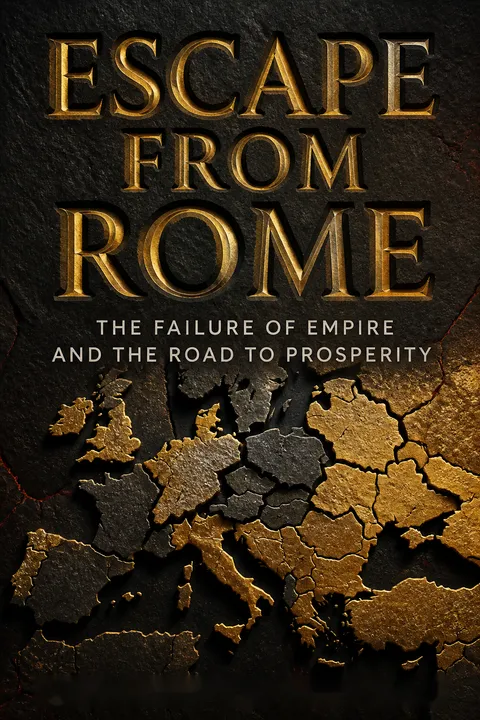
Escape from Rome by Walter Scheidel argues that Europe's modern prosperity stems from Rome's permanent collapse, creating persistent political fragmentation. Unlike China and other regions where empires repeatedly reformed, Europe's "polycentrism" fostered intense competition, driving innovation in science, technology, and institutions. Scheidel uses extensive counterfactual analysis to demonstrate why Europe never reunified, attributing this to geography, distance from steppes, and structural factors. Reviews praise the book's ambitious scope, synthesizing world history across 3,000 years, though some find it dense or overly reliant on counterfactuals.
People Also Read






The Princeton Economic History of the Western World Series Series


About the Author
Download PDF
Download EPUB
.epub digital book format is ideal for reading ebooks on phones, tablets, and e-readers.








































