
Summary Unavailable
This book is not suitable for a summary (it may be a textbook, workbook, cookbook, reference book, or collection). However, you can still explore the FAQs, about author, and other metadata below!
Key Takeaways
1. Dynamics: The Study of Accelerated Motion
Dynamics is concerned with the accelerated motion of bodies.
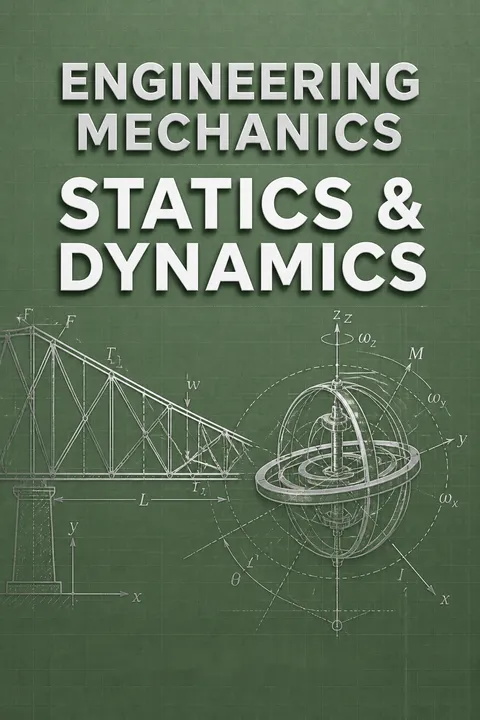
Foundational understanding. Engineering Mechanics is broadly divided into statics, dealing with bodies in equilibrium, and dynamics, which focuses on bodies undergoing accelerated motion. Dynamics itself is further categorized into kinematics, which describes the geometry of motion without considering forces, and kinetics, which analyzes the forces causing that motion. This fundamental distinction is crucial for approaching any problem in the field.
Particle vs. rigid body. The initial step in dynamic analysis involves modeling the object of interest either as a particle or a rigid body. A particle is an idealized model with mass but negligible size and shape, simplifying analysis by focusing solely on its translational motion. A rigid body, conversely, possesses both mass and a fixed size and shape, meaning its motion can involve both translation and rotation, introducing additional complexities.
Problem-solving framework. Regardless of the model chosen, the overarching goal in dynamics is to predict how objects move under the influence of forces or to determine the forces required to achieve a desired motion. This involves a systematic approach that integrates kinematic descriptions with kinetic principles, often requiring the use of specific mathematical tools and coordinate systems tailored to the problem at hand.
2. Mastering Free-Body Diagrams is Essential for Kinetics
Successful application of the equation of motion (1.1) requires a complete specification of all the known and unknown external forces (ΣF) that act on the object.
Visualizing forces. A free-body diagram (FBD) is a fundamental tool in dynamics, serving as a visual representation of an object isolated from its surroundings, with all external forces and couple moments acting upon it clearly depicted. This isolation helps to identify every force, whether active (tending to cause motion) or reactive (resulting from constraints), ensuring no critical component is overlooked in the analysis.
Kinetic diagrams complement. Often, a kinetic diagram is drawn alongside the FBD, graphically representing the resultant acceleration terms (e.g., ma for a particle or maG and IGα for a rigid body). Together, the FBD and kinetic diagram provide a pictorial form of Newton's Second Law, making it easier to formulate the scalar equations of motion by equating the sum of external forces/moments to the corresponding acceleration terms.
Systematic approach. The procedure for drawing an FBD involves:
- Selecting an inertial coordinate system (e.g., x-y, n-t).
- Isolating the object and sketching its outline.
- Identifying and drawing all external forces (applied loads, reactions, weight, friction).
- Labeling known magnitudes and directions, and assigning variables to unknowns.
- Indicating the assumed direction of unknown forces; a negative result later will simply mean the actual direction is opposite.
3. Particle Kinetics: Force, Acceleration, and Coordinate Systems
Newton’s second law of motion states that the unbalanced force on a particle causes it to accelerate.
Newton's core law. For a particle, the cornerstone of kinetics is Newton's Second Law, expressed as ΣF = ma. This vector equation relates the net external force acting on the particle to its mass and the acceleration it experiences. Its validity hinges on measurements being made from a Newtonian or inertial frame of reference, which is either fixed or translates at a constant velocity.
Scalar components. In practical applications, the vector equation ΣF = ma is typically broken down into scalar components along chosen coordinate axes. Depending on the nature of the motion, different coordinate systems are advantageous:
- Rectangular (x, y, z): Ideal for rectilinear motion or when forces are easily resolved into fixed perpendicular directions.
- Normal and Tangential (n, t): Best for curvilinear motion along a known path, as acceleration naturally decomposes into
an = v²/ρ(normal, towards center of curvature) andat = dv/dt(tangential, along path). - Cylindrical (r, θ, z): Useful when motion is described by radial distance, angular position, and axial height, particularly for problems involving angular motion of a radial line.
Problem-solving integration. Solving particle kinetics problems often involves a three-step process: drawing the FBD, applying the appropriate scalar equations of motion based on the chosen coordinate system, and then using kinematic equations (if needed) to relate acceleration to velocity or position. This systematic approach ensures all forces and motion characteristics are accounted for.
4. Work and Energy: A Powerful Alternative for Kinetic Analysis
The principle of work and energy for a particle is described by the equation T₁ + ΣU₁₋₂ = T₂.
Energy conservation. The principle of work and energy provides an alternative, scalar approach to solving kinetic problems, particularly those involving force, velocity, and displacement. It states that the initial kinetic energy (T₁) of a particle plus the work done by all forces (ΣU₁₋₂) acting on it equals its final kinetic energy (T₂). Kinetic energy is defined as T = ½mv², always positive, and work is done only when a force causes displacement in its direction.
Types of work. Understanding how different forces perform work is critical:
- Constant Force:
U = F cosθ (s₂ - s₁). - Variable Force: Requires integration
U = ∫F cosθ ds. - Weight:
U = ±Wy, positive if displacement is downward, negative if upward. - Spring Force:
U = -½k(s₂² - s₁²), negative as the spring force opposes the body's displacement.
Forces like reactions at fixed supports or those perpendicular to displacement do no work.
Conservative forces and potential energy. A special class of forces, known as conservative forces (e.g., gravity, elastic springs), do work independent of the path taken. For these forces, the principle of conservation of mechanical energy applies: T₁ + V₁ = T₂ + V₂, where V is the potential energy (Vg = Wy for gravity, Ve = ½ks² for springs). This simplifies analysis by only requiring initial and final states, rather than tracking work over a path.
5. Impulse and Momentum: Analyzing Force Over Time and Impact
The principle of linear impulse and momentum is obtained from a time integration of the equation of motion and is described by the equation mv₁ + ∫F dt = mv₂.
Force over time. The principle of linear impulse and momentum is a vector approach particularly useful for problems involving force, time, and velocity, especially when forces are constant or time-dependent. It states that a particle's initial linear momentum (mv₁) plus the sum of all linear impulses (∫F dt) applied to it equals its final linear momentum (mv₂). Linear momentum (L = mv) is a vector quantity, and linear impulse (I = ∫F dt) measures the effect of a force over a time interval.
Conservation of momentum. A powerful simplification occurs when the sum of external impulses acting on a system of particles is zero; in this case, linear momentum is conserved (Σ(mv)₁ = Σ(mv)₂). This principle is invaluable for analyzing collisions (impact) where internal forces are large and unknown, as these internal impulses cancel out within the system. Non-impulsive forces (like weight over a very short impact duration) can often be neglected.
Angular momentum and impact. Beyond linear motion, angular momentum (H₀ = r × mv or H₀ = I₀ω for rigid bodies) and the principle of angular impulse and momentum ((H₀)₁ + ∫M₀ dt = (H₀)₂) are used for rotational effects. For impact problems, particularly eccentric impact where the line of impact doesn't pass through the mass centers, both linear momentum conservation (along the line of impact) and the coefficient of restitution (e = -(vB₂ - vA₂)/(vA₁ - vB₁)) are crucial for determining post-impact velocities.
6. Rigid Body Motion: Combining Translation and Rotation
When all the particles of a rigid body move along paths which are equidistant from a fixed plane, the body is said to undergo planar motion.
Complex motion types. Unlike particles, rigid bodies can exhibit more complex motion due to their fixed size and shape. Planar rigid-body motion, where all particles move in planes equidistant from a fixed plane, is categorized into three types:
- Translation: Every point in the body moves with the same velocity and acceleration. This can be rectilinear (straight-line paths) or curvilinear (curved, parallel paths).
- Rotation about a Fixed Axis: All points move in circular paths around a fixed axis, described by angular position (
θ), angular velocity (ω), and angular acceleration (α). - General Plane Motion: A combination of translation and rotation, where the body translates and simultaneously rotates about an axis perpendicular to the plane of motion.
Angular motion parameters. For rotational motion, angular velocity (ω = dθ/dt) and angular acceleration (α = dω/dt) are key. These are vector quantities, with direction along the axis of rotation. The motion of any point P on a rotating body is then related to these angular quantities and its radial distance r from the axis:
- Velocity:
v = rω, tangent to the circular path. - Acceleration: Has tangential (
at = rα) and normal (an = rω²) components.
Kinematic analysis. Analyzing rigid body motion often involves relating the motion of different points on the body. For translation, vB = vA and aB = aA. For rotation, vP = ω × rP and aP = α × rP + ω × (ω × rP). These vector relationships are fundamental for understanding how different parts of a rigid body move relative to each other.
7. Planar Rigid Body Kinetics: Force, Acceleration, and Moment of Inertia
The moment of inertia is a measure of the resistance of a body to angular acceleration in the same way that mass is a measure of the body’s resistance to acceleration.
Rotational inertia. For rigid bodies, kinetics extends beyond ΣF = ma to include rotational effects. A new property, the moment of inertia (I = ∫r²dm), quantifies a body's resistance to angular acceleration about a specific axis. It depends on the body's mass distribution and the chosen axis. The parallel-axis theorem (I = IG + md²) allows calculation of moment of inertia about any parallel axis if IG (about the mass center G) is known.
Equations of motion. Planar kinetics for a rigid body is governed by three scalar equations:
- Translational:
ΣFx = m(aG)xandΣFy = m(aG)y, relating external forces to the acceleration of the mass centerG. - Rotational:
ΣMG = IGα, relating the sum of moments about the mass centerGto the angular accelerationαandIG. Alternatively, moments can be summed about any pointP(ΣMP = (Mk)P), where(Mk)PincludesIGαand the moments ofmaGcomponents aboutP.
Problem-solving strategy. Solving rigid body kinetics problems requires a meticulous approach:
- Draw a free-body diagram to identify all external forces and couple moments.
- Determine the moment of inertia (
IGorIO). - Apply the three equations of motion, choosing a moment center (G or a fixed point O) that simplifies calculations.
- Integrate kinematic relationships (e.g.,
aG = rαfor rolling without slipping) if additional equations are needed.
8. Relative Motion Analysis: Simplifying Complex Kinematics
The relative velocity equation vB = vA + ω × rB/A can be applied either by using Cartesian vector analysis, or by writing the x and y scalar component equations directly.
Breaking down complexity. When a rigid body undergoes general plane motion, the motion of one point relative to another can be complex. Relative motion analysis simplifies this by relating the motion of two points on the same rigid body. The key equations are:
- Velocity:
vB = vA + vB/A = vA + ω × rB/A - Acceleration:
aB = aA + aB/A = aA + α × rB/A - ω²rB/A
Here,vB/AandaB/Arepresent the relative velocity and acceleration of point B with respect to point A, as if A were fixed.
Instantaneous Center of Zero Velocity (IC). For velocity analysis, the concept of the Instantaneous Center of Zero Velocity (IC) is a powerful shortcut. The IC is a point on or off the body that momentarily has zero velocity. If point A is chosen as the IC, then vA = 0, simplifying the velocity equation to vB = ω × rB/IC. This means the body appears to rotate purely about the IC at that instant, and the velocity of any other point B is simply vB = rB/IC * ω, perpendicular to rB/IC.
Limitations of IC. While the IC is excellent for velocities, it generally does not have zero acceleration (aIC ≠ 0), so it cannot be directly used to simplify acceleration analysis. For accelerations, the full relative acceleration equation must be applied, often requiring a prior velocity analysis to determine ω.
9. Three-Dimensional Dynamics: Expanding Inertia and Motion Equations
For the kinetic analysis of three-dimensional motion it will sometimes be necessary to calculate six inertial quantities.
Beyond planar motion. Three-dimensional rigid body dynamics significantly increases complexity, requiring a more comprehensive description of mass distribution and motion. Instead of a single moment of inertia, six inertial quantities are needed: three moments of inertia (Ixx, Iyy, Izz) and three products of inertia (Ixy, Iyz, Ixz). These are organized into an inertia tensor, which fully characterizes a body's inertial properties relative to a chosen coordinate system.
Angular momentum in 3D. The angular momentum vector H in 3D has components that depend on all moments and products of inertia and the angular velocity components (ωx, ωy, ωz). If the coordinate axes are aligned with the body's principal axes of inertia (where products of inertia are zero), the angular momentum simplifies to Hx = Ixωx, Hy = Iyωy, Hz = Izωz.
Euler's equations of motion. The rotational equations of motion in 3D are more intricate than their planar counterparts. When the coordinate axes are fixed to and move with the body (and are principal axes of inertia), they become Euler's equations:
Mx = Ixω̇x - (Iy - Iz)ωyωzMy = Iyω̇y - (Iz - Ix)ωzωxMz = Izω̇z - (Ix - Iy)ωxωy
These are a set of coupled, nonlinear differential equations, making general solutions challenging and often requiring numerical methods.
10. Vibrations: Understanding Periodic Motion and System Response
A vibration is the periodic motion of a body or system of connected bodies displaced from a position of equilibrium.
Periodic motion. Vibrations describe the oscillatory motion of a system around an equilibrium position, driven by restoring forces (gravitational or elastic). They are classified by their nature:
- Free Vibration: Occurs when a system is displaced and released, oscillating at its natural frequency.
- Forced Vibration: Caused by an external, periodic force or support displacement.
- Undamped Vibration: Idealized motion where frictional effects are neglected, allowing indefinite oscillation.
- Damped Vibration: Realistic motion where frictional forces cause oscillations to decay over time.
Undamped free vibration. For a simple one-degree-of-freedom system (like a block-spring), undamped free vibration is described by ẍ + p²x = 0, where p = √(k/m) is the circular frequency. The solution x(t) = C sin(pt + φ) defines the amplitude C, period τ = 2π/p, and natural frequency f = 1/τ. Energy methods (conservation of T + V) can also be used to derive p.
Damped and forced vibrations. Real-world systems experience damping, often modeled as viscous damping (F = cẋ). This leads to mẍ + cẋ + kx = 0, with solutions depending on the damping coefficient c relative to the critical damping cc. Forced vibrations (mẍ + cẋ + kx = F₀ sinωt) introduce a forcing frequency ω. A critical phenomenon, resonance, occurs when ω approaches the natural frequency p, leading to dangerously large amplitudes if damping is insufficient.
Last updated:
Report IssueReview Summary
People Also Read

About the Author
Other books by Russell C. Hibbeler

Download PDF
Download EPUB
.epub digital book format is ideal for reading ebooks on phones, tablets, and e-readers.








































