

Key Takeaways
A soul mate doesn't complete you; it triggers your own wholeness
Cayce flips the romantic myth. Popular culture, borrowing from Plato's Symposium (where Zeus splits humans in half, leaving each craving its lost other), treats a soul mate as your missing piece. Edgar Cayce, the trance clairvoyant who gave roughly 2,000 life readings between 1901 and 1944, rejected that. When a woman asked him to define the term in relation to her spiritual growth, he described it as one soul answering another like tongue to groove, tenon to mortise, a complement of mind and spirit rather than physical attraction.
The purpose is growth, not rescue. You are drawn to someone not because they finish you, but because being with them supplies the friction and support to finish yourself. Every soul, Cayce insisted, eventually becomes whole within itself.
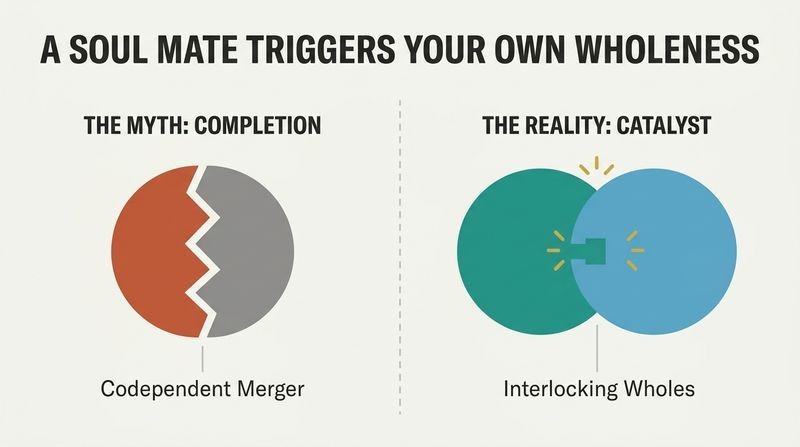
The reframe is quietly radical and lines up with modern relationship psychology. Attachment researchers and therapists like Esther Perel warn that expecting one partner to be your everything (lover, best friend, therapist, muse) sets marriages up to fail. Cayce's version predates that critique by decades: stop outsourcing your wholeness. What's striking is how this dissolves the scarcity panic ("what if I never find them?") baked into the myth. The weakness, of course, is empirical: the claim rests on trance readings and reincarnation, not controlled study. But the psychological payload survives even if one brackets the metaphysics entirely.
You have dozens of soul mates, not one cosmic needle in a haystack
The math of destiny is generous. Asked whether one particular man was hers to marry, Cayce answered that she had met several she could marry. When a woman in 1942 wanted to know if someone other than her fiance could make her equally happy, he replied that she could find twenty-five or thirty such partners if she chose to, because "it is what you make it."
Choice outranks fate. Rose, a 1920s Broadway actress, asked Cayce to confirm her suitor Bryant. He refused to gush, saying only "What they make it!" and noting no one is perfectly suited at the start. They married anyway and stayed together over forty years. Each soul mate simply offers a different set of lessons; some choices are wiser than others, but none is the only door.
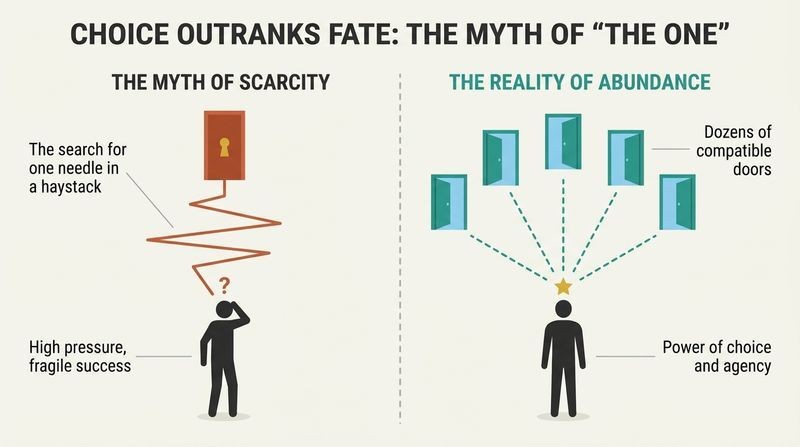
This defuses the paralyzing "one true match" anxiety that dating apps and rom-coms inflame. Behavioral economists would recognize the danger Cayce sidesteps: maximizers who believe in a single optimal choice report lower satisfaction than satisficers who commit and build. The counterintuitive move is treating compatibility as constructed rather than discovered. A fair challenge: if everyone is a potential soul mate, the term risks meaning nothing. Cayce's answer is that the label matters less than the work, which is precisely the point, though skeptics may find the concept stretched past usefulness.
Expect conflict from your soul mate; the friction is the curriculum
The perfect-relationship fantasy is the trap. Cayce warned that a soul mate hands you problems and obstacles just as you hand them yours. The person you feel closest to often becomes the mirror reflecting your own weaknesses back at you. Rose and Bryant fought, endured a hostile mother-in-law (traced to a past-life rivalry), and clashed over her longing for the spotlight versus his obsession with business.
Reconcilable is not the same as easy. Hans and Katherine, married fifty-four years, offered their formula bluntly: give sixty percent and expect forty. Cayce told one struggling couple it would take them at least ten years to build an ideal relationship. The distinction he drew was between happiness and contentment: happiness fluctuates, but two people can always be made content if they hold a shared purpose.
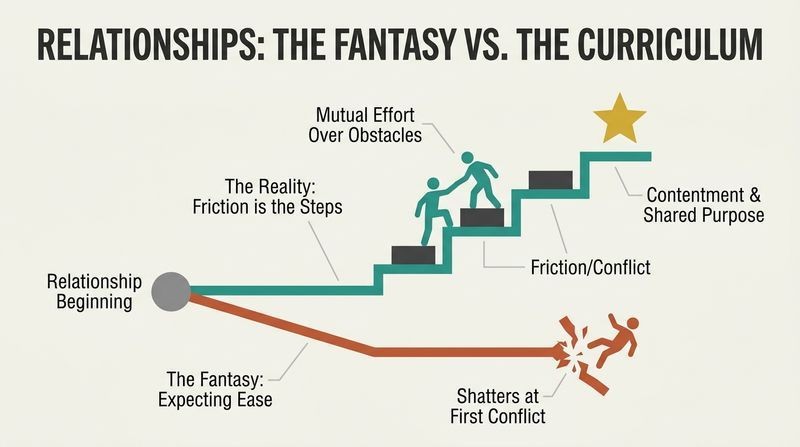
John Gottman's decades of marriage research converge here: roughly two-thirds of relationship conflicts are perpetual and never fully solved, and thriving couples simply learn to manage them with what he calls repair attempts. Cayce's "minimize the faults, magnify the virtues" is essentially Gottman's positive-to-negative interaction ratio in devotional language. The give-sixty-expect-forty rule beats the tidy fifty-fifty because it builds in slack for asymmetry and bad days. The corrective this offers modern readers is against conflict-avoidance: the absence of friction may signal disengagement, not harmony. Where it gets shakier is attributing every marital snag to karmic residue rather than ordinary incompatibility.
Tell real love from mere pull by asking if it makes you better
Desire draws in; love gives out. Cayce defined true love as giving in action with no concern for return, while desire is the impulse to draw a person or thing toward yourself. Attraction alone, even overpowering attraction, often signals unfinished karmic business rather than a partnership worth building. A New York attorney felt "hopelessly drawn" to his mistress, abandoned his wife repeatedly, and Cayce diagnosed the pull as self-gratification traced to an ancient adultery, not love.
Four diagnostic questions. When torn, ask yourself: Does this relationship make me a better person? Does it stretch and challenge me? Does it push me toward becoming more balanced and giving? Does it summon the best in me? If the answer is a hormonal yes but a spiritual no, the magnetism may be a lesson, not a life.
The give-versus-grab distinction maps neatly onto psychologist Robert Sternberg's triangular theory, where infatuation (passion without intimacy or commitment) burns hot and dies fast, exactly what happened to the author's own friend whose "soul mate" affair collapsed in six months. Neuroscience adds teeth: the dopamine-driven limerence of early attraction is chemically distinct from the oxytocin-based bonding of durable attachment, and it reliably fades in twelve to eighteen months. Cayce's four questions function as a sobriety test for that chemical high. The nuance worth adding: intense attraction and genuine love are not mutually exclusive, and the framework can be misused to rationalize settling.
You chose your parents, and your children chose you
Souls select their families. Between lifetimes, Cayce taught, a soul takes stock of what it needs to learn, then waits for the right parents and moment. Asked why she picked her parents, a teenager was told: for her own enlightenment and her parents' understanding. This applies to adopted children too, who choose spiritually where birth children choose only at a soul level.
Even hard families are chosen deliberately. The unsettling corollary: a soul may pick an abusive parent to master a lesson or to become equipped to help others through the same wound. In one reading a woman who had nearly destroyed someone in a past life became mother to that same soul, now born blind and disabled, so she could learn loving service. The soul weighs the potential outcome, not the comfort, of the situation.
This is the book's most emotionally combustible claim, and it deserves careful handling. Framed carelessly, "you chose your abuse" curdles into victim-blaming, a critique leveled at karma doctrines broadly and at some New Age teachers specifically. Cayce's own hedge is that free will governs what you do with the situation, never that suffering is deserved. There is a redemptive cousin to this idea in secular psychology: post-traumatic growth research shows some survivors convert adversity into meaning and helping vocations, exactly the counselor-born-to-hardship pattern described. But agency reframed as prenatal consent remains philosophically slippery, and readers grieving real harm should hold it loosely.
Every important friendship is a contract you signed in a past life
Nobody significant is a stranger. "Friendships are only the renewing of former purposes," Cayce said. He told a young man that his closest present-day friends were simply those active in his life right now, because we do not meet anyone of importance for the first time. Tina's childhood best friend Lauren, with whom she agreed to never say goodbye, was traced through a regression to a Scottish lifetime as her older sister, part of a bond built over 8,000 years.
Friendship is grown, not hoarded. Cayce repeatedly warned that no one has so many friends they can afford to lose even one. His practical counsel: where you agree, deepen it; where you disagree, do not try to win. Love and friendship, he said, grow only by being showered on others.
Strip the reincarnation and a durable social-science truth remains: the instant-click sensation of meeting someone and feeling you have known them forever is real and studied. Psychologists call it fast friendship, driven by rapid reciprocal self-disclosure, the same mechanism Arthur Aron engineered in his famous 36-questions experiment. Cayce intuited that the depth precedes the timeline. His "don't try to convince a friend of your veracity" is also sturdy conflict advice, echoing research that persuasion attempts in close relationships often backfire and erode trust. The past-life framing is unfalsifiable, but it functions usefully as a reason to treat every meaningful bond as precious and non-disposable.
Twin souls share a mission, not a mattress
The most misread term in the book. People begged Cayce to identify their "twin soul," "twin flame," or "twin ray," assuming it meant the ultimate romantic other half. He corrected them flatly: no two souls are identical, just as no two leaves or blades of grass are. A twin soul relationship is defined by unity of purpose, two people bound to accomplish a shared work.
Often not romantic at all. Cayce named Jesus and his mother Mary as twin souls. Most revealingly, his own twin soul was not his beloved wife Gertrude but his secretary Gladys Davis, who recorded and preserved 95 percent of his readings. Gertrude, in turn, was twin soul to their son Hugh Lynn, who built the organization that carried the work forward. The tie is vocational, not sexual.
The contemporary "twin flame" industry has drifted far from this, marketing an intense, often turbulent romance as spiritual destiny, sometimes to justify staying in toxic dynamics. Cayce's original is almost the opposite: a partnership organized around a task, frequently platonic, sometimes parent-child. That reframe is healthier and more interesting. It resonates with the idea of a "work spouse" or a great creative duo (Lennon and McCartney, the Curies) whose bond is generativity rather than passion. The obvious limitation is verifiability, since who counts as whose twin was declared by Cayce in trance with no external check, making the concept impossible to test or falsify.
Cure loneliness by serving others, not by hunting for a mate
Cayce never gave directions to love. Struck by how consistently he refused to tell lonely people where to find a partner, the author highlights his standard prescription instead: do something for someone worse off, develop your buried talents, and find your ideal first. To a widow craving companionship he said make others' lives worthwhile, because "only that ye give away do ye possess."
Loneliness is a signal, not a sentence. He often diagnosed it as self-suppression. Women who felt isolated were repeatedly told they had stifled their own gifts, writing, teaching, entertaining, out of fear of others' opinions, and that expressing those gifts would draw people in. One woman, told to stop hunting and return to her work with children, ran into her old employer a month later and eventually met her husband right on schedule.
This inverts the intuitive fix and matches robust findings. Loneliness researcher John Cacioppo showed that chronic loneliness distorts social perception, making the lonely hypervigilant to rejection, which drives others away, a self-fulfilling loop; the exit is other-focused engagement, not more anxious seeking. Volunteering is linked in multiple studies to reduced loneliness and higher wellbeing. Cayce's "like attracts like" is a folk statement of the truth that warmth radiated tends to return. One caution worth naming: for people whose loneliness stems from social anxiety, trauma, or circumstance, "just go serve others" can feel dismissive, and structural or therapeutic support may be needed alongside the giving.
Your attitude at conception helps decide which soul comes to you
Parents are magnets, not just vessels. Cayce taught that the thoughts, feelings, and ideals held at conception and throughout pregnancy create a vibration that only certain souls can enter through. Asked what mental attitude to keep, he told one expectant mother it depended entirely on the character of child she wanted: dwell on music and beauty for an artistic soul, on mechanics for a mechanical one.
Attitude shapes character. He urged mothers to stay cheerful, spiritual, and hopeful, to read uplifting material, and to treat the pregnancy as offering a channel for God's love rather than a duty. He cited Isaac and Rebekah, whose clashing desires produced opposite twins Esau and Jacob, and Hannah, whose spiritual expectancy drew the prophet Samuel. Without higher ideals, he warned, parents could just as easily attract a soul bent on chaos.
The metaphysics here are unprovable, but a scientifically respectable shadow of it exists. Prenatal and perinatal research (the field of fetal programming, and studies on maternal stress hormones like cortisol crossing the placenta) shows that a mother's psychological state measurably influences fetal development and later temperament. Epigenetics adds that environment can switch genes on and off without altering the code. Cayce, writing before any of this vocabulary existed, gestured at maternal mindset shaping the child. The risk is a heavy guilt burden: telling mothers their attitude determines their child's soul can weaponize normal ambivalence and anxiety into self-blame, which the compassionate reading must actively resist.
The people who irritate you are mirrors of what you avoid facing
Like attracts like, so others reflect you. Cayce's recurring universal law says you constantly draw to yourself what you put out. The practical twist: anyone who provokes a strong emotional reaction, positive or negative, is showing you a part of yourself. The people who drive you crazy reveal what you still need to work on; the people you admire reveal qualities you can claim.
Change yourself, change the relationship. Because you can only change yourself, healing any relationship starts internally. A man seeking family harmony was told his home was disordered because he was; fix the inner discord and the family would follow. Cayce's proof was homely: even your worst enemy has a best friend, and your best friend has someone who dislikes them, so the difference lives in the perceiver, not the person.
This is the ancient doctrine of projection dressed in spiritual clothes, and it anticipates Carl Jung's shadow work almost exactly: the traits we cannot tolerate in others are often disowned parts of ourselves. Jung, incidentally, appears in the book as a chapter epigraph, and the overlap is no accident given both drew on reincarnation-adjacent ideas. Modern cognitive-behavioral therapy converges too, teaching that we control our appraisals and responses, not others' behavior. The valuable discipline here is radical ownership. The overreach is the implication that all interpersonal friction is self-generated; sometimes difficult people are simply difficult, and reflexive self-blame can trap victims in harmful situations they should leave.
Build love in four moves, because perfect partners are made not found
Cayce's practical method for any relationship. He gave the same recipe whether the bond was a marriage, friendship, or feud:
1. Learn to love and understand yourself, since a poor self-image attracts critics and controllers.
2. Set a conscious spiritual ideal, a chosen intent like forgiveness, and ask how a forgiving person would respond.
3. Apply the best you know now, because knowledge without action changes nothing.
4. Expect things to change so they can.
Act instead of react. The point of the ideal is to stop running old grievance patterns and start responding deliberately. Joe and Christine, both on their third marriage, credit becoming each other's honest mirror. Cayce's line: heal your corner of the world one relationship at a time, and the ultimate soul mate you are seeking through all of them is the Creator.
The sequence is a clean cognitive-behavioral protocol in disguise: self-worth, then a values-based intention, then behavioral activation, then outcome expectancy, the same architecture found in acceptance and commitment therapy, where chosen values steer action regardless of feelings. "Act, don't react" is the core of emotional regulation research on the gap between stimulus and response. The self-love-first step aligns with attachment findings that a secure relationship with oneself predicts healthier partnerships. The closing move, that every human bond is ultimately practice for union with the divine, is the book's theological capstone; it will land powerfully for spiritual readers and feel like a leap for secular ones, but the four steps stand on their own without it.
Analysis
This is a spiritual self-help book built on an unusual foundation: the trance readings of Edgar Cayce, America's most documented twentieth-century psychic, reinterpreted by Kevin Todeschi, longtime steward of Cayce's archive. Structurally it is a case-history anthology, alternating archival readings (identified by confidential numbers) with contemporary couples, threaded onto a single thesis. That thesis is genuinely contrarian within its genre. Where soul mate literature sells the fantasy of a predestined other half who completes you, Todeschi's Cayce dismantles it: you have many soul mates, they arrive to catalyze rather than complete you, and the relationship is a workshop for self-development, not a reward.
The book's intellectual value survives its metaphysics. Bracket reincarnation and the Akashic Records, and what remains is a coherent relational psychology strikingly congruent with later research: expect perpetual conflict (Gottman), stop maximizing for a mythical perfect match (Schwartz), cure loneliness through other-directed service (Cacioppo), own your projections (Jung), and change the only person you can, yourself. The give-sixty-expect-forty ethic and the four-step method for building love are portable and testable in daily life regardless of belief.
The weaknesses are real. The evidentiary base is unfalsifiable; every claim traces to a sleeping man's pronouncements, and confirmation bias saturates the follow-up reports, which are self-selected and interpreted by believers. The doctrine that souls choose abusive parents and that maternal attitude summons a child's character carries genuine ethical hazard, sliding toward victim-blaming and parental guilt if held rigidly. Todeschi's Cayce hedges with free will, but the tension is never fully resolved.
What makes the book endure is its reframe of longing. It converts the desperate external search for "the one" into an internal project of becoming whole, and it insists that difficult relationships are not failures but assignments. Read as psychology wearing spiritual dress, it is quietly practical; read as literal cosmology, it demands a faith it cannot prove.
Review Summary
Edgar Cayce On Soul Mates receives mixed reviews, with readers appreciating its insights on relationships and personal growth. Many find the concept of multiple soul mates across lifetimes intriguing, while others criticize the book for being repetitive or lacking new information. Positive reviews highlight the book's perspective on relationships as opportunities for spiritual growth and learning. Critics argue that the content is common sense or irrelevant to understanding soul mates. Overall, readers seem divided on the book's value, with some finding it enlightening and others dismissing it as uninteresting or overly simplistic.
People Also Read



FAQ
What's "Edgar Cayce on Soul Mates" about?
- Exploration of Soul Mates: The book delves into the concept of soul mates as described by Edgar Cayce, focusing on the dynamics of soul attraction and the spiritual growth that comes from relationships.
- Cayce's Readings: It draws extensively from the psychic readings of Edgar Cayce, providing insights into how past-life connections influence present relationships.
- Purposeful Relationships: The book emphasizes that soul mate relationships are not perfect from the start but are meant to be purposeful, aiding in personal and spiritual development.
Why should I read "Edgar Cayce on Soul Mates"?
- Understanding Relationships: It offers a unique perspective on relationships, suggesting that they are opportunities for spiritual growth and self-discovery.
- Spiritual Insights: The book provides spiritual insights into the nature of love and companionship, drawing from Cayce's extensive readings.
- Practical Advice: Readers can find practical advice on how to improve their relationships by understanding past-life influences and applying spiritual principles.
What are the key takeaways of "Edgar Cayce on Soul Mates"?
- Soul Growth: Relationships are a means for soul growth and personal transformation, not just romantic fulfillment.
- Past-Life Connections: Many of our current relationships are influenced by past-life connections, which can be both positive and negative.
- Spiritual Ideals: Establishing spiritual ideals can help transform relationships, making them more fulfilling and purposeful.
How does Edgar Cayce define soul mates in the book?
- Not Just Romantic: Soul mates are not limited to romantic partners; they can be family members, friends, or even work associates.
- Ongoing Connection: A soul mate relationship is an ongoing connection that spans various lifetimes, providing opportunities for growth.
- Spiritual Development: The primary purpose of a soul mate relationship is to assist each individual in their spiritual development.
What advice does Edgar Cayce give for creating soul mate relationships?
- Self-Understanding: Begin by learning to love and understand yourself, as this sets the foundation for all relationships.
- Spiritual Ideals: Establish a spiritual ideal to guide your actions and interactions with others.
- Application and Expectation: Apply what you know to be right and expect positive changes in your relationships.
What role do past lives play in soul mate relationships according to the book?
- Influence on Present: Past lives influence present relationships by bringing unresolved issues or positive connections into the current life.
- Karmic Patterns: Relationships often pick up where they left off in past lives, providing opportunities to resolve karmic patterns.
- Purposeful Encounters: The book suggests that no significant relationship is by chance; they are purposeful encounters meant for growth.
How does the book suggest handling challenges in soul mate relationships?
- Self-Reflection: Challenges are opportunities to meet oneself and should be approached with self-reflection and understanding.
- Spiritual Growth: Use challenges as stepping stones for spiritual growth rather than obstacles.
- Unconditional Love: Approach difficulties with unconditional love and patience, focusing on the spiritual development of both parties.
What are some of the best quotes from "Edgar Cayce on Soul Mates" and what do they mean?
- "A divided house cannot stand." This emphasizes the importance of unity and cooperation in relationships for them to thrive.
- "Love is giving in action." True love is about selfless giving without expecting anything in return, which is central to soul mate relationships.
- "Each soul must find its way back to its God." This highlights the spiritual journey of each soul towards realizing its divine connection.
How does Edgar Cayce's concept of twin souls differ from soul mates?
- Shared Purpose: Twin souls come together for a shared purpose or work, rather than primarily for romantic reasons.
- Not Identical Halves: Twin souls are not two halves of the same soul but are deeply connected through shared ideals and missions.
- Examples in History: The book cites examples like Jesus and Mary as twin souls, emphasizing their joint spiritual mission.
What is the significance of spiritual ideals in relationships according to the book?
- Guiding Principles: Spiritual ideals serve as guiding principles that help individuals navigate their relationships with purpose and clarity.
- Transformative Power: By aligning actions with spiritual ideals, individuals can transform their relationships into more fulfilling and harmonious experiences.
- Foundation for Growth: Ideals provide a foundation for personal and spiritual growth, influencing how individuals interact with others.
How does the book address the concept of loneliness in relation to soul mates?
- Time for Growth: Loneliness is seen as a time for personal growth and self-discovery, preparing individuals for future relationships.
- Service to Others: The book encourages reaching out and serving others as a way to overcome loneliness and attract meaningful relationships.
- Inner Reflection: Loneliness prompts inner reflection, helping individuals understand their true needs and desires.
What does the book say about the role of parents in soul attraction?
- Influence of Attitudes: Parents' attitudes and ideals during conception and pregnancy influence the soul that is attracted to them.
- Spiritual Environment: Creating a spiritual environment can attract a soul that brings light and love into the world.
- Responsibility of Parenthood: Parents are responsible for providing an upbringing that nurtures the child's spiritual and personal development.
Download PDF
Download EPUB
.epub digital book format is ideal for reading ebooks on phones, tablets, and e-readers.








































