Key Takeaways
1. Economics is a broad, evolving, and often derided field, yet it profoundly shapes our world.
“Practical men, who believe themselves quite exempt from any intellectual influences, are usually the slaves of some defunct economist.”
Defining economics. Economics, derived from Greek words for 'household' and 'rules,' initially focused on estate management but has expanded to encompass the study of the economy, coordination processes, scarcity, choice, and human behavior. It integrates elements from sociology, psychology, politics, geography, statistics, and mathematics, primarily focusing on market-based transactions involving money. Despite its pervasive influence on daily news and election outcomes, the field is frequently mocked for its inaccurate forecasts and perceived market fundamentalism.
Historical evolution. Economic thought has dramatically shifted over centuries, from ancient rulers concerned with tax revenues and famine prevention to medieval philosophers debating "just prices" and usury. The 17th and 18th centuries saw the emergence of the economy as a complete system, with thinkers like Sir William Petty and François Quesnay attempting to map income flows. This evolution highlights a continuous adaptation to contemporary issues, from early trade debates to modern concerns about productivity and climate change.
Key economic indicators. Understanding economics requires familiarity with core macroeconomic statistics, despite their inherent measurement challenges and forecasting difficulties. These vital metrics provide a snapshot of economic health and guide policy debates:
- Gross Domestic Product (GDP): Measures the monetary value of final goods and services, indicating overall economic health.
- Unemployment: The number of people without jobs, crucial for assessing labor market slack.
- Inflation: A general rise in prices, measured by a basket of goods, impacting purchasing power.
- Balance of Payments: Tracks a nation's transactions with the rest of the world, including trade and financial flows.
- Productivity: The art of creating more output without greater inputs, essential for long-term living standards.
2. Governments wield significant power through fiscal policy, balancing taxation and spending to influence economic activity.
“To stimulate the economy, should governments cut taxes, or increase social benefits, to boost demand? Or should governments cut the regulations and taxes imposed on business to let industry thrive?”
Taxation's purpose. Taxes, a constant throughout recorded civilization, serve not only to fund government spending but also to influence behavior and redistribute wealth. Historically, taxes evolved from corvée and tithes to levies on specific products, and eventually to modern income and sales taxes. The incidence of taxes—where the burden truly falls—is complex, as firms can pass costs to shareholders, customers, or workers, depending on market competitiveness and capital mobility.
Keynesian vs. austerity. Fiscal policy, encompassing government taxation and spending, is a primary tool for economic management. John Maynard Keynes argued that during recessions, governments should increase spending (even if it means deficits) to stimulate demand and create jobs, leading to a "multiplier effect." This contrasts with austerity measures, which advocate cutting spending and raising taxes to balance budgets, a strategy often criticized for exacerbating downturns, as seen in the 2010s post-financial crisis.
Modern fiscal debates. The efficacy and appropriate scale of fiscal policy remain contentious. Debates include:
- Lucas Critique: Argues that anticipated government stimuli are self-defeating as rational agents adjust behavior.
- Crowding Out: Government borrowing might raise interest rates, reducing private sector investment.
- Modern Monetary Theory (MMT): Proposes that governments issuing their own currency can spend freely, constrained only by inflation, not by deficits.
- Tax Design: Taxes are used to influence behavior (e.g., Pigouvian taxes on externalities like pollution) but can also create distortions or fall disproportionately on certain income groups.
3. Central banks manage monetary policy, primarily through interest rates and money supply, to control inflation and ensure financial stability.
“This meant that there was a conflict between the actions needed to save the banking system (increased money supply and low interest rates) and those needed to maintain the gold standard (restricted money supply and high rates).”
Interest rates as a lever. Monetary policy, largely controlled by independent central banks, primarily uses short-term interest rates to influence economic demand. Higher rates encourage saving and discourage borrowing, cooling inflation, while lower rates stimulate spending and investment. Central banks interact with commercial banks through reserves and open market operations to keep market rates aligned with their targets, aiming for price stability and full employment.
Post-crisis innovations. The 2007–09 financial crisis pushed interest rates to the "zero lower bound," prompting central banks to innovate with unconventional tools. Quantitative Easing (QE) involved central banks buying government bonds to lower long-term interest rates and inject liquidity into the economy. While QE successfully averted deflation and financial collapse, it raised concerns about potential long-term inflation, increased government debt, and exacerbated wealth inequality by boosting asset prices.
Money creation and challenges. Most money in a modern economy is created by commercial banks through lending, not by central banks printing notes. Monetarists argue that controlling money supply is key to managing inflation, but this proved difficult in practice due to financial innovation and the variable "velocity of circulation." Monetary policy also faces "long and variable lags" in its effects, making precise timing challenging, and can disproportionately impact financial markets, potentially fostering speculative bubbles and "moral hazard."
4. International trade, driven by specialization and comparative advantage, fosters global prosperity but faces persistent protectionist pressures.
“The benefits of trade are still controversial, even 250 years after The Wealth of Nations was published.”
Foundations of trade. Adam Smith's insights on specialization and David Ricardo's theory of comparative advantage underpin the economic case for free trade. Specialization allows individuals and nations to focus on producing goods and services where they are most efficient, maximizing output and enabling a wider range of goods for consumers. This global division of labor, facilitated by reduced transport costs and international agreements, has been a significant driver of prosperity, particularly for developing nations.
Government interventions. Despite the economic benefits, governments frequently intervene in trade, often citing protectionist arguments. Historical examples include Alexander Hamilton's "infant industry" argument for tariffs and 20th-century "import substituting industrialization" policies. Modern protectionism often arises from concerns over job losses due to foreign competition, national security, or environmental considerations, as seen with the US Inflation Reduction Act's domestic content requirements.
Trade dynamics and institutions. Trade balances (current account surpluses or deficits) reflect a nation's savings and investment dynamics, with persistent deficits often financed by foreign capital inflows. The World Trade Organization (WTO), established after the General Agreement on Tariffs and Trade (GATT), aimed to reduce trade barriers and settle disputes, fostering globalization. However, the WTO faces challenges from populist anti-globalization sentiment and disputes over national sovereignty, leading to a rise in regional trade blocs and a potential retreat from multilateralism.
5. Long-term economic growth fundamentally relies on innovation and productivity, though their measurement and drivers remain complex.
“Productivity is not everything, but in the long run, it’s almost everything.”
Productivity's paramount role. Productivity, defined as producing more output with the same or fewer inputs, is the ultimate driver of improved living standards. Historical examples like the shift from candles to electricity or the iron plough demonstrate how technological and organizational innovations dramatically boost efficiency. Unlike labor or capital, which face diminishing returns, technological change can sustain productivity growth over very long periods, fundamentally transforming economies through "creative destruction."
The productivity puzzle. Despite the transformative power of innovations like the internet, productivity growth has significantly slowed in developed economies since the 2007–09 financial crisis. This slowdown is particularly concerning given aging populations, which place greater reliance on productivity for economic growth. Potential explanations for this "productivity puzzle" include:
- Impact of the financial crisis: Discouraged business investment and led to skill loss.
- Exhaustion of internet-related gains: The initial boost from digital technologies may have peaked.
- Ultra-low interest rates: May have propped up less productive "zombie" firms.
- Increased market concentration: Reduced competition and innovation incentives for dominant firms.
Fostering innovation. Productivity gains stem from various sources, including general-purpose technologies (like electrification or AI), specific gadgets (cotton gin), and new production methods (assembly line). Economists debate whether innovation is "exogenous" (maverick inventors) or "endogenous" (driven by economic structure and policy). Endogenous growth theory suggests that government policies, such as investment in research and development, education, and intellectual property protection (e.g., patents), are crucial for encouraging sustained economic prosperity.
6. The labor market is a dynamic interplay of supply, demand, and policy, grappling with unemployment, inequality, and demographic shifts.
“Demoralisation caused by vast unemployment is our greatest extravagance. Morally, it is the greatest menace to our social order.”
Understanding unemployment. Unemployment, a major concern since the Great Depression, has cyclical, frictional, and structural components. Cyclical unemployment fluctuates with the business cycle, while frictional unemployment is temporary joblessness as workers transition between roles. Structural unemployment arises from mismatches between available jobs and worker skills or location, potentially leading to "hysteresis" where long-term joblessness erodes skills and motivation. Economists also debate the "natural rate of unemployment" (NAIRU), below which inflation accelerates.
Evolving labor dynamics. The 21st century has seen lower overall unemployment rates compared to past decades, but also significant shifts in labor force participation. Factors influencing participation include:
- Aging populations: Baby boomers retiring early.
- Decline in manufacturing: Fewer well-paid jobs for those without college degrees.
- Increased incarceration rates: Limits employment opportunities for felons.
- Women's entry into workforce: A long-term trend that boosted participation until the early 2000s.
Wages, inequality, and policy. The "lump of labor fallacy"—the idea of a fixed number of jobs—is often used to argue against immigration or older workers, but ignores that workers also create demand. While immigration's impact on wages is generally small, skill-biased technological change and executive compensation trends have contributed to widening income inequality. Policies like minimum wages, once controversial, are now seen by some as a way to counter employer power and boost low-income workers, with empirical studies showing limited negative employment effects.
7. Microeconomics reveals how individual and firm decisions, influenced by market forces and information, shape resource allocation and competition.
“Economists like the price mechanism because of its function as a signal to participants in the market.”
Supply, demand, and prices. Microeconomics studies how individuals and firms make decisions, focusing on the fundamental "law" of supply and demand. As prices rise, supply increases while demand falls, and vice versa, eventually reaching a market-clearing equilibrium. The responsiveness of supply and demand to price changes is known as elasticity. The price mechanism acts as a crucial signal, guiding producers to make more of desired goods and consumers to adjust their purchasing behavior, a concept championed by Friedrich von Hayek against government intervention.
Market imperfections. The ideal model of "perfect competition" (many buyers/sellers, homogenous products, perfect information) rarely holds true. Real-world markets are often characterized by:
- Market Power: Monopolies (single seller), duopolies (two dominant sellers), or oligopolies (few sellers) can set prices and earn above-normal profits, stifling competition and innovation.
- Asymmetric Information: One party knows more than the other, leading to inefficiencies (e.g., the "lemons problem" in used car markets, or adverse selection in insurance).
- Winner's Curse: Overpaying in auctions due to competitive bidding.
Firm behavior and utility. Firms exist to efficiently organize complex tasks that markets might make cumbersome, benefiting from limited liability to encourage risk-taking and growth. They make decisions on production, pricing, investment (capital), and labor, aiming to maximize profits. Consumers, in turn, are assumed to maximize "utility"—the satisfaction derived from consuming goods—though this is unmeasurable and subject to "bounded rationality," where decisions are made with limited information and foresight.
8. Beyond mainstream models, critical economic thought highlights crucial issues like environmental costs, inequality, and behavioral biases.
“Economists are frequently criticised by those outside the profession for having too great a focus on transactions and interactions that have a monetary value.”
Environmental blind spots. Mainstream economics is often criticized for failing to adequately account for environmental damage. Activities like pollution or deforestation, while adding to GDP, deplete natural assets without an equivalent accounting for their long-term costs. Economists address these "externalities" through mechanisms like Pigouvian taxes (e.g., carbon taxes) or cap-and-trade schemes, aiming to internalize costs. However, implementing such policies faces challenges, including global coordination, potential disproportionate impact on lower-income groups, and the difficulty of valuing non-monetary benefits like clean air.
Climate change and intergenerational equity. The climate crisis presents a profound economic challenge, requiring current generations to incur costs (e.g., investing in renewable energy) to mitigate future risks for descendants. The debate hinges on the "discount rate" applied to future welfare, with lower rates justifying more immediate action. Beyond economic models, critics advocate for a "doughnut" model that balances social foundations (food, income) with ecological limits, and argue for wealth transfers from historically polluting rich nations to vulnerable developing countries.
Inequality and behavioral insights. Critics argue that economics has historically underemphasized inequality, particularly gender and racial disparities. Unpaid work (often by women) is excluded from GDP, and systemic biases persist in labor markets. Thomas Piketty's work on capital accumulation highlights rising wealth inequality, while studies show that talent allocation improvements have significantly boosted GDP. Behavioral economics, a growing field, challenges the "Homo economicus" assumption of perfect rationality, revealing cognitive biases like "loss aversion" and "hyperbolic discounting" that influence economic decisions, from saving for retirement to financial market speculation.
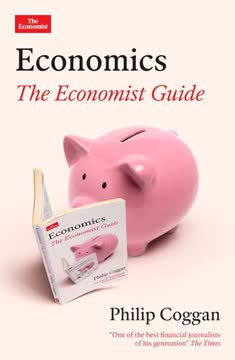
Review Summary
Economics receives a 3.94/5 rating with mixed reviews. Readers appreciate it as a great introduction to economics, particularly praising the A-Z glossary of economic terms. However, criticisms include inaccurate explanations of insurance concepts that misrepresent the industry, and weak coverage of topics like Nash Equilibrium. One reviewer notes the explanations could be more strategic and concise. Despite these issues, readers find it accessible, avoiding complex charts and equations, making it suitable for general readers seeking basic economic understanding.








































