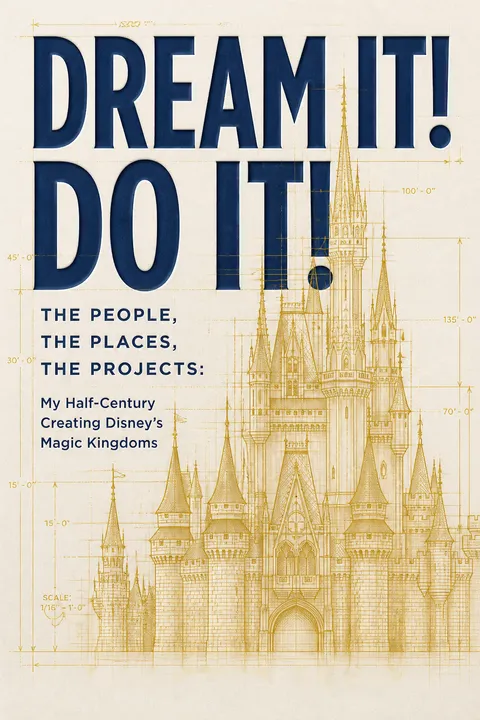

Key Takeaways
1. Walt Disney's Vision: A Relentless Pursuit of New Worlds
I have to move on to new things—there are many new worlds to conquer.
Restless creativity. Walt Disney possessed an insatiable drive to innovate, constantly seeking new challenges and avoiding repetition. His vision extended beyond mere entertainment, aiming to address societal needs and set new standards for community planning. This forward-thinking approach defined his projects, from Disneyland to the ambitious EPCOT concept.
Master showman. Walt's genius lay in his ability to connect with people, transcending age and cultural barriers through his unique brand of entertainment. He believed in the power of storytelling to inspire and reassure, always striving to "plus an idea" and deliver unparalleled quality. His personal touch and unwavering belief in his product made him an exceptional salesman.
EPCOT's genesis. Walt envisioned EPCOT not just as a theme park, but as an "Experimental Prototype Community of Tomorrow," a living laboratory for urban planning and technological advancement. He sought to create a model for future cities, emphasizing public need, innovative transportation, and environmental responsibility, a grand vision that continued to inspire after his passing.
2. Imagineering: The Fusion of Creativity and Technical Know-How
Imagineering is the blending of creative imagination with technical know-how.
A unique discipline. The term "Imagineering," coined by Buzz Price, perfectly encapsulated Walt's desire to combine artistic vision with engineering prowess. This new organization, WED Enterprises, brought together diverse talents—animators, art directors, special effects wizards, and engineers—to create immersive, three-dimensional experiences unlike anything seen before.
Mentorship and growth. Walt fostered an environment where talent was constantly challenged and expanded. Early Imagineers, many transitioning from film to theme park design, became mentors, shaping a new generation of creators. This collaborative spirit, described by Ray Bradbury as "Renaissance People," was crucial for developing the 140 disciplines that comprise Imagineering today.
Beyond architecture. When architect Welton Becket advised Walt to "train your own people" for Disneyland, he recognized the unique demands of Walt's vision. Imagineering's approach went beyond traditional design, focusing on creating entire themed environments where every element contributed to a cohesive story, setting a new benchmark for the entertainment industry.
3. The Guest Experience: Walt's Unwavering Focus on Audience Delight
Just do something people will like!
Audience-centric design. Walt's singular focus was always on the guest, ensuring every attraction and detail resonated with visitors. He believed in creating experiences that were fun, engaging, and offered a sense of reassurance, a stark contrast to the often "raucous and shoddy" amusement parks of his time. This philosophy guided all design decisions.
The "wienie" concept. Walt famously used the term "wienie" to describe visual magnets that draw guests through the park, like Cinderella Castle or the Matterhorn. These beckoning fingers guide visitors, ensuring a logical flow and encouraging exploration. This strategic visual planning is a hallmark of Disney park design.
Language of magic. To differentiate Disneyland from traditional amusement parks, a new vocabulary was developed, replacing "rides" with terms like "adventures," "experiences," and "attractions." This subtle but significant shift in language reinforced the immersive storytelling and unique quality of Disney's offerings, shaping public perception.
4. Innovation Through Adversity: Building Dreams Against All Odds
A good idea may come back to life in the world of Disney…but a great idea will find its way into our parks somewhere in the world.
EPCOT's rebirth. Despite the energy crisis of 1974 and Walt's passing, the vision for EPCOT was resurrected, driven by the belief in its potential to address global challenges. This ambitious project required unprecedented collaboration between Imagineers, corporate partners, and external experts, pushing the boundaries of design and technology.
Technological leaps. Projects like Space Mountain exemplified Disney's commitment to innovation, requiring the first all-computer-designed roller coaster and a new vehicle chassis. The WEDWay Transit System, developed for the New York World's Fair, showcased driverless vehicles and efficient guest movement, later becoming a key attraction and a real-world transportation solution.
Problem-solving ethos. Imagineering's culture fostered a "no" is not an answer mentality, encouraging creative solutions to seemingly impossible challenges. From building on Florida's swampy land to designing complex ride systems, the teams consistently found ways to bring Walt's most ambitious ideas to life, often taking a decade to realize a vision.
5. Strategic Partnerships: The Cornerstone of Disney's Grand Projects
No one company can do this project [Epcot] alone.
Collaborative vision. Walt Disney recognized early on that large-scale projects like EPCOT required external collaboration and significant financial backing from major corporations. This led to the development of strategic partnerships, where companies like GE, Ford, AT&T, and GM became "participants" in bringing Disney's visions to life.
Epcot Forums. To engage potential sponsors and gather expert insights, Disney launched the Epcot Future Technology Conferences. These forums brought together leaders from industry, academia, and government, fostering dialogue and shaping the thematic content of the pavilions. The feedback highlighted public trust in Disney as a communicator of complex information.
Navigating corporate interests. Securing sponsorships often involved intricate negotiations and adapting concepts to corporate objectives, as seen with Exxon's Universe of Energy. Imagineers learned to balance creative integrity with sponsor demands, ensuring that while corporate logos were present, the core Disney storytelling and entertainment value remained paramount.
6. Global Expansion: Navigating Cultural Landscapes for International Success
While both Europe and Japan can support a Disneyland project, Japan offers the highest potential for success, even though it may be more difficult to execute.
First international ventures. Disney's expansion into Japan and France presented unique challenges, from cultural differences to financial models. Tokyo Disneyland, a "carbon copy" of the Magic Kingdom, was an instant success, while Disneyland Paris faced initial struggles due to perceived cultural insensitivity and overbuilding.
Cultural adaptation. In Japan, the park's design incorporated local preferences, such as the enclosed World Bazaar for shopping and an enlarged central plaza to accommodate crowds. Conversely, early missteps in Paris, like the "cultural Chernobyl" criticism, highlighted the need for deeper understanding of local customs, including alcohol policies and labor relations.
Architectural statements. Michael Eisner's "star architect" strategy for Disneyland Paris hotels aimed to make a bold statement and control the resort's accommodation market. While controversial, it resulted in iconic designs that contributed to the resort's unique aesthetic, even if some initial concepts were met with resistance.
7. Leadership Dynamics: The Eisner-Wells Era and Internal Tensions
We learned that one plus one adds up to a lot more than two.
A powerful partnership. The collaboration between Michael Eisner and Frank Wells, chairman/CEO and president/COO respectively, revitalized Disney, leading to significant growth in parks, films, and television. Wells's business acumen and Eisner's creative instincts formed a dynamic duo, often making swift decisions and pushing ambitious projects forward.
Creative acceleration. Eisner's impatience with long development timelines led to rapid project execution, such as Captain Eo and Star Tours. His "Elastic E" (ability to change his mind) and keen eye for story gaps, as seen with "It's Tough to be a Bug!" and Mickey's PhilharMagic, often sparked innovative solutions from Imagineering.
Internal conflicts. The relationship between Imagineering and the Parks Operations division, particularly under Dick Nunis, was often fraught with tension. While Eisner and Wells recognized the value of this creative friction, attempts by operations to control design led to clashes, highlighting the delicate balance required to maintain Disney's unique creative process.
8. The "We" Business: Fostering Collaboration and Nurturing Talent
It’s not an I business; it’s a we business.
Collective genius. Imagineering operates on the principle that creativity is a collaborative effort, not the domain of a single individual. This ethos, instilled by Walt, meant that credit was shared, and the focus remained on the project's success rather than individual recognition.
Mentorship and opportunity. Sklar championed Walt's tradition of giving young, inexperienced talent opportunities to "spread their wings." Programs like ImagiNations sought to diversify the creative staff, ensuring a continuous flow of fresh perspectives and skills, echoing the learning-by-doing approach of early Imagineers.
Beyond the ego. Imagineers are driven by passion for their work and the Disney brand, understanding that "there is only one name on the door: Walt Disney." This collective dedication to excellence, rather than personal fame, is a cornerstone of the organization's enduring success and ability to deliver "Disney Magic."
9. The Disney Difference: Elevating Quality Beyond "Amusement Park Rides"
In a Disney park, not only is storytelling ‘the thing’—every thing tells a story. It’s the details, stupid!
Reassurance, not escapism. John Hench passionately argued that Disney parks offer "reassurance," providing clean, safe, and functional public spaces where families can connect. This commitment to quality and reliability differentiates Disney from mere "escapism," fostering trust and a sense of well-being among guests.
The "no rides" rule. To elevate the perception of Disney's offerings, a deliberate effort was made to avoid the term "rides," instead using "attractions," "adventures," and "experiences." This linguistic distinction reinforced the immersive storytelling and unique nature of Disney's themed environments, setting them apart from traditional amusement parks.
Uncompromising quality. The dedication to detail, from architectural authenticity to the individual pollination of plants in The Land pavilion, is paramount. Even during periods of budget cuts, the commitment to maintaining show quality and guest experience remained a core value, as evidenced by the extensive refurbishment efforts at Disneyland for its 50th anniversary.
10. Marty Sklar's Legacy: Guiding Principles for Creative Leadership
Remember: every day is the only day many of our guests will ever visit one of our parks!
Ambassador of Imagineering. Marty Sklar's career spanned the entire history of Disney parks, from Disneyland's opening to the global expansion. As Imagineering Ambassador, he championed the legacy of creativity and innovation, inspiring new generations of talent and communicating the "Disney difference" worldwide.
Mickey's Ten Commandments. Sklar distilled his learnings from Walt and the Imagineering Legends into a set of leadership principles, widely adopted across the industry. These commandments emphasize understanding the audience, visual communication, storytelling, avoiding contradictions, and relentless maintenance, serving as a timeless guide for themed entertainment.
Impactful communication. From ghostwriting Walt's final messages to crafting dedication plaques and internal memos, Sklar's words shaped Disney's public and internal narrative. His ability to articulate the company's philosophy and values, often with wit and wisdom, left an indelible mark on Disney's culture and its global presence.
Review Summary
Dream It! Do It! receives mixed reviews (3.94/5). Readers appreciate insider Disney park stories and Sklar's unique perspective working alongside Walt Disney. However, many criticize the book's disorganized structure, jumping between time periods without clear transitions. Common complaints include excessive name-dropping, heavy reliance on block quotes from other books, self-congratulatory tone, and wandering narrative. Some find it inspiring and valuable for Disney history despite these flaws, while others struggled to finish it. Positive reviews praise the behind-the-scenes details and leadership lessons.
People Also Read


About the Author
Other books by Marty Sklar

Download PDF
Download EPUB
.epub digital book format is ideal for reading ebooks on phones, tablets, and e-readers.








































