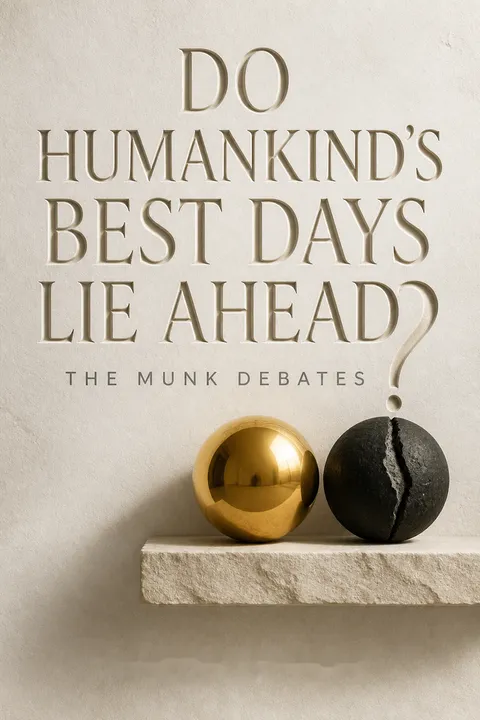

Key Takeaways
1. Unprecedented Global Progress Across Key Metrics
On average, people are living longer, healthier, richer, safer, freer, more literate, and more peaceful lives.
Data-driven optimism. Steven Pinker argues that the belief in progress is not faith-based but grounded in facts and numbers, urging a look beyond sensational headlines. He presents ten key indicators of human well-being that show consistent global improvement, not just in privileged regions like Canada. These trends are gradual and cumulative, building on each other to create a better world.
Ten dimensions of well-being. Pinker highlights significant advancements across various aspects of human life.
- Life expectancy: Increased from 30 to 70 years globally.
- Health: Eradication of smallpox and cattle plague, near eradication of polio and guinea worm, decimation of other diseases.
- Prosperity: Extreme poverty reduced from 85% to 10% of the world population, with a UN target of zero by 2030.
- Peace: Obsolescence of war between developed nations (70 years without conflict), declining global death rates from wars.
- Safety: Falling global rates of violent crime, with homicide rates projected to halve in 30 years.
- Freedom: Global democracy index at an all-time high, over 60% of the world living in open societies.
- Knowledge: Basic education coverage increased from 17% (1820) to 82% and rapidly approaching 100%.
- Human Rights: Measurable inroads against child labor, capital punishment, human trafficking, violence against women, and criminalization of homosexuality.
- Gender Equity: Women are better educated, marrying later, earning more, and gaining power.
- Intelligence: IQ scores rising by three points per decade globally.
Beyond perfection. While acknowledging that a better world is not a perfect world, Pinker emphasizes that the resolution is about humankind's best days lying ahead, implying significant reduction in scourges, not their complete elimination. He dismisses science fiction dystopias as fanciful, while serious threats like nuclear war and climate change are deemed solvable through ingenuity and policy.
2. Innovation and Interconnectedness Drive Accelerated Improvement
Innovation, driven by the meeting and mating of ideas to produce baby ideas, is the fuel that drives them.
Fueling progress. Matt Ridley posits that the engine of progress is innovation, which he describes as the "meeting and mating of ideas to produce baby ideas." Far from running out of fuel, humanity is just getting started, with an infinite number of ways to recombine existing ideas into new ones. This process is no longer confined to North America and Europe but is a global phenomenon, accelerated by the internet.
Globalized solutions. The internet has dramatically sped up the rate at which people can communicate and cross-fertilize ideas, leading to widespread benefits. For instance, the invention of vaping in China by Hon Lik, combining chemistry and electronics, has helped millions quit smoking. This global exchange of ideas means life-saving innovations can emerge from anywhere, improving collective well-being.
Environmental improvements and demographic shifts. Ridley highlights that progress often benefits the environment, with many indicators improving in richer countries, such as more forests, wildlife, and cleaner air/water. He also notes that global population growth is slowing, not due to Malthusian fears, but due to prosperity, education, and health, as smaller families are planned when more children survive. This, combined with expanding farm yields, makes feeding the world easier, freeing up land for nature.
3. Pessimism as a Cognitive Bias, Optimism as a Self-Fulfilling Prophecy
Optimism is a self-fulfilling prophecy; so is pessimism.
Overcoming cognitive biases. Steven Pinker argues that the human mind is prone to illusions and biases that lead to a pessimistic view of the world. Memorable negative images (e.g., plane crashes, not safe landings) dominate news, making the world seem worse. People also confuse personal aging with societal decline, becoming nostalgic for "good old days" that were often far harsher.
Data as the antidote. Pinker asserts that the cure for these cognitive fallacies is data, which unequivocally shows positive trends in longevity, health, wealth, safety, freedom, literacy, and peace. He cites studies where people consistently choose pessimistic answers about global indicators, performing worse than chimpanzees picking randomly, refuting the idea that optimism is a default human position.
The power of belief. Progress is not an inevitable law but the result of human effort. People spot problems and apply ingenuity to solve them, rather than succumbing to despair. Pinker warns against fatalism, especially when objective indicators show improvement, as pessimism can lead to inaction and a focus on self-preservation, hindering collective problem-solving and making a grim future more likely.
4. Progress Reconfigures Risk, It Doesn't Eliminate It
What we are really facing when we look at the future is a future that’s different.
A shift in risk. Malcolm Gladwell challenges the notion that the future will simply be "better," arguing instead that it will be "different." He concedes historical progress but emphasizes that the debate is about the future from this point forward. He suggests that society is not reducing risk but reconfiguring it, trading everyday low-level threats for new, potentially catastrophic ones.
New forms of catastrophe. Gladwell provides examples of how technological advancements introduce new, larger-scale risks.
- Digital 9/11: While everyday hacking threats are better managed, the risk of a nation-state hacking critical infrastructure (e.g., electrical grid, traffic systems) for widespread disruption is a novel and terrifying prospect.
- Dual-use technology: Cellphones in Africa, while beneficial for individuals, also facilitate coordination for terrorist groups like ISIL and Boko Haram, making threats "greater and more pervasive."
- Mega-hurricanes: Advances in dealing with ordinary climate crises (e.g., famine, drought) are offset by concerns about mega-hurricanes driven by warming oceans, representing a "risk of a whole other order."
The other half of the story. Gladwell contends that while Pinker and Ridley's data on past progress is true, it's only "half the story." The critical question is whether the change in the nature of risks we face ought to scare us, to which he believes the answer is "obvious: it should." This reconfiguration means that while interpersonal risks might decrease, existential risks increase.
5. Material Progress Fails to Address Deeper Human Flaws and Unhappiness
Even when the last malaria bug has been eradicated, humankind remains incredibly vulnerable to a host of challenges.
Beyond material well-being. Alain de Botton argues that while optimists focus on the victory of knowledge, economic growth, peace, and medicine, these material gains do not guarantee a perfect or truly happy existence. Drawing on his Swiss background, he notes that even in a country that has largely "solved" these problems, legions of "first-world problems" persist, marring existence.
Stubborn human imperfections. De Botton asserts that fundamental human flaws are not eradicated by reason or wealth.
- Idiocy: Not removed by education; evil is not merely the result of ignorance.
- Poverty: Not eradicated by GDP growth; millionaires can still feel they "don't have enough," defining a form of poverty.
- Violence: War's elimination doesn't end meanness, violence, and cruelty in societies.
- Mortality: Despite medical advances, death remains an inescapable reality, with no cure on the horizon.
The "faulty walnut." De Botton metaphorically describes the human brain as a "faulty walnut" at the top of our spinal cords, endowed with destructive impulses and resistant to certain forms of education. He believes that true human progress requires acknowledging this fundamental imperfection, fostering forgiveness, tenderness, and sympathy, rather than pursuing a dangerous perfectionism that leads to anger and entitlement when paradise is not delivered.
6. Existential Threats Are a Distinctly Modern Creation
The notion that a computer malfunction could lead to us all being blown up — the threat of that — is as real today as it was thirty years ago in the Petrov incident.
The shadow of nuclear war. Malcolm Gladwell highlights nuclear war as a critical, distinctly modern existential threat that the "Pollyannas" gloss over. He recounts the 1983 Petrov incident, where a Soviet lieutenant colonel single-handedly averted nuclear retaliation based on a computer malfunction, underscoring the fragility of global security in the nuclear age.
A different order of threat. Gladwell argues that while interpersonal risks may have decreased, existential risks have increased. Reducing the number of nuclear weapons by 80% offers little consolation when "all it takes is one weapon in the hands of one crazy person to blow us all up." This contrasts sharply with historical threats, as no famine or disease in the past had the potential for global annihilation.
The trade-off of progress. The core of Gladwell's argument is that the extraordinary progress in reducing everyday risks has come at the cost of increasing existential risks. He challenges the audience to consider whether these trade-offs leave humanity "better off," implying they do not. This shift in the configuration of risk, from frequent but localized dangers to rare but globally catastrophic ones, is a crucial distinction.
7. The Peril of Scientific "Perfectionism" and Arrogance
What you have in front of you, ladies and gentlemen, is a new kind of scientist who is so cocksure of what he and his lab can do that he has discarded two thousand years of insights from the humanities, from religion, and from anything that lies outside of the scientific method.
A narrow, materialistic view. Alain de Botton criticizes the "Pollyannas" for what he perceives as an underlying, brittle arrogance and an "extremely materialistic view of human beings." He argues that their focus on quantitative data and scientific solutions disregards the complexities of the human psyche and the insights offered by the humanities, literature, and philosophy.
Discarding humanistic wisdom. De Botton expresses alarm at Steven Pinker's dismissal of literature as "not real" and "made up," interpreting it as a dangerous rejection of two thousand years of humanistic understanding of the human mind and its dilemmas. He sees this as a "secularized, scientific version of that New Jerusalem," a millennial fantasy of perfectionism that is historically dangerous and reductive.
The danger of boosterism. De Botton views the optimistic stance as a "conventional boosterish philosophy" of mainstream capitalism and science, constantly promising improvement like a new iPhone. He contrasts this with the ancient Greek concept of tragedy, which reminded city-states of their constant vulnerability and need for modesty. This "cocksure" attitude, he warns, can lead to intolerance and cruelty, failing to properly accept the cyclical nature of life and the inherent flaws of human nature.
8. Wisdom Lies in Pessimistic Realism and Modesty
Forgiveness and tenderness and sympathy are based on an acceptance of our own fundamental imperfection.
A counter-philosophy. Alain de Botton advocates for "pessimistic realism" as a more humane and liveable philosophy than the "boosterish" optimism of his opponents. He argues that accepting our fundamental imperfection and vulnerability is the root of wisdom, fostering forgiveness, tenderness, and sympathy in relationships and society.
The value of humility. De Botton suggests that perfectionism breeds anger and a sense of entitlement when life inevitably falls short of utopian ideals. He contrasts this with the appreciation for "smaller islands of perfection," like flowers, that old people develop due to their awareness of life's imperfections. Humour, too, is born from the gap between hopes and reality, allowing for sympathy towards failed dreams.
Lessons from history and faith. De Botton warns that many of history's worst movements stemmed from perfectionist minds, whether scientists or politicians, who believed they could "straighten things out, once and for all." He points to Christianity's wise insistence on human frailty and brokenness as a classical, conservative starting point for wisdom, arguing that true human progress is often the work of modest individuals who accept flaws rather than attempting to create a paradise on earth.
9. The Interplay of Complexity: Vulnerability vs. Resilience
The greater connectivity of the world actually makes us less vulnerable to collapses.
Connectivity's double edge. The debate touches on whether increased global interconnectedness and complexity make humanity more vulnerable or more resilient. Malcolm Gladwell argues that while global connectedness offers positive outcomes, it also creates "all kinds of negative outcomes," such as the rapid spread of lethal organisms or viruses, making human extinction a modern concern for epidemiologists.
Spreading risk vs. concentrating it. Matt Ridley counters that greater connectivity can actually reduce vulnerability. He uses the example of global food trade: in the 17th century, localized famines could wipe out 15% of a country's population due to lack of trade. Today, a failed harvest in one region might cause a slight price uptick but won't lead to widespread famine because trade allows food to be moved globally, effectively spreading and reducing risk.
Rationality as a problem-solver. Steven Pinker asserts that rationality allows humanity to observe its own limitations, including the complexity of its systems, and set problem-solving goals. He believes that our best minds will work to make systems robust to perturbations, simplify where possible, and develop AI to manage complexity. He dismisses analogies to past civilizations like the Mayans, citing our unique edifice of science, technology, and information infrastructure.
10. The Debate: Data-Driven Optimism vs. Humanistic Realism
This debate, though it seems to be a debate around science — and we have many science-y people in the room — is really a debate about wisdom and the philosophy of wisdom that you might want to adopt in your own life.
Clash of worldviews. The Munk Debate ultimately pits a data-driven, scientific optimism against a humanistic, pessimistic realism. Pinker and Ridley champion the power of empirical evidence and human ingenuity to solve problems and continue an upward trajectory of well-being, emphasizing that progress is real and accelerating.
Beyond statistics. De Botton and Gladwell argue that a focus solely on quantitative data misses the qualitative dimensions of human experience, the reconfiguration of risks, and the stubborn persistence of human flaws and unhappiness. They advocate for a philosophy that acknowledges vulnerability, imperfection, and the insights of literature and philosophy, rather than a "brittle" scientific perfectionism.
The audience's verdict. The pre-debate vote showed 71% in favor of the resolution ("humankind's best days lie ahead"), with 29% against. After the spirited exchange, the final vote shifted slightly, with 73% in favor and 27% against. This marginal shift, indicating more voters moved to the "pro" side, declared Steven Pinker and Matt Ridley the victors, suggesting that their arguments for data-backed progress resonated more strongly with the audience.
Review Summary
Do Humankind's Best Days Lie Ahead? transcribes a 2015 debate between optimists Steven Pinker and Matt Ridley versus skeptics Alain de Botton and Malcolm Gladwell. Reviews are mixed (3.34/5), with many noting the debate felt mismatched and lacked depth. Readers appreciated Pinker and Ridley's data-driven arguments about measurable progress in health, wealth, and peace, but criticized de Botton's weak philosophical stance and failure to effectively counter scientific claims. Several reviewers noted the teams talked past each other, with scientists citing statistics while philosophers raised existential concerns. Many suggested watching the YouTube video instead, calling the written format disappointing and the debate superficial.
People Also Read



About the Author
Other books by Steven Pinker



Download PDF
Download EPUB
.epub digital book format is ideal for reading ebooks on phones, tablets, and e-readers.








































