
Key Takeaways
1. The Modern Predicament: Endless Distraction and the Buffered Self
The electronic buzz of the twenty-first century combined with the proliferation of personal stories of meaning (what I call “micronarratives of justification,” as opposed to “metanarratives”) has helped create what we may call distracted, buffered selves.
A pervasive hum. Modern life is characterized by a constant "electronic buzz" of immediately gratifying activities, from social media to streaming services. This relentless engagement resists reflection and meditation, leading to mental fatigue and a "scrambled" mind. We become adept at self-avoidance, using technology to escape unsettling truths about ourselves or our lives.
The buffered self. This distraction dramatically exacerbates the effects of the "buffered self," a term coined by Charles Taylor. Modern individuals imagine themselves insulated from external forces, especially supernatural or transcendent ones, interpreting the world through a "closed, physical universe" or "immanent frame" where everything has a natural explanation. This internalizes the source of meaning, making transcendent ideas feel less plausible.
Consequences for faith. The convergence of distraction and the buffered self means that when Christians speak of faith, hearers often perceive it as merely another personal preference in a sea of cultural options. Deep, challenging ideas about God, sin, and salvation are easily co-opted into individual narratives without genuine spiritual obligation, leaving conversations untouched and participants vaguely pleased but unchanged.
2. The Secular Age: Contested Beliefs and Fragile Identities
The shift to secularity in this sense consists, among other things, of a move from a society where belief in God is unchallenged and indeed, unproblematic, to one in which it is understood to be one option among others, and frequently not the easiest to embrace.
An age of options. Secularism isn't atheism, but a state where belief in God is merely one "live option" among many. This creates an explosion of plausible belief systems, all endlessly contested, making the idea of a transcendent God less conceivable. Our commitment to any single belief becomes "fragile," easily changed, and less rooted in external authority.
Identity as the core. In this secular age, identity formation becomes the central concern. Beliefs are often adopted and expressed as ways to articulate this identity, rather than as objective truths. This means objections to Christianity are often existential ("it's not my thing") rather than purely logical, as faith is evaluated by how it fits with one's self-conception or improves quality of life.
Thin belief. This environment fosters "thin belief"—foundational ideas about the world that lack robust explanatory power, have obscured sources, and may conflict with other beliefs. They are easily adopted and discarded, serving primarily to craft a self-image. This contrasts with "thick beliefs" which involve deep understanding, embodied practice, and consistent application.
3. The Quest for Fullness: Meaning Found Inwardly, Not Transcendentally
To be fully human, we must discover who we are, actualize our identity, express ourselves, be true to ourselves, and so on.
The burden of being. Life's miraculousness, our agency, and capacity for love and reason create a "burden of existence"—a demand for justification: "What right do I have to such a life?" In a cold, indifferent universe, this burden is often explained as an illusion of evolution, but for most, this isn't satisfying. We seek meaning that extends over time and circumstances, a telos or ultimate purpose.
Generic existentialism. The dominant way this desire for meaning manifests in the modern West is a generic existentialist philosophy: meaning is something we create and impose on a neutral world. As buffered selves, we naturally conceive of meaning as internally determined. This aligns perfectly with:
- Expressive individualism: Discovering, creating, and expressing our "authentic self" from within.
- Instrumental reason: Using disengaged reason to interpret and impose meaning on the world.
The "nova effect." This inward turn, combined with the internet and globalization, has led to a "nova effect"—an explosion of "micronarratives of fullness." People find meaning and justification in incredibly diverse, often immersive, communities and lifestyles (e.g., organic living, cosplay, professional gaming). These become their "vision of fullness," shaping purpose, worth, consumer choices, ethics, and aesthetics, often until something new comes along.
4. The Solution: A "Double Movement" Reorienting Towards God
Simply put, the double movement is the practice of first acknowledging goodness, beauty, and blessing wherever we encounter them in life, and then turning that goodness outward to glorify God and love our neighbor.
Challenging self-centeredness. The core of our distracted, secular age is a cognitive movement towards the individual, where everything is directed towards our own perspective and choices. This makes us the authoritative interpreters and protagonists of existence. A disruptive witness requires challenging this movement by shifting our telos from ourselves to a transcendent God.
The double movement. This shift involves a "double movement":
- Acknowledging goodness: Recognizing beauty, blessing, and wonder in creation.
- Glorifying God: Turning that goodness outward to God in gratitude and praise, and then to our neighbor.
This practice directly challenges the secular assumption of a closed, materialist universe and counters the pride in human ability that often replaces gratitude for creation.
Beyond moral authority. While Christians are taught to "put Christ on the throne of our lives" and obey his moral authority, the double movement extends Christ's lordship beyond morality. It aims for a deeper sense that we live in a created world sustained by a loving God, allowing creation and revelation to "pierce our buffered selves" and interpret us, rather than us solely interpreting them.
5. Disruptive Personal Habits: Cultivating Contemplation and Allusiveness
Living aesthetically is disruptive because it unsettles the artificial naturalness of living in a closed, materialist world.
Reclaiming attention. To counter the constant distraction, we must reclaim our attention by cutting down on "filler distractions"—those moments we instinctively fill with technology. This means intentionally creating space for undirected thought, allowing us to process experiences, reflect on sins, and cultivate gratitude, thereby redeeming time for God's glory, not just busyness or productivity.
Living allusively. Christians are called to live an "aesthetic life," recognizing the "allusiveness" of creation. Everything in the world alludes to God, its Creator. This practice involves:
- Acknowledging beauty (e.g., a sunset, a flower).
- Allowing our minds to be drawn "onward and upward" to God.
This experiential reminder that the material world is not complete, that it resists total control, and that its meaning points to a Creator, directly challenges the secular, materialist worldview.
Sabbath and grace. Practices like saying grace before meals and observing a Sabbath rest are profoundly disruptive. Saying grace defies the secular etiquette of privatizing religion and challenges the materialist account of provision, affirming a personal God's common grace. Sabbath rest, a "spiritual defiance against the ideal of existential justification through production and consumption," denies the cultural belief that we must always be working, asserting that time has inherent meaning beyond our manipulation.
6. Disruptive Church Practices: Resisting Excarnation Through Embodied Liturgy
The church must embody the faith in such a way as to reveal its exclusivity, solemnity, transcendent power, incarnational theology, and authority.
Plugging the leaks. The church often inadvertently trivializes the gospel by adopting secular, market-driven approaches to branding, marketing, and promotion. Using mediums like Christian T-shirts or high-production church services can make faith appear as just another consumer preference or motivational conference, rather than a transcendent, exclusive truth. We must critically ask:
- What messages does this medium typically convey?
- Will this message be perceived as radically unique or just another consumer choice?
Resisting excarnation. Charles Taylor's concept of "excarnation" describes the modern shift from embodied religious worship to a faith that primarily happens "in our heads." This devalues the body's role in worship, making church feel like an intellectual lecture rather than a holistic encounter with God. Excarnation renders regular church attendance obsolete if its purpose is merely cognitive growth.
Reclaiming embodied liturgy. The church has historical resources to counter excarnation by restoring and revitalizing embodied practices:
- Liturgical calendar: Marking seasons like Advent and Lent reorients us to a cosmic rhythm, challenging mechanical time.
- Greeting of Peace: Physically greeting others reminds us that worship is communal and we are dependent on God and each other, drawing us out of self-sufficiency.
- Communal singing: Standing and singing together, hearing one another, enacts the mystery of the body of Christ, resisting individual, emotional exercises.
7. The Lord's Supper: A Profound Challenge to Secularism
Every movement in the liturgy of the Lord’s Supper calls us away from a distracted, flattened, material, individualist, and secular view of the world.
Reorienting moral vision. The public reading of God's law in church reorients our moral vision away from fragmented, incoherent ethics derived from social pressures or media narratives. It challenges the "secular liturgy" of consumerism that instills a sense of autonomy, reminding us that morality is formed by an external, transcendent authority, not personal preference.
Confession and pardon. Weekly public and silent confession, followed by assurance of pardon, cultivates honest self-reflection and challenges prevailing social narratives that either nullify guilt or point out failures without offering forgiveness. This communal act underscores universal sinfulness and God's grace, dashing the meritocracy of American society.
Communion with a living God. Prayer and the Lord's Supper are perhaps the most disruptive liturgical acts. Prayer affirms our contingency, dependency, and the reality of a personal God who supersedes earthly principalities, re-enchanting a world that often feels purely material. The Lord's Supper, however, is the supreme act of disruptive witness.
A spiritual, objective event. The Lord's Supper grounds the sacrament in ancient history, ripping us out of presentism and joining us with saints across time and space. It is not mere recollection but a mysterious, spiritual, yet objective event where God communes with us, profoundly at odds with a secular understanding that lacks language for such miraculous, irreducible meaning.
8. Disruptive Cultural Participation: Leaning into "Cross Pressures"
The whole culture experiences cross pressures, between the draw of the narratives of closed immanence on one side, and the sense of their inadequacy on the other, strengthened by encounter with existing milieu of religious practice, or just by some intimations of the transcendent.
Moments of tension. There are moments when we feel a "cross pressure" between modern life within the immanent frame and a longing for something beyond it. These are invitations to reflect, rather than distract, on the possibility of a meaningful, ordered existence centered on God. Non-Christians often interpret these "intimations of the transcendent" as "immanent transcendence"—a sense of going beyond the immanent frame, but still within it.
Inadequate explanations. Charles Taylor identifies three key areas where these cross pressures are most keenly felt, as a strictly closed immanence struggles to adequately explain them:
- Human agency: Our capacity for creative action.
- Moral obligations: The inherent force of ethical demands.
- Aesthetic experiences: The profound power of art and nature.
These elements of life, which matter most to us, demand an account that does them justice, and a closed immanent frame often offers an impoverished vision.
A felt inconsistency. We are not just brains in vats; we know things with and through our bodies. An aesthetic experience with a novel, film, or song can give us a "felt inconsistency"—a kind of knowledge about existence that clashes with our basic assumptions. This isn't a logical inconsistency, but an embodied one, where our deepest longings and experiences resonate with a reality beyond purely material explanations.
9. Stories as Disruptive Witnesses: Evoking Transcendence and Empathy
Well-made stories by Christians can open people to the possibility of a reality beyond the immanent frame—but even well-made stories by non-Christians that use allegories of transcendence can awaken us to our latent desire for the transcendent.
Tapping into desire. Stories—novels, films, TV shows, songs, video games—have a unique ability to tap into and evoke our desires for the transcendent. They reveal and accentuate cross pressures, appealing to us as whole persons through aesthetics. By portraying worlds and allowing us to empathize, stories help us imagine new paradigms and question our visions of fullness.
Beyond the frame. Stories provide the imaginative space to "break from the immanent order to a larger, more encompassing one, which includes it while disrupting it." This is crucial for those deeply inured by the closed immanent frame, as it offers new languages and ways of seeing that resonate more fully than purely rational arguments.
Intentional participation. Christians can participate in stories disruptively by:
- Choosing aesthetically excellent stories: Prioritizing "haunting" stories that trouble the buffered self, compel contemplation, and expand our understanding, whether through beauty, delight, or tragedy.
- Engaging in thoughtful dialogue: Interpreting stories in community, revealing cross pressures, and relating them to our lives, offering interpretations that affirm longings for beauty, goodness, and love beyond the immanent frame.
This avoids treating stories as mere allegories or moralistic props, fostering humility, charity, and a desire to know.
10. Tragedy as Disruptive Witness: Confronting Mortality and Longing for Eternity
Suffering can make plain to us some of the meaning of life which we couldn’t appreciate before, when it all seemed swimmingly benign; this is after all what tragedy as an art form explores.
The burden of death. Tragedy, especially the death of a loved one, puts our commitments to the immanent frame under immense pressure. Love "demands eternity," and the finality of death within a closed immanent frame feels incomprehensible, defying our embodied sense that personhood ought not have an end. This creates a "deep incongruity" between the banality of daily life and the infinite significance of a single human life.
Signals of transcendence. This feeling—that the world should stop when someone dies—is a "signal of transcendence." It's a prototypical human experience that makes most sense when interpreted through an appeal to the transcendent, suggesting that each human life is truly that significant. This challenges the absurdity of imposing meaning on an indifferent world.
Mourning authentically. Our culture frantically denies and silences death, treating mourning as a problem to be overcome. Christians can offer a disruptive witness by:
- Mourning with those who mourn: Affirming the reality of loss and giving space for sorrow and contemplation of mortality, suffering, and evil.
- Using language that comforts without trivializing: Resisting the therapeutic language of secular modernity and affirming that human life is significant because it is made in God's image.
This presence and openness itself witnesses to God's compassion and the profound significance of each human life, affirming the pressure we feel toward a reality beyond the immanent frame.
11. The Danger of Inaction: A Withering Church in a Secular Age
Failure to reassess how we bear witness to our faith in the twenty-first century, and failure to take these societal changes into account, has had and will continue to have serious effects on the life of the church and our ability to have a prophetic voice in the world.
Secularization's subtle creep. While the mid-20th century prediction of secularization (that religion would fade to the margins) was largely incorrect, a subtler secularism has pervaded. Americans haven't lost faith, but the space faith fills in our lives and our ability to communicate its meaning have changed. The church risks unknowingly accepting secular premises and uncritically embracing distracting technologies.
Weakening witness. The inertia of society pushes towards thin beliefs and self-defined identities. If the church continues to trade on emotive, self-help faith and allows believers to find identity in Christian subculture rather than Christ, it will dramatically weaken. When Christian ethics become culturally offensive, a church built on individual sovereignty and self-definition will lack the "thick resources and community" to respond.
The cost of compromise. If the church buys into expressive individualism, it will support traditional biblical ethics only until they conflict with identity, then acquiesce to social pressure. This subtle secularism will weaken the church's witness and life, making the beauty of Christian faith invisible. To remain vibrant, the church cannot play by the rules of secularism's "game," which forces superficiality and shifts focus inward, away from commitment to transcendent truth.
12. The Call to Action: Drawing "Large and Startling Figures" in a Distracted World
To cause that, it takes something more—perhaps something much simpler—than these kinds of church spectacles.
Beyond the spectacle. In a world saturated with "large and startling figures"—advertisements, viral videos, and constant shouting—true disruptive witness isn't about louder spectacles or more outlandish church events. Such efforts merely startle in the same way a Super Bowl ad does, impressing but not disturbing people from their comfortable, distracted lives.
Stripping away distractions. A disruptive witness requires pulling away the identities, beliefs, and distractions that prevent us from asking life's difficult questions. Cormac McCarthy's The Road, for example, strips away civilization to force characters (and readers) to confront the fundamental question of why to continue living in a dying, cruel world. The father and son's clinging to hope and the boy's goodness as a "sign of God's Word" offer a witness that transcends the immanent frame.
Gambling everything. Our calling is not to invent allusions to God but to reveal and affirm the ones already present in the world. This witness defies secular expectation and explanation, unsettling neighbors from their technological/consumerist stupor. It gambles everything on the existence and goodness of a transcendent (and immanent!) God, whose sacrificial love compels us to love in return, offering a profound and beautiful alternative to the comfortable suffering of modern life.
Review Summary
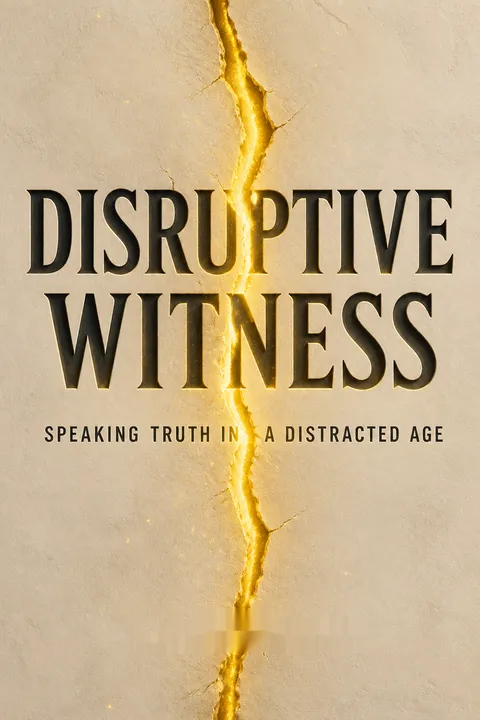
Readers widely praise Disruptive Witness as a timely, convicting exploration of how distraction and secularism undermine Christian witness. Drawing heavily on Charles Taylor, Noble convincingly diagnoses modern culture's "buffered self" and endless technological distraction as barriers to genuine gospel engagement. Many highlight his practical prescriptions — silence, sabbath, liturgy, and cultural participation — as genuinely countercultural. Some find the first half stronger than the second, wishing for deeper practical development. Tim Keller called it the best book he'd read recently. Overall, readers consider it essential reading for anyone engaged in ministry or evangelism today.
People Also Read
About the Author
Other books by Alan Noble
Download PDF
Download EPUB
.epub digital book format is ideal for reading ebooks on phones, tablets, and e-readers.








































