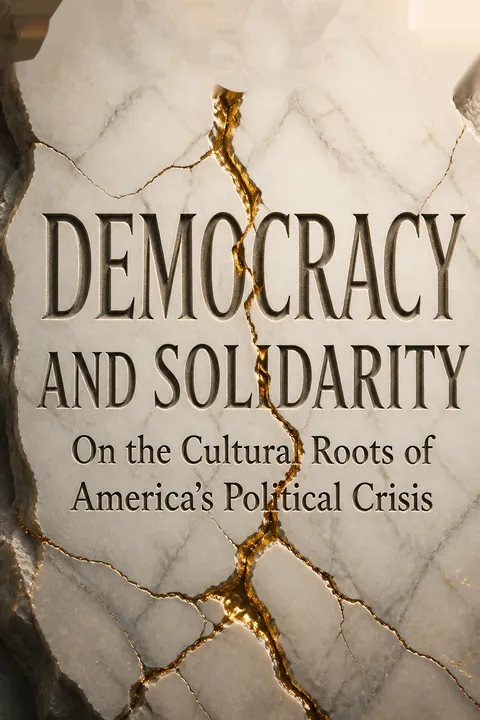

Key Takeaways
1. Democracy relies on a deep, tacit cultural solidarity rather than mere political consensus
The power of solidarity is found in the unspoken, often vague or fuzzy resonances of shared identity, shared affections, shared challenges, and a shared destiny.
Tacit cultural foundations. Political systems do not exist in a vacuum; they are sustained by a deep, pre-political stratum of social thought. While "consensus" implies a conscious, rational agreement on policy, "solidarity" is a far richer, affective bond that operates beneath the surface of conscious awareness. It is this implicit order—composed of shared myths, sensibilities, and social imaginaries—that makes democratic institutions and practices intelligible in the first place.
The priority of culture. Culture is not merely a reflection of economic or political power, but the very framework that defines reality itself. Because language and meaning constitute all human experience, politics is always subordinate to the cultural matrix that underwrites it. When a society's cultural foundations decay, its political structures inevitably lose their legitimacy. Key elements of this deep structure include:
- Implicit metaphysical assumptions about the nature of reality
- Epistemological frameworks determining how we define truth
- Shared anthropological views on the worth of human persons
- A common teleology orienting collective action toward a shared future
The limits of diversity. Every society must draw boundaries to define who is included in the collective "we" and who is excluded as "they." Boundary work, or social control, is the inescapable process by which a community polices these lines of tolerable difference. In a healthy democracy, the "unum" must be thick enough to contain the disagreements of the "pluribus," providing a shared vocabulary that prevents political disputes from degenerating into existential warfare.
2. America's foundation rested on a fragile "hybrid-Enlightenment" of reason and providential faith
The Enlightenment, and the American adaptation of it in particular, underwrote the project of modern liberalism that, for all of its voluminous flaws and appalling failures, can fairly boast of achievements that stand among the greatest in human history.
A unique syncretism. The American Founding was not a purely secular triumph of cold rationality, but a lively, historically contingent synthesis of diverse intellectual tributaries. This "hybrid-Enlightenment" seamlessly blended classical republicanism, Lockean individualism, and Reformed Protestant theology. Rather than destroying religious faith, the American Enlightenment was understood religiously, while Protestant theology became deeply rationalist in its attempt to align with natural law.
The Lockean bridge. John Locke served as the transitional figure who bridged these worlds, grounding the natural rights of equality and liberty in a Christian, specifically Calvinist, vision of individuals under God's dominion. The Scottish Enlightenment further modified this by emphasizing innate moral sentiments like sympathy and benevolence as the glue of civil society. This hybrid cosmology provided:
- A transcendent moral order accessible to human reason
- A shared language of universal rights and duties
- An inner-worldly, ascetic work ethic that prized utility and discipline
- A providentialist mythos of America as a nation with a redemptive destiny
The new citizen. Out of this hybrid culture emerged a novel conception of the citizen as a self-governing moral agent endowed with reason and virtue. Citizenship was viewed as a sacred office that required individuals to subordinate their private interests to the public good. This political transformation was reinforced by a burgeoning religious populism that empowered ordinary people to think for themselves, fostering an antinomian ethos that was both highly democratic and potentially destabilizing.
3. Democratic progress occurs by "working through" the system's inherent moral contradictions
The hope of a vibrant political solidarity implied in America’s hybrid-Enlightenment was always set against contradictions intrinsic within itself, contradictions that have guaranteed and continue to guarantee tension, conflict, and, at times, violence.
The core contradiction. The fundamental tragedy of American democracy lies in the glaring contradiction between its universalist promise of equality and its systematic practice of exclusion. From its inception, the hybrid-Enlightenment excluded African Americans, Native Americans, women, and religious minorities from the boundaries of full citizenship. The historical narrative of American democracy is not a story of static consensus, but of a continuous, painful struggle to resolve these internal hypocrisies.
The process of Durcharbeiten. To resolve these deep-seated tensions, American society has repeatedly engaged in a process of "working through" (durcharbeiten) its cultural contradictions. Borrowed from psychoanalysis, this concept describes how a collective ego consciously confronts and reinterprets its past traumas and repressions to achieve a healthier self-understanding. This dialectical process is enacted by:
- Public intellectuals who articulate changing cultural dynamics
- Social movements that mobilize resources to challenge the status quo
- Elite networks that contest the boundaries of moral and legal legitimacy
- The gradual expansion of the "unum" to encompass previously excluded groups
The risk of failure. Working through is an arduous, conflict-laden process that takes generations to integrate into a society's habits of thought and practice. When a moral reckoning is forced prematurely through raw state power or legal fiat without cultural preparation, it often produces severe distortions and backlash. If the underlying causes of the contradiction are not genuinely eliminated, the past is merely repressed, creating a simulacrum of solidarity that eventually fractures under pressure.
4. The nineteenth-century "evangelical turn" refashioned America into a moralistic Christian Republic
The history of the nation, he [Lyman Beecher] argued, was indicative of "some grand design," a history "of perils and deliverances, and of strength ordained out of weakness" that included the "wars with the savage tribes, and with the French, and at last with the English."
The rise of the Christian Republic. In the early decades of the nineteenth century, the hybrid-Enlightenment was worked through in a way that dramatically expanded its religious elements while marginalizing its secular, deistic tributaries. Driven by the Second Great Awakening, a populist, experiential evangelicalism swept the nation, turning the abstract political philosophy of the Founders into a popular mythos of America as a "Christian Republic." This evangelical turn provided the moral energy and cultural cohesion necessary for a century of rapid nation-building.
The voluntary establishment. Because the Constitution prohibited a legal religious establishment, Protestant leaders devised a brilliant alternative: a "voluntary establishment" of faith and morals. The church and the state remained legally separate, but they were functionally joined through a vast network of voluntary associations known as the "Benevolent Empire." This network sought to reform public morals and build a complete Christian commonwealth through:
- National Bible, tract, and Sunday school societies to spread literacy and faith
- Temperance movements to combat poverty, domestic ruin, and industrial disorder
- Moral reform societies targeting vice, gambling, and Sabbath-breaking
- The common school movement, which used the King James Bible to form virtuous republican citizens
The dark side of perfectionism. While this moral perfectionism fueled extraordinary social reform, it also doubled down on the boundaries of exclusion, justifying horrific violence against those who did not fit the Anglo-Protestant mold. Native Americans were subjected to forced removal and cultural erasure under the guise of "civilizing" them, while Mormons and Catholics faced violent nativist mobs. Most egregiously, Southern theologians and scientists used the authority of Scripture and emerging racial theories to defend the brutal institution of slavery as a benevolent, God-ordained order.
5. A massive "secular turn" in the twentieth century stripped the religious establishment of its authority
By taking sides so prominently in the war and having intensified the moral stakes of the conflict, biblical faith, in effect, had discredited itself as a source for interpreting and directing policy matters and directly influencing public life.
The discrediting of faith. The catastrophic bloodshed of the Civil War, where both sides read the same Bible and prayed to the same God to destroy the other, dealt a fatal blow to the public authority of Protestant Christianity. In the decades that followed, the religious interpretation of the world lost its credibility as a unifying framework for national life. This moral vacuum paved the way for a sweeping "secular turn" that systematically dismantled the cultural hegemony of the Protestant establishment.
The rise of technocratic elites. This secular revolution was not an accidental byproduct of modernization, but an active, ideological campaign led by a new class of lay intellectuals, scientists, and business leaders. They successfully wrested control of the nation's key culture-producing institutions away from the clergy. Higher education, journalism, and law underwent rapid professionalization, replacing theological and moral standards with:
- The prestige and objective methodologies of modern science
- The evolutionary theories of Darwin and social Darwinism of Spencer
- Legal positivism, which severed the law from natural and divine law
- The utilitarian, efficiency-driven values of industrial capitalism and managerial bureaucracy
The fundamentalist retreat. The Protestant establishment attempted to reassert its authority through the prohibition movement and the Scopes trial of 1925, but these efforts backfired catastrophically. Mocked by the secular press as bigoted and ignorant, traditionalist Christians suffered a humiliating public defeat. In response, they retreated into a defensive, sectarian subculture, leaving the dominant institutions of American public life firmly in the hands of a secular, technocratic elite.
6. Mid-century secular humanism failed to provide a durable, non-metaphysical basis for democracy
Our objective is clear: We must defend and strengthen free society . . . to restore the center that mediates between collective purpose and individual interest.
The quest for a secular center. In the wake of the totalitarian threats of fascism and Communism, mid-twentieth-century public intellectuals recognized that liberal democracy was in desperate need of a new, non-religious moral foundation. Figures like John Dewey, Arthur Schlesinger Jr., and Walter Lippmann attempted to work through the hybrid-Enlightenment to construct a secular, universal humanism. They hoped to find a "vital center" that could unite a pluralistic society without relying on the discredited dogmas of traditional religion.
Competing secular visions. This humanistic project was deeply divided over the nature of human beings and the role of reason. John Dewey championed a radical, naturalistic pragmatism that placed absolute faith in scientific intelligence and progressive education to solve all social ills. Conversely, Reinhold Niebuhr's "Christian realism" offered a devastating critique of Dewey's optimism, arguing that:
- Human nature is fundamentally flawed by egocentricity and sin
- Collective groups are inherently more immoral and power-seeking than individuals
- Social justice can never be achieved through education alone, but requires the balancing of power
- Democracy requires a tragic, mythic framework of forgiveness and contrition to survive its own conflicts
The failure of the abstract "Man." Ultimately, this mid-century humanism proved too thin and abstract to sustain a durable democratic solidarity. By defining "Man" as a universal category divorced from the concrete particularities of history, race, and class, it ignored the deep-seated structural injustices that continued to marginalize millions of Americans. While this fragile humanism provided the moral vocabulary that Martin Luther King Jr. would brilliantly leverage to demand civil rights, its inability to resolve the contradictions of racial and economic inequality eventually led to its collapse.
7. The culture wars polarized America into irreconcilable camps of moral authority
The conflict between these men and us is so great that "preferences" is the wrong word.
The polarization of authority. By the late twentieth century, the collapse of the mid-century liberal consensus gave rise to a comprehensive "culture war" that polarized American public life. This conflict was not merely a disagreement over discrete policy issues like abortion or gay rights, but a profound division over the very nature of moral authority. The nation split into two incommensurable camps: the "orthodox," who believe in a transcendent, objective moral order, and the "progressives," who believe that moral truth is immanent, historically contingent, and subject to human revision.
The institutionalization of conflict. This deep cultural cleavage quickly became institutionalized across every major sphere of social life, turning them into active battlefields. The family, public education, higher education, the arts, the news media, and the law were all conscripted into the struggle for cultural hegemony. This polarization was reinforced by:
- The rise of specialized, single-issue advocacy groups
- The creation of separate, ideologically aligned media ecosystems (e.g., Fox News vs. mainstream media)
- The transformation of electoral politics into a symbolic arena for cultural warfare
- The packing of the federal judiciary with ideologically vetted judges
The collapse of the middle. As the culture war intensified, the middle ground of public discourse evaporated. Thinkers like Richard John Neuhaus argued that a "naked public square" stripped of religious values would inevitably degenerate into state despotism, while legal scholars like Laurence Tribe championed a constitutional "invisible" order based on radical personal autonomy. Because these competing visions of the human person and the common good were rooted in fundamentally incompatible premises, they reached an absolute impasse, rendering genuine democratic deliberation impossible.
8. The depletion of our cultural resources has ushered in a destructive era of passive and active nihilism
The highest values devalue themselves. The aim is lacking, and "Why" finds no answer.
The onset of nihilism. Today, American political culture has entered a state of profound exhaustion. The cultural resources of the hybrid-Enlightenment—which once provided a shared, if highly imperfect, framework for working through national crises—have been completely depleted. In their place, a destructive culture of nihilism has filled the void, manifesting as a pervasive sense of valuelessness, epistemic anarchy, and the loss of any shared national purpose or destiny.
Passive and active forms. This nihilism operates at both a passive and an active level. Passive nihilism is the quiet, systemic byproduct of late modern life—its bureaucratic impersonality, its technological mediation, and its consumerist focus on therapeutic self-realization, which together strip life of transcendent meaning. Active nihilism, by contrast, is a violent, political force that manifests as a will to power and a desire to destroy the opposition. This dual crisis is characterized by:
- The deconstruction of objective truth in favor of subjective "perspectives"
- The collapse of public trust in all major truth-telling institutions (media, science, government)
- An emotivist moral ethos where ethical claims are used merely as weapons of social control
- The reduction of the common good to the raw, competitive interests of antagonistic factions
The death of public reason. In this post-truth environment, the very concept of public reason has been abandoned. Partisans on both sides no longer believe in the possibility of persuading their opponents through rational argument. Instead, they operate within a closed epistemic loop, relying on the new communications technologies to amplify outrage, confirm their biases, and construct alternative realities. When truth is reduced to a matter of subjective feeling and political utility, the only remaining arbiter of public life is raw, coercive power.
9. Modern political discourse is dominated by ressentiment and the weaponization of injury
The sufferers, one and all, are frighteningly willing and inventive in their pretexts for painful emotions; they even enjoy being mistrustful and dwelling on wrongs and imagined slights...
The logic of ressentiment. The defining feature of contemporary American political culture is ressentiment—a specific, highly toxic form of resentment that has become encoded within our institutional life. Unlike ordinary anger at injustice, which seeks resolution and reconciliation, ressentiment is an obsessive, self-poisoning of the mind that relives and nurtures historical injuries. It functions as a cultural logic that organizes collective identity around a permanent narrative of woundedness and victimhood.
The politics of negation. Within this logic, identity groups on both the Left and the Right find their unifying coherence not in what they are for, but in what they are against. The "other" is cast as an existential threat, a perpetrator of unspeakable cruelty who must be completely negated. This negational discourse is actively cultivated by a professional class of political consultants and media platforms because outrage and moral rage are highly profitable. This system is sustained by:
- The constant curation and exaggeration of "atrocity stories" to justify hatred
- The inversion of moral status, where being a victim is the sole source of moral superiority
- The practice of "cancel culture" and public shaming as rituals of purification
- The totalizing rejection of any nuance, compromise, or constructive participation in public life
The trap of victimhood. The tragic irony of ressentiment is that it is ultimately self-defeating. Because these identity groups define themselves entirely by their woundedness and exclusion, they cannot actually afford to have their grievances resolved. To lose the injury would be to lose their very identity and their claim to political significance. Consequently, they remain perpetually attached to their own powerlessness, preferring the moralizing revenge of the weak to the difficult, constructive work of building a shared, equal, and free society.
10. The collapse of organic solidarity inevitably triggers a dangerous, bipartisan authoritarian impulse
Between two groups of people who want to make inconsistent kinds of worlds, I see no remedy but force.
The authoritarian surrogate. When a society loses its shared cultural foundations, its moral vocabulary, and its capacity for rational persuasion, it can no longer generate organic solidarity. In the absence of this voluntary cohesion, the only remaining tool to prevent total anarchy is the coercive power of the state. This is the root of the contemporary "authoritarian impulse" that is rapidly expanding across the political spectrum: it is a desperate, non-democratic attempt to impose an artificial solidarity on a deeply divided nation.
Bipartisan manifestations. This authoritarian temptation is not unique to any one political party, though it manifests differently on the Left and the Right. On the Left, it takes the form of an aggressive, identitarian moralism that uses the power of cultural institutions, corporate HR departments, and the state to enforce ideological conformity and punish dissent. On the Right, it manifests as "national conservatism" or "common good constitutionalism," which openly advocates for the use of state power and executive authority to reward friends, punish enemies, and enforce a traditional moral order. Meanwhile, a technocratic elite seeks to bypass democratic deliberation altogether, using:
- Behavioral science and "nudging" to manipulate public choices
- The unaccountable, algorithmic power of Silicon Valley monopolies to police speech
- The administrative state and unelected experts to make crucial societal decisions
- The executive branch to govern through decree rather than legislative compromise
The path to force. Ultimately, this bipartisan turn toward coercion represents a profound despair in the democratic project. When the "other" is viewed as an illegitimate, irrational enemy, the hard work of "working through" our differences is abandoned in favor of a raw struggle for domination. If this trajectory continues, the thin proceduralism of our Republic will completely buckle, paving the way for a regime where the only arbiter of public life is force. The survival of liberal democracy depends on our capacity to reject this authoritarian impulse and rediscover a transcendent, humane vision of the common good.
Confirmation
Review Summary
Reviews of Democracy and Solidarity are largely positive, averaging 4.31 out of 5. Many praise Hunter's sweeping historical analysis of America's "hybrid-Enlightenment" and its connection to our current political crisis, calling it brilliant, essential, and deeply researched. Readers appreciate his balanced approach and avoidance of partisan bias. Common criticisms include the book's dense, academic prose and a weak concluding section. Some critics argue Hunter creates a false equivalence between left and right, while others feel his proposed solutions are insufficiently developed.
Download PDF
Download EPUB
.epub digital book format is ideal for reading ebooks on phones, tablets, and e-readers.








































