
Key Takeaways
1. Jung's Covert Idealism: The Psyche as Ultimate Reality
I am of the opinion that the psyche is … indisputably real.
Beyond Materialism. Carl Jung, despite his public stance as an empirical scientist, implicitly championed a profound metaphysical idealism. He vehemently rejected materialism, the notion that physical matter is all that exists and that the psyche is merely an emergent byproduct of brain chemistry. For Jung, such a view was an "irrational reversal of standpoint" and a "metaphysical presumption" that flew in the face of direct experience.
Psyche's Primacy. Jung consistently argued for the epistemic and metaphysical primacy of the psyche, asserting that all knowledge and existence are fundamentally psychic. He believed that the psyche is its own 'ousia'—a substance or essence existing in and by itself—and not reducible to anything non-psychic. This means that the experiential nature of our inner lives is the most fundamental reality, not a secondary phenomenon.
World as Psychic. This perspective leads to the conclusion that the physical world itself is essentially psychic. Jung suggested that the body owes its existence and function to the psyche, rather than the other way around, and even dared to define physics as "a science of ideas with a material label." For Jung, the entire universe, in its deepest essence, is a play of experiences, making him a proponent of objective idealism.
2. The Psyche's Spectrum: From Conscious Ego to Autonomous Daemons
The psyche is the world’s pivot: not only is it the one great condition for the existence of a world at all, it is also an intervention in the existing natural order, and no one can say with certainty where this intervention will finally end.
Defining the Psyche. Jung's foundational concept of the psyche encompasses both conscious and unconscious processes, extending far beyond mere intellect. He defined consciousness restrictively, requiring deliberate volition, self-reflective meta-cognition (knowing that one experiences), and firmly-knit cognitive associations. The unconscious, conversely, consists of experiences that lack these properties to varying degrees.
Unconscious Depths. The unconscious is not a passive repository but an active, creative matrix, older than consciousness and its root. It comprises:
- Objective experiences: Autonomous, outside deliberate control, common to multiple individuals.
- Un-re-represented experiences: Phenomenal states not accessible to introspection.
- Dissociated complexes: Internally connected webs of experience, potentially conscious from their own perspective, but cut off from the ego.
Daemons and Ego. Within this "decentralized congeries of psychic processes," Jung posited the existence of "daemons"—autonomous complexes or agencies with their own resolve, capable of influencing or even subjugating ego-consciousness. These daemons, sometimes personifications of archetypes, represent secondary, fragmentary centers of consciousness that can impinge on our subjective field, shaping our thoughts, feelings, and behaviors.
3. Archetypes: The Universal Blueprints of Experience
The archetype in itself is empty and purely formal.
Primordial Templates. At the foundation of the collective unconscious lie the archetypes: primordial, a priori templates of psychic activity, akin to Plato's Ideas. These are purely formal, abstract tendencies or dispositions, not experiences themselves, but rather the "axial system of a crystal" that preforms psychic structure. They are universal patterns inherited by all humanity, shaping our inner lives and behaviors.
Manifestation and Meaning. Archetypes manifest as images, feelings, and spontaneous behavioral patterns, which Jung called "archetypal images" or "symbols." These symbols are not literal but point to deeper meanings, providing a universal language accessible across cultures. For example, the "mother archetype" influences a woman's nurturing behavior, while the "hero archetype" drives ambition and achievement.
Instinct, Spirit, and Individuation. Instinct and spirit are seen as "modos agendi"—ways of acting—of the archetypes. The tension between instinct's egotistic energy and spirit's impersonal drive fuels psychic life. The ultimate goal of psychic life, "individuation," is the full realization and integration of the entire personality into conscious awareness, guided by these archetypal manifestations.
4. Synchronicity: When Inner Meaning Mirrors Outer World
Synchronicity could be understood as an ordering system by means of which “similar” things coincide, without there being any apparent “cause.”
Beyond Causality. Jung's concept of synchronicity posits an acausal ordering principle in nature, operating alongside mechanistic causality. It describes "meaningful coincidences"—conjunctions of an inner psychic state with an external physical event that share the same archetypal meaning, without any causal link between them. Examples include a patient dreaming of a scarab just as a beetle flies into the room.
Psyche and Physics United. Synchronicity implies a profound unity between psyche and physics, suggesting that the same "living reality" expresses itself in both our inner states and the outer world. Jung and physicist Wolfgang Pauli even discussed extending synchronicity to all acausal events in nature, including quantum fluctuations, proposing that causality itself might be an epiphenomenon of deeper, similarity-based archetypal patterns.
The World as a Dream. This means the physical world is not merely a collection of causally linked events, but is also shaped by archetypal templates, much like our dreams. The universe, in this view, is interpretable as "the dream of a greater and more comprehensive consciousness," conveying meaning through symbolic expression. Even the "unreasonable effectiveness of mathematics" can be explained if numbers are archetypes of order underlying both human thought and physical reality.
5. The Collective Unconscious: The World's Experiential Ground
So far as we can see, the collective unconscious is identical with Nature to the extent that Nature herself, including matter, is unknown to us.
Shared Foundation. Jung posited that the collective unconscious is not merely a genetic inheritance but a transpersonal experiential field, a common, unitary metaphysical ground linking all living beings and the inorganic world. This field is the "psychic infra-red" and "psychic ultra-violet" that "gradually passes over into" matter and spirit, implying a fundamental continuity and shared essence between them.
Matter as Psyche. For Jung, the physical world and the collective unconscious are one and the same entity, presenting itself to us in two different ways. The supposedly material substrate underlying our perceptions is, in fact, the collective unconscious itself. This objective, transpersonal experience impinges on our ego-consciousness both from within (as dreams and visions) and from without (as the perceived physical world).
An Experiential Environment. This perspective means that the inanimate universe is the outer appearance of unconscious inner life, its regular and predictable laws reflecting the instinctual, non-deliberate nature of unconscious experiences. Our empirical self is always surrounded by the collective unconscious, like an island in an ocean, making it the fundamental experiential environment we inhabit.
6. God's Quest for Self-Awareness: Humanity's Sacred Role
God is an obvious psychic and non-physical fact, i.e., a fact that can be established psychically but not physically.
God as Reality. Jung, in his deeply personal work Answer to Job, boldly asserted God's existence as an "obvious psychic and non-physical fact," indistinguishable from the collective unconscious. For Jung, God is Reality itself, the unifying experiential field at the ground of all existence, including ourselves. To place God in the psychic sphere, for Jung, was not to diminish but to affirm God's ultimate reality, as everything truly real is psychic.
Divine Incarnation. We, as human beings, are "bits of God that had become independent," incarnate sparks of divine being. Jung believed that God, as the collective unconscious, possesses superior and even omniscient knowledge but lacks self-reflection—the ability to deliberately introspect. This is where humanity's purpose lies: "God wants to become man" to attain consciousness through us.
Our Service to God. Our lives are sacrificial, offered up to the greater idea of divine self-awareness. By reflecting upon life and the world, we contribute to God's consciousness, helping "light may emerge from the darkness, that the Creator may become conscious of His creation, and man conscious of himself." This understanding imbues human existence with an inevitable, profound meaning, transforming our struggles into a vital service to the divine.
7. The Fall: Our Curse and Our Divine Gift of Reflection
The biblical fall of man presents the dawn of consciousness as a curse.
The Curse of Consciousness. Jung interpreted the biblical Fall of Man—eating from the tree of knowledge—as a symbol for the development of human consciousness, specifically the acquisition of self-reflection. Before the Fall, Adam and Eve experienced nakedness but felt no shame because they lacked the meta-cognitive ability to know that they experienced it. This shift from unconscious, instinctual being to self-aware reflection was a "curse," leading to suffering.
The Gift of Knowledge. This "curse" is also our unique gift. Self-reflection allows us to create internal narratives about past and future, leading to regret, anxiety, and a struggle against "what is." Yet, this very struggle sharpens our consciousness, enabling us to fulfill our divine purpose. The "tree of the knowledge of good and evil" signifies that through this knowledge, we help God become aware of itself, transforming suffering into meaning.
Pre-historical Event. Remarkably, Jung's interpretation aligns with modern paleoanthropology, which suggests that anatomically modern humans experienced a "qualitative leap in cognitive state" to symbolic thinking, independent of physical evolution. This "unimaginable transition" from a non-symbolic to a symbolic condition, for which there is no clear natural explanation, was the Fall—an "act of God" that initiated our lives of sacrifice and meaning.
Review Summary
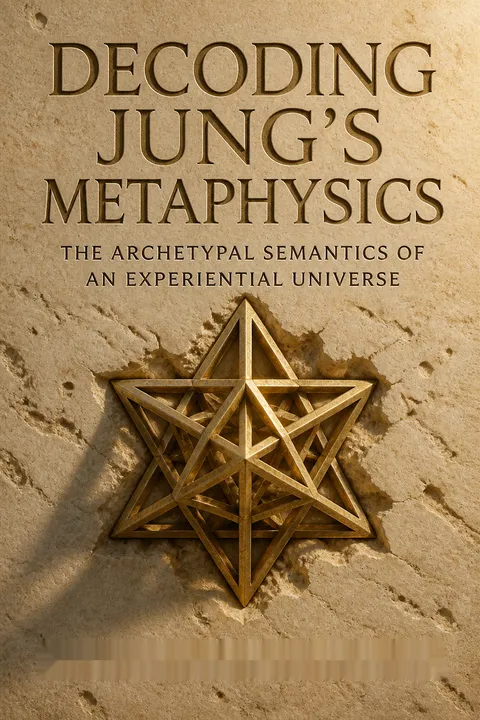
Decoding Jung's Metaphysics receives widespread praise for its clarity in systematizing Jung's philosophical underpinnings within an idealist tradition. Readers appreciate Kastrup's ability to make Jung's elusive metaphysical concepts accessible, particularly regarding the collective unconscious, archetypes, and synchronicity. Many find it transformative and intellectually stimulating. Critics note occasional repetitiveness, the author's heavy self-citation, and suggest Kastrup's own idealist commitments sometimes overshadow Jung's voice. Overall, it is considered a valuable, thought-provoking entry point into Jungian metaphysics.
People Also Read








About the Author
Other books by Bernardo Kastrup

Download PDF
Download EPUB
.epub digital book format is ideal for reading ebooks on phones, tablets, and e-readers.








































