
Key Takeaways
1. Accept that your narcissistic mother will never change
When you let go of the useless hope that your narcissistic mother will change, you free yourself from constantly flying into that window.
The illusion of change. Many daughters of narcissistic mothers (DONMs) spend decades flying fruitlessly into a closed window, hoping that this time their mother will finally show genuine love, support, or validation. This cycle is driven by the false belief that if we just fix our own supposed flaws, the relationship will magically heal. However, the painful truth is that narcissists cannot and will not change, as they are incapable of seeing any flaws in themselves.
Breaking the cycle. True freedom begins only when you accept this reality deep down in your core, rather than just understanding it rationally. Letting go of this useless hope frees up an immense amount of emotional energy that was previously wasted on trying to achieve the impossible. This energy can now be redirected toward your own healing and thriving.
Shifting your mindset. To transition from rational knowledge to deep-seated belief, you must actively reprogram your subconscious mind. This can be achieved through targeted practices that challenge the old, brainwashed programming:
- Journaling and freewriting about your mother's toxic patterns
- Using affirmations to reinforce your new understanding of reality
- Practicing Emotional Freedom Technique (EFT) to release emotional attachments to her approval
2. Reclaim your power by processing righteous anger and grief
You have, in a very real sense, lost your mother, just as much as if she had died.
Righteous anger. When you finally acknowledge the abuse you suffered, you will likely experience a wave of intense, unfamiliar rage. This anger is a healthy, protective voice telling you that you were mistreated, and it must be felt and processed rather than suppressed. Suppressing this anger requires massive amounts of energy, whereas allowing yourself to feel it—even through violent fantasies that bring the narcissist down to size in your head—helps you reclaim your power.
The pain of grief. Alongside anger comes a deep sense of grief and bereavement for the loving mother you never had and will never have. This is a uniquely private, unacknowledged grief because society does not offer funerals or cultural frameworks for the loss of a living, toxic parent. You must treat this as a literal bereavement, being gentle with yourself as you mourn the death of the mother-myth.
Processing the trauma. Healing from a narcissistic upbringing is akin to recovering from a war zone, often resulting in Complex PTSD (C-PTSD). To safely move these heavy emotions through your body, consider the following tools:
- Freewriting without stopping to bypass your inner critic
- Tapping (EFT) while walking and speaking your anger aloud
- Seeking trauma-informed therapy, such as EMDR, to erase deep psychological injuries
3. Apply "Rule 1" and bypass the trap of societal politeness
With narcissists, the normal rules don’t apply.
The politeness trap. Narcissists masterfully exploit our manners, social conditioning, and desire to be "nice" to trap us in no-win situations. They count on us playing by the rules of polite society—such as sending thank-you notes for manipulative gifts or returning hostile phone calls—while they break every rule of human cooperation. To protect yourself, you must realize that you are under no obligation to play a rigged game.
Embracing Rule 1. The ultimate antidote to this manipulation is Rule 1: Do what you want to do. As children, DONMs were brainwashed to believe their own needs, wants, and desires did not matter at all. Reclaiming your autonomy means prioritizing your own well-being and giving yourself permission to make decisions based on your own desires rather than your mother's demands.
The politeness bypass. Developing a "politeness bypass" is essential for survival when dealing with toxic individuals who use etiquette as a weapon. You can reclaim your power by refusing to participate in standard social expectations:
- Declining to send birthday cards or holiday greetings
- Refusing to answer personal or intrusive questions
- Ignoring manipulative gifts, texts, and phone calls without offering an explanation
4. Establish firm boundaries and enforce consequences without guilt
Boundaries are your birthright, and you are entitled to have them.
Claiming your space. Setting boundaries is the greatest gift you can give yourself because it tells both the world and your subconscious that you have value. Boundaries define where you end and others begin, protecting your time, physical space, and emotional well-being. For a DONM, identifying boundaries often starts with noticing what annoys or drains you, which is a clear sign that a boundary is being breached.
Enforcing with consequences. Narcissists hate boundaries because they view them as personal attacks on their control, and they will rage, cry, or ignore them to force you to back down. A boundary is useless without a clear, enforceable consequence that is entirely within your power to enact, such as hanging up the phone or leaving the room. You must enforce these consequences consistently, treating the process like training an undisciplined puppy.
A menu of boundaries. To begin reclaiming your autonomy, write down a personal manifesto of non-negotiable boundaries, which may include:
- No one is allowed to drop by your house without calling first
- No one is allowed to comment on your weight, appearance, or lifestyle
- You have the right to say "No" without offering any further explanation
- You have the right to say, "I'll think about it and get back to you" to avoid pressure
5. Recognize manipulation tactics like rage, tears, and the silent treatment
The only rule that you need to worry about is the rule to protect yourself and your family from her manipulation.
Narcissistic rage. When a narcissist is thwarted, they throw massive temper tantrums—essentially toddler rages in adult bodies. Because we were programmed as children to fear her anger as a threat to our survival, our adult bodies still react with a freeze-or-flight response. To survive this, you must emotionally detach, observe her behavior objectively like an anthropologist, and remind yourself that her rage is merely pathetic noise and bluster.
Manipulative tears and silence. If rage fails, the narcissistic mother will weaponize tears to make you feel like a monster, or use the silent treatment to banish you until you apologize. These tactics are designed to trigger intense, unearned guilt so you will surrender your autonomy to keep the peace. Recognize that her silence only has the power you give it; you can choose to let her sulk and refuse to chase after her.
Breaking the script. When she attempts to manipulate you through these emotional displays, you must change your default, programmed responses:
- Never explain your decisions, as she will only use your reasons as leverage
- Reflect her feelings back to her calmly ("I can see you are upset") without taking responsibility
- Walk away or hang up the moment she begins shouting or crying manipulatively
6. Deflect "Flying Monkeys" and step off the Drama Triangle
The Flying Monkey is responsible for their own relationship with your mother; you are not responsible for that.
The enabler network. When you establish boundaries or go No Contact, your mother will often deploy "Flying Monkeys"—friends, siblings, or relatives who act on her behalf to guilt you back into submission. These individuals are often trapped in her co-dependent web and want you to submit so they don't have to bear the brunt of her frustration. They will urge you to "be the bigger person," which is simply a euphemism for letting your mother abuse you.
The Drama Triangle. Narcissistic families operate on the Drama Triangle, where members constantly rotate between the roles of Victim, Rescuer, and Persecutor. The narcissistic mother cast you as her Rescuer (making you responsible for her happiness) or her Persecutor (blaming you for her misery) so she can remain the perpetual Victim. Stepping off this triangle requires you to refuse these roles and reclaim your adult autonomy.
Deflecting the pressure. To protect your peace from the enabler network and step off the Drama Triangle, you must establish firm boundaries with the Flying Monkeys themselves:
- State clearly: "I am not going to discuss my mother with you"
- Refuse to apologize for things you did not do just to keep the family together
- Accept that you may lose relationships with enablers who choose your mother's drama over your boundaries
7. Erase the toxic belief that you were born broken
You are injured and requiring healing, rather than flawed and requiring fixing as she told you.
The core wound. The most toxic legacy of a narcissistic mother is the deep-seated, subconscious belief that you were born broken, grotesque, and inherently flawed. This toxic shame is a projection of her own deep insecurities, dumped onto you so she could appear perfect by comparison. We carry this invisible air pressure into adulthood, hiding our true selves because we fear others will find us as repulsive as our mother claimed we were.
The false mirror. In reality, you are an ordinary, decent, averagely flawed human being, and the "false face" you show the world is actually much closer to your true self than the gargoyle your mother painted. She held up a distorted mirror to keep you docile and compliant. Healing requires you to consciously reject this false shame and hand it back to its rightful owner.
Reprogramming your self-worth. To shatter the false mirror and rebuild your self-esteem, you must actively challenge your deeply ingrained beliefs:
- Practice looking in a mirror, meeting your own eyes, and tapping (EFT) to process the discomfort
- Use the daily affirmation: "I am not who she said I am" to overwrite the old programming
- Forgive yourself for the survival mechanisms and "maladaptive behaviors" you adopted to cope with the trauma
8. Reclaim your emotions and practice self-care as an act of victory
It’s impossible to clamp down on bad emotions without also clamping down on good ones.
Emotional theft. Narcissistic mothers forbid their daughters from expressing or even feeling negative emotions, demanding constant cheerfulness to feed their own ego. As a result, DONMs grow up disconnected from their own feelings, often using addictions, eating disorders, or self-sabotage to numb the pain. Because you cannot selectively numb emotions, clamping down on your pain also destroys your capacity to feel genuine joy, peace, and excitement.
Reclaiming your barometer. Emotions are your internal barometer, an essential human birthright that tells you when your boundaries are being crossed or when you are safe. Reclaiming your emotions means allowing yourself to feel anger, sadness, and fear without judgment, knowing that feelings cannot harm you and are always temporary. By observing your emotions objectively, you can receive their messages and let them pass.
Self-care as defiance. When you practice basic self-care, feed yourself well, and celebrate your successes, you achieve the ultimate victory over your abuser. You stop carrying the baton of her abuse and refuse to do her dirty work for her. Every healthy decision you make is a powerful act of defiance:
- Scanning your body daily to identify and validate what you are feeling
- Speaking to yourself with kindness and compassion rather than critical self-talk
- Prioritizing your own physical, mental, and emotional well-being without feeling selfish
9. Build resilience and embrace your scars through the art of Kintsugi
We have been left with dreadful scars by our upbringing. But we can accept and celebrate those scars, and accept them as part of who we are, rather than being ashamed of them.
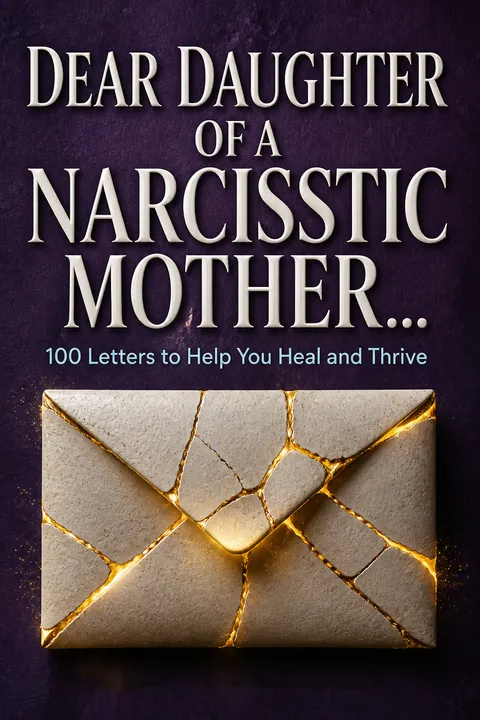
The art of Kintsugi. In the Japanese art of Kintsugi, broken pottery is mended with gold lacquer, highlighting and celebrating the cracks rather than hiding them as shameful flaws. As a survivor of narcissistic abuse, you are a "Bonsai Child" whose growth was artificially stunted and pruned. However, your scars are proof of your survival, and by embracing them, you transform your history into a source of unique beauty and strength.
Cultivating resilience. Building resilience is a proactive, daily practice that prepares you to navigate a world where you may still face betrayal, judgment, or self-doubt. It involves trusting in your own ability to recover from setbacks and learning to hold your relationships and desires lightly. True resilience means deciding to be happy and okay within yourself, independent of external circumstances or other people's approval.
Moving forward. While you may never fully recover the "height" you would have reached with loving parents, the road you are on will still take you to a beautiful destination. You can build a rich, authentic life by focusing on the present and taking consistent, small steps forward:
- Practicing a sense of humor and finding moments of joy and laughter daily
- Surrounding yourself with healthy, reciprocal relationships that pass the red-flag test
- Accepting that while your life is pieced back together, it is whole, valuable, and entirely your own
Review Summary
"Dear Daughter of a Narcisstic Mother..." holds an overall rating of 4.12/5 on Goodreads. Readers generally praise the book for providing insight into narcissistic maternal behavior, with many finding comfort in feeling less alone. Standout elements include the "Bonsai Children" chapter. Some readers compare it favorably to similar works like Will I Ever Be Good Enough? However, criticism includes repetition from the author's previous work, and one reviewer strongly objected to the book's tone, particularly its assertion that narcissistic mothers are incapable of love.
Download PDF
Download EPUB
.epub digital book format is ideal for reading ebooks on phones, tablets, and e-readers.








































