

Key Takeaways
Your life is shaped less by events than by how you respond to feelings
The core thesis. Brackett, founding director of the Yale Center for Emotional Intelligence, argues that nearly everything that has gone right in your life came from an intelligent response to an emotion, and nearly everything that went wrong came from an unwise one. You cannot control what happens or even what you feel, but you can control your response. He borrows Viktor Frankl's insight from Auschwitz: the last human freedom is choosing your response to circumstance.
This is a learnable skill, not a personality trait. Fewer than 10% of the people he surveyed said they learned emotion skills growing up at home. We wrongly treat our reactions as fixed parts of ourselves. They are not. Emotion regulation is a toolbox that can be taught, practiced, and refined for a lifetime.
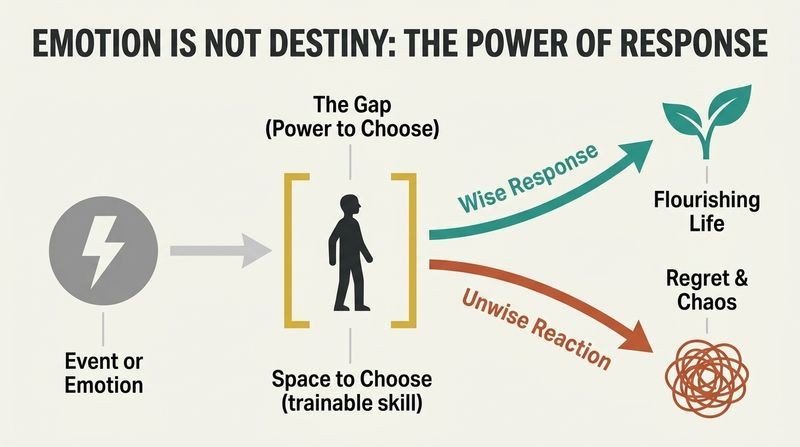
The claim that responses matter more than events echoes Stoic philosophy (Epictetus) and cognitive behavioral therapy's founding premise. What's striking is Brackett's insistence that this is teachable, contradicting popular fatalism about temperament. A useful nuance: attributing outcomes so heavily to personal response risks minimizing structural forces like poverty or racism, which he acknowledges elsewhere. The strongest version of his argument is agency at the margin. Even when you cannot change what happens, the quality of your response compounds across thousands of moments, quietly determining relationships, health, and success far more than any single dramatic event does.
Regulation means using emotions wisely, not suppressing or controlling them
Redefining a loaded word. People hear "regulation" and imagine smothering, fixing, or policing their feelings. Brackett flips this. Regulation starts with permission to feel every emotion without judging it good or bad, then choosing a deliberate, helpful response instead of an automatic one. The goal is transitioning from reactions you regret to responses that serve your goals.
Most emotions need no management at all. A pleasant spring breeze passes unnoticed. The rude driver, the snarky teenager, the inconsiderate line-cutter are the ones that hijack us. Every emotion is a two-part event: first you feel it, then you respond. Psychologists distinguish "hot" impulsive processing from "cool" deliberate thinking. The task is moving from hot to cool before doing damage, though hot processing has its place in creativity, danger, and moral outrage.
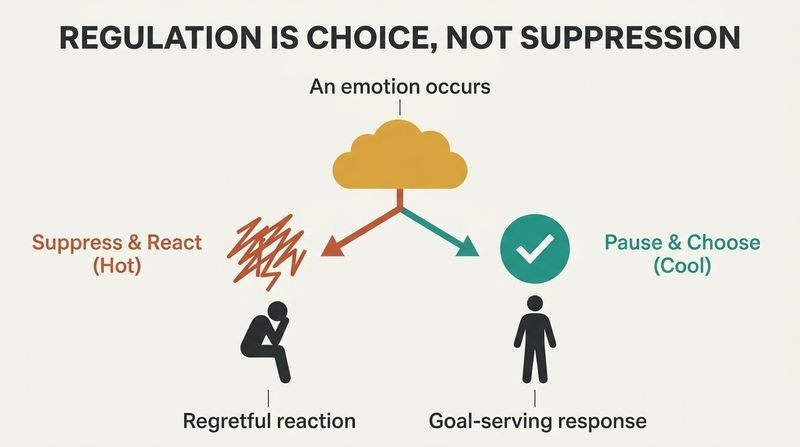
Brackett's reframing addresses a real problem: the suppression trap. Research by James Gross shows that expressive suppression (hiding feelings) increases physiological stress and impairs memory, while reappraisal (rethinking situations) does not. His point that most emotions self-regulate implicitly is well supported and reassuring, countering the wellness-industry implication that we must constantly monitor our inner states. The hot/cool distinction, drawn from Metcalfe and Mischel's marshmallow-test research, is elegant. One tension worth naming: sometimes the "cool" response is avoidance dressed as wisdom, a caveat Brackett himself flags repeatedly throughout his strategies.
Set five goals with every emotion using the PRIME framework
A menu of emotional aims. Before choosing how to respond, decide how you want to feel. Brackett's PRIME acronym captures five goals, used singly or in combination:
1. Prevent unwanted emotions before they arise (skip the dreaded family dinner).
2. Reduce them when prevention fails (sit at the far end of the table).
3. Initiate desirable emotions (play favorite music, seek out fun people).
4. Maintain the good feelings you have created.
5. Enhance and amplify them further.
Prevention beats treatment. Like physical health, it is far easier to avoid an emotional problem than to clean up after one. His running example is the fictional annoying Aunt Hillary at Thanksgiving: you can prevent, reduce, initiate, maintain, and enhance your way through the day rather than exploding and regretting it.
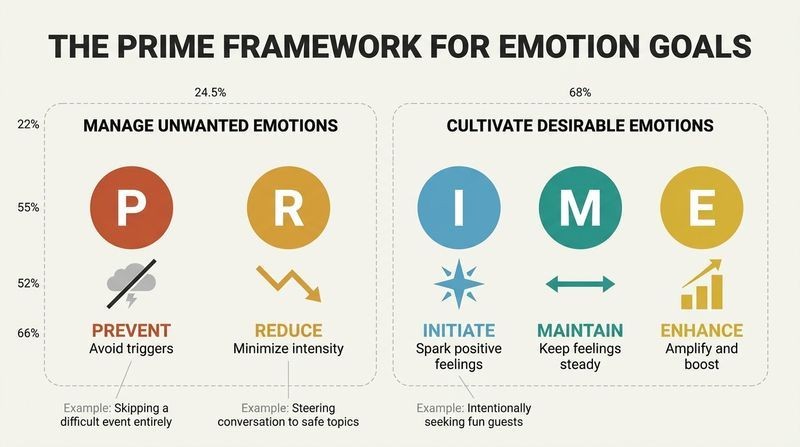
PRIME's real contribution is expanding the emotional imagination beyond damage control. Most self-help fixates on calming down negative feelings; Brackett gives equal weight to cultivating and savoring positive ones, aligning with Barbara Fredrickson's broaden-and-build theory that positive emotions expand cognitive range and build lasting resources. The prevention emphasis connects to public-health logic (upstream intervention). A fair critique: the P and R goals can shade into chronic avoidance, and Brackett wisely warns that dodging a colleague forever may mask an inability to tolerate disagreement. The framework works best as a diagnostic prompt, not a rigid sequence.
We constantly co-regulate each other, often without noticing
Emotions are contagious and interpersonal. Co-regulation means intentionally shaping another person's emotional state (and being shaped in return) with a positive purpose. Brackett cites the famous "still face" experiment: when a mother suddenly goes blank-faced, her babbling infant becomes distressed within seconds, proving even newborns expect emotional reciprocity. Romanian orphanage studies showed institutionalized children suffered cognitive, linguistic, and neurological damage from missing this exchange.
Co-regulation precedes self-regulation. Babies learn to manage their own emotions only after being effectively soothed by others. Attachment styles (secure, anxious, avoidant, disorganized) form through these early back-and-forth interactions and follow us into adulthood. The toxic version exists too: gaslighting, passive-aggression, and withholding affection are co-regulation aimed at making someone feel worse.
The still-face paradigm (Edward Tronick, 1970s) remains one of developmental psychology's most replicated and haunting demonstrations. Brackett's move to frame adult relationships as continuous co-regulation is supported by research on physiological linkage: couples' heart rates and cortisol synchronize, and holding a partner's hand measurably reduces pain (Coan's fMRI work). What's valuable here is reframing emotional influence as an inescapable responsibility rather than an optional kindness. Even ignoring someone regulates them. The attachment-style claim is somewhat deterministic; contemporary research emphasizes that attachment is more malleable across the lifespan and relationship-specific than the four-category model suggests.
A growth mindset about emotions is the hidden precursor to regulation
Beliefs about feelings drive everything. Borrowing Carol Dweck's fixed-versus-growth distinction, Brackett shows the same applies to emotions. People with a fixed emotion mindset believe feelings are uncontrollable forces that dictate behavior, so they stop trying and simply suppress. People with a growth mindset believe emotions are malleable information they can work with.
The stakes are measurable. In Maya Tamir's study of university freshmen, those with fixed emotion mindsets reported more negative experiences, less social support, and by year's end, more depression symptoms. Ironically, fixed-mindset people are often more emotional, not less, because their feelings run the show. We also have "meta-emotions," feelings about our feelings: Brackett confesses discomfort with happiness and anger rooted in a bullied, fearful childhood. Naming these relationships with emotions is the starting point.
Extending Dweck's framework to emotions is intuitive and empirically backed, though the mindset literature has faced replication scrutiny; effect sizes in some interventions are smaller than early enthusiasm suggested. Brackett's honesty about his own meta-emotions strengthens the case by modeling it. A genuinely useful wrinkle he raises: people who strongly believe emotions are controllable show slightly less empathy, presumably assuming others should just manage themselves. This complicates the tidy growth-is-better narrative and points toward a mature position: hold a growth mindset for yourself while extending compassion to others who struggle, avoiding the trap of weaponized self-regulation as tough love.
You cannot regulate what you cannot name, so get granular
Precision unlocks control. The Center's motto is that you have to label it to regulate it. Most people describe rich inner lives with a handful of words: mad, sad, stressed, fine. Lisa Feldman Barrett's research shows "granulars" who distinguish subtle emotions lose their cool less, drink less under stress, and stay healthier than "clumpers." A UCLA study found spider-phobics who precisely labeled their fear showed the lowest physiological response, beating distraction and reappraisal.
Underlying causes hide beneath surface feelings. Brackett distinguishes anxiety (uncertainty about the future), fear (immediate danger), stress (too many demands, too few resources), and being overwhelmed. Brené Brown discovered her "resentment" was actually envy, which changed how she solved it. Kids melting down over a broken-down car on the way to the zoo are not angry, they are disappointed, which demands a different response.
The affect-labeling research (Matthew Lieberman) is neurologically grounded: naming an emotion dampens amygdala activity and engages the prefrontal cortex, literally quieting the alarm. This is why "name it to tame it" has entered therapeutic vocabulary. Brackett's core-relational-themes framework (built on Richard Lazarus's appraisal theory) gives labeling analytic teeth by linking each emotion to its typical cause. The clinical example of misdiagnosed anxiety masking heart disease in women is a sobering real-world stake. One caution: excessive introspection can backfire into rumination, a tension Brackett acknowledges through Ethan Kross's work. Labeling should clarify, then release, not fuel endless analysis.
Deactivate before you decide: breath creates the space to respond
Physiology first. When triggered, the sympathetic nervous system floods you with cortisol and adrenaline, narrowing focus into fight, flight, or freeze. Slow, deep breathing activates the parasympathetic system through the vagus nerves, restoring calm. Brackett's phrase: you have to deactivate to regulate. Techniques include box breathing (used by Navy SEALs: inhale, hold, exhale, hold, each for four counts), coherent breathing (six breaths per minute), and the physiological sigh (two inhales, one long exhale).
Practice when calm, not just in crisis. The critical rule: rehearse breathing daily so it becomes automatic muscle memory, available when you actually need it. Mindfulness goes further than relaxation, teaching you to sit with uncomfortable emotions without reacting. But Brackett warns that breathing alone is insufficient. A kid who took a deep breath after a cruel fight still had not addressed the guilt or repaired the relationship. Breath buys time; it does not solve problems.
The neuroscience here is sound: vagal tone genuinely predicts emotional resilience, and slow exhalation shifts autonomic balance measurably. Brackett's honesty that breathing is a first step, not a cure, distinguishes this from the mindfulness hype that treats meditation as a panacea. His nuance that breath-based versus loving-kindness meditation produce different effects (one aids focus and eased guilt but reduced the urge to apologize, the other boosted empathy) is unusually sophisticated for a popular book. The practical insight most people miss: regulation tools fail in the moment precisely because they were never practiced in calm, when neural pathways actually form.
Fight negativity bias by reappraising, time-traveling, and distancing
Your brain is wired for pessimism. Negativity bias (Rozin and Royzman, 2001) means we weight and remember bad events more than good ones, an evolutionary holdover from when missing a predator was fatal. Cognitive strategies, rooted in CBT, counteract this by changing interpretation, not reality. Brackett offers five:
1. Spatial distance: watch the upsetting scene shrink, as if on a TV screen or from a hot-air balloon.
2. Temporal distance: ask whether this will matter in a week, a month, ten years.
3. Distanced self-talk: address yourself by name, as you would comfort a friend.
4. Reappraisal: reconstrue the event (the curt cashier had a bad morning) or repurpose it (a missed train means prep time).
5. Visualization: mentally rehearse a challenge going well.
Originality boosts effectiveness. In a Center study, the most novel reappraisals were the most helpful. And distanced self-talk ("you" instead of "I") measurably lowered stress and improved performance in a University of Michigan speech experiment.
These map directly onto validated CBT and emotion-regulation research. The self-distancing work (Kross and Ayduk) is particularly robust: third-person self-talk reliably reduces reactivity, likely by recruiting the same perspective-taking we use for others. Solomon's Paradox (Grossmann) captures why we advise friends wisely but flounder in our own crises. Brackett's crucial guardrail: distancing can become avoidance. Turning a difficult spouse into a TV character works for a dying, unchangeable father, but repeated on intimates, it erodes connection. The book's recurring discipline of evaluating whether a strategy actually served your goals, rather than just felt good, is what separates skillful regulation from sophisticated denial.
Never worry alone: find your Uncle Marvin and become one
Connection is a regulation tool. Brackett's uncle Marvin saved his bullied, lonely childhood by doing three things: giving him permission to feel, listening without judgment, and offering active compassion. Only about 35% of people surveyed had such a person; just 2% named their father. The right co-regulator is a good listener, nonjudgmental, empathic, and crucially, not a fixer.
Isolation is lethal. Chronic loneliness raises early-death risk by roughly 20% and rivals smoking as a health hazard. Yet three unhelpful responses masquerade as support: venting (which embeds bad feelings rather than resolving them), tough love (shaming disguised as help, like Brackett's father ordering him to run the block in a plastic sweat suit), and fixing (jumping to solutions instead of asking guiding questions). Better: help others when you struggle, celebrate their joys with positive empathy, and perform small acts of kindness, all of which lift your own mood.
The loneliness statistics draw on Holt-Lunstad's meta-analyses and Cacioppo's work, now central to public-health discourse (the US Surgeon General declared a loneliness epidemic). Brackett's critique of venting is counterintuitive but supported: co-rumination among adolescent girls predicts more depression, not less. The distinction between compassion and fixing echoes therapeutic training, where premature problem-solving signals the helper's discomfort more than the sufferer's need. The "helper's high" claim (giving buffers stress, Poulin's research) reframes altruism as self-interested resilience. What elevates this chapter is the reciprocity insight: the same skills that regulate others regulate you, so surrounding yourself with well-regulated people is itself a strategy.
Sleep, food, and movement are your emotion regulation budget
The body funds the mind. Borrowing Lisa Feldman Barrett's "body budget," Brackett argues that without physical income from activity, nutrition, and sleep, you lack the mental energy to regulate. The links are direct and measured:
1. Exercise: a 2023 review found it roughly 1.5 times more effective than counseling or medication for depression, and just 5 to 10 minutes lifts mood for up to 24 hours.
2. Nutrition: glucose fuels the prefrontal cortex; the gut microbiome produces much of the body's serotonin and half its dopamine.
3. Sleep: the deprived are about 60% more reactive to emotional stimuli, as sleep loss severs the calming link between amygdala and prefrontal cortex.
Identity beats willpower. Brackett's own two-year fitness transformation succeeded only when working out shifted from something he did to who he is. Emotional eating, cortisol-driven and shame-reinforcing, shows how feelings and physiology feed each other in a loop.
This chapter's strength is refusing the mind-body dualism that most emotion books tacitly assume. The exercise-versus-antidepressant comparison deserves caution: such meta-analyses often compare heterogeneous interventions and cannot fully control for expectation effects, so "1.5 times more effective" should be read as suggestive, not prescriptive against medication. Still, the mechanistic story (BDNF, hippocampal neurogenesis, vagal tone) is solid. Matt Walker's sleep-reactivity findings are well established. The identity-shift point connects to James Clear's habit work and Bandura's self-efficacy: sustainable behavior change flows from who you believe you are, not from grinding willpower against a resistant self.
Take a Meta-Moment: pause and ask what your best self would do
A tool for the moment within the moment. Developed by Brackett and Robin Stern, the Meta-Moment has four steps:
1. Sense that you are activated and about to react on autopilot.
2. Stop, breathe, create space, and if possible name the feeling.
3. See your best self, the person you want others to experience.
4. Strategize and act using your regulation toolkit to close the gap.
Best self is context-dependent and learnable. Brackett suggests listing the people you spend most time with, noting how they would describe you, and comparing that reputation to your ideal. Research on imagining your "best possible self" shows increased optimism and decreased depression. Even children benefit: the "Batman effect" found kids who pretended to be a superhero persevered longer at hard tasks. Obstacles like exhaustion, poor health, and lack of self-compassion block the best self; if-then plans and Kristin Neff's self-compassion (which builds resilience, not softness) help overcome them.
The Meta-Moment operationalizes the gap between stimulus and response that Frankl only described. Its power lies in the identity anchor: invoking a valued future self recruits the prefrontal cortex and blocks impulsive reaction, consistent with self-distancing research. The Batman effect (White and colleagues) is a charming demonstration that psychological distance aids self-control even in five-year-olds. Neff's self-compassion research is a critical corrective to the achievement culture that equates self-criticism with motivation; her data show self-compassion reduces fear of failure and increases grit. The honest note that even a "Feelings Master" still gets triggered keeps the tool from feeling like magical thinking.
Analysis
Dealing with Feeling is a thesis-driven self-help book built on a single, forcefully repeated claim: emotion regulation is the most consequential life skill, and it is learnable rather than innate. Marc Brackett, a Yale psychologist whose credibility rests on decades of research and the widely adopted RULER program, structures the book as a progression from mindset to skills to practice. Its distinctive strength is scaffolding: he refuses to let "regulation" mean suppression, insists on granular labeling, and organizes strategies into memorable frameworks (PRIME, the Meta-Moment, the seven-strategy toolkit).
What sets the book apart from a crowded genre is its integration of the interpersonal. Where most emotion books treat feelings as a solo project, Brackett makes co-regulation central, grounding it in developmental science (the still-face experiment, attachment theory, Romanian orphanage studies) and extending it to adult relationships and even institutions. This is his most original contribution and his most socially ambitious: he genuinely believes a single generation trained in co-regulation could dissolve much societal dysfunction.
The book's evidentiary base is broad but uneven. Some claims rest on robust, replicated findings (affect labeling and amygdala activity, self-distancing, sleep and emotional reactivity). Others lean on single studies or meta-analyses whose effect sizes are more modest than the confident prose implies, particularly the exercise-versus-medication comparison and the mindset literature, which has faced replication challenges. Brackett's frequent memoir passages (the bullying, the abusive father, the rage-filled Christmas sweat suit, Uncle Marvin) are the book's emotional engine and give abstract science a human spine.
His most intellectually honest move is the repeated warning that every strategy can become avoidance, that distancing from intimates or exercising to escape family are self-defeating. This demand to evaluate whether a response actually served your goals, rather than merely felt good, elevates the work above feel-good advice. The book's limitation is scope inflation: attributing "virtually every problem" to emotion regulation risks minimizing structural causes, a tension Brackett acknowledges but never fully resolves. Read as a practical, science-informed manual rather than a totalizing theory, it delivers unusually actionable tools.
People Also Read






Download PDF
Download EPUB
.epub digital book format is ideal for reading ebooks on phones, tablets, and e-readers.








































