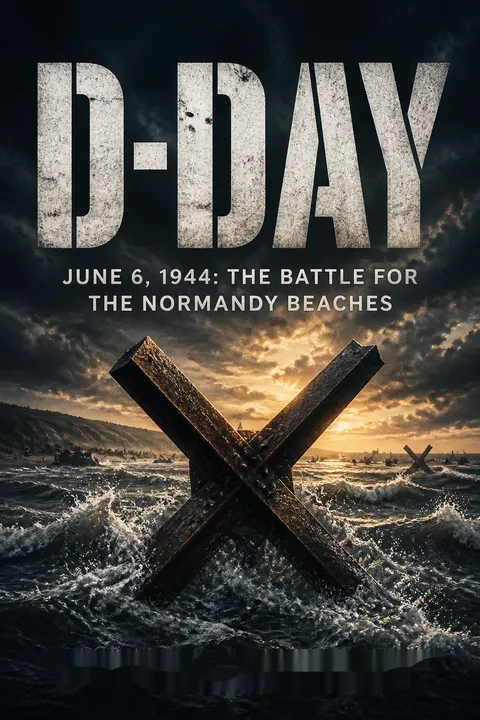

Key Takeaways
1. Operation Overlord: A Gamble of Unprecedented Scale and Secrecy
"It would be difficult to conceive of a more soul-racking problem."
Massive undertaking. Operation Overlord was the largest amphibious invasion in history, involving 175,000 fighting men, 50,000 vehicles, 5,333 ships, and almost 11,000 airplanes. This colossal effort, stretching back two years in planning and involving millions, was deemed by Winston Churchill as "the most difficult and complicated operation ever to take place." Its success hinged on overcoming historical precedents of failed invasions against organized opposition.
Surprise was paramount. The Allies understood that if Germany knew the "where and when" of the attack, they could concentrate forces and defeat the assault. To achieve this, an elaborate deception plan, "Fortitude," was implemented, convincing the Germans that the main invasion would target the Pas-de-Calais and Norway, while the real landing was planned for Normandy. This deception was critical, as any failure would mean no second attempt in 1944.
Citizen soldiers' test. Despite the immense planning and technological superiority, ultimate success rested on the shoulders of young, mostly inexperienced citizen-soldiers, aged 18 to 28. Hitler, confident in totalitarian fanaticism over democratic "softness," believed these men would fail. Their courage, determination, and initiative in the face of unprecedented horrors would prove him wrong, embodying what Eisenhower called "the fury of an aroused democracy."
2. Germany's Fatal Defensive Strategy and Command Paralysis
"He who defends everything, defends nothing."
Overextended empire. By 1944, Nazi Germany was critically overextended, fighting a three-front war across Europe and at home against Allied air raids. Hitler's insistence on defending "every inch of occupied soil" led to a policy of fixed fortifications, the "Atlantic Wall," a stark departure from the mobile blitzkrieg tactics that had brought early successes. This strategy, born of desperation and a conqueror's mentality, spread German resources too thin.
Rommel's flawed vision. Field Marshal Rommel, tasked with strengthening the Atlantic Wall, believed the decisive battle would be fought "at the beaches—that's where the enemy is always weakest." He poured immense effort into beach obstacles and fortifications, but his insistence on immediate counterattacks by mobile panzer divisions was undermined by Hitler's refusal to release these units from his direct control. This created a critical strategic disagreement with Field Marshal Rundstedt, who favored fighting inland.
High command's disarray. The German command structure was plagued by Hitler's micromanagement and a "divide and rule" principle, leading to fragmented authority and inter-service rivalry. On D-Day, this paralysis was evident:
- Many senior commanders were away for a war game in Rennes.
- Hitler slept through crucial early hours, delaying the release of panzer reserves.
- Rommel was absent, traveling to see Hitler, unable to direct immediate counterattacks.
This disunity, coupled with the success of Allied deception, prevented any coherent German response to the landings.
3. Allied Ingenuity and Industrial Might Paved the Way
"If Higgins had not designed and built those LCVPs, we never could have landed over an open beach. The whole strategy of the war would have been different."
Landing craft revolution. The success of Overlord hinged on overcoming the historical difficulty of amphibious assaults. Andrew Jackson Higgins, a self-taught genius from New Orleans, revolutionized landing craft design with his "Eureka" boat, which evolved into the LCVP (Landing Craft, Vehicle and Personnel). These "Higgins boats" were crucial for delivering infantry to shore, while LSTs (Landing Ship, Tank) and LCTs (Landing Craft, Tank) transported vehicles.
Technological edge. Beyond landing craft, the Allies leveraged significant technological advantages:
- Ultra: The British system for breaking German Enigma codes provided invaluable intelligence on enemy dispositions.
- Double Cross System: Turned German spies fed misinformation, reinforcing deception efforts.
- Mulberries: Prefabricated artificial harbors towed across the Channel provided instant port facilities.
- Hobart's Funnies: Specialized British tanks (flails, bridge-layers, flamethrowers) were designed to overcome beach obstacles and fortifications.
American production miracle. The United States transformed its industry from Depression-era stagnation to an unparalleled war machine. Factory output soared, producing thousands of planes, tanks, ships, and weapons monthly. This "fury of an aroused democracy" provided the sheer volume of materiel necessary for an operation of Overlord's scale, ensuring that the Allies could out-produce and ultimately overwhelm the Germans.
4. Eisenhower's Agonizing Decision Amidst Unpredictable Weather
"I am quite positive that the order must be given."
The weight of command. On June 4, 1944, with the invasion fleet already at sea, Eisenhower faced his most agonizing decision: proceed with D-Day on June 5 despite a deteriorating weather forecast, or postpone. Air Vice Marshal Leigh-Mallory predicted catastrophic losses for the airborne divisions, intensifying Eisenhower's "soul-racking problem." The Supreme Commander understood that a second postponement to June 19 would risk compromising the entire operation.
Stagg's crucial forecast. Group Captain J. M. Stagg, the "dour but canny Scot" meteorologist, delivered a grim forecast for June 5 but offered a narrow window of opportunity for June 6: a 36-hour break in the storm. This glimmer of hope, though accompanied by warnings of continued scattered clouds and potential rough seas, was enough for Eisenhower to make his choice.
"OK, let's go." Despite divided opinions among his subordinates—Montgomery eager to proceed, others advocating delay—Eisenhower made the solitary decision to launch on June 6. He recognized the immense risks but also the impossibility of further delay, stating, "The question is just how long can you hang this operation on the end of a limb and let it hang there?" His resolve, and the subsequent "cheers" from his staff, underscored the immense pressure and the collective relief that the moment of truth had arrived.
5. Airborne Troops: Scattered Chaos, Critical Success
"Never in the annals of warfare have so few been commanded by so many."
Dispersed landings. The American airborne assault was plagued by severe scattering due to cloud cover, intense flak, and evasive pilot maneuvers. Pathfinders, meant to mark drop zones, largely missed their targets, leading to widespread disorientation. Units were fragmented, with men from different companies, battalions, and even divisions mixed together, often miles from their objectives.
Individual initiative. Despite the chaos, the paratroopers and glider-borne troops demonstrated remarkable initiative. Junior officers, NCOs, and even privates, often alone or in small, ad hoc groups, set out to accomplish their missions. This decentralized aggression, though not always according to plan, confused the Germans, who overestimated the size and coherence of the attacking force.
Critical objectives achieved. The airborne's primary missions were to disrupt German communications, prevent concentrated counterattacks against the beaches, and secure key flanks and exits.
- British 6th Airborne: Successfully destroyed Dives River bridges, captured Orne Canal/River bridges (Pegasus Bridge), and neutralized the Merville battery.
- American 101st Airborne: Secured the northern exits from Utah Beach (Pouppeville, St.-Martin-de-Varreville) and destroyed German artillery at Brecourt Manor and Holdy.
- American 82nd Airborne: Captured Ste.-Mere-Eglise, a vital crossroads, and fought fiercely for the Merderet River crossings, despite being heavily scattered and isolated.
6. Utah Beach: Fortuitous Landing, Swift Inland Push
"We'll start the war from right here."
Accidental advantage. The 4th Infantry Division's landing at Utah Beach was a testament to serendipity and quick thinking. Due to strong currents and the loss of control craft, the first waves landed about a kilometer south of their intended target. This "wrong" spot proved fortuitous, as the German defenses there were significantly weaker, having been heavily damaged by the preceding Marauder bombing.
Decisive leadership. Brigadier General Theodore Roosevelt, Jr., landing with the first wave, famously declared (or was attributed with saying), "We'll start the war from right here." This on-the-spot decision, made without hesitation by Colonel Van Fleet, to exploit the unexpected landing site rather than attempt a costly repositioning, was crucial. It allowed the division to quickly establish a foothold with minimal casualties.
Rapid beach clearance. Engineers and naval demolition teams, despite initial challenges, swiftly cleared obstacles and blasted gaps in the seawall. This efficiency, combined with the relatively light German resistance, allowed a rapid flow of troops and vehicles inland. By day's end, over 20,000 troops and 1,700 vehicles had landed, far exceeding German estimates for the entire invasion. The 4th Division's success was a direct result of the airborne's actions inland, preventing German counterattacks and securing vital causeway exits.
7. Omaha Beach: A Near Catastrophe Forged by Infantry Valor
"Every man who set foot on Omaha Beach that day was a hero."
A nightmare scenario. Omaha Beach lived up to its grim reputation, becoming a "nightmare" for Allied forces. The pre-assault air and naval bombardments largely failed to neutralize German defenses, leaving the beach and bluffs bristling with machine guns, mortars, and artillery. Mislandings, strong currents, and heavily mined obstacles led to horrific casualties in the water and on the narrow beach.
Initial paralysis. The first waves of the 116th and 16th Regiments were decimated, with many units losing most of their officers and NCOs within minutes. Survivors were pinned down behind the shingle embankment, exhausted, seasick, and disorganized, facing a "red snowstorm" of tracer fire. General Bradley, observing from offshore, considered evacuating the beachhead, believing it an "irreversible catastrophe."
Infantry's breakthrough. Despite the overwhelming odds, individual initiative and small-unit leadership turned the tide. Men like General Cota, Colonel Canham, Captain Dawson, and numerous lieutenants and sergeants rallied the demoralized troops. They led desperate charges across minefields, up steep bluffs, and into German trenches, often without heavy weapons or communication. This raw courage, epitomized by Sergeant Summers' solo assault on WXYZ, cracked the German defenses and allowed the beach exits to be slowly opened.
8. British and Canadian Beaches: Specialized Armor and Fierce Village Fights
"We were saved by our flail tanks. No question about it."
Gadgets and grit. The British and Canadians at Gold, Juno, and Sword beaches relied heavily on "Hobart's Funnies"—specialized tanks designed to overcome beach obstacles and fortifications. Flail tanks cleared minefields, bridge-laying tanks spanned seawalls and ditches, and flamethrower tanks blasted pillboxes. These innovations, though not without their own challenges, were crucial in breaching the initial German defenses.
Heavy resistance and delays. Despite the specialized armor, the landings were met with fierce German resistance, particularly in the seaside villages and fortified positions. Inaccurate Allied bombardments meant many German guns remained operational, inflicting heavy casualties on the assault waves. Congestion on the beaches and the need to clear urban areas slowed the advance, preventing the rapid inland thrust Montgomery had envisioned.
Payback for Dieppe. The Canadian 3rd Division, landing at Juno, faced some of the toughest opposition, reminiscent of the disastrous Dieppe raid. However, their determination and the effective use of specialized tanks allowed them to push inland further than any other Allied division on D-Day. While objectives like Caen remained elusive, the British and Canadian forces established strong bridgeheads, demonstrating their fighting prowess and securing vital ground for the subsequent campaign.
9. The Unseen Heroes: Naval Support and Combat Engineers
"I am a destroyer man from that day on."
Destroyers' decisive role. While the initial naval bombardment was often ineffective against hardened German positions, the destroyers proved indispensable. Frustrated by the lack of targets and the plight of troops pinned on Omaha Beach, destroyer captains like Commander Ramey (McCook) and Commander Semmes (Frankford) defied orders and sailed dangerously close to shore. They delivered point-blank fire against German pillboxes and strong points, providing the only effective artillery support for the infantry.
Engineers' relentless work. Combat engineers and naval demolition teams faced immense dangers, clearing mines and obstacles under heavy fire. Their methodical, often heroic, efforts were critical for opening paths through the beach defenses and creating exits for vehicles. Despite heavy losses and constant shelling, they relentlessly worked to transform the chaotic beaches into functional logistical hubs.
Logistical lifeline. The sheer volume of supplies and reinforcements brought across the Channel by the Allied navies was a logistical marvel. Though Omaha's initial supply efforts were severely hampered, the continuous flow of men, vehicles, and materiel, even under fire, ensured that the beachheads could be sustained and expanded. This unwavering support, from minesweepers to hospital ships, underscored the vital, often unglamorous, role of naval and support personnel.
10. The Home Front: Anxious Vigil and Unwavering Support
"The cause prays for itself, for it is the cause of the God who created man free and equal."
Global anxiety. News of D-Day gripped the world, from American diners to European hideaways. Radio broadcasts, though often sparse on details due to censorship, became a lifeline for anxious families. The lack of specific information about units and locations heightened personal worries, as nearly every American knew someone involved in the European theater.
National unity and prayer. Across the United States, Canada, and Britain, D-Day evoked a profound sense of national unity and solemn reflection. Churches and synagogues filled with worshipers, and President Roosevelt led the nation in a powerful prayer. Public life paused, with stores closing and sports events canceled, as citizens focused on the immense sacrifice being made.
Sacrifice and dedication. The home front's contribution was immense, from factory workers producing war materiel to women taking on new roles in the workforce and military. Andrew Jackson Higgins' message to his employees—"the work of our hands, our hearts and our heads is being put to the test"—captured the spirit of collective effort. Despite the distance, the home front was deeply intertwined with the battle, providing the essential foundation for the "Great Crusade."
Review Summary
Reviews for D-Day, June 6, 1944 are largely positive, averaging 4.32/5. Many praise Ambrose's use of first-hand accounts and oral histories, calling it compelling and well-researched. Critics, however, note a strong American bias, with British, Canadian, and other Allied forces receiving minimal coverage. Some question the book's historical accuracy and flag concerns about Ambrose's objectivity. Despite these criticisms, most readers find it an engaging, informative account of the Normandy invasion, particularly for those new to the subject.
People Also Read



Download PDF
Download EPUB
.epub digital book format is ideal for reading ebooks on phones, tablets, and e-readers.








































