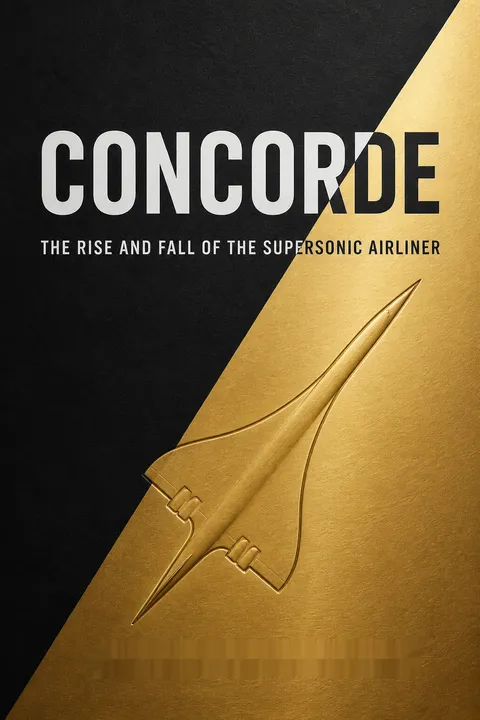

Key Takeaways
1. Concorde: A Bold Anglo-French Dream
Britain, a pioneer – the pioneer – of civil jet aviation, was being left behind by the Americans.
Ambitious Genesis. The idea for Concorde was born from a post-war desire for Britain to reclaim its leadership in civil aviation, especially after the de Havilland Comet's early failures. In 1956, the Supersonic Transport Aircraft Committee (STAC) was formed, recognizing the need to "go above the speed of sound, or leave it" in the face of American dominance with aircraft like the Boeing 707. This marked a pivotal moment for national prestige and industrial future.
International Collaboration. Realizing the immense cost and complexity, Britain sought international partners. France, with its own advancements in supersonic flight and shared technology (like the Rolls-Royce Avons in the Caravelle), became the natural ally. The Anglo-French treaty signed in 1962, despite political wavering and General de Gaulle's initial skepticism about British EEC membership, cemented the joint venture, pooling resources and expertise for an unprecedented project.
Political Imperative. Beyond commercial viability, Concorde was a political statement. Julian Amery, the British Minister of Aviation, saw it as a "gamble" but one that would halve the ante with French collaboration, asserting that it was "of immense value to this country as an indication of our technical skill." This commitment, often overriding economic doubts, ensured the project's survival through early government budget cuts and skepticism, driven by a belief in technological advancement and national pride.
2. Mastering Supersonic Flight
What was missing when Colby was writing in 1944, and even ten years later, was a full and practical understanding of the aerodynamic characteristics and qualities of a successful supersonic aircraft.
Breaking Barriers. Early attempts to break the sound barrier, like the Miles M.52 and the Bell X-1, highlighted the immense technical challenges beyond mere engine power. The M.52, despite its cancellation, contributed crucial insights into bullet-shaped fuselages, thin wings, and the all-moving stabilator, which were vital for controlling aircraft at transonic speeds. These early experiments laid the groundwork for understanding the complex physics of supersonic flight.
The Ogival Delta Wing. Concorde's distinctive ogival delta wing was a revolutionary compromise, balancing the need for efficient high-speed flight with stable low-speed operation for airport compatibility. Pioneering work by German aerodynamicist Dietrich Küchemann at RAE Farnborough, alongside French counterparts, led to the understanding of vortex lift—deliberately separating airflow to generate tremendous, stable lift at steep angles, a concept initially considered "ugly" by traditional aerodynamicists.
Rigorous Testing. The development involved extensive theoretical work, wind tunnel tests with papier-mâché and later sophisticated models, and flying prototypes.
- The Handley Page HP.115 tested low-speed delta wing characteristics.
- The BAC 221 (a modified Fairey Delta 2) tested the ogee delta wing, droop snoot, and pivoting cockpit.
- Two full-scale airframes underwent extreme heating and cooling cycles (35,000 infrared lamps, 70,000 litres of liquid oxygen) to simulate flight conditions and test material durability.
This meticulous, multi-year process ensured Concorde's safety and performance, pushing the boundaries of aerospace engineering.
3. The Race Against Rivals
The Soviet Council of Ministers had given its approval for the Tupolev airliner in June 1963, just weeks after President Kennedy announced the US SST programme.
Cold War Competition. The development of Concorde was inextricably linked to the Cold War and the "Space Race." Both the United States and the Soviet Union viewed supersonic transport as a matter of national prestige and technological supremacy. President Kennedy's 1963 announcement of a US SST program, following the Anglo-French agreement, explicitly aimed to surpass European efforts, while the Soviets, under Khrushchev, were determined to "compete and leapfrog them if necessary."
The American Dreamliner. Boeing's 2707, initially a swing-wing Mach-3 behemoth, was designed to be bigger, faster, and more advanced than Concorde. Despite a seductive full-scale mock-up and options from 26 airlines, its complex variable-geometry wing proved problematic, leading to weight increases and design revisions. Ultimately, a powerful environmental lobby, coupled with economic concerns and the FAA's disastrous sonic boom tests over Oklahoma City, led to the program's cancellation in 1971, leaving Concorde without a direct US rival.
Konkordski's Flaws. The Soviet Tu-144, dubbed "Konkordski" due to its striking resemblance to Concorde, was rushed into production, flying before its Anglo-French counterpart. Despite initial propaganda victories, it suffered from critical design flaws:
- Limited range due to constant afterburner use.
- Excessive cabin noise and primitive interiors.
- A catastrophic crash at the 1973 Paris Air Show, killing its crew and villagers.
These issues, combined with a lack of commercial market, led to its brief, troubled service and eventual cancellation, confirming Concorde's unique position.
4. A Triumph of Engineering Artistry
It was also, quite simply, very beautiful indeed.
Aerodynamic Beauty. Concorde's striking aesthetic was not a superficial design choice but a direct consequence of its functional requirements for supersonic flight. The subtle curvature of its ogival delta wings, the slender fuselage, and the distinctive droop snoot were all meticulously shaped by aerodynamic necessity. This "unpremeditated art" emerged from complex mathematics and fluid dynamics, making it a prime example of form following function at its most elegant.
Iconic Status. Concorde's visual impact transcended its engineering marvel, captivating artists, architects, writers, and the public worldwide. It consistently topped polls for design excellence, winning the Great British Design Quest in 2006, beating out other icons like the London Underground map and the Spitfire. Its silhouette, whether soaring or stationary, conveyed speed and grace, making it a symbol of technological optimism and a "sky god" in the public imagination.
Timeless Appeal. Even decades after its retirement, Concorde retains a modern and graceful appearance, contrasting sharply with contemporary subsonic airliners. Its beauty is often compared to natural forms, like seabirds, or other engineering masterpieces such as the Spitfire or the E-Type Jaguar, whose aesthetics were also dictated by performance. This enduring appeal highlights how its design achieved a rare confluence of scientific precision and profound visual harmony.
5. Battling Noise and Naysayers
No city dweller or countryman would tolerate this kind and level of noise on a regular basis.
The Sonic Boom. From its inception, Concorde faced significant opposition due to the sonic boom—the shockwave generated when an aircraft exceeds the speed of sound. Early tests over London in 1967, using RAF Lightnings, generated 12,000 complaints, leading to a ban on supersonic flight over Britain. This issue became a major hurdle, as the cone of sound spread across a 25-mile area, causing distress and property damage.
Environmental Lobby. A powerful environmental movement, spearheaded by figures like Richard Wiggs and William Shurcliff, actively campaigned against Concorde. Their concerns extended beyond noise to potential damage to the ozone layer from high-flying SST exhausts. This "Coalition against the SST" successfully lobbied for bans on supersonic flight over the United States and strict noise limits at airports, severely restricting Concorde's operational routes.
The Fight for New York. New York, a crucial economic destination, initially banned Concorde flights, a decision only overturned by the Supreme Court in 1977 after intense political and legal battles. Protests, including car cavalcades and roof-top slogans, highlighted the deep-seated public resentment towards the aircraft's noise. This prolonged struggle underscored the immense political and social sensitivity surrounding Concorde's environmental impact, despite its technological prowess.
6. An Elite Commercial Service
Concorde was an aerial business express and a supersonic ferry for players of the beautiful game.
Exclusive Experience. Concorde's commercial service, launched in 1976, was designed as an unashamedly elite experience, catering to a niche market of high-flying executives, diplomats, and celebrities. With limited seating and premium pricing (up to £8,000 for a return transatlantic trip), the focus was on speed, luxury, and impeccable service, including gourmet meals, fine wines, and dedicated departure lounges.
Transatlantic Lifeline. The London-New York and Paris-New York routes became Concorde's economic backbone, allowing passengers like David Frost to fly there and back in a single day, effectively gaining time. Despite initial financial losses for Air France and British Airways, the latter, under Sir John King, transformed its Concorde operation into a profitable asset by targeting the commercial elite and leveraging its prestige.
Global Symbolism. Concorde's presence, though limited to a small fleet of 14 aircraft, became a powerful symbol of national pride and technological achievement. It performed ceremonial flypasts for royal jubilees, carried heads of state, and was chartered for glamorous round-the-world trips. This widespread public adoration, even among those who could never afford a ticket, cemented its status as a cherished icon, transcending its commercial realities.
7. The Tragic Fall and Phoenix Rise
Concorde had been brought down to earth by accident for the first time in its thirty-one-year flying history.
The Gonesse Tragedy. On July 25, 2000, Air France Flight 4590 crashed shortly after takeoff from Charles de Gaulle Airport, killing all 109 on board and four on the ground. The investigation revealed a titanium strip from a preceding Continental Airlines DC-10 burst a Concorde tire, sending debris into a fuel tank, causing a fire and engine failure. This single accident, after decades of impeccable safety, irrevocably damaged Concorde's reputation and commercial viability.
Grounding and Modifications. In the wake of the crash, both Air France and British Airways grounded their Concorde fleets. A rigorous, multi-national effort was launched to address the identified safety issues. Key modifications included:
- Kevlar synthetic-fibre linings for fuel tanks.
- New Kevlar-reinforced Michelin NZG (Near Zero Growth) tires.
- New wiring shields to prevent electrical arcing.
These changes, though costly and complex to implement, were deemed essential for the aircraft's return to service.
Brief Resurgence. Concorde returned to service on November 7, 2001, with renewed confidence from both airlines and passengers, symbolized by simultaneous flights to New York. Its return was seen as a defiant gesture against terrorism (post-9/11) and a testament to human ingenuity. However, the economic downturn, coupled with rising maintenance costs and a lack of manufacturer support for spare parts, ultimately sealed its fate, leading to its final retirement in 2003.
8. The End of an Aviation Adventure
Concorde was a hopeless hybrid: the aircraft of the future had become the aircraft of past fantasies, a flying symbol of a science fiction world that never came to be.
Economic Realities. Despite its post-Gonesse modifications and a brief period of profitability for British Airways, Concorde's operational costs, particularly maintenance and fuel consumption, became unsustainable. Airbus's refusal to provide spare parts beyond 2003 was the decisive factor, making continued operation economically unfeasible for both Air France and British Airways, despite public demand and offers from entities like Virgin Atlantic.
Shifting Priorities. Concorde's retirement reflected a broader shift in the aviation industry and societal values. The focus moved from speed and luxury to mass-market, low-cost travel, epitomized by budget airlines and wide-bodied, fuel-efficient jets. The romance of flight gave way to the "bloody bus with wings" mentality, where the journey became a mere means to an end, and aircraft design prioritized capacity and economy over aesthetic or technological daring.
Loss of Innovation. The closure of research facilities like NGTE Pyestock and the decline of British industrial manufacturing underscored a broader trend of risk aversion and reduced public-sector investment in groundbreaking technology. Concorde, a product of a "Golden Quarter" of innovation, became an anachronism in a world increasingly dominated by consumer-driven digital advancements and a reluctance to pursue ambitious, costly projects without guaranteed commercial returns.
9. The Elusive Future of Speed
Whether or not anyone really wants or needs to fly this fast remains a question to be answered by future generations.
Hypersonic Dreams. Despite Concorde's retirement, the dream of superfast flight persists, with research into hypersonic (Mach 5+) airliners continuing. Projects like the German Spaceliner and the European LAPCAT A2 envision flying from London to Sydney in hours, using advanced materials (carbon fibre, titanium) and propulsion systems (scramjets, dual-mode turbine-ramjets). However, challenges remain:
- Extreme heat (up to 1,000°C on the skin).
- Lack of windows for passengers and crew.
- Immense development costs and infrastructure needs (dedicated launch pads).
Technological Hurdles. While unmanned scramjets like NASA's X-43A have achieved incredible speeds (Mach 9.7), integrating such technology into a commercial airliner capable of taking off, landing, and carrying passengers safely and economically is a monumental task. The need for multi-mode engines that can operate across subsonic, supersonic, and hypersonic regimes is a key challenge, with no clear solution yet for efficient, quiet operation.
Niche Markets. The most likely immediate future for supersonic flight lies in executive jets, such as the Spike Aerospace S-512 and Aerion AS2. These smaller, quieter aircraft, designed for business travelers, aim to offer exclusivity and time-saving benefits, circumventing the mass-market challenges that plagued Concorde. However, they still face regulatory hurdles regarding overland supersonic flight and the inherent high costs, suggesting that widespread supersonic travel remains a distant prospect.
People Also Read









Download PDF
Download EPUB
.epub digital book format is ideal for reading ebooks on phones, tablets, and e-readers.








































